Jeff Hickman, Matt Camden, & Rich Hanowski Virginia Tech - - PowerPoint PPT Presentation
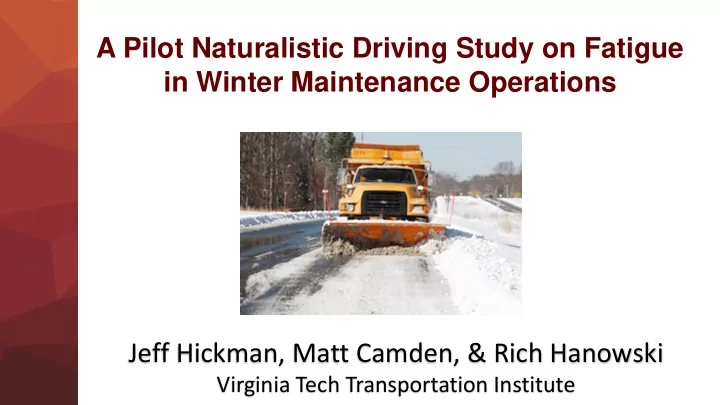
A Pilot Naturalistic Driving Study on Fatigue in Winter Maintenance Operations Jeff Hickman, Matt Camden, & Rich Hanowski Virginia Tech Transportation Institute Overview of Project Sponsored by Clear Roads Goal: Feasibility of
Overview of Project
- Sponsored by Clear Roads
- Goal:
– Feasibility of naturalistic driving approach in winter emergencies
Literature Review Summary
- Limited information
- Fatigue/drowsiness in trucks
– Heavy vehicle – Inconsistent, varying schedules – Long shifts
- Fatigue in 15% to 30% of crashes
Naturalistic Driving Methods
- 4 VDOT operators
- 2 instrumented trucks
- Drove for 3 consecutive months
- 2 drove night shift, 2 drove day shift
– 7p to 7a – 7a to 7p
Test Vehicles
- No experimenter present
- Highly capable DAS
– 5 cameras and various sensors
- Data collected continuously
- Detailed pre-crash/crash
Instrumentation
How do we Measure Sleep?
Operator Instructions
- Work/drive as you normally drive
- Wear watch for three months
- $100/month
Actigraph Data Analysis
- Identify and mark any “bad
data” episodes,
- Convert data into minute-by-
minute files,
- Import all data into
actigraphy database, and
- Implement algorithm to
identify sleep periods
Flat line in data
Naturalistic Driving Data Reduction
- Run triggers
- Validate triggers
- Classify event
- Apply data directory
Time of Day
2 4 6 8 10 12 14 16 1 2 3 4 5 6 7 8 9 10 11 12 13 14 15 16 17 18 19 20 21 22 23 Percent
- f SCEs
Hour of Day
Time on Task
2 4 6 8 10 12 14 16 18 20 1 2 3 4 5 6 7 8 9 10 11 Percent
- f SCEs
Hours into Shift
Fatigue (ORD > 40)
Participant # Total Number
- f SCEs
Total Number of SCEs with ORD ≥ 40 Percent of SCEs Where Driver was Drowsy 1 52 33 63.5% 2 12 N/A N/A 3 16 0% 4 12 0% Total 92 33 35.9%
Actigraph Data
Participant # Daily Sleep Daily Sleep during Non- winter Emergency Sleep 24 Hours Prior to a Winter Emergency Sleep during Consecutive Winter Emergency Shifts Sleep 24 Hours Prior to SCE 1 8.05 8.63 6.31 7.48 4.55 2 10.04 10.66 8.58 8.71 8.83 3 8.12 8.10 8.26 8.32 8.02 4 8.64 8.53 8.31 8.73 7.81 Average 8.71 8.98 7.87 8.31 7.30
Discussion
- Fatigue was evident in SCEs
– Mostly during winter emergency – Between 12:00 a.m. and 6:00 a.m. – Contributing factor in 28.3%
- …but only for 1 driver
- Less sleep during winter emergencies
- Less sleep prior to a SCE
Limitations
- Only 4 operators
- Driving data only during winter
emergencies
- Specific to southwest VA
- Mostly rural area
- No daily logs
Future Research
- Naturalistic driving data showed some
interesting trends
- Need more research
– More instrumented trucks and operators – Log book to investigate naps – Drive during winter emergencies and regular hours – Technology/equipment that increases fatigue
- Design an FMP for winter maintenance
- perators