
SLIDE 1
Jean Van Heijenoort’s View of Modern Logic
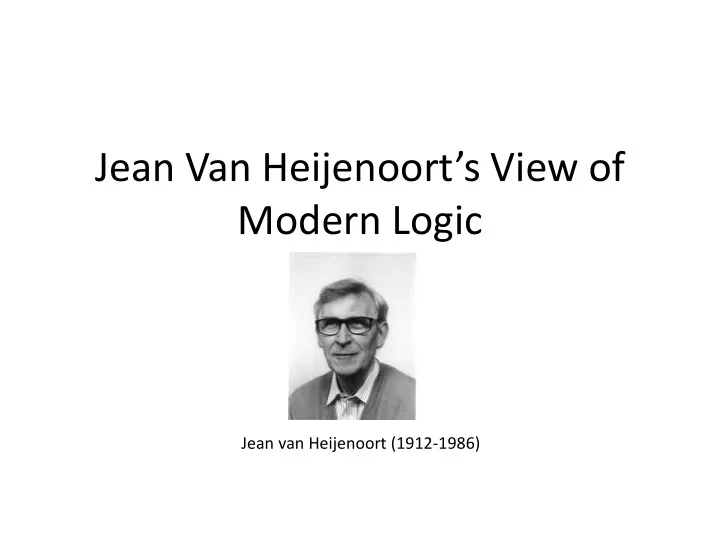
Jean van Heijenoort (1912-1986)
Jean Van Heijenoorts View of Modern Logic Jean van Heijenoort - - PowerPoint PPT Presentation
Jean Van Heijenoorts View of Modern Logic Jean van Heijenoort (1912-1986) Modern logic began in 1879, the year in which Gottlob Frege (1848 1925) published his Begriffsschrift . p. 242, Jean van Heijenoort, Historical Development
Jean van Heijenoort (1912-1986)
“Modern logic began in 1879, the year in which Gottlob Frege (1848–1925) published his Begriffsschrift.”
[Prepared by Irving H. Anellis from a previously unpublished typescript of 1974.]
2
“In less than ninety pages this booklet presented a number of discoveries that changed the face of logic. The central achievement of the work is the theory of quantification; but this could not be obtained till the traditional decomposition of the proposition into subject and predicate had been replaced by its analysis into function and argument(s). A preliminary accomplishment was the propositional calculus, with a truth-functional definition of the connectives, including the
avoided, logical derivations are to be formal, that is, have to proceed according to rules that are devoid of any intuitive logical force but simply refer to the typographical form of the expressions; thus the notion of formal system made its
rather than to logic, and presents a logical definition of the notion of mathematical
in the development of a science.”
3
The major characteristics of modern mathematical logic, as found in the Begriffsschrift and first introduced by Frege:
conditional;
predicate;
logicization of mathematics).
Jean van Heijenoort, “Logic as Calculus and Logic as Language”, Synthèse 17, 324–330; reprinted in Robert S. Cohen & Marx W. Wartofsky (eds.), Boston Studies in the Philosophy of Science 3 (1967), In Memory of Russell Norwood Hansen, Proceedings of the Boston Colloquium for Philosophy of Science 1964/1965 (Dordrecht: D. Reidel, 1967), 440–446.
4
Jean van Heijenoort, “Logic as Calculus and Logic as Language”, Synthèse 17, 324–330; reprinted in Robert S. Cohen & Marx W. Wartofsky (eds.), Boston Studies in the Philosophy of Science 3 (1967), In Memory of Russell Norwood Hansen, Proceedings of the Boston Colloquium for Philosophy of Science 1964/1965 (Dordrecht: D. Reidel, 1967), 440–446.
In addition, Frege, according to van Heijenoort (and adherents of the historio- graphical conception of a “Fregean revolution”):
and
for philosophy of language).
5
In “On the Frege-Russell Definition of Number” (undated ms.), van Heijenoort added:
universal propositions such as “All Greeks are mortal.”
6
Logic as Calculus
“Considered by itself, the period would, no doubt, leave its mark on the history
7
Logic as Language
8
“heralded by Leibniz” – From Frege to Gödel, p. vi
9
Logic as Language
“Frege’s work was slow in winning recognition. …Frege’s Begriffsschrift and Peano’s Arithmeticies principia…led to Principia mathematica.” – From Frege to Gödel, p. vi
10
Logic as Language / Logic as Calculus Absolutism Relativism Universality (Universal universe of Universes of discourse, with discourse (Universum) fixed, with multiple interpretations nothing extra-systematic, to logically reconstruct the universe Formal deductive system “ignore proofs” Syntactic and semantic Syntactic (model-theoretic): * Frege: Wertverlauf semantic; individuals and relations * Russell: set-theoretic semantic) Function-theoretic structure of props Algebraic structure of props “tried to copy mathematics too closely, often artificially” (– From Frege to Gödel, p. vi) “Hilbert’s position is somewhat between that of Frege-Russell and that of Peirce- Schröder-Löwenheim…”
Elliott Holland (eds.), Logic Colloquium ’76, (Oxford, 1976) (North-Holland, Amsterdam, 1977), 183–190
11
Schröder, Vorlesungen uber die Algebra der Logik (Exakte Logik), Bd. II, 1891, § 30, 35
1 2 3 1 1
n n n
1 2 3 1 1
n n n
12
“Löwenheim’s paper (1915), which links up with the work of Schröder, brings to the fore notions (validity, decision methods)….” – From Frege to Gödel, p. vii Including: Löwenheim-Skolem Theorem, Herbrand’s Fundamental Theorem
13
14
15
16
Transcription: Jedes Mathem. Problem kann auf folgende Frage zurückgeführt werden: Gegeben ist ein Gesetz, vermöge dessen zu jeder vorlegten ‹vorgelegten› nur aus Null und 1 bestehenden nicht abbrechenden Reihe (α) 0 0 1 1 0 0 ... eine bestimmte andere solche Reihe (durch Rechenoperationen: Grösste Ganze suchen, Teilersuche etc. nicht Würfeln...) (β) 1 0 0 1 1 1.... construiert ‹konstruiert› werden kann. Man soll durch eine endliche Zahl von Operationen entscheiden ob in irgendeiner Reihe (β) eine 0 vorkommt oder ob alle Reihen (β) nur ‹aus› Einsen bestehen? Ich behaupte: Jede solche Entscheidung ist durch eine endliche Zahl von Operationen (Rechenoperationen) möglich«,» d.h. es giebt kein Gesetz, bei welchem die Entscheidung nicht durch eine endliche Zahl von Operationen möglich wäre. D.h. jedes math. Problem ist lösbar. Alles dem menschlichen Verstande erreichbare (durch reines Denken ohne Materie) ist auch aufzulösen. Es giebt nur ein Problem. (z.B. Quadratur des Kreises, hat π = 3,14... 10 aufeinander folgende 7en, etc.) Von der Annahme der Möglichkeit geht man von vorne herein ‹vornherein› aus. Translation Every mathematical problem can be reduced to the following question: A rule is given, by which to every given non- breaking off sequence consisting only of zero and 1 (α) 0 0 1 1 0 0... a certain other such sequence (by computational operations: «Grösste Ganze Suchen», etc. not throwing dice...) (β) 1 0 0 1 1 1.... can be constructed. One is to decide by a finite number of operations whether if zero occurs in some sequence (β)
I claim: every such decision is possible through a finite number of operations (computational operations), i.e. there is no rule, with which the decision would not be possible by a finite number of operations, i.e. every math. problem is solvable. All that the human intellect can reach (by pure thinking without matters) is also to be dissolved. There is
from the assumption of the possibility.
17
“Gödel’s Theorem”, Paul Edwards (ed.), Encyclopedia of Philosophy, vol. 3 (New York: Macmillan, 1963), 348–357; “Logical Paradoxes”, Paul Edwards (ed.), Encyclopedia of Philosophy, vol. 5 (New York: Macmillan, 1963), 45–51; “Système et métasystème chez Russell”, in The Paris Logic Group (eds.), Logic Colloquium ’85 (North-Holland, Amsterdam/London/New York, 1987), 111–122; “Nature of Logic” (undated manuscript notes):
The consequence of the universality of Frege’s and Russell’s conception of logic is that, although issues regarding the properties of their logical systems arise, in particular the properties of consistency and completeness, they have to rely upon ad hoc extra-logical devices in their attempts to deal with these issues; they cannot deal with these within their logical systems.
Bertrand Russell, “Mathematical Logic as Based on the Theory of Types”, American Journal of Mathematics 30 (1908), 222–262
18
19
Thank you very much for your friendly card and the offprints of your papers. I am concurrently sending you reprints of my two essays regarding the fundamentals; several passages therein relate to the results that you obtained. For example, my paper entitled “Über formal unentscheid- bare Sätze etc.” also provides a contribution to the set-theoretical relativism held by
calculation*, the consistent, but not w- consistent systems examined on page 190 indicate that there exist realizations for axiom systems in set theory in which certain quantities that are infinite from an absolute standpoint are “finite” within the
showed for the term “uncountable quantity” also holds true for the term “finite quantity,” namely that it cannot be axiomatically characterized (expressed by a number). Since you made a suggestion in your paper “Über einige Satzfunktionen in der Arithmetik” which points in this direction, I think you will find this particularly interesting.
20
number theory (Ex: Fermat’s Last Theorem; Goldbach’s Conjecture; Riemann’s Hypothesis), of both T and ~T within the formal system BUT also: The unprovability within any formal axiomatic system adequate for number theory of the consistency of that system; i.e.
Satz XI: Sei k eine beliebige rekursive widerspruchsfreie Klasse von FORMELN, dann gilt: Die SATZFORMEL, welche besagt, daß k widerspruchsfrei ist, ist nich k-BEWEISBAR; inbesondere ist die Widerspruchsfreiheit von P in P unbeweis- bar, vorausgetzt, daß P widerspruchsfrei ist (im entgegengesetzten Fall ist natürlich jede Aussage beweisbar). Thus: for any consistent formal system Z (of PRA) adequate for axiomatizing the sequence of natural numbers, the consistency of Z is unprovable in Z:
21
Precisely van Heijenoort’s point w.r.t. the incompleteness theorems, and in particular to the second incompleteness theorem,
was that the complex, multi-layered proof by Gödel, especially w.r.t. the second incompleteness theorem, is that the constant shifting back-and-forth between the system and metasystem, the syntactic and the semantic levels, and between true and provable, is necessitated for universal systems, i.e. systems in which there is nothing extra-systematic – Principia-like – systems because the proofs concerning properties of those systems CANNOT be carried within those systems.
22
The sets of manuscript notes “Nature of Logic” comprise van Heijenoort’s attempts to understand: 1) the relation between logic and metalogic (which he was calling in these notes “basic logic”); and 2) the relation of logic (formal or ideal language) to Ordinary Language, where the basic logic is the tool for investigating and comparing the properties of various logical systems – and to do so without falling into a Carnapian metalinguistic regress. In “Nature of Logic”, the issue reaches no resolution.
“adulthood” of modern logic development of “quantification theory”, i.e. proof procedures for FOL= (considered by van Heijenoort primarily in unpublished manuscripts and in El desarrollo de la teoría de la cuantificación; (Turing, Church, Kleene, et al.): decidability theory (considered by van Heijenoort primarily in unpublished manuscripts and class lectures, e.g. in “Foundation of Mathematics” seminar) “Mathematical logic is what logic , through twenty-five centuries and a few transformations, has become today.” – From Frege to Gödel, p. vii From Frege to Gödel intended to document the growth of modern logic from birth with Frege to entry to maturity with Gödel
23
24
Spitzfindigkeit [Subtlety] The word is borrowed from a title of Kant, Die falsche Spitzfindigkeit der vier syllogistischen Figuren erweisen, Königsberg 1762. Spitzfindigkeit is subtlety in questions of logical form and divides thinkers into two well-marked camps: on the one side, those who have it: Aristotle, the Stoics, Abelard, Albertus Magnus, Peter of Spain, the logicians of the 14th and 15th centuries, Leibniz, Frege, Boole, De Morgan; on the other, those who do not have it: Sextus Empiricus, Cicero, the logicians of the 16th century, Descartes, the authors of the Port-Royal logic, Kant, Prantl. The article is a sketch, in black and white, of the history of logic and retells the history, familiar today after the work published in the last ten years, of four great epochs of logic: aristotelian, stoic-megaran, mediævel, and modern. Numerous quotes from Prantl of stunning ignorance show how recent and deep the renewal
The article concludes in a militant tone that logic will either be subtle or it will not exist. It will certainly help to disturb the prejudices which still prevail among those who speak of the history of logic without knowing it close up.
English translation by Thomas Drucker of Jean van Heijenoort, Review of I. M. Bocheński, “Spitzfindigkeit”, JSL 22(1957), 382