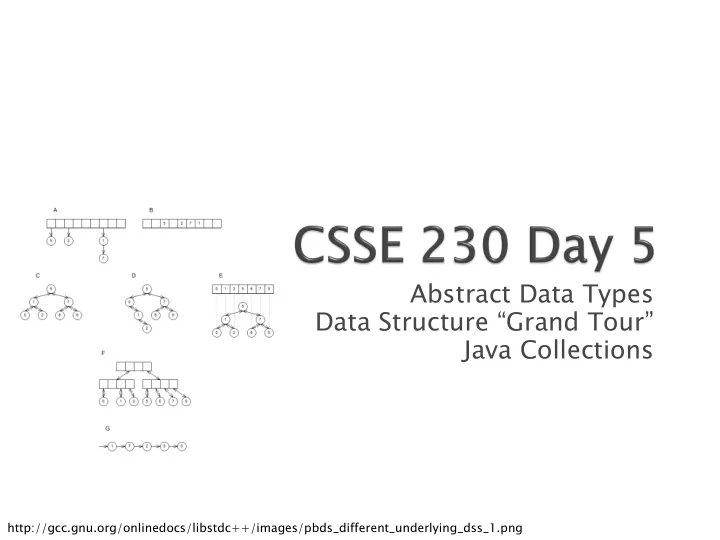
SLIDE 1 Abstract Data Types Data Structure “Grand Tour” Java Collections
http://gcc.gnu.org/onlinedocs/libstdc++/images/pbds_different_underlying_dss_1.png
SLIDE 2 Stacks and Queues
- Hopefully you have met with your partner to start
- Hopefully you and your partner can work well
- together. I usually like to pair people with similar
backgrounds, but since I don’t know that yet, they are arbitrary.
SLIDE 3 From question 2:
Suppose T1(N) is O(f(N)) and T2(N) is O(f(N)). Prove that T1(N) + T2(N) is O(f(N)) or give a counter- example:
Hint: Constants c1 and c2 must exist for T1(N)
and T2(N) to be O(f(N))
Does this work exactly like this for T1(N) - T2(N) ? Remember, O isn’t a tight bound.
SLIDE 4
explain what an ADT is list four examples of ADTs in the Collections
framework
list examples of implementations of the ADTs
in the Collections framework
explain why stacks and queues are still good
ADTs to use, even though lists could be used.
SLIDE 5
What is data? What do we mean by structure?
SLIDE 6
- A set of operations
- May be provided by the hardware (int and double)
- By software (java.math.BigInteger)
- By software + hardware (int[])
SLIDE 7 A mathematical model of a data type Specifies:
- The type of data stored
- The operations supported
- Argument types and return types of these operations
- What each operation does, but not how
SLIDE 8 One special value: zero Three basic operations:
Derived operations include plus Sample rules:
- isZero(succ(n)) false
- pred(succ(n)) n
- plus(n, zero) n
- plus(n, succ(m)) succ(plus(n, m))
Q1 Q1
SLIDE 9
Q2 Q2
Specification “what is it?” Implementation: “How do you do that?” Application: “how can you use that?” CSSE220 CSSE230
SLIDE 10
Some review Some new All will appear again
SLIDE 11 Array List
Stack Queue Set
- Tree Set
- Hash Set
- Linked Hash Set
Map
Priority Queue Tree Graph Network
Implementations for almost all
- f these* are provided by the
Java Collections Framework in the java.util package.
*Exceptions: Tree, Graph, Network
SLIDE 12 Search for Java 8 Collection With a partner, read the javadocs to answer
the quiz questions. You only need to submit
- ne quiz per pair. (Put both names at top)
I have used the rest of the slides when
teaching CSSE230 before.
When you finish, you may work on your
current CSSE230 assignments
Q3 Q3-11 11
SLIDE 13
Size must be declared when the
array is constructed
Can look up or store items by index
Example: nums[i+1] = nums[i] + 2;
How is this done?
a[0] a[1] a[2] a[i] a[N-2] a[N-1]
L a
SLIDE 14
A list is an ordered collection where elements
may be added anywhere, and any elements may be deleted or replaced.
Array
ray List: t: Like an array, but growable and shrinkable.
Link
nked ed List:
SLIDE 15 Op Operati ations
Prov
ided Array y List t Efficie ciency ncy Linke nked d List t Efficie cienc ncy Random access O(1) O(n) Add/remove item O(n) O(1)
SLIDE 16 A last-in, first-out (LIFO)
data structure
Real-world stacks
the cafeteria
Some uses:
- Tracking paths through a maze
- Providing “unlimited undo” in an application
Operati ations
Prov
ided Efficie cienc ncy Push item O(1) Pop item O(1)
Implemented by Stack, LinkedList, and ArrayDeque in Java
SLIDE 17 first-in, first-out
(FIFO) data structure
Real-world queues
the BMV
- Character on Star Trek TNG
Some uses:
- Scheduling access to shared resource (e.g., printer)
Op Oper erati ations
Prov
ided Ef Efficie cienc ncy Enqueue item O(1) Dequeue item O(1) Implemented by LinkedList and ArrayDeque in Java
SLIDE 18 A collection of items wi
without ut dupl plic icate ates s (in general, order does not matter)
- If a and b are both in set, then !a.equals(b)
Real-world sets:
One possible use:
item is in a collection
Op Operati ations
HashS hSet et TreeSet Add/remove item O(1) O(log n) Contains? O(1) O(log n)
Can hog space Sorts items! Example from 220
SLIDE 19 Associate keys with va
values es
Real-world “maps”
Some uses:
- Associating student ID with transcript
- Associating name with high scores
Operati ations
Has ashM hMap ap Tr Tree eeMap ap Insert key-value pair O(1) O(log n) Look up the value associated with a given key O(1) O(log n)
Can hog space Sorts items by key!
How is a a Tr Tree eeMap ap like e a T a Tree eeSet et? ? How is it different? erent?
SLIDE 20
SLIDE 21 Each item stored has an
an associated priori
ty
- Only item with “minimum” priority is accessible
- Operations: insert, findMin, deleteMin
Real-world “priority queue”:
- Airport ticketing counter
Some uses
- Simulations
- Scheduling in an OS
- Huffman coding
Not like regular queues! Op Operati ations
Provide
Efficie cienc ncy Insert O(log n) Find Min O(log n) Delete Min O(log n)
The version in Warm Up and Stretching isn’t this efficient.
SLIDE 22 Collection of nodes
- One specialized node is the root.
- A node has one parent (unless it is the root)
- A node has zero or more children.
Real-world “trees”:
- Organizational hierarchies
- Some family trees
Some uses:
- Directory structure
- n a hard drive
- Sorted collections
Operati ations
Prov
ided Efficie cienc ncy Find O(log n) Add/remove O(log n)
Only if tree is “balanced”
SLIDE 23 A collection of nodes and edges
- Each edge joins two nodes
- Edges can be directed or undirected
Real-world “graph”:
Some uses:
- Tracking links between web pages
- Facebook
Op Operati ations
Prov
ided Efficie cienc ncy Find O(n) Add/remove O(1) or O(n) or O(n2)
Depends on implementation (time/space trade off)
SLIDE 24 Graph whose edges have numeric labels Examples (labels):
- Road map (mileage)
- Airline's flight map (flying time)
- Plumbing system (gallons per minute)
- Computer network (bits/second)
Famous problems:
- Shortest path
- Maximum flow
- Minimal spanning tree
- Traveling salesman
- Four-coloring problem for planar graphs
SLIDE 25 Array List
Stack Queue Set
Map
Priority Queue Tree Graph Network
We’ll implement and use nearly all of these, some multiple ways. And a few other data structures.
SLIDE 26
Structure cture find insert rt/re /remove ve Comments nts Array O(n) can't do it Constant-time access by position Stack top only O(1) top only O(1) Easy to implement as an array. Queue front only O(1) O(1) insert rear, remove front. ArrayList O(log N) O(N) Constant-time access by position Linked List O(n) O(1) O(N) to find insertion position. HashSet/Map O(1) O(1) If table not very full TreeSet/Map O(log N) O(log N) Kept in sorted order PriorityQueue O(log N) O(log N) Can only find/remove smallest Tree O(log N) O(log N) If tree is balanced Graph O(N*M) ? O(M)? N nodes, M edges Network shortest path, maxFlow
SLIDE 27
If we have time left