
SLIDE 1
Jason-3 Information Briefing
Walid Bannoura Jason-3 Project Manager NOAA NESDIS
1
- 2013
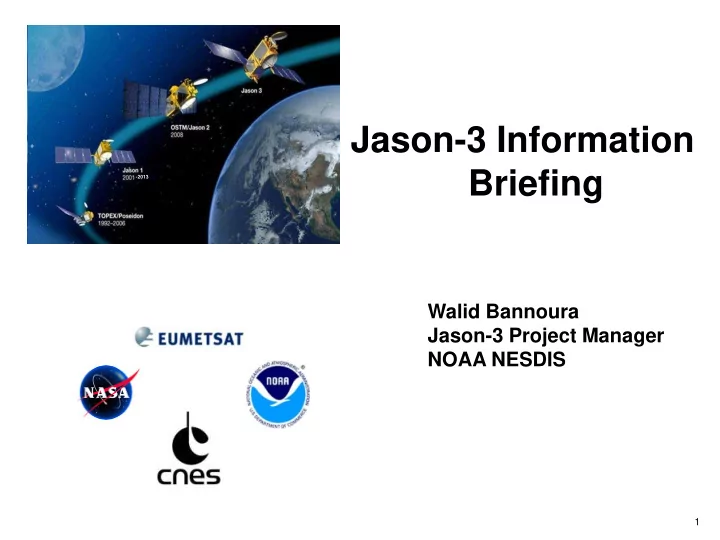
Jason-3 Information Briefing -2013 Walid Bannoura Jason-3 Project - - PowerPoint PPT Presentation
Jason-3 Information Briefing -2013 Walid Bannoura Jason-3 Project Manager NOAA NESDIS 1 Mission Overview Science Measurements Global sea surface height to an accuracy of < 4 cm every 10 days, for determining ocean circulation, climate
Walid Bannoura Jason-3 Project Manager NOAA NESDIS
1
Instruments*
Science Measurements
Global sea surface height to an accuracy of < 4 cm every 10 days, for determining ocean circulation, climate change and sea level rise
Mission Objectives Mission Overview
continuation of multi-decadal ocean topography measurements achieved through TOPEX/Poseidon, Jason-1 and OSTM/Jason-2
and NASA/JPL providing implementation support NOAA funded items in BLUE
* Same Requirements, S/C Bus, and orbit as Jason-2. Implementation approach is to maximize recurrence
2
Hurricane Intensity Forecasting Global & Regional Sea Level Rise Coast Guard Search & Rescue Oil Spill Monitoring High Wave Forecasting El Niño/La Niña Forecasting Operational Ocean “Weather”- 3-13 Feb 14
warnings, search & rescue, hurricane intensity forecasting
Niño/La Niña forecasting
year Jason sea level rise record
3
– Project Management – Satellite, Proteus bus – Payload (on Behalf of EUMETSAT)
– Joint Radiation Experiment Payload
– Ground System & Operations
– System integration & test – Mission Operation support for CNES instruments – System Coordination for all mission phases – User interface
– Project Management – Launch vehicle – Payload
– JPL Payload integration and test – Mission Operation support for JPL instruments
– Project Management – Ground System & Operations *
– User interface
– Project Management – Ground System & Operations
– User interface
* Modernizing the existing NOAA Jason-2 Ground Segment to serve both Jason-2 and Jason-3 satellites
4
Payload Provided By Description Poseidon-3B Altimeter
EUMETSAT
A radar altimeter. The mission's main instrument. Measures sea level, wave heights and wind speed. Advance Microwave Radiometer (AMR)
NOAA
Measures water vapor content in the atmosphere so that we can determine how it impacts radar signal propagation GPS Payload receiver (GPSP)
NOAA
Tracking system that uses GPS constellation of satellites to determine exact position of a transmitter. Enhances the Precise Orbit Determination (POD) performance of DORIS and LRA Laser Reflector Array (LRA)
NOAA
Allows the spacecraft to be tracked with centimeter accuracy by 40 satellite laser ranging stations Doris Tracking Receiver
EUMETSAT
Provides Precise Orbit Determination (POD). Locates the satellite on orbit in real time Joint Radiation Experiment (JRE) (Passenger - Experimental)
CNES/JAXA
Includes Carmen-3 (radiation and particle detectors) and Light Particle Telescope (LPT). Used to measure the influence of space radiation on advanced components NOAA funded items are in blue
5
NASA/JPL
NOAA CNES EUMETSAT
EUMETSAT – Usingen, Germany NOAA - Wallops/ Fairbanks – Barrow - USA Dedicated Launch Vehicle : Falcon9 v 1.1 NASA Instrument Ops Operational product processing and Science Data archive & Distribution Operational product processing & Distribution Science data processing, archive & Distribution
U.S. Elements European Elements
S/C Operations (Suitland, MD) S/C Operations (Toulouse, France) Passengers Ops and mission centers CNES- JAXA
AMR Reflector AMR Electronics GPSP Antenna LRA Poseidon 3B Altimeter DORIS
Jason-3 System elements
6
7
8
– All 4 partner ground systems are implemented and validated
system (ARCS)
9
Phase Spacecraft activities Leader Phase Leader OPERATIONAL
CNES & NASA w/ support of NOAA, EUM and PIs
VERIFICATION
Till S/C decommissioning
S/C on final orbit – Jason2 & 3 formation flight Orbit acquisition key point Jason-2 Orbit Change Final verif workshop OFL products generation
Till S/C decommissioning EUMETSAT & NOAA
NRT products generation & dissemination
CNES
OFL products dissemination
Till S/C decommissioning CNES & NOAA
Products activities
OFL products reprocessing
Till S/C decommissioning NOAA w/ support of EUMETSAT, NASA, CNES
S/C Operations Handed Over to NOAA HandOver review
CNES w/ support of EUMETSAT, NASA, NOAA
ASSESSMENT
4 weeks max: Orbit acquis
S/C & instruments functional (nom/nom mode)
3-5 days: LEOP
LEOP
CNES w/ support of EUMETSAT, NASA, NOAA CNES w/ support of EUMETSAT, NASA, NOAA
OPERATIONAL
2 months max 10 months max: OFL Verif 2 months: Assessment Jason2 & 3 formation flight 5 months max: NRT Verif
Start of cycle 1 S/C & GS nominal operations Fully assessed S/C on final orbit In Flight Assessment meeting Jason-2 / 3 Inter Calibration Key Point First verif workshop
Jason2 & 3 tandem flight
Mission phases
10
– AVISO CNES Data Center http://aviso-data-center.cnes.fr/ssalto – AVISO offline data user satisfaction survey performed each year
Jason-3 products via: – NODC: http://www.nodc.noaa.gov/SatelliteData/jason/ for NRT OGDR, IGDR and GDR as well as Quality Monitoring – CLASS: www.class.noaa.gov for telemetry, all auxiliary and ancillary data, and the XDGR family (with 4-6 hour latency). – GTS: Global Telecommunication System (alternative option for reception of BUFR products)
J3 near-real-time products via: – The Earth Observation Portal available on www.eumetsat.int (retrieval of archived products). – EUMETCast: Satellite Broadcasting System (reception of disseminated products). – GTS: Global Telecommunication System (alternative option for reception of BUFR products).
11
– Spacecraft is in storage. Pre-Ship review May 12, 2015
– All ground systems developments and tests are complete – Ground System Operational Qualification (QO) will continue through launch
successfully in March
12
13
AMR Advanced Microwave Radiometer CDR Critical Design Review CLA Coupled Load Analysis CLASS Comprehensive Large-Array Stewardship System CNES Centre National d’Etudes Spatiales DORIS Doppler Orbitography and Radiopositioning Integrated by Satellite GDR Geophysical Data Record GOWG Ground Operations Working Group GPSP Global Positioning System Package IGDR Interim Geophysical Data Record KDP Key Decision Points KSC Kennedy Space Center LRA Laser Retroreflector Assembly LRD Launch Readiness Date LSP Launch Service Program LSWG Loads & Structures Working Group L/V Launch Vehicle MIWG Mission Integration Working Group NESDIS National Environmental Satellite, Data, and Information Service NODC National Oceanographic Data Center OGDR Operational Geophysical Data Record PIM Payload Instrument Module PSWG Payload System Working Group SIR System Integration Review SpaceX Space Technology Corporation
14