
SLIDE 1
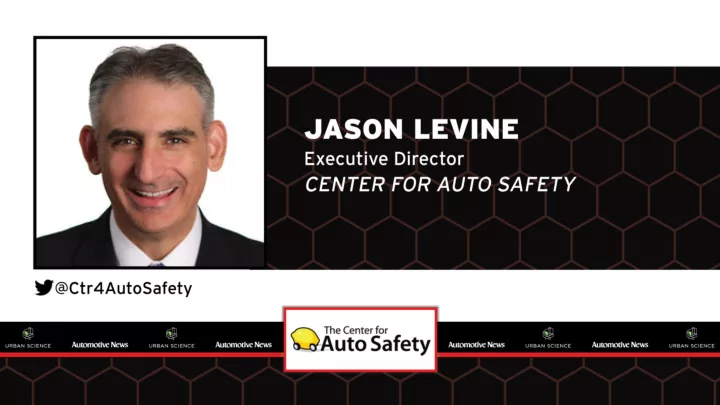
Jaso son n Levine ine Ex Executive cutive Director ector - - PowerPoint PPT Presentation
Your independent voice for automotive safety, quality and fuel economy. 1825 Connecticut Ave. NW, Suite 330, Washington, DC 20009 www.autosafety.org On the e Front t Lines nes of f Safe fety Jaso son n Levine ine Ex Executive cutive
On the e Front t Lines nes of f Safe fety Jaso son n Levine ine Ex Executive cutive Director ector November 13, 2019 Orlando, Florida
Your independent voice for automotive safety, quality and fuel economy. 1825 Connecticut Ave. NW, Suite 330, Washington, DC 20009 www.autosafety.org
3
4
5
“Hey Lara. Your car has another recall. See the attached article from Chris. I guess we will soon be getting a letter from GM. FYI Love Dad” “Oh great, one thing after another with that car. Thanks for the heads up! See you in a couple of days!”
6
“Hey Lara. Your car has another recall. See the attached article from Chris. I guess we will soon be getting a letter from GM. FYI Love Dad” “Oh great, one thing after another with that car. Thanks for the heads up! See you in a couple of days!”
7
8
9
10
11
12
TAKATA
13
The Center for Auto Safety is an independent, non- profit organization dedicated to advocating for auto safety and quality on behalf of our members and all drivers, passengers, and pedestrians. In 1970, following the recall of the Corvair, the Center was founded by Consumers Union and Ralph Nader in
watchdog to protect drivers because automakers and the government were not adequately regulating safety. In order to be close to those entities most in need of
Center has always called Washington, DC home.
14
minimum performance standards;
easy to return a defective car;
Enact ct State ate law aws s to fo force ce disclosure sclosure of f sec ecret ret warra rantie ties s on cars s that t can n save ve consumers sumers bill llions ions of f dol
lars s each ch yea ear; r;
by industry by taking legal action against government agencies;
ke recal call repairs pairs fr free ee of f charge rge to consu nsume mers; s;
15
Standards Written/Safety Required Advocated for by the Center for Auto Safety
saving lives from Rollovers (over steady and continued industry objection)
16
17
18
19
20
“When the Office of the Inspector General – that’s the internal watchdog at the NHTSA – says that the NHTSA is doing a subpar job at overseeing its recalls, that’s something that should concern all of us,” says Jason Levine with the Center for Auto Safety. Levine’s group has been critical of NHTSA’s handling of recalls. “Recalls
a defect on that car that’s dangerous,
They’re not done for cosmetic reasons.”
21
22
23
24
4
Source: 2018 Cox Automotive Service Industry Study
62% 8% 6% 7% 8% 4%
< 2 Year Old Vehicles
Dealerships General Repair/Service Station QuickLube Tire Store Retail Body Shop Specialist
5% 56% 11% 11% 9% 5%
2-5 Year Old Vehicles
Dealerships General Repair/Service Station QuickLube Tire Store Body Shop Other Specialist Retail
1% 4% 3% 29% 27% 13% 14% 7% 5%
> 5 Year Old Vehicles
Dealerships General Repair/Service Station QuickLube Tire Store Retail Body Shop Other Specialist
3%2%
Dealership Usage Declines as Vehicles Age
SHARE OF SERVICE VISITS BY VEHICLE AGE
(AMONG THOSE WHO PURCHASED FROM A DEALERSHIP)
% Under Warranty 91% 60% 8%
26
WHAT DO I DO IF MY CAR IS RECALLED? When you receive a notification, follow any interim safety guidance provided by the manufacturer and contact your local dealership. Whether you receive a recall notification or are subject to a safety improvement campaign, it is very important that you visit your dealer to have the vehicle serviced. The dealer will fix the recalled part or portion of your car for free.
27
28
Dad dies saving daughter from icy pond. The car had been recalled for a brake problem.
29
30
31
32
33
CONTACT INFO Jason Levine Executive Director, Center for Auto Safety Email: jlevine@autosafety.org Websites: www.autosafety.org, www.fixautorecalls.com Twitter: @CTR4AutoSafety Facebook: CenterForAutoSafety