Intro January 18, 2013 - p. 1/13
January 18, Week 1 Today: Chapter 2, Position and Average Velocity - - PowerPoint PPT Presentation
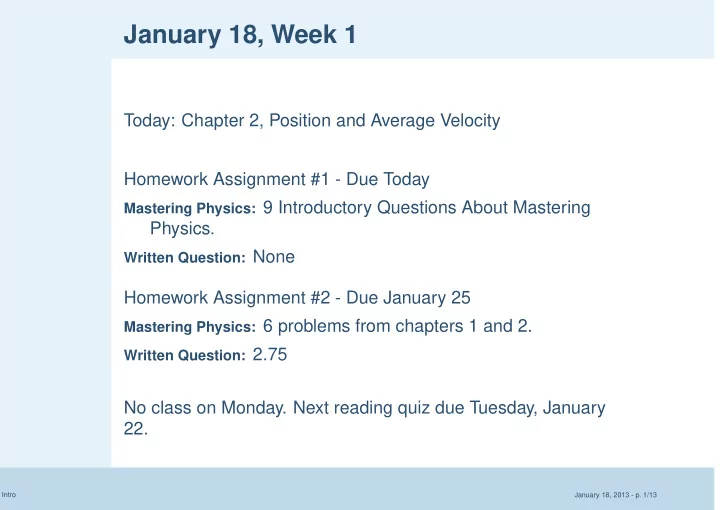
January 18, Week 1 Today: Chapter 2, Position and Average Velocity Homework Assignment #1 - Due Today Mastering Physics: 9 Introductory Questions About Mastering Physics. Written Question: None Homework Assignment #2 - Due January 25 Mastering
Intro January 18, 2013 - p. 2/13
Special Announcement
THE OFFICE OF ACCESSIBILITY RESOURCE CENTER IS LOOKING FOR A STUDENT IN THIS CLASS TO VOLUNTEER TO PROVIDE NOTES FOR THIS CLASS. THE STUDENT WILL BE PAID A STIPEND FOR THE SEMESTER. INTERESTED STUDENT SHOULD COME BY OUR OFFICE AT 2021 MESA VISTA HALL TO COMPLETE THE REQUIRED HIRING PAPERWORK.
Intro January 18, 2013 - p. 3/13
- S. I. Units
To compare physical quantities, everyone must use the same system of units.
Intro January 18, 2013 - p. 3/13
- S. I. Units
To compare physical quantities, everyone must use the same system of units.
■ Physics uses the S. I. system (Système International
D’unités).
Intro January 18, 2013 - p. 3/13
- S. I. Units
To compare physical quantities, everyone must use the same system of units.
■ Physics uses the S. I. system (Système International
D’unités).
■ There are three fundamental units/measurements in S. I.
Intro January 18, 2013 - p. 3/13
- S. I. Units
To compare physical quantities, everyone must use the same system of units.
■ Physics uses the S. I. system (Système International
D’unités).
■ There are three fundamental units/measurements in S. I. ◆ Unit of length
Intro January 18, 2013 - p. 3/13
- S. I. Units
To compare physical quantities, everyone must use the same system of units.
■ Physics uses the S. I. system (Système International
D’unités).
■ There are three fundamental units/measurements in S. I. ◆ Unit of length = meter (m)
Intro January 18, 2013 - p. 3/13
- S. I. Units
To compare physical quantities, everyone must use the same system of units.
■ Physics uses the S. I. system (Système International
D’unités).
■ There are three fundamental units/measurements in S. I. ◆ Unit of length = meter (m) ◆ Unit of mass
Intro January 18, 2013 - p. 3/13
- S. I. Units
To compare physical quantities, everyone must use the same system of units.
■ Physics uses the S. I. system (Système International
D’unités).
■ There are three fundamental units/measurements in S. I. ◆ Unit of length = meter (m) ◆ Unit of mass = kilogram (kg)
Intro January 18, 2013 - p. 3/13
- S. I. Units
To compare physical quantities, everyone must use the same system of units.
■ Physics uses the S. I. system (Système International
D’unités).
■ There are three fundamental units/measurements in S. I. ◆ Unit of length = meter (m) ◆ Unit of mass = kilogram (kg) ◆ Unit of time
Intro January 18, 2013 - p. 3/13
- S. I. Units
To compare physical quantities, everyone must use the same system of units.
■ Physics uses the S. I. system (Système International
D’unités).
■ There are three fundamental units/measurements in S. I. ◆ Unit of length = meter (m) ◆ Unit of mass = kilogram (kg) ◆ Unit of time = second (s)
Intro January 18, 2013 - p. 4/13
- U. S. Customary Units
In the United States, we use the U. S. customary system or British engineering system of units in everyday life.
Intro January 18, 2013 - p. 4/13
- U. S. Customary Units
In the United States, we use the U. S. customary system or British engineering system of units in everyday life. There are also three fundamental units in the U. S. customary.
Intro January 18, 2013 - p. 4/13
- U. S. Customary Units
In the United States, we use the U. S. customary system or British engineering system of units in everyday life. There are also three fundamental units in the U. S. customary.
■ Unit of length
Intro January 18, 2013 - p. 4/13
- U. S. Customary Units
In the United States, we use the U. S. customary system or British engineering system of units in everyday life. There are also three fundamental units in the U. S. customary.
■ Unit of length = foot (ft)
Intro January 18, 2013 - p. 4/13
- U. S. Customary Units
In the United States, we use the U. S. customary system or British engineering system of units in everyday life. There are also three fundamental units in the U. S. customary.
■ Unit of length = foot (ft) ■ Unit of weight
Intro January 18, 2013 - p. 4/13
- U. S. Customary Units
In the United States, we use the U. S. customary system or British engineering system of units in everyday life. There are also three fundamental units in the U. S. customary.
■ Unit of length = foot (ft) ■ Unit of weight = Pound (lb)
Intro January 18, 2013 - p. 4/13
- U. S. Customary Units
In the United States, we use the U. S. customary system or British engineering system of units in everyday life. There are also three fundamental units in the U. S. customary.
■ Unit of length = foot (ft) ■ Unit of weight = Pound (lb) ■ Unit of time
Intro January 18, 2013 - p. 4/13
- U. S. Customary Units
In the United States, we use the U. S. customary system or British engineering system of units in everyday life. There are also three fundamental units in the U. S. customary.
■ Unit of length = foot (ft) ■ Unit of weight = Pound (lb) ■ Unit of time = second (s)
Intro January 18, 2013 - p. 5/13
- S. I. Prefixes
To make more convenient units, the S. I. system has a uniform system of prefixes that act as multipliers of powers of ten.
Intro January 18, 2013 - p. 5/13
- S. I. Prefixes
To make more convenient units, the S. I. system has a uniform system of prefixes that act as multipliers of powers of ten.
■ kilo (k) = 1000 = 103
Intro January 18, 2013 - p. 5/13
- S. I. Prefixes
To make more convenient units, the S. I. system has a uniform system of prefixes that act as multipliers of powers of ten.
■ kilo (k) = 1000 = 103 ■ mega (M) = 106
Intro January 18, 2013 - p. 5/13
- S. I. Prefixes
To make more convenient units, the S. I. system has a uniform system of prefixes that act as multipliers of powers of ten.
■ kilo (k) = 1000 = 103 ■ mega (M) = 106 ■ giga (G) = 109
Intro January 18, 2013 - p. 5/13
- S. I. Prefixes
To make more convenient units, the S. I. system has a uniform system of prefixes that act as multipliers of powers of ten.
■ kilo (k) = 1000 = 103 ■ mega (M) = 106 ■ giga (G) = 109 ■ tera (T) = 1012
Intro January 18, 2013 - p. 5/13
- S. I. Prefixes
To make more convenient units, the S. I. system has a uniform system of prefixes that act as multipliers of powers of ten.
■ kilo (k) = 1000 = 103 ■ mega (M) = 106 ■ giga (G) = 109 ■ tera (T) = 1012 ■ centi (c) = 0.01 = 10−2
Intro January 18, 2013 - p. 5/13
- S. I. Prefixes
To make more convenient units, the S. I. system has a uniform system of prefixes that act as multipliers of powers of ten.
■ kilo (k) = 1000 = 103 ■ mega (M) = 106 ■ giga (G) = 109 ■ tera (T) = 1012 ■ centi (c) = 0.01 = 10−2 ■ mili (m) = 0.001 = 10−3
Intro January 18, 2013 - p. 5/13
- S. I. Prefixes
To make more convenient units, the S. I. system has a uniform system of prefixes that act as multipliers of powers of ten.
■ kilo (k) = 1000 = 103 ■ mega (M) = 106 ■ giga (G) = 109 ■ tera (T) = 1012 ■ centi (c) = 0.01 = 10−2 ■ mili (m) = 0.001 = 10−3 ■ micro (µ) = 10−6
Intro January 18, 2013 - p. 5/13
- S. I. Prefixes
To make more convenient units, the S. I. system has a uniform system of prefixes that act as multipliers of powers of ten.
■ kilo (k) = 1000 = 103 ■ mega (M) = 106 ■ giga (G) = 109 ■ tera (T) = 1012 ■ centi (c) = 0.01 = 10−2 ■ mili (m) = 0.001 = 10−3 ■ micro (µ) = 10−6 ■ nano (n) = 10−9
Intro January 18, 2013 - p. 5/13
- S. I. Prefixes
To make more convenient units, the S. I. system has a uniform system of prefixes that act as multipliers of powers of ten.
■ kilo (k) = 1000 = 103 ■ mega (M) = 106 ■ giga (G) = 109 ■ tera (T) = 1012 ■ centi (c) = 0.01 = 10−2 ■ mili (m) = 0.001 = 10−3 ■ micro (µ) = 10−6 ■ nano (n) = 10−9 ■ pico (p) = 10−12
Intro January 18, 2013 - p. 6/13
S.I. Exercise
Which of the following correctly lists time intervals from longest to shortest?
Intro January 18, 2013 - p. 6/13
S.I. Exercise
Which of the following correctly lists time intervals from longest to shortest? (a) 1500 s, 3.6 ks, 700 ms
Intro January 18, 2013 - p. 6/13
S.I. Exercise
Which of the following correctly lists time intervals from longest to shortest? (a) 1500 s, 3.6 ks, 700 ms (b) 5 Ms, 3.6 ks, 1500 s
Intro January 18, 2013 - p. 6/13
S.I. Exercise
Which of the following correctly lists time intervals from longest to shortest? (a) 1500 s, 3.6 ks, 700 ms (b) 5 Ms, 3.6 ks, 1500 s (c) 29 µs, 3.6 ks, 5 Ms
Intro January 18, 2013 - p. 6/13
S.I. Exercise
Which of the following correctly lists time intervals from longest to shortest? (a) 1500 s, 3.6 ks, 700 ms (b) 5 Ms, 3.6 ks, 1500 s (c) 29 µs, 3.6 ks, 5 Ms (d) 700 ms, 1500 s, 29 µs
Intro January 18, 2013 - p. 6/13
S.I. Exercise
Which of the following correctly lists time intervals from longest to shortest? (a) 1500 s, 3.6 ks, 700 ms (b) 5 Ms, 3.6 ks, 1500 s (c) 29 µs, 3.6 ks, 5 Ms (d) 700 ms, 1500 s, 29 µs (e) 700 ms, 29 µs, 3.6 ks
Intro January 18, 2013 - p. 6/13
S.I. Exercise
Which of the following correctly lists time intervals from longest to shortest? (a) 1500 s, 3.6 ks, 700 ms (b) 5 Ms, 3.6 ks, 1500 s (c) 29 µs, 3.6 ks, 5 Ms (d) 700 ms, 1500 s, 29 µs (e) 700 ms, 29 µs, 3.6 ks
Intro January 18, 2013 - p. 6/13
S.I. Exercise
Which of the following correctly lists time intervals from longest to shortest? (a) 1500 s, 3.6 ks, 700 ms (b) 5 Ms, 3.6 ks, 1500 s (c) 29 µs, 3.6 ks, 5 Ms (d) 700 ms, 1500 s, 29 µs (e) 700 ms, 29 µs, 3.6 ks 3.6 ks = 3.6 (1000) s = 3600 s = 1 h
Intro January 18, 2013 - p. 7/13
Motion
Mechanics - Study of how and why objects move.
Intro January 18, 2013 - p. 7/13
Motion
Mechanics - Study of how and why objects move. Kinematics - Motion without regard to how it is caused.
Intro January 18, 2013 - p. 7/13
Motion
Mechanics - Study of how and why objects move. Kinematics - Motion without regard to how it is caused. One-Dimensional Motion - Straight-line motion. The object can
- nly go left/right or up/down.
Intro January 18, 2013 - p. 7/13
Motion
Mechanics - Study of how and why objects move. Kinematics - Motion without regard to how it is caused. One-Dimensional Motion - Straight-line motion. The object can
- nly go left/right or up/down.
To describe motion completely, we need to know:
Intro January 18, 2013 - p. 7/13
Motion
Mechanics - Study of how and why objects move. Kinematics - Motion without regard to how it is caused. One-Dimensional Motion - Straight-line motion. The object can
- nly go left/right or up/down.
To describe motion completely, we need to know:
■ Where the object is located at every time = Position
Intro January 18, 2013 - p. 7/13
Motion
Mechanics - Study of how and why objects move. Kinematics - Motion without regard to how it is caused. One-Dimensional Motion - Straight-line motion. The object can
- nly go left/right or up/down.
To describe motion completely, we need to know:
■ Where the object is located at every time = Position ■ How fast and in what direction the object is going at every
time = Velocity
Intro January 18, 2013 - p. 7/13
Motion
Mechanics - Study of how and why objects move. Kinematics - Motion without regard to how it is caused. One-Dimensional Motion - Straight-line motion. The object can
- nly go left/right or up/down.
To describe motion completely, we need to know:
■ Where the object is located at every time = Position ■ How fast and in what direction the object is going at every
time = Velocity
■ Whether the object is speeding up or slowing down at every
time = Acceleration
Intro January 18, 2013 - p. 7/13
Motion
Mechanics - Study of how and why objects move. Kinematics - Motion without regard to how it is caused. One-Dimensional Motion - Straight-line motion. The object can
- nly go left/right or up/down.
To describe motion completely, we need to know:
■ Where the object is located at every time = Position ■ How fast and in what direction the object is going at every
time = Velocity
■ Whether the object is speeding up or slowing down at every
time = Acceleration Particle Model - For now, it suffices to treat moving objects as particles ⇒ little dots with a single value of position.
Intro January 18, 2013 - p. 8/13
Position
Position = How far and what direction from an origin.
Intro January 18, 2013 - p. 8/13
Position
Position = How far and what direction from an origin. x
Intro January 18, 2013 - p. 8/13
Position
Position = How far and what direction from an origin. x What we mean is: x
Intro January 18, 2013 - p. 8/13
Position
Position = How far and what direction from an origin. x What we mean is: x For 1D Motion, direction is indicated by giving positive or negative values for physics quantities. The usual convention is that right = positive and left = negative or up = positive and down = negative.
Intro January 18, 2013 - p. 9/13
Displacement
Moving objects change their position, so we introduce displacement.
Intro January 18, 2013 - p. 9/13
Displacement
Moving objects change their position, so we introduce displacement. Displacement = change in position = ∆x (Delta x)
Intro January 18, 2013 - p. 9/13
Displacement
Moving objects change their position, so we introduce displacement. Displacement = change in position = ∆x (Delta x) Initial Position = x1,
Intro January 18, 2013 - p. 9/13
Displacement
Moving objects change their position, so we introduce displacement. Displacement = change in position = ∆x (Delta x) Initial Position = x1, Final Position = x2
Intro January 18, 2013 - p. 9/13
Displacement
Moving objects change their position, so we introduce displacement. Displacement = change in position = ∆x (Delta x) Initial Position = x1, Final Position = x2 x1 x2 ∆x
Intro January 18, 2013 - p. 9/13
Displacement
Moving objects change their position, so we introduce displacement. Displacement = change in position = ∆x (Delta x) Initial Position = x1, Final Position = x2 x1 x2 ∆x x1
Intro January 18, 2013 - p. 9/13
Displacement
Moving objects change their position, so we introduce displacement. Displacement = change in position = ∆x (Delta x) Initial Position = x1, Final Position = x2 x1 x2 ∆x x1 x2
Intro January 18, 2013 - p. 9/13
Displacement
Moving objects change their position, so we introduce displacement. Displacement = change in position = ∆x (Delta x) Initial Position = x1, Final Position = x2 x1 x2 ∆x x1 x2 ∆x = x2 − x1
Intro January 18, 2013 - p. 10/13
Distance
Distance, d = always positive number which gives how far an
- bject has traveled.
Intro January 18, 2013 - p. 11/13
Displacement Exercise
An eagle is flying 4 m above a lake when it spies a fish that is 35 cm below the surface. If the eagle dives straight down and grabs the fish, what the eagle’s displacement? Use the typical convention that up is positive.
Intro January 18, 2013 - p. 11/13
Displacement Exercise
An eagle is flying 4 m above a lake when it spies a fish that is 35 cm below the surface. If the eagle dives straight down and grabs the fish, what the eagle’s displacement? Use the typical convention that up is positive. (a) 39 cm
Intro January 18, 2013 - p. 11/13
Displacement Exercise
An eagle is flying 4 m above a lake when it spies a fish that is 35 cm below the surface. If the eagle dives straight down and grabs the fish, what the eagle’s displacement? Use the typical convention that up is positive. (a) 39 cm (b) −39 cm
Intro January 18, 2013 - p. 11/13
Displacement Exercise
An eagle is flying 4 m above a lake when it spies a fish that is 35 cm below the surface. If the eagle dives straight down and grabs the fish, what the eagle’s displacement? Use the typical convention that up is positive. (a) 39 cm (b) −39 cm (c) 4.35 m
Intro January 18, 2013 - p. 11/13
Displacement Exercise
An eagle is flying 4 m above a lake when it spies a fish that is 35 cm below the surface. If the eagle dives straight down and grabs the fish, what the eagle’s displacement? Use the typical convention that up is positive. (a) 39 cm (b) −39 cm (c) 4.35 m (d) −4.35 m
Intro January 18, 2013 - p. 11/13
Displacement Exercise
An eagle is flying 4 m above a lake when it spies a fish that is 35 cm below the surface. If the eagle dives straight down and grabs the fish, what the eagle’s displacement? Use the typical convention that up is positive. (a) 39 cm (b) −39 cm (c) 4.35 m (d) −4.35 m (e) −4 m
Intro January 18, 2013 - p. 11/13
Displacement Exercise
An eagle is flying 4 m above a lake when it spies a fish that is 35 cm below the surface. If the eagle dives straight down and grabs the fish, what the eagle’s displacement? Use the typical convention that up is positive. (a) 39 cm (b) −39 cm (c) 4.35 m (d) −4.35 m (e) −4 m When adding or subtracting, quantities must have the same unit
Intro January 18, 2013 - p. 12/13
Distance Exercise
An eagle is flying 4 m above a lake when it spies a fish that is 35 cm below the surface. The eagle dives straight down, grabs the fish, and then flies straight back up to where it started. For the entire trip, what the eagle’s displacement ∆x and distance d traveled? Use the typical convention that up is positive.
Intro January 18, 2013 - p. 12/13
Distance Exercise
An eagle is flying 4 m above a lake when it spies a fish that is 35 cm below the surface. The eagle dives straight down, grabs the fish, and then flies straight back up to where it started. For the entire trip, what the eagle’s displacement ∆x and distance d traveled? Use the typical convention that up is positive. (a) ∆x = 0, d = 8.7 m
Intro January 18, 2013 - p. 12/13
Distance Exercise
An eagle is flying 4 m above a lake when it spies a fish that is 35 cm below the surface. The eagle dives straight down, grabs the fish, and then flies straight back up to where it started. For the entire trip, what the eagle’s displacement ∆x and distance d traveled? Use the typical convention that up is positive. (a) ∆x = 0, d = 8.7 m (b) ∆x = 0, d = 4.35 m
Intro January 18, 2013 - p. 12/13
Distance Exercise
An eagle is flying 4 m above a lake when it spies a fish that is 35 cm below the surface. The eagle dives straight down, grabs the fish, and then flies straight back up to where it started. For the entire trip, what the eagle’s displacement ∆x and distance d traveled? Use the typical convention that up is positive. (a) ∆x = 0, d = 8.7 m (b) ∆x = 0, d = 4.35 m (c) ∆x = 8.7 m, d = 8.7 m
Intro January 18, 2013 - p. 12/13
Distance Exercise
An eagle is flying 4 m above a lake when it spies a fish that is 35 cm below the surface. The eagle dives straight down, grabs the fish, and then flies straight back up to where it started. For the entire trip, what the eagle’s displacement ∆x and distance d traveled? Use the typical convention that up is positive. (a) ∆x = 0, d = 8.7 m (b) ∆x = 0, d = 4.35 m (c) ∆x = 8.7 m, d = 8.7 m (d) ∆x = 8.7 m, d = 0
Intro January 18, 2013 - p. 12/13
Distance Exercise
An eagle is flying 4 m above a lake when it spies a fish that is 35 cm below the surface. The eagle dives straight down, grabs the fish, and then flies straight back up to where it started. For the entire trip, what the eagle’s displacement ∆x and distance d traveled? Use the typical convention that up is positive. (a) ∆x = 0, d = 8.7 m (b) ∆x = 0, d = 4.35 m (c) ∆x = 8.7 m, d = 8.7 m (d) ∆x = 8.7 m, d = 0 (e) ∆x = 0, d = 0
Intro January 18, 2013 - p. 12/13
Distance Exercise
An eagle is flying 4 m above a lake when it spies a fish that is 35 cm below the surface. The eagle dives straight down, grabs the fish, and then flies straight back up to where it started. For the entire trip, what the eagle’s displacement ∆x and distance d traveled? Use the typical convention that up is positive. (a) ∆x = 0, d = 8.7 m (b) ∆x = 0, d = 4.35 m (c) ∆x = 8.7 m, d = 8.7 m (d) ∆x = 8.7 m, d = 0 (e) ∆x = 0, d = 0
Intro January 18, 2013 - p. 13/13
Average Velocity
Faster moving objects travel farther than slower ones in a given period of time.
Intro January 18, 2013 - p. 13/13
Average Velocity
Faster moving objects travel farther than slower ones in a given period of time. speed = How fast
Intro January 18, 2013 - p. 13/13
Average Velocity
Faster moving objects travel farther than slower ones in a given period of time. speed = How fast Average speed: spav = distance elapsed time = d ∆t ∆t = t2 − t1
Intro January 18, 2013 - p. 13/13
Average Velocity
Faster moving objects travel farther than slower ones in a given period of time. speed = How fast Average speed: spav = distance elapsed time = d ∆t ∆t = t2 − t1 Units: When we multiply or divide units, we make a new compound unit. Here, we can use any distance and time
- combination. Typically, we’ll use m/s = meters per second.
Intro January 18, 2013 - p. 13/13
Average Velocity
Faster moving objects travel farther than slower ones in a given period of time. speed = How fast Average speed: spav = distance elapsed time = d ∆t ∆t = t2 − t1 Units: When we multiply or divide units, we make a new compound unit. Here, we can use any distance and time
- combination. Typically, we’ll use m/s = meters per second.
velocity = How fast and the direction of motion
Intro January 18, 2013 - p. 13/13
Average Velocity
Faster moving objects travel farther than slower ones in a given period of time. speed = How fast Average speed: spav = distance elapsed time = d ∆t ∆t = t2 − t1 Units: When we multiply or divide units, we make a new compound unit. Here, we can use any distance and time
- combination. Typically, we’ll use m/s = meters per second.