
SLIDE 1
22 september 2006
1
1
Developing a C4I Architecture for the Netherlands Armed Forces
Dick Ooms & Tim Grant Netherlands Defence Academy
2
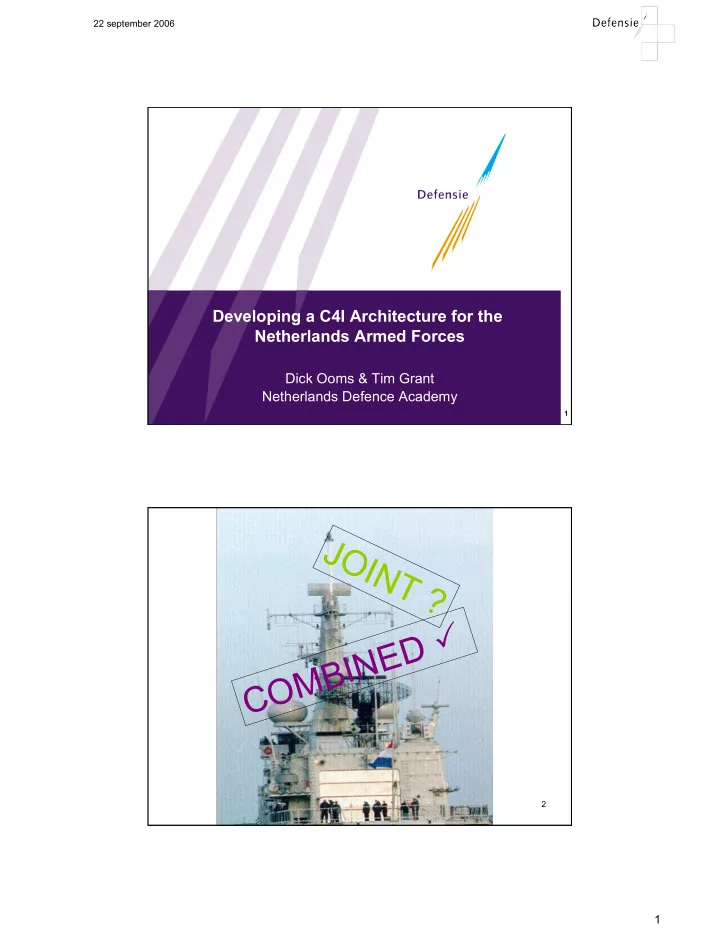
J O I N T ? COMBINED 2 1 22 september 2006 Presentation - - PDF document
22 september 2006 Developing a C4I Architecture for the Netherlands Armed Forces Dick Ooms & Tim Grant Netherlands Defence Academy 1 J O I N T ? COMBINED 2 1 22 september 2006 Presentation Structure Why a C4I Architecture?
22 september 2006
1
1
Developing a C4I Architecture for the Netherlands Armed Forces
Dick Ooms & Tim Grant Netherlands Defence Academy
2
22 september 2006
2
3
Presentation Structure
4
Presentation Structure
22 september 2006
3
5
Navy C2 systems
6
Army mobile C2
22 september 2006
4
7
Air Force & Army C2
Combined Air Operations Center (CAOC) Battalion Command Post (CP) in the field
8
Challenge 1: Effective information sharing among dissimilar entities
5/14/09 8
22 september 2006
5
9
Challenge 2: building the C2 chain
DISMOUNTED MOBILE DEPLOYED
ISIS TITAAN OSIRIS XANTHOS AFSIS TITAAN RADIO NET THEMIS PALLAS DECIUS CYRUS
NL Army suite of C2 systems
10
22 september 2006
6
11
Presentation Structure
12
DIVA Architecture Model
RICHTING conceptueel, wat/ waarom RICHTING
Requirements for ICT Solutions Information Support Requirements Goals and Tasks Environment Concept of Operations
logisch, hoe VORMGEVING
Components model Information Services Model Organisation Process Models Information Flow Building Blocks Information Systems Organisation- implementation Entities, Roles & Activities BV-Architectuur IV-Architectuur ICT-Architectuur direction composition implementation
22 september 2006
7
13 5/14/09 13
DIVA Architecture Hierarchie
Corporate Architecture (HDIO) Sub Architectures
C4I: CDS M&F: DMO/DFEZ P&O: HDP management::DIO
Aspect Architectures
Security: BA Networks & Comms: DIO Integration: DIO
Project Architectures (DMO/IVENT)
e.g. TITAAN, OMIS, MS Walrus, ISIS, BMS AFSIS etc.
C4I (sub) Architecture
14
Initial Operational Process Model
22 september 2006
8
15
Presentation Structure
16
Boyd’s OODA loop
Observations
Feed Forward
Decision (Hypothesis)
Action (Test)
Feed Forward Cultural Traditions
Genetic Heritage
New Information Previous Experience
Analyses & Synthesis
Feed Forward
Unfolding Interaction With Environment Unfolding Interaction With Environment Note how orientation shapes observation, shapes decision, shapes action, and in turn is shaped by the feedback and other phenomena coming into our sensing or observing window. From “The Essence of Winning and Losing,” John R. Boyd, January 1996.
22 september 2006
9
17
Possible Process Hierarchie
Observations Feed Forward Decision (Hypothesis) Action (Test) Feed Forward Cultural Traditions Genetic Heritage New Information Previous Experience Feed Forward Unfolding Interaction With Environme nt Unfolding Interaction With Environme nt Observations Feed Forward Decision (Hypothesis) Action (Test) Feed Forward Cultural Traditions Genetic Heritage New Information Previous Experience Feed Forward Unfolding Interaction With Environment Unfolding Interaction With Environment Observations Feed Forward Decision (Hypothesis) Action (Test) Feed Forward Cultural Traditions Genetic Heritage New Information Previous Experience Feed Forward Unfolding Interaction With Environment Unfolding Interaction With EnvironmentRecognized Air Picture Common Operational Picture Joint Air Defence
18
Air Defence Parallel Processes
Is e Is ever erybody ybody inf informed of m
y assessment and assessment and int intentions? entions? What is the What is the current Air current Air Picture? Picture? What are m What are my y capabilities and capabilities and possible cour possible courses ses
Do I need t Do I need to adjus
t the aler alert s t stat tate? e? What about the What about the EMCON Plan? EMCON Plan? Do I need an Do I need an adjus adjustment of the tment of the Rules of ules of Engagement? Engagement? Do I need t Do I need to
reposition my units y units in vie in view of the threat w of the threat axis? axis? What is the What is the actual w actual weapon eapon and fuel s and fuel stat tate of e of my f y fight ighter ers? s? What is the What is the ennem ennemy’s mos y’s most t lik likely cour ely course of se of action? action?
22 september 2006
10
19
Stakeholders & COIs
Primary Stakeholders:
Predefined COIs:
requirements, acquisition, R&D, HRM
C4I-planning & -management, weapon employment, sensor management, ISR/INTEL, education & training
20
Stakeholders, COIs and views
22 september 2006
11
21
Purpose C4I Architecture
22
Presentation Structure
22 september 2006
12
23
C4I Architecture products
24
C4I Basic Considerations & Principles
RICHTING conceptueel, wat/ waarom RICHTING
Requirements for ICT Solutions Information Support Requirements Goals and Tasks Environment Concept of Operations
logisch, hoe VORMGEVING
Components model Information Services Model Organisation Process Models Information Flow Building Blocks Information Systems Organisation- implementation Entities, Roles & Activities BV-Architectuur IV-Architectuur ICT-Architectuur direction composition implementation
22 september 2006
13
25
C4I Standards & Technologies
RICHTING conceptueel, wat/ waarom RICHTING
Requirements for ICT Solutions Information Support Requirements Goals and Tasks Environment Concept of Operations
logisch, hoe VORMGEVING
Components model Information Services Model Organisation Process Models Information Flow Building Blocks Information Systems Organisation- implementation Entities, Roles & Activities BV-Architectuur IV-Architectuur ICT-Architectuur direction composition implementation
26
Checklist C4I Requirement Process & Technical Requirements & Guidelines
RICHTING conceptueel, wat/ waarom RICHTING
Requirements for ICT Solutions Information Support Requirements Goals and Tasks Environment Concept of Operations
logisch, hoe VORMGEVING
Components model Information Services Model Organisation Process Models Information Flow Building Blocks Information Systems Organisation- implementation Entities, Roles & Activities BV-Architectuur IV-Architectuur ICT-Architectuur direction composition implementation
22 september 2006
14
27
Development model
B1: Definition A: Stakeholder-analysis
Time
C1:Development (iterative) Evolutional development Development first architecture products Phase 2 (from April 2009) Follow-on development (iterative) Version 0.x Version 1.x Version 1.0 Phase 3 (t.b.d.) B2: Definition C2: Development (iterative) Maintenance (iterative) D: Using & testing
28
Presentation Structure
22 september 2006
15
29
Development Process & Services Models
30
Interdependencies
RICHTING conceptueel, wat/ waarom RICHTING
Requirements for ICT Solutions Information Support Requirements Goals and Tasks Environment Concept of Operations
logisch, hoe VORMGEVING
Components model Information Services Model Organisation Process Models Information Flow Building Blocks Information Systems Organisation- implementation Entities, Roles & Activities BV-Architectuur IV-Architectuur ICT-Architectuur direction composition implementation
22 september 2006
16
31
Selection of processes to be modelled first
Criteria:
Processes selected:
Next: Peace Support Ops, CIMIC
32
Presentation Structure
22 september 2006
17
33
What we learned so far
domains in scope
format (e.g. OODA-Loop)
34
Further research
NEC transition
to support info exchange between military & civil partners
22 september 2006
18
35