ISSUE #1: Purpose of a Fictitious Outside Date Six certainties of - - PowerPoint PPT Presentation

issue 1 purpose of a fictitious outside date
SMART_READER_LITE
LIVE PREVIEW

ISSUE #1: Purpose of a Fictitious Outside Date Six certainties of - - PowerPoint PPT Presentation

ISSUE #1: Purpose of a Fictitious Outside Date Six certainties of leases: parties premises commencement date term rent material terms not incidental to Landlord and Tenant relationship Exact


slide-1
SLIDE 1

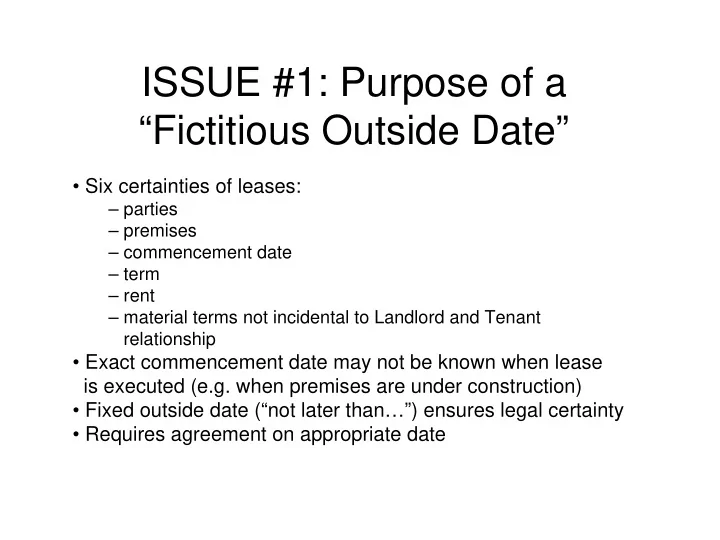
ISSUE #1: Purpose of a “Fictitious Outside Date”

  • Six certainties of leases:

– parties – premises – commencement date – term – rent – material terms not incidental to Landlord and Tenant relationship

  • Exact commencement date may not be known when lease

is executed (e.g. when premises are under construction)

  • Fixed outside date (“not later than…”) ensures legal certainty
  • Requires agreement on appropriate date
slide-2
SLIDE 2

ISSUE #2: Gross- Ups

  • Amount of square footage upon which tenant pays rent, over and

above its actual useable space

  • Part of BOMA definition of “Rentable Area”
  • $ per sq. ft. is artificially reduced
slide-3
SLIDE 3

Issue # 3: Why Do Some Leases Allow Landlords To Terminate In Lieu Of Consenting To A Sublease While Others Do Not?

  • Landlord's Leasing Plan
  • Needs of other tenants
  • Financial Considerations
slide-4
SLIDE 4

ISSUE #4: What is the Covenant of Quiet Enjoyment?

  • Implied covenant that Tenant can possess and use the premises

without interference from Landlord

  • May be restricted or qualified by express terms (e.g. subject to other

terms of the lease and to Tenant’s performance)

  • Includes protection against interference by parties claiming by,

through or under the Landlord. Exception: Prior registered encumbrances

  • Examples of breach by Landlord:

– failure to maintain premises in habitable condition (if required by lease) – intimidation / threatening conduct

slide-5
SLIDE 5

ISSUE #5: Subordination, Attornment & Non-Disturbance

  • Subordination – tenant’s leasehold interest does not have priority
  • ver mortgage
  • Attornment – tenant agrees to recognize foreclosing lender as its

Landlord

  • Non-Disturbance – lender contractually agrees to honour tenant’s

lease

slide-6
SLIDE 6

Issue #6: Why Or When Does A Default Cause Three Months Rent to Accelerate

  • Bankruptcy and Insolvency Act
slide-7
SLIDE 7

ISSUE #7: Role of Brokers and Lawyers

  • Yin and yang (opposing yet complementary)
  • Different skill set
  • Brokers have

– detailed market knowledge – property and cost comparisons

  • Lawyers can address myriad of legal and risk related issues
  • Major lease transactions can involve lawyers and brokers from start

to finish

slide-8
SLIDE 8

ISSUE #8: Demolition Clauses

  • Landlord uses where project could be torn down or substantially

renovated

  • Dangerous provisions for tenant where location is critical
  • What is the trigger point?
slide-9
SLIDE 9

Issue #9: Why Do Some Leases Have Security Interests And Others Do Not?

  • Tenant Balance Sheet
  • Tenant Improvement Allowance
  • Exclusions: Inventory
slide-10
SLIDE 10

Issue #10: When Can A Clause Stipulate A Penalty For Non- Performance?

  • Genuine pre-estimate of damages
  • Impossible to determine otherwise
  • Relief from forfeiture/penalty
slide-11
SLIDE 11

ISSUE #11: Forfeiture and Waiver of Forfeiture

  • Forfeiture: deprivation of a right in consequence of non-performance
  • f some obligation (i.e. right to terminate lease for Tenant’s default)
  • Waiver of Forfeiture: unequivocal act of Landlord confirming

existence of lease after Landlord has knowledge of breach

  • Examples: acceptance of rent by Landlord which accrues after it

becomes aware of breach, or exercise of power of distress for such rent

: Negotiation of resolution with Tenant

  • Not limited to acts occurring after notice of default issued by

Landlord

  • Solution: settlement discussions to take place on a formal “without

prejudice” basis

: Elect to terminate, then discuss new lease terms

slide-12
SLIDE 12

ISSUE #12: Fixtures, Chattels and Tenant Improvements

  • Fixtures – high degree of affixation – intent is that they remain with

building

  • Chattels – affixation is minor – can be removed without damaging

building – tenant wants to retain

  • Tenant Improvements – generally benefits building and can not be

removed

  • Trade Fixtures – significant benefit only to Tenant – usually

removable with obligation to repair damage

slide-13
SLIDE 13

Issue #13: What Is The Difference Between Bankruptcy And Insolvency And Default? Don’t They All Mean The Same Thing, i.e. a Tenant In Trouble?

  • Financial/monetary default
  • Covenant default
slide-14
SLIDE 14

Issue #14: What Does Reasonable Wear And Tear Mean?

  • Office Lease:

Paint and Carpet

  • Retail Lease:

Merchandising Plan/Consumer Demands

  • Residential Leases: Carpet Cleaning