ISCTM Recommendations on the Translation and Adaptation of Clinician - - PowerPoint PPT Presentation

isctm recommendations on the translation and adaptation
SMART_READER_LITE
LIVE PREVIEW

ISCTM Recommendations on the Translation and Adaptation of Clinician - - PowerPoint PPT Presentation

ISCTM Recommendations on the Translation and Adaptation of Clinician Reported Outcomes in International Clinical Trials Elizabeth Pappadopulos PHD, Global CNS Lead - Pfizer Objective The ISCTM guidelines are intended to provide practical


slide-1
SLIDE 1

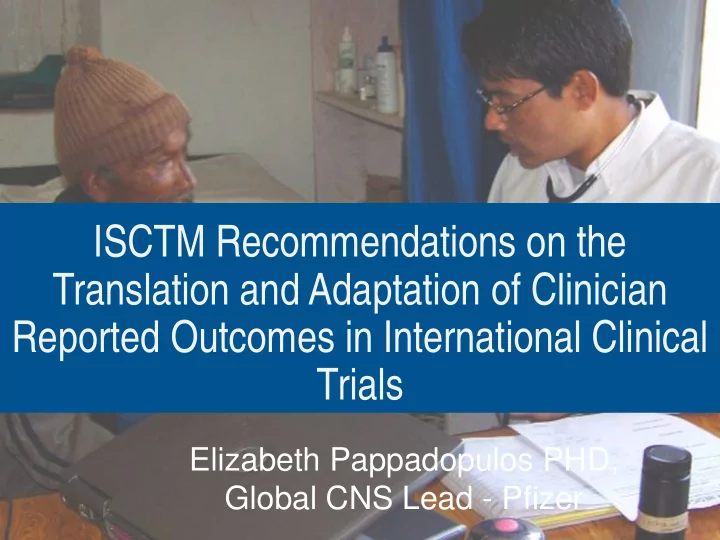
ISCTM Recommendations on the Translation and Adaptation of Clinician Reported Outcomes in International Clinical Trials

Elizabeth Pappadopulos PHD, Global CNS Lead - Pfizer

slide-2
SLIDE 2

Objective

The ISCTM guidelines are intended to provide practical guidance to industry decision-makers weighing measurement and study accuracy against costs and time.

slide-3
SLIDE 3

Consensus Process

  • 1. Workgroup members were representatives

from academic & government research, industry and clinical research organization

  • 2. Identified study challenges related to ClinROs

used in international trials

  • 3. Informed by existing guidance and literature
  • 4. Survey of 442-person membership
slide-4
SLIDE 4

PRO Guidance is Abundant

  • FDA PRO guidance document (2009) recommends that,

“sponsors provide evidence of content validity and other measurement properties” but does not outline specific methods

  • ISPOR (2009) issued decision aid tools and minimum

standards for translating and culturally adapting psychometrically valid PROs

  • World Health Organization (2011)
  • Numerous recommendations by therapeutic area
slide-5
SLIDE 5

Expert and/or Regulatory Guidance not available for ClinROs

  • Registration trials in psychiatry rely heavily of

ClinRO for regulatory approval

  • Diagnostic clarity and item sensitivity is critical
  • Most ClinROs developed in Western cultures

are used in non-western sites

slide-6
SLIDE 6

Table1: ISPOR-recommendations for language translation and cultural adaptation of PROs

slide-7
SLIDE 7

Unique Challenges for CNS ClinRO Validity

  • Rater expertise varies widely – training needed to

ensure consistency of neuropathological constructs

  • Patient/clinician communication around ClinRos may

vary by gender/race/ethnicity

  • Systematic cultural variation based on norms, taboo or

stigma (eg, libido, what is good functioning?)

  • Growing interest and investment in “emic” outcomes –

mood, QOL, functioning that are culturally sensitive

  • Unwarranted confidence that ClinROs administered by

a language fluent physician are valid

slide-8
SLIDE 8

Survey of Membership

  • 14 - item survey of practices and perceptions
  • f international trials
  • 78 responders
  • Sent to 442-person ISCTM membership
slide-9
SLIDE 9

Experience/expertise in the following areas (1-no experience/ 7-deep expertise):

1 2 3 4 5 6

0% 10% 20% 30% 40% 50% 60% 70% 80% 90% 100% 4.2

4.8

4.1 4.6 4.6 5.1 5.2 6 5.2

1 2 3 4 5 Weighted Average 6 7 Deep Expertise/ Experience Average Rating No Expertise/ Experience

slide-10
SLIDE 10

1 2 3 4 5 6

0% 10% 20% 30% 40% 50% 60% 70% 80% 90% 100%

Use in prior trails for the indication of interest (n=70) Frequently cited (n=69) Existing FDA/CDER qualifications (n=69) Psychometric properties (n=69) Validated in other languages/cultures) (n=69) CRO recommedations (n=68)

Rate the importance of the following factors when selecting a ClinRo measures for CNS clinical trials (1-not important, 7- extremely important):

1

Extremely Important

2 3 4 5 6 7

Average Rating Not Important

5.6 5 6 6 3 5

5.0

Weighted Average

slide-11
SLIDE 11

Top 3 threats to data integrity in international trials

0.2 0.4 0.6 0.8 1 1.2 1.4 1.6 1.8 2 5 10 15 20 25 30 35 40 45 50 Item/items misunderstood or not relevant in the target culture (e.g. independent living highly rated in a culture that does not) (n=46) Concepts that are difficult or impossible to translate (n=42) Items is well understood, but value

  • f behavior differs

across cultures (n=35) An entire rating scale is not culturally appropriate(e.g. sexual activity) (n=32) Cultural impact - honesty is valued less than discretion (n=28) Mistranslation of aspects of the rating (n=27)

Ranking

slide-12
SLIDE 12

Frequency of engagement in the following ClinRo activities (1 - never, / 7 - all the time)?

slide-13
SLIDE 13

Survey Summary

  • Culturally relevant and sensitive ClinRos are a concern to

the research community and critical to accurate clinical evaluation

  • Too few investigators prioritize cultural translation and

validation studies

  • Reliance on established measures without evidence of

cultural validation seems the norm

  • Data integrity becomes a concern only after there are

problems

  • Bottom-line / Rigor with ClinROs is lacking despite being

critical to a successful trial

  • Addressing these risks prospectively can mitigate threats

to study outcomes

slide-14
SLIDE 14

Recommendations for Sponsors

  • Consider cultural adequacy and statistical integrity of

ClinRO before initiating the study

  • Invest early in rigorous translation and validation activities

with understanding of the potential risks to data integrity given the TA, ClinRo and study objectives

  • Evolve study SOPs that reflect the current state of

international trials and will ensure consistency despite ever-changing industry leadership

  • Consult with experts where internal expertise of

translation, adaptation and statistical validation is limited

slide-15
SLIDE 15

Recommendations for the Research Community

  • Develop an open repository of translated and validated

ClinRos and PROs to encourage the use of the same adaptations across trials

  • Provide incentives and resources for underserved

indications that will have high impact on the global healthcare economy – schizophrenia, neurodegeneration, etc.

  • Setting regulatory standards for ClinRo integrity would

adjust priorities

  • Publications on measurement are not attractive to

journals – but they are critical to advancing the field. Journals could devote a few pages a year to such issues

  • Journals could request that translation and validation

methods be outlined in published trial results

slide-16
SLIDE 16

Challenges to Implementation

  • Sponsors fail to prioritize ClinRO cultural

adaptation and validation despite spending millions on a development program (small- investment can reduce measurement error)

  • Business leaders must weigh the risks of

inadequately validated ClinRos against other business and research needs requiring investment – with eyes half open

slide-17
SLIDE 17

Conclusions

  • More works is needed to educate and guide on

the translation and adaptation

  • Shifting sponsor judgement on the importance
  • f investing in cultural adaptation of ClinROs is

a major challenge

  • Persuading the research community to share

measures with rigorous adaptation and statistical validation is unlikely