Is your MCI plan ready for take-off? Lessons From Asiana 214 - - PowerPoint PPT Presentation

is your mci plan ready for take off lessons from asiana
SMART_READER_LITE
LIVE PREVIEW

Is your MCI plan ready for take-off? Lessons From Asiana 214 - - PowerPoint PPT Presentation

Is your MCI plan ready for take-off? Lessons From Asiana 214 Clement Yeh MD Medical Director San Francisco Fire Department San Francisco Department of Emergency Management UCSF Department of Emergency Medicine Disclaimer The opinions


slide-1
SLIDE 1

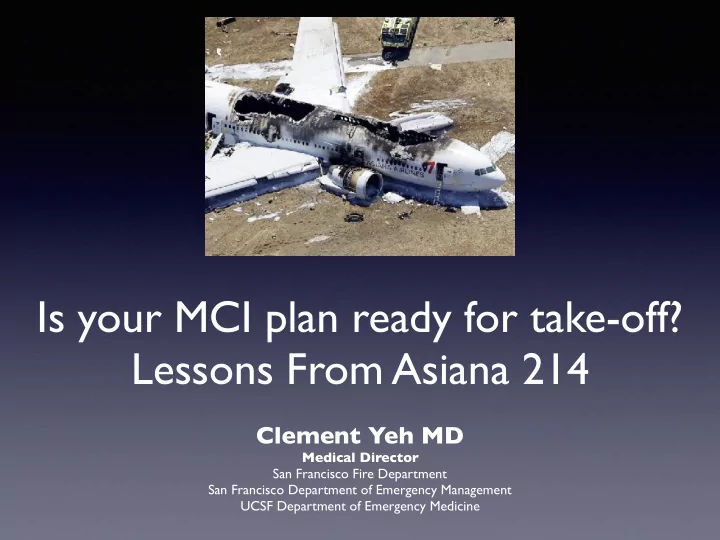
Is your MCI plan ready for take-off? Lessons From Asiana 214

Clement Yeh MD

Medical Director San Francisco Fire Department San Francisco Department of Emergency Management UCSF Department of Emergency Medicine
slide-2
SLIDE 2

Disclaimer

“The opinions expressed in this presentation are those of the authors and may not reflect the official analyses or opinions of the San Francisco Fire Department, American Medical Response, San Francisco Department of Emergency Management, University of California San Francisco, San Francisco International Airport, San Francisco City & County, County of San Mateo, San Mateo County EMSA or the National Transportation Safety Board.”

slide-3
SLIDE 3

SF General Hospital Foundation Video

slide-4
SLIDE 4

Overview & Objectives

  • Incident Overview
  • Melding of MCI Plans
  • Considerations for

change in your area

  • Pediatric considerations
slide-5
SLIDE 5

Take Home Points

  • Make Disasters “Normal”
  • Plans + Planning + Practice
  • Interoperability Challenges
  • Overall System Management
slide-6
SLIDE 6

July 6th, 2013 11:27AM PST

slide-7
SLIDE 7
slide-8
SLIDE 8
slide-9
SLIDE 9

Audio: Dispatch SM

slide-10
SLIDE 10

Audio: MCI

slide-11
SLIDE 11
slide-12
SLIDE 12
slide-13
SLIDE 13
slide-14
SLIDE 14
slide-15
SLIDE 15
slide-16
SLIDE 16
slide-17
SLIDE 17
slide-18
SLIDE 18

Mass Casualty Transport

  • Ambulance Bus
  • 15 beds + 10 seated
  • 26 seated
  • MCI/Evacuation
  • Fireground rehab
  • Mass gathering

medical care

slide-19
SLIDE 19

SFFD MCT

  • 1 & MCT
  • 2
slide-20
SLIDE 20
slide-21
SLIDE 21

Incident Timeline

1132 SF Dispatch Notified of Crash 1134 Initial Dispatch 1134 First Alarm Struck 1140 Yellow Alert Declared 1145 First SFFD Units On-Scene 1146 Second Alarm Struck 1147 Red Alert Declared, First Amb On Scene, IC Established 1151 Third Alarm Struck 1159 Modified Response Declared 1215 Passenger Count & Manifest Reported 1259 All Patients transported from tarmac 1917 IC Closes Incident 1129 Dispatch Notified of Crash 1130 Dispatch of Level 1 MCI 1130 Activation of EMSystems 1130 First Amb On-Scene (AMR NICU Unit) 1134 First 911 Amb On-Scene 1137 Level 8 MCI Requested AMR Supervisor 1142/5 SMC EMSA On-Call Notified 1304 All Passengers/Crew Off Tarmac 1326 SMC 911 Ambulances Released to System 1338 Ground Amb Coordinator; declared sufficient ground transport resources on-scene 1746 EMS Branch Secured

City & County of SF San Mateo County

slide-22
SLIDE 22
slide-23
SLIDE 23

Communications

  • Language barriers
  • Instantaneous
  • Comm overload should

be expected

  • Mitigating factors
  • Interpreters
  • Redundancy
  • Fallback plans
slide-24
SLIDE 24

Communications

slide-25
SLIDE 25

Patient Characteristics

  • 307 on board
  • 291 Passengers
  • 16 Crew
  • 175+ patients

transported to area hospitals

slide-26
SLIDE 26

Patient Distribution

  • Language resources
  • Reunification
  • Special populations
  • Trauma
  • Burns
  • Pediatrics
slide-27
SLIDE 27

Patient Distribution: Counties

50% 16% 32% 1% (88) (2)

San Francisco Eden Stanford

(57)

San Mateo

(29)

slide-28
SLIDE 28

Patient Distribution: Hospitals

  • Stanford: 56
  • SFGH: 53
  • Mills Peninsula: 14
  • UCSF: 14
  • Kaiser Redwood City: 10
  • CPMC (all campuses): 9
  • Kaiser San Francisco: 5
  • St. Francis: 7
  • Sequoia Hospital: 5
  • St. Mary’s: 4
  • Eden: 2
slide-29
SLIDE 29

Patient Distribution: Timeline (SFGH)

  • 1300 First Wave:

10 patients: 5 critical, 5 serious

  • 1600 Second Wave:

17 patients: critical to good condition

  • 1700-1900 Third & Fourth Wave

25 patients

  • Sunday 2100: 5th Wave

9 patients

  • Monday: 6th Wave

4 patients, all children

slide-30
SLIDE 30

Patient Distribution

slide-31
SLIDE 31

Surge Capacity

  • Increased space
  • Increased resources
  • Increased staffing?
  • Reverse Triage
slide-32
SLIDE 32

SF 911 System Impact

slide-33
SLIDE 33

SF System Impact

  • UHU = Utilization/ Units x

Staffed Hours

  • Goal Transport UHU = 0.35 - 0.44
  • SF 2013

YTD UHU = 0.38 (SD 0.04)

  • SF 2013 Saturdays UHU = 0.40 (SD 0.04)
  • Saturday 7/6/13 UHU = 0.41

0.125 0.25 0.375 0.5 Goal YTD Sat 7/6/13

0.4 0.38 0.40

0.41

slide-34
SLIDE 34

San Mateo 911 System Impact

7 of 16 911 Ambulances Sent to Crash AMR Surge Plan and MCI Plans Inter-Facility Surge Unit In County Mutual Aid South SF Fire Inter-Facility BLS Inter-Facility Network Providers Special Operations Team Call Back Corporate Resources Response Time Compliance 92.1%

slide-35
SLIDE 35

The End?

  • Patient Reunification
  • Law Enforcement
  • Post Incident Analysis
  • CISD
slide-36
SLIDE 36

Take Home Points

  • Make Disasters “Normal”
  • Plans + Planning + Practice
  • Interoperability Challenges
  • Overall System Management