
SLIDE 1
Living on the edge: the narrow genetic base of the rootstocks is a serious threat
Daniel Pap GBG2018
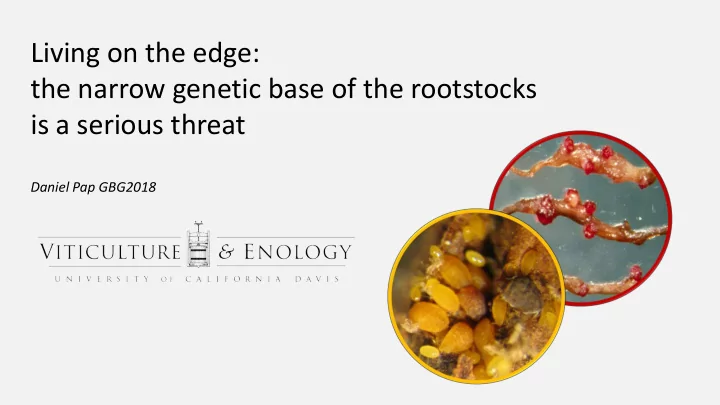
is a serious threat Daniel Pap GBG2018 VIT ITIS IS ROOTSTOCK - - - PowerPoint PPT Presentation
Living on the edge: the narrow genetic base of the rootstocks is a serious threat Daniel Pap GBG2018 VIT ITIS IS ROOTSTOCK - Narrow genetic base? Gloire de M., Ressgier 2, du Lot contribution to the total genetic background is 40%
Daniel Pap GBG2018
Principal Coordinate Analysis of Rootstocks and Reference Species
Gloire de M., Rességier 2, du Lot contribution to the total genetic background is 40% Chloroplast haplotype diversity limited – few mother lines In California: minimal requirements are: Root-knot nematode resistance, Phylloxera resistance
R to Race3 R to both Race3/Harm Susceptible (some level)
Börner 1613C 1616C 3309C Dog Ridge Freedom Harmony Kober 5 BB 44-53 101-14 420A 1103P Ramsey 110R 99R 140Ru Schwarzmann SO4 Teleki 5 C Glorie de Mpt.
0.1
Based on Ferris et al 2012 Pathotype ID Species Race3
Harmony-C
Harmony-A
(based on Bulk Segregate Analysis)
RKN screen in the greenhouse
Biotype
TUB. NOD. LEAF TUB. NOD. LEAF TUB. NOD. LEAF
5 5 2 2 5 2 5
Granett et al. 1985, King and Rilling 1985
2 2 5 5 2 5
Granett et al. 1985
2 5 5 5 5 5
King and Rilling 1985, Forneck et al 2001, Kocsis et al 2002
2 2 5 ? 5 5
Kellow et al 2002, Corrie and Hoffmann 2004
5 5 5 5 ? 5 5
Powel and Kristic 2015
5 5 5 ? ? ? ? 2 5
MA Walker
? ? 5 ? 5 5 ? 2 5
Forneck et al 2016
Hybrids American Sp.
AAX Resistant Susceeptible
Excercised roots in Petri dishes
Greenhouse evaluation in perlite filled bins
Summaira Riaz Nina Romero Rebecca Wheeler-Dykes
Karl Lund Astrid Forneck Funding Sources California Grape Rootstock Improvement Commission California Grapevine Rootstock Research Foundation CDFA Improvement Advisory Board California Table Grape Commission Louis P. Martini Endowed Chair funds