SLIDE 1
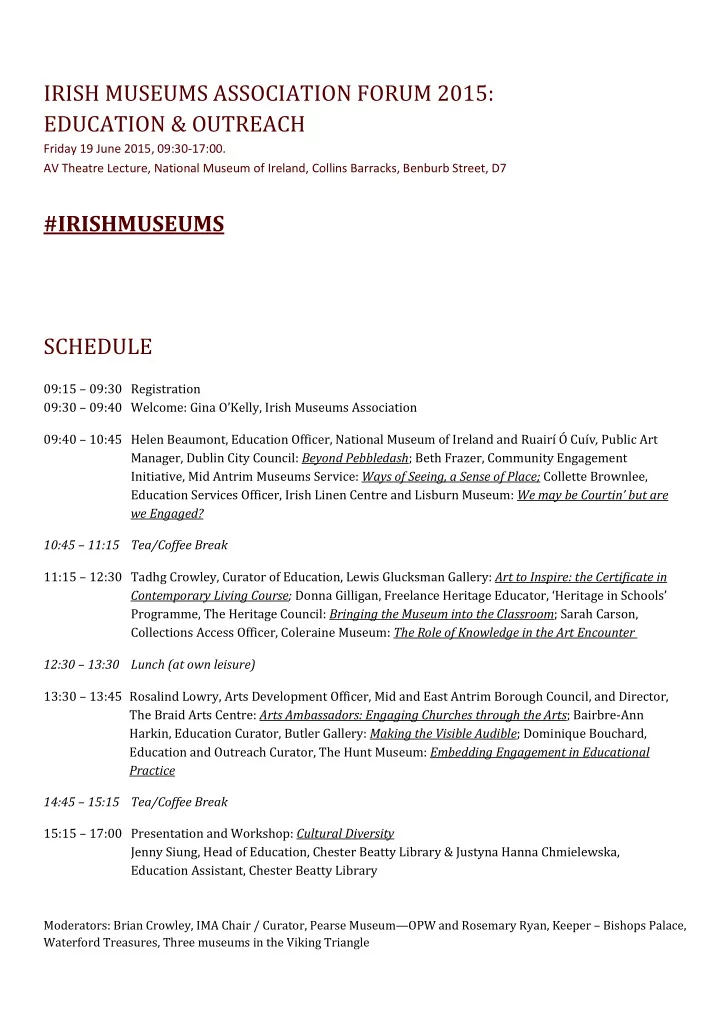
IRISH MUSEUMS ASSOCIATION FORUM 2015: EDUCATION & OUTREACH
Friday 19 June 2015, 09:30-17:00. AV Theatre Lecture, National Museum of Ireland, Collins Barracks, Benburb Street, D7
#IRISHMUSEUMS SCHEDULE
09:15 – 09:30 Registration 09:30 – 09:40 Welcome: Gina O’Kelly, Irish Museums Association 09:40 – 10:45 Helen Beaumont, Education Officer, National Museum of Ireland and Ruairí Ó Cuív, Public Art Manager, Dublin City Council: Beyond Pebbledash; Beth Frazer, Community Engagement Initiative, Mid Antrim Museums Service: Ways of Seeing, a Sense of Place; Collette Brownlee, Education Services Officer, Irish Linen Centre and Lisburn Museum: We may be Courtin’ but are we Engaged? 10:45 – 11:15 Tea/Coffee Break 11:15 – 12:30 Tadhg Crowley, Curator of Education, Lewis Glucksman Gallery: Art to Inspire: the Certificate in Contemporary Living Course; Donna Gilligan, Freelance Heritage Educator, ‘Heritage in Schools’ Programme, The Heritage Council: Bringing the Museum into the Classroom; Sarah Carson, Collections Access Officer, Coleraine Museum: The Role of Knowledge in the Art Encounter 12:30 – 13:30 Lunch (at own leisure) 13:30 – 13:45 Rosalind Lowry, Arts Development Officer, Mid and East Antrim Borough Council, and Director, The Braid Arts Centre: Arts Ambassadors: Engaging Churches through the Arts; Bairbre-Ann Harkin, Education Curator, Butler Gallery: Making the Visible Audible; Dominique Bouchard, Education and Outreach Curator, The Hunt Museum: Embedding Engagement in Educational Practice 14:45 – 15:15 Tea/Coffee Break 15:15 – 17:00 Presentation and Workshop: Cultural Diversity Jenny Siung, Head of Education, Chester Beatty Library & Justyna Hanna Chmielewska, Education Assistant, Chester Beatty Library Moderators: Brian Crowley, IMA Chair / Curator, Pearse Museum—OPW and Rosemary Ryan, Keeper – Bishops Palace, Waterford Treasures, Three museums in the Viking Triangle
SLIDE 2
SPEAKERS’ BIOGRAPHIES AND ABSTRACTS
BEYOND PEBBLEDASH
“Beyond Pebbledash is neither a nostalgic celebration of a housing typology nor a critique of a suburban life, but rather an invitation to question, to strip away the layers and peel back the exterior. Beyond Pebbledash is concerned with critical enquiry, a quest to look beyond façades to excavate the surface image or material for meaning.” This presentation provides an overview of the ‘Beyond Pebbledash’ exhibition, at the National Museum of Ireland, Collins Barracks from August 2014 – January 2015 and focuses on the public engagement programme that ran parallel to the exhibition. The engagement programme targeted a wide range of publics – Transition Year students, local youth groups, families, and adult museum visitors including former soldiers who had lived at Collins Barracks from 1950s – 1990s. Using the house installation as a starting point, the engagement programme sought to generate discussion about how Irish society values the places in which we live and about future urban developments and design for urban living. A team of professional architects/ artists worked with school and youth groups and families to explore these themes. The project culminated in a public exhibition, showcasing the work of participants was a fitting conclusion to the successful programme. Helen Beaumont is Education and Outreach Officer at the National Museum of Ireland – Decorative Art and History, Collins Barracks. Appointed to this role when the museum opened in 1997, she set up and subsequently manages this section of the museum’s Education Department. Her role includes working on exhibition development; on-going planning and provision of public and schools programmes; managing a team; and working on a range of projects in partnership with community groups, institutions and government bodies. Before joining the National Museum of Ireland, Helen worked for eight years as a second level teacher in Dublin and London. She is a graduate of the MA in Arts Management and Cultural Policy, UCD, and worked in the Education Department of the National Gallery of Ireland. Ruairí Ó Cuív is Public Art Manager for Dublin City Council. He began his career as History of Art lecturer at Sligo RTC. In 1991 he was appointed Director of Temple Bar Gallery and Studios. Since 1996 he has worked as an independent curator and arts consultant specialising in public art and as art advisor to building projects such as Rua Red, South Dublin Arts Centre. Public art projects have included a commissioning programme for Kerry County Council in visual art, digital media, music, literature, drama and dance. He has also curated public art projects for the HSE, Department of Education and Science, and Letterkenny Institute of Technology. His writing has been widely published in many catalogues and publications including A Review of the Per Cent for Art Scheme in Cork City, 1986-2003 published in 2006.
SLIDE 3 WAYS OF SEEING, A SENSE OF PLACE
The importance of built heritage, history and their connected stories is significant in regional identity. The way we see these sites and landmarks can instil a sense of place in a community or individual locality and promote civic stewardship. The ‘Ways of Seeing, a Sense of Place’ project is a community engagement initiative designed to encourage awareness of the significance of built heritage through local histories and stories stimulated by art collections held within the museums service. This project has given the community groups involved the opportunity to view artworks that are often inaccessible, improving the museum experience and inspiring groups to open historic houses to others, write a local history booklet, create audio recordings, make creative responses, gain new knowledge, complete an accredited course and visit built heritage sites within their local and surrounding area. Groups have had the
- pportunity to contribute to two touring exhibitions on local built heritage and the overall community
engagement and artworks project. Beth Frazer is Community Engagement Initiative Trainee, Northern Ireland Museums Council (NIMC), with Mid-Antrim Museums Service. This role spans four local government museums, Mid-Antrim Museum, Carrickfergus Museum, Larne Museum and The Museum at The Mill, Newtownabbey. She holds a BA Hons in Creative Imagery, accreditation in youth work and historical research skills, and vocational qualifications in museums, culture and heritage. Beth is currently on secondment from the Ulster Museum at National Museums Northern Ireland where she played a key role in the successful ‘Night at the Museum’ sleepover events and has previously worked at W5 interactive science discovery centre. Beth is a practicing and exhibiting artist.
WE MAY BE COURTIN’ BUT ARE WE ENGAGED?
Lisburn Museum is one of three Northern Ireland museums invited by the Northern Ireland Museum Council (NIMC) to develop a pilot community engagement project aimed at socially excluded groups. As Lisburn Museum has a strong schools programme, it was decided to target local non-visiting community groups. The project used the temporary exhibition ‘Lisburn 1912-1914’ as a springboard for groups to engage with the period, looking at ‘World War One and Us’. The Lisburn pilot targeted community groups identified from geographical areas that appeared high on the social deprivation index. Four groups have been participating on the project which runs from January to June
- 2015. The aim of the pilot was to get participant views on two areas: museums and the Great War. Part of the
project involved taking participants to visit historical sites: The Somme Heritage Centre, Kilmainham Jail, Arbour Hill, Islandbridge and the Public Records Office. Another part was inviting guest speakers into Lisburn Museum to talk on subjects related to 1912-1914. These included Dr Eamon Phoenix, Mr Philip Orr and Mr Cathal Donaghy and Ms Siobhan Deane from the 6th Connaught Rangers Research Group. Participants were also given opportunities to handle specially hired
- bjects, and to create their own craft or written piece. Their experiences will form the basis of a display at
Lisburn Museum between 22 May and 19 June 2015. The pilot has already borne fruit; some participants have set up their own meetings at Central library and PRONI to further investigate their past. By giving participants a copy of the display to take back in their communities it is hoped further engagement may be facilitated.
SLIDE 4 Collette Brownlee is Education Services Officer with the Irish Linen Centre and Lisburn Museum. Collette came to museum education over twenty years ago with a background of teaching in schools, community, further education and university access courses. She is in her fourth year at Queens University Belfast, studying part-time for a doctorate in education (EDD). She has developed an education service at the Irish Linen Centre and Lisburn Museum on the “pedagogy of the real” and her academic studies are taking her towards further evolution of Lisburn Museum’s education services through a Children’s Rights approach. Collette manages the education team at Lisburn Museum, two Assistant Education Officers, three Gallery Assistants and up to fourteen casual Gallery Attendant staff. Leading a service catering to 5-6000 school children each year and additional adult and children’s audiences for special programming and events, her role involves developing innovative education policy and practice.
ART TO INSPIRE: THE CERTIFICATE IN CONTEMPORARY LIVING COURSE
The Certificate in Contemporary Living (CCL) is a two year education programme for people with intellectual disabilities designed for delivery in a third level education setting. In 2015, the Glucksman devised and delivered an expressive arts module as part of the CCL course. Over the course of six weeks, the students were introduced to the visual arts through three modes. Considering Art - Looking at influential artists who overcame major difficulties in their lives to pursue a life of creativity, students were presented with examples of the artist’s work and biography, looked at short films and discussed important elements of their art practice. Investigating Art - Students were brought to view art works up close, both in the Glucksman gallery spaces and across the wider campus to view works in the University Art Collection. Armed with a set of questions and a sketchbook students were invited to examine, interact and question artworks. Creating Art - These sessions invited students to explore and express themselves through different art
- mediums. Over the weeks students worked with paint, clay modelling, collage and printmaking. These
sessions were the culmination of the study of artists, artworks and theories explored earlier in the day. At the end of the 6-week module the Glucksman held a public exhibition of the artworks created during the workshops to celebrate and demonstrate the expressive talents of the participants. This presentation will consider in further detail the process of working with the CCL group as well as considering our own learning in the context of module provision for students with disabilities. Tadhg Crowley is Curator of Education at The Lewis Glucksman Gallery, University College Cork, Ireland. He graduated with a BA (Honours) in Fine Art from Limerick School of Art and Design in 2005. Since taking over his current role in 2013, Tadhg has expanded the schools programme at the gallery to incorporate age appropriate workshops and an annual ‘Teachers’ Preview’ evening. In recent months he has created a programme of workshops for groups from the CCL programme at UCC, the Irish Wheelchair Association and Focus Program. He has assisted in integrating an educational/ interactive area in each of the gallery’s exhibitions offering visitors of all ages the opportunity to explore and understand some of the themes raised in the exhibition. Tadhg is currently working on developing a 6-week art course for children living in direct provision and a summer course for teachers.
SLIDE 5 BRINGING THE MUSEUM INTO THE CLASSROOM - INTRODUCING CHILDREN TO HERITAGE CONSERVATION THROUGH THE CREATION OF SCHOOL MUSEUMS
Schools are the primary place where children are first educated on their local and national heritage. They further hold the potential to be the initial setting for learning about the function, purpose and importance of museums in the preservation of these aspects. However, many children have limited knowledge of the work and role of the museum and several lack the opportunity to regularly visit a local or national museum. The creation of school and classroom museums form an excellent way in which to introduce children to the concepts of heritage and conservation, as well as to the importance of the role of the museum in society. The author’s role as a Heritage Expert in the ‘Heritage in Schools’ programme has led to her participation and guidance in the creation of a number of such museums in Irish primary schools. This talk will detail a case study
- f the joint creation of a dedicated school museum between the speaker and the students of a Co. Galway
primary school, carried out over the course of a number of heritage visits in 2015. It examines the validity and value of the interaction of heritage experts with schools, and the potential for the museum sector to use school museums as a way to create and develop an engaged and informed audience and visitor base from an early age. Donna Gilligan is a Freelance Heritage Educator with the Heritage Council’s ‘Heritage in Schools’ programme, where she delivers educational workshops on Irish heritage and archaeology to primary level schools across the country. An archaeologist and museum professional who has worked for the past nine years in the commercial archaeology and museum sectors, Donna began her career in excavation following a B.A. and M.A. in Archaeology, both at the National University of Ireland, Galway. Her excavation experience led onto wider experience in the post-excavation sector of commercial archaeology, where she specialised in working with
- artefacts. Donna later specialised with an MA in Museum Practice & Management from the University of Ulster.
She has worked in a number of positions dealing specifically with the responsibilities of heritage interpretation and education, and also currently works as Documentation Assistant in the National Museum of Ireland - Archaeology for the Irish Antiquities Inventory Project.
ENGAGING WITH 17TH CENTURY COLERAINE
With the celebration in 2013 of the 400th anniversary of Coleraine’s Town Charter, Coleraine Borough Council (now Causeway Coast and Glens Borough Council) commemorated the occasion by offering a schools workshop programme across the borough. Nearly 900 pupils from state schools, catholic schools, an integrated school and a special needs school have attended workshops over two phases of the project. The first phase of the programme included an introduction to the plantation, a town tour, archaeology and mapping session and then an art workshop to reflect on the history. The culmination of this was an event that brought all the schools, which were available to attend, together to celebrate the project. The second phase of workshops involved the use of resources developed in the first phase. This included the use of a reconstructed town map, an emphasis
- n using the archaeology and objects in our collection to tell the story of plantation and a town tour to gain a
sense of what was once there. The resources used included story cubes which use objects from the collection which the children then have to connect in a story format and offer a different and very accessible way to make use of our collection.
SLIDE 6 Sarah Catherine Carson is Collections Access Officer at Coleraine Museum. She holds a PGDip in Museum and Gallery Studies from the University of St Andrews in Scotland, where she worked at the Fife Folk Museum and co-curated a temporary exhibition in the St Andrews Museum with fellow students. On her return to Northern Ireland she volunteered at the Causeway School Museum and on the Fishermen’s Cottage project at Carrick-a-
- Rede. She joined Coleraine Museum in 2009 where, while collections management is the main focus, she has
undertaken temporary exhibitions with event programmes, volunteer management and the organisation and running of several education workshop programmes including ‘Victorian Coleraine’, ‘St Patrick’s Graveyard’ project and the ‘Coleraine 400’ project. As part of these projects Sarah has developed a ‘Coleraine 400’ learning resource with classroom activities and churchyard trails as part of the St Patrick’s project.
ARTS AMBASSADORS: ENGAGING WITH CHURCHES THROUGH THE ARTS
May 2015 will see the Methodist Modern Art Collection travel outside England for the first time. The collection will be shown at The Braid Arts Centre in collaboration with 10 local churches and church organisations across the religious divides in Northern Ireland. An art trail around the local churches will be programmed encouraging visitors and groups to tour each church following an art map, to view an individual painting from the collection which will be exhibited in each church. The main body of the collection will be shown in The Braid Arts Centre. A series of arts and cultural events will be held by each church during the open days while they are exhibiting their paintings. Churches will be open to the public for the exhibition programme for visitors to view the painting and also the Church – Inter Faith development programme is part of the event An Arts Ambassadors programme has been developed to encourage participants from each Church to train as arts advisors for the collection. 126 Arts Ambassadors have joined the programme and a Legacy programme is being investigated to encourage continuous engagement by the Arts Ambassadors. Rosalind Lowry is Arts Development Officer, Mid and East Antrim Borough Council, and Director, The Braid Arts Centre. She has over 22 years’ experience working in arts development in Northern Ireland. Her experience includes the capital development of a major arts facility, arts partnerships & collaborations, community arts development and programming, artistic programming of arts and cultural facilities, public art commissioning & extensive experience as a practicing artist. She has extensive knowledge of the design sector in the UK including London Institute & Arts Council Awards and commissions for work by London Docklands, Natural History Museum, Royal Victoria Hospital, Queens University and the British Broadcasting Corporation. Rosalind has initiated and managed arts and cultural collaborations including projects throughout Northern Ireland, USA, China, Uganda, Uruguay, Japan & Canada. She is also Expert Advisor for Creative Europe, Culture Programme; Chief Examiner for CCEA – Council for Curriculum, Examinations and Assessments – Arts subjects; Artistic Assessor for Arts Council of NI and Deputy Chair of Voluntary Arts Ireland.
SLIDE 7 MAKING THE VISIBLE AUDIBLE: DISCOVERY PENS AT BUTLER GALLERY
In 2013, Butler Gallery first worked with Arts & Disability Ireland to pilot the use of Discovery Pen technology to make a contemporary visual art exhibition accessible to blind and visually impaired visitors. Since then, Butler Gallery has committed to providing Discovery Pen audio description for one exhibition from its annual calendar each year, while working on the longer term goal of audio describing the permanent collection. Discovery Pens are small handheld devises that work by enabling visitors to access verbal descriptions of the works as they pass through the gallery. This presentation will explore the process of audio describing an exhibition, giving examples of audio described works from Amy Walsh’s exhibition ‘The Talking Earth’ and Bob and Roberta Smith’s exhibition ‘Art Makes Children Powerful’. It will describe how the working partnership between Butler Gallery and Art & Disability Ireland evolved, reflecting on challenges that arose, looking at visitor feedback and examining Butler Gallery’s commitment to audio description in the coming years, including this year’s planned audio description of Janet Mullarney’s exhibition ‘My Minds I’, opening October
- 22nd. Audience members will also get a chance to see the Discovery Pens and try them out for themselves.
Bairbre-Ann Harkin is Education Curator at Butler Gallery. Before this, Bairbre-Ann worked as Education Assistant / Access Officer of Dublin Contemporary 2011 and completed an internship within the Education Department of the Museum of Modern Art New York in 2010. Bairbre-Ann is a founding member of Azure, a collaborative partnership to explore the potential for greater participation of people with dementia in cultural settings in Ireland and has delivered Azure programmes and training at Turner Prize 2013, Dun Laoghaire LexIcon, and National Gallery of Art, Lithuania. Bairbre‐Ann is a graduate of Law with French Law in University College Dublin and holds a PG Dip. in Contemporary Art History from Goldsmiths College, University of London.
EMBEDDING ENGAGEMENT IN EDUCATIONAL PRACTICE
This paper considers the community participation component of ‘Learning Together: Museums and Cities
- f Culture for All’ international conference hosted by The Hunt Museum in September 2014. The conference
programme brought together scholars, artists, museum professionals, and community participants to explore the central question: “How do we ensure that culture is accessible to all, including those in underserved areas, and how do museums support the cultural rights of individuals and communities?” Museums and cultural institutions regularly espouse the importance of integrating community perspectives and priorities to create genuine ground-up interventions which meet the needs and interests of the groups they intend serve and engender ownership on the part of participants and/or groups. Yet community participants are rarely present at conferences where practitioners discuss and debate best practice and priorities. This paper will explore the community participation component of ‘Learning Together’, outlining its dual purpose – as an international meeting and as a community engagement programme with its own set of aims and
- bjectives – and its implications.
SLIDE 8 Dr Dominique Bouchard is Curator of Education and Outreach at The Hunt Museum. She holds a BS in Applied Physics and AB in Mathematics from Columbia University and a DPhil in history and archaeology from the University of Oxford. Her doctoral research explored the role of classical iconography in discourses of power in Medieval and Renaissance Italy. Dominique began her career at the Ashmolean Museum and has recently worked in Northern Ireland at the Mid-Antrim Museums Service. She currently leads the Education Department at The Hunt Museum and works as a consultant for both the Council of Europe and the UN Office of the High Commissioner for Human Rights in the area of museums, heritage and divided societies. She is co- director of the Summer School on the Arts and Human Rights at the Irish Centre for Human Rights, NUI
- Galway. Her research interests are in the area of interpretation, socially-engaged curatorial practice, the history
- f collecting and of museums, cultural rights, and heritage in divided societies. Dominique is currently
seconded to the team behind Limerick City’s bid for European City of Culture 2020.
CULTURAL DIVERSITY WORKSHOP
This workshop proposes to look at the dramatic changes in Ireland through migration in the past fifteen years and how participants’ respective organisations (actively) engage with diverse communities through their programmes and policies. Participants will reflect on their own and their organisations’ attitudes to recent changes in demographics of
- Ireland. They will be challenged to examine their organisation’s involvement with local, old and new, migrant
communities and consider their organisations ethos, policies and commitment to work with culturally diverse communities / population:
- What does cultural diversity mean to me?
- How and why should my organisation work with culturally diverse audiences?
- How do I identify and approach culturally diverse audiences?
- How can my institution integrate cultural diversity into core services?
- How can my organisation plan, deliver and sustain culturally diverse projects?
The workshop has been designed by: Jennifer Siung is Head of Education in the Chester Beatty Library, Dublin, Ireland. She commenced her post in 2000 and has developed the first multi and intercultural learning programme in an Irish museum. Her work involves engaging with the Islamic, Asian, North African, East Asian and European collections of the Library, devising numerous programmes including intercultural projects for schools, cultural festivals, and creating links with local multi-ethnic communities. Jennifer has been invited to sit on a number advisory boards; Dublin City Council Chinese New Year Festival, ASEMUS Museum Education Exchange Programme, Cultural Diversity Policy of the Arts Council and the European Open Method of Coordination on Intercultural Dialogue. She has studied art history, arts administration, adult and community education, an M Litt exploring Japanese influence on 20th century Irish art, intermediate level in Mandarin and has participated in the Getty NextGen for museum leaders in 2012 and ‘Learning in Museums’, ICOM China in 2014. (Continues)
SLIDE 9 Justyna Hanna Chmielewska is Education Assistant, Chester Beatty Library, Dublin, Ireland. She holds an MA in Cultural Studies (Adam Mickiewicz University, Poznan, Poland). She is the Education Assistant in the Chester Beatty Library and manages the Volunteer and the Public Programme, this includes coordinating suitable programmes that facilitate public engagement with the Western, Islamic and East Asian Collections. She has participated in several EU funded projects, i.e. The Creative Museum (2014 – 2017), The Learning Museum (2010 – 2013) and Museums Tell Many Stories (2005 – 2007). Justyna has developed an Intercultural Community Ambassador programme. Volunteers from various communities give guided tours in Arabic, Japanese, Mandarin and Irish.
THANKS AND ACKNOWLEDGMENTS:
Brian Crowley, IMA Chair and Curator, Pearse Museum - OPW; Emily Mark-Fitzgerald, School of Art History, and Cultural Policy, University College Dublin; Carla Marrinan, National Print Museum; Rosemary Ryan, Waterford Treasures, Three Museums in the Viking Triangle and Gina O’Kelly, Irish Museums Association The National Museum of Ireland who generously provide the forum with use of the AV Lecture Room The Department of Arts, Heritage and the Gaeltacht, The Heritage Council and IMA Members for their support
- f the Irish Museums Association