IRES IRISH RESIDENTIAL PROPERTIES REIT PLC RESULTS TO 31 DECEMBER - - PDF document

ires
SMART_READER_LITE
LIVE PREVIEW

IRES IRISH RESIDENTIAL PROPERTIES REIT PLC RESULTS TO 31 DECEMBER - - PDF document

IRES IRISH RESIDENTIAL PROPERTIES REIT PLC RESULTS TO 31 DECEMBER 2017 Review 22 February 2018 23 March 2018 Irish Residential Properties REIT plc ( I-RES or the Company ), an Irish investment company focused on residential rental


slide-1
SLIDE 1

IRES

Irish Residential Properties REIT plc – Preliminary Announcement – 31 December 2017

  • 1 -

IRISH RESIDENTIAL PROPERTIES REIT PLC RESULTS TO 31 DECEMBER 2017

Review

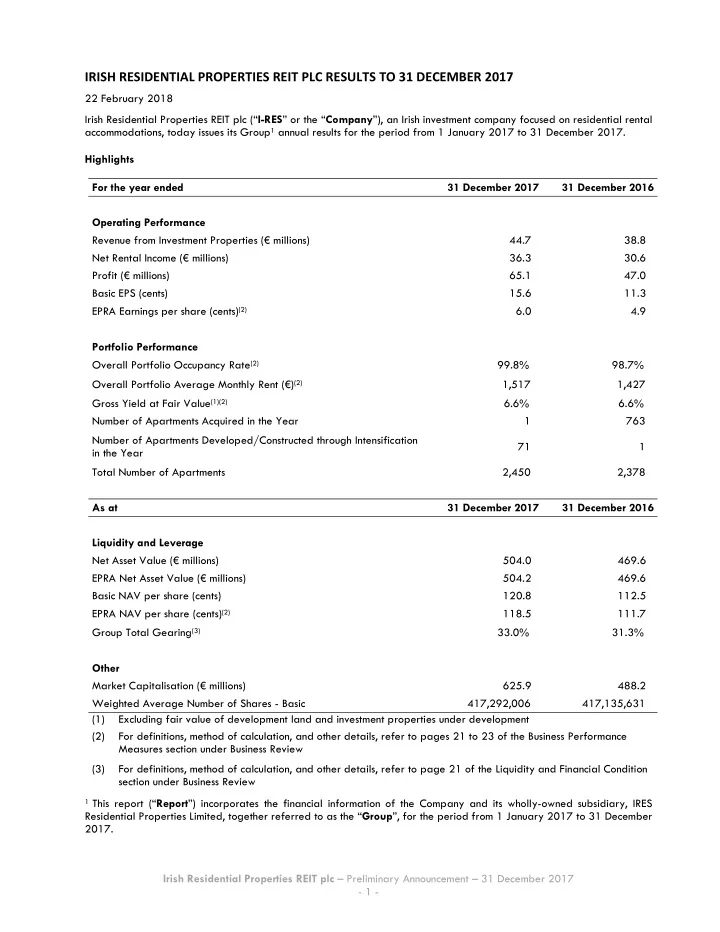
22 February 2018 23 March 2018 Irish Residential Properties REIT plc (“I-RES” or the “Company”), an Irish investment company focused on residential rental accommodations, today issues its Group1 annual results for the period from 1 January 2017 to 31 December 2017. Highlights For the year ended 31 December 2017 31 December 2016 Operating Performance Revenue from Investment Properties (€ millions) 44.7 38.8 Net Rental Income (€ millions) 36.3 30.6 Profit (€ millions) 65.1 47.0 Basic EPS (cents) 15.6 11.3 EPRA Earnings per share (cents)(2) 6.0 4.9 Portfolio Performance Overall Portfolio Occupancy Rate(2) 99.8% 98.7% Overall Portfolio Average Monthly Rent (€)(2) 1,517 1,427 Gross Yield at Fair Value(1)(2) 6.6% 6.6% Number of Apartments Acquired in the Year 1 763 Number of Apartments Developed/Constructed through Intensification in the Year 71 1 Total Number of Apartments 2,450 2,378 As at 31 December 2017 31 December 2016 Liquidity and Leverage Net Asset Value (€ millions) 504.0 469.6 EPRA Net Asset Value (€ millions) 504.2 469.6 Basic NAV per share (cents) 120.8 112.5 EPRA NAV per share (cents)(2) 118.5 111.7 Group Total Gearing(3) 33.0% 31.3% Other Market Capitalisation (€ millions) 625.9 488.2 Weighted Average Number of Shares - Basic 417,292,006 417,135,631 (1) Excluding fair value of development land and investment properties under development (2) For definitions, method of calculation, and other details, refer to pages 21 to 23 of the Business Performance Measures section under Business Review (3) For definitions, method of calculation, and other details, refer to page 21 of the Liquidity and Financial Condition section under Business Review

1 This report (“Report”) incorporates the financial information of the Company and its wholly-owned subsidiary, IRES

Residential Properties Limited, together referred to as the “Group”, for the period from 1 January 2017 to 31 December 2017.

slide-2
SLIDE 2

IRES

Irish Residential Properties REIT plc – Preliminary Announcement – 31 December 2017

  • 2 -

Strong operating results supported by strong market fundamentals  Organic growth in revenue from investment properties and net rental income (“NRI”) was driven by stronger

  • ccupancies and higher average monthly rents compared to the same period last year

 The Group has increased residential occupancy levels to 99.8% as at 31 December 2017 year end, and continues to generate strong rental rate growth across the portfolio  Solid rental rate growth during the period arising from renewals and turnovers of residential apartments  NRI margin of 81.2% for the year ended 31 December 2017, an increase compared to 78.8% for the year ended 31 December 2016. The main drivers of the higher NRI margin are higher revenues from investment properties, with lower vacancies, lower property taxes, as well as savings on property management fees and payroll chargebacks due to a value added tax grouping between I-RES, IRES Residential Properties Limited and IRES Fund Management. The stabilised NRI margin should continue to be in the range of 78% to 79% Active period with strategic developments and capital funding  Completed construction of 68 apartments at Block B2B, Beacon South Quarter, Sandyford, Dublin 18 on 12 July 2017 (referred to as “The Maple”), and was fully leased by August 2017  On 15 September 2017, I-RES increased its revolving credit facility from up to €250 million to up to €350 million (the “Increased Credit Facility”)  Preliminary alternative designs for the construction of apartments and ground floor retail/commercial space above three floors of basement car parking at Rockbrook, Sandyford, Dublin 18 are in progress  Acquired a 4.5 acre development site in Hansfield Wood, Dublin 15 on 15 November 2017 for a total purchase price

  • f €7 million (including VAT and excluding other transaction costs). In conjunction with this acquisition, the Company

also entered into a development agreement for a total consideration of €23 million (including VAT and excluding

  • ther transaction costs) to develop 99 residential units on this site, which will be handed over to the Company on a

phased basis with all units completed by August 2018 Interest Rate Swap  On 28 February 2017, I-RES entered into interest rate swap agreements aggregating to €160 million. The agreement has an effective date of 23 March 2017 and a maturity date of January 2021. On 15 September 2017, I-RES entered into a new interest rate swap agreement totalling €44.8 million. The new agreement has an effective date of 15 September 2017 and a maturity date of January 2021. The weighted average EURIBOR rate is c. minus 0.09% per annum on the total €204.8 million interest rate swap.  The interest rate swap agreements effectively converts the hedged portion of the increased Credit Facility (€204.8 million) to a fixed rate facility up to the maturity date (see Note 11 for further details) Delivering shareholder value  Basic EPS and EPRA EPS were 15.6 and 6.0 cents respectively for the year ended 31 December 2017, up approximately 38.1% and 22.4% respectively compared to Basic EPS of 11.3 cents and EPRA EPS of 4.9 cents for the year ended 31 December 2016  Basic NAV per share and EPRA NAV per share were 120.8 cents and 118.5 cents respectively, up 7.4% and 6.1% from 112.5 and 111.7 respectively as of 31 December 2016, driven by strong fair value increases on investment properties Dividends  Intention to declare an additional dividend of 2.7 cents per share for the year ended 31 December 2017 following the filing of the relevant financial statements for the Company with the Companies Registration Office in Dublin, Ireland

  • n or about 22 February 2018, which would bring the total for the year to 5.2 cents

 Paid a dividend of 2.5 cents per share in September 2017 for the period 1 January 2017 to 30 June 2017  Paid a dividend of 4.9 cents per share in March 2017 for the year ended 31 December 2016

slide-3
SLIDE 3

IRES

Irish Residential Properties REIT plc – Preliminary Announcement – 31 December 2017

  • 3 -

Positive outlook  Strong market demand continues to move rental rates higher  Accretive Intensification opportunities, subject to planning approvals, to add approximately 600 apartments with significant infrastructure (eg. parking garages) in place. In particular, the Company is planning to submit a new application seeking in the order of 450 apartments at Rockbrook.  Continued investment in new housing supply through new development opportunities including apartments, houses, development partnerships and other types of accommodation for rental purposes  Continued evaluation of new acquisition opportunities  Development and acquisition capacity of c. €150 million at 31 December 2017 based on a target gearing of 45% Margaret Sweeney, the Company’s Chief Executive Officer commented: “The I-RES Strategy which we are executing successfully, is to acquire and develop high quality assets in attractive neighbourhoods with good transport links and to deliver exceptional service which helps transform the residential rental sector in Ireland. Our relationship with IRES Fund Management and CAPREIT, is key in this regard. By leveraging their expertise, systems and technology platform together with a dedicated team of 49 staff in Dublin, we can deliver an excellent service to our tenants as well as strong returns for our shareholders. We continue to invest strongly in the supply

  • f apartments and houses for rent through a combination of acquisitions and build to let. In 2017, we successfully

completed and fully let The Maple, our first development, while also commencing construction on our first project where we partnered with local developers to deliver Hansfield Wood - a 4.5 acre, 99 unit residential development. These projects are illustrative of our strategy to invest in our assets through intensification, developments on existing I-RES properties, continued accretive acquisitions, and as opportunities arise, investments in urban centres outside of Dublin. The success of our strategy is evident in EPRA earnings per share rising to 6.0 cents for the year ended 31 December 2017.’’

slide-4
SLIDE 4

IRES

Irish Residential Properties REIT plc – Preliminary Announcement – 31 December 2017

  • 4 -

Chairman’s Statement

First of all, I am delighted to welcome Margaret Sweeney as the new Chief Executive Officer of I-RES. With her extensive experience, I am confident that she will be an excellent successor to David Ehrlich. I would also like to thank David for his services and contributions as I-RES’ first Chief Executive Officer, and congratulate him on his appointment as Chief Executive Officer of CAPREIT. It is with great sadness that we said goodbye to our founder, Thomas Schwartz, who sadly passed away in August 2017. He was a man of great vision and leadership in the residential real estate industry. He recognised the opportunity in Ireland that has led to the success of I-RES. The ongoing evolution of I-RES continues to ensure steadily growing dividends for investors. In the early stage of its growth, during which the asset base grew primarily through acquisitions, I-RES changed the residential rental market in Ireland. As the country’s first professional residential property manager, I-RES has applied the advanced investment management techniques of our Investment Manager to ensure high levels of tenant satisfaction and retention, which generate consistent returns for I-RES shareholders. As at 31 December 2017, the Group had invested approximately €644 million (including VAT and other transaction costs) in 2,450 apartments across 20 locations in the Dublin area, funded through a combination of equity and debt. In addition, the Group has adjoining development sites which it is progressing through planning stages. Following a refusal by An Bord Pleanala (the planning appeals board) for the development of 456 apartments in October 2017, the Company is preparing to submit a new planning application during the course of 2018 for construction in the

  • rder of 450 apartments and ground floor retail/commercial space above three floors of basement car parking at

Rockbrook, Sandyford, Dublin 18. Financial Results The Group has generated strong rental growth and increased occupancy across the portfolio during 2017. Approximately 61.3% of the apartments renewed and/or turned with rental increases during the period ended 31 December 2017. Basic EPS and EPRA EPS increased to 15.6 cents and 6.0 cents, respectively, for the period ended 31 December 2017, compared to 11.3 cents and 4.9 cents for the year ended 31 December 2016. Basic NAV per share and EPRA NAV per share increased by 7.4% and 6.1% respectively for the year ended 31 December 2017 compared to 31 December 2016. This growth is driven by increases in property valuation of investment properties and NRI, partially offset by dividends paid in March 2017 and September 2017. Dividends For the year ended 31 December 2016, the Company paid dividends of 4.9 cents per share on 24 March 2017. For the six month period ended 30 June 2017 the Company paid dividends of 2.5 cents per share on 18 September 2017. The Company’s Board of Directors (the “Board”) intends to declare an additional dividend of approximately € 11.3 million (dividends per share of 2.7 cents) for the year ended 31 December 2017 following the filing of the relevant financial statements for the Company with the Companies Registration Office in Dublin, Ireland on or about 22 February 2018, which would bring the total for the year to 5.2 cents.

slide-5
SLIDE 5

IRES

Irish Residential Properties REIT plc – Preliminary Announcement – 31 December 2017

  • 5 -

Investment Manager The Board continues to be very satisfied with the significant contribution that IRES Fund Management Limited, the Company’s alternative investment fund manager (“IRES Fund Management” or the “Investment Manager”), and senior management (as well as the other staff) of CAPREIT Limited Partnership (“CAPREIT LP”) have made. Through the services agreement among I-RES, CAPREIT LP and IRES Fund Management, CAPREIT LP provides significant support, including senior and other personnel, an advanced SAP systems platform and other important contributions supporting the Investment Manager and therefore I-RES. Auditors The EU audit reform measures introduce prohibitions on the provision of certain non-audit services by a statutory auditor. As a result of these measures and to ensure that there are no restrictions on the Group’s procurements of professional services, the Group intends to appoint KPMG as its Group external auditor with effect for the financial year ending 31 December 2018. The Board will formally recommend the new appointment to shareholders at the 2018 annual general meeting of the Company. The appointment follows a competitive tender process overseen by management and the audit committee. Outlook In summary, the Board is pleased with the Group’s performance. The Board believes the positive economic outlook for Ireland and the property market will lead to increased demand in the residential rental sector, along with increases in development and intensification opportunities. Both of which the Board believes should result in continued growth in the performance of the Group on a sustainable and long-term basis. Declan Moylan Chairman

slide-6
SLIDE 6

IRES

Irish Residential Properties REIT plc – Preliminary Announcement – 31 December 2017

  • 6 -

Chief Executive Officer’s Statement

Market conditions and the strategic positioning of I-RES in the Irish residential rental sector continue to deliver excellent returns for investors. The combination of an existing portfolio of 2,450 modern, high-quality assets and industry-leading investment management services are attracting and retaining excellent tenants, enabling I-RES to build on the solid and growing demand for rental accommodation. As well as continuing to ensure successful management of the existing rental operations, I-RES has turned its attention to the next phase of growth, which will be guided by continued evaluation of new acquisition opportunities and exploring new development and intensification opportunities. I-RES completed its first development at The Maple, Beacon South Quarter, Sandyford on 12 July 2017. The project came in on budget and on time, with the 68 apartments fully leased and occupied by the end of August. Shortly thereafter, on 15 November 2017, I-RES further advanced its strategy by acquiring a 4.5 acre development site in Hansfield Wood, Dublin 15 for €7 million (including VAT and excluding other transaction costs). This project is the result of an agreement with Garlandbrook Limited, as developer, and Newline Homes Limited, as building contractor, to develop 99 residential units on the site for a total consideration of €23 million (including VAT and excluding

  • ther transaction costs), with units being handed over to the Company on a phased basis and expected completion of all

residential units by August 2018. Construction costs for the 99 residential units will be paid in stages. As at 31 December 2017, the portfolio consisted of 2,450 extremely high-quality, well-located apartments, at a total investment of €644 million (including VAT and other acquisition costs). All of the apartments are in the Dublin area near important transportation links and employment centres. Operationally, we generated solid increases in our key operational performance benchmarks, driven by strong organic growth resulting from high occupancies and solid increases in monthly rents on renewals and turnovers. Below is a table summarising the Group’s financial position as at 31 December 2017 and profit or loss results for the period ended 31 December 2017:

As at As at Statement of Financial Position: 31 December 2017 31 December 2016 Total Property Value (€ millions) 750.9 685.1 Net Asset Value (€ millions) 504.0 469.6 EPRA Net Asset Value (€ millions) 504.2 469.6 Basic NAV per Share (cents) 120.8 112.5 EPRA NAV per Share (cents) 118.5 111.7 Bank Indebtedness (€ millions) 245.4 212.2 Group Total Gearing 33.0% 31.3% Statement of Profit or Loss and Other Comprehensive Income: For the period ended For the period ended 31 December 2017 31 December 2016 Revenue from Investment Properties (€ millions) 44.7 38.8 Net Rental Income (€ millions) 36.3 30.6 Profit (€ millions) 65.1 47.0 Basic EPS (cents) 15.6 11.3 Diluted EPS (cents) 15.4 11.2 EPRA EPS (cents) 6.0 4.9

We continue to maintain a strong financial position.

slide-7
SLIDE 7

IRES

Irish Residential Properties REIT plc – Preliminary Announcement – 31 December 2017

  • 7 -

For the year ended 31 December 2017, there was a 5.6% increase in values for the properties held as at 31 December 2016 (excluding The Maple development). The main drivers of this valuation increase in the period were continued rental growth from income properties and high demand for development sites resulting in higher values for undeveloped sites. In addition, the completion of our first development (The Maple) further contributed to the total fair value gain on investment properties as it was highly accretive. Basic NAV per share and EPRA NAV per share were 120.8 cents and 118.5 cents respectively as at 31 December 2017, up 7.4% and 6.1% from 112.5 cents and 111.7 cents as at 31 December 2016 respectively. The main drivers of the net value increase in the period were continued property valuation and NRI increases, partially offset by the dividends paid in March 2017 and September 2017. On 15 September 2017, I-RES increased its revolving credit facility from €250 million to €350 million. As at 31 December 2017, the Group Total Gearing was 33.0%, and the Company had an acquisition (including development) capacity of approximately €150 million based on a target gearing of 45%. Average monthly rent for the total portfolio increased by €90 per month from €1,427 per apartment as at 31 December 2016 to €1,517 per apartment as at 31 December 2017, up by 6.3% compared to the same date last year. The increase in AMR is partially attributed to the completion of The Maple. On a stabilised basis, properties owned as of 31 December 2016 had an AMR of €1,503 as at 31 December 2017, up by 5.3% compared to the same date last year. The average monthly rent increased due to rental growth on renewals and turnovers. As a result of strong property management programs and strong market fundamentals in the Irish residential rental sector, the residential occupancy level is near full occupancy at 99.8% at 31 December 2017 compared to 98.7% as at 31 December 2016. For the year ended 31 December 2017, NRI for the total portfolio increased by 18.6% compared to the same period last year, and the NRI margin also increased to 81.2% compared to the NRI margin of approximately 78.8% for the same period last year. The increase in the NRI margin is due to professional property management and strong market fundamentals leading to rental growth, lower vacancies, lower property taxes and savings on property management fees and payroll chargebacks due to a value added tax grouping between I-RES, IRES Residential Properties Limited and IRES Fund Management. The stabilised NRI margin should continue to be in the range of 78% to 79% EPRA EPS grew strongly to 6.0 cents for the year ended 31 December 2017 compared to 4.9 cents for the same period last year, up by 22.4%. Dividends Under the Irish REIT regime, subject to having sufficient distributable reserves, the Company is required to distribute to shareholders at least 85% of the Property Income of its Property Rental Business for each financial year. A dividend of 4.9 cents per share was paid in March 2017 for the year ended 31 December 2016. Furthermore, a dividend of 2.5 cents per share was paid in September 2017 for the six month period ended 30 June 2017. The Board intends to declare an additional dividend of 2.7 cents per share for the year 31 December 2017 following the filing of the relevant financial statements for the Company with the Companies Registration Office in Dublin, Ireland on or about 22 February 2018, which would bring the total for the year to 5.2 cents. Positive Outlook I-RES is actively expanding its development and investment in response to the significant supply and demand imbalance in the Dublin area. We are initiating and continuing planning processes with respect to a number of our existing development sites, including a number of intensification opportunities. We continue to evaluate new acquisition and development

  • pportunities located in main urban centres in Ireland.
slide-8
SLIDE 8

IRES

Irish Residential Properties REIT plc – Preliminary Announcement – 31 December 2017

  • 8 -

On the demand side, the Irish economy remains one of the fastest-growing in the European Union (“EU”) with 65,000 new jobs created in 2016 and the unemployment rate at a nine-and-a half year low, both of which continue to support residential demand. We continue to monitor the impact and potential opportunities for the Group from market events such as Brexit and US policy on Foreign Direct Investment in Ireland. We believe, however that it is too early to definitively gauge the likely impact of these events for Ireland and potentially for the Irish residential real estate market. We have a high quality property portfolio with steadily growing rental income, an historically low interest rate environment, a strong balance sheet and further lands for future development, all of which continue to support building a leading residential rental business generating strong shareholder returns. I would like to take this opportunity to thank the excellent team in IRES Fund Management here in Dublin, our partners and colleagues in CAPREIT and the Board of Directors of the Company for their support and invaluable guidance and advice as we continue to grow I-RES together. Margaret Sweeney Chief Executive Officer

slide-9
SLIDE 9

IRES

Irish Residential Properties REIT plc – Preliminary Announcement – 31 December 2017

  • 9 -

Investment Manager’s Statement

As one of the fastest growing economies in the European Union, Ireland is an ideal location for the I-RES model of long- term commitment to a residential market. I-RES’ strategy is to acquire and develop high-quality assets in attractive neighbourhoods and deliver exceptional service that exceeds tenant expectations. As the first professional residential property management company in Ireland, IRES Fund Management, a wholly-owned company of CAPREIT is changing the rental experience for I-RES tenants. CAPREIT, a Canadian leader in the professional property management of rental accommodation, owns interests in 50,624 residential units on sites in or near major urban centres across Canada and the Netherlands, in addition to being fully aligned with I-RES shareholders through an indirect 15.7% beneficial ownership interest. By leveraging the expertise, systems, and technology platforms of CAPREIT, IRES Fund Management delivers a superior tenant experience through a hands-on approach, 24/7 service, an experienced team of 49 staff in Dublin, and offices located near I-RES properties. We also apply the CAPREIT model by delivering open and regular communication with residents, best practices in employee development, and innovative strategies for attracting and retaining tenants. Additionally, the track record for growth and value creation of our veteran leadership team is being applied to expand

  • ur asset base. Leading up to 2017, we were very active in accretive acquisitions of new properties, and I-RES now owns

a portfolio of 2,450 properties with the potential to develop up to 600 more on existing properties. Going forward, we will follow the strategic direction of I-RES to pursue local development partnerships, development on existing properties, and accretive acquisitions. The Maple and Hansfield Wood projects are both examples of these strategies in action. I am so proud of everything our team has accomplished this year. It is a privilege to work on behalf of I-RES’ and to serve the tenants who occupy I-RES’ properties. We are excited about the opportunities that lie ahead and are committed to continuing to raise the bar for Irish residential property and asset management. We are confident that through our proven property management programmes, we can continue to maintain high residential occupancy levels and achieve ongoing rental growth to generate strong cash flows over the long term. We have proven we can source and complete acquisitions and development, and we will continue to build on this success going forward. Scott Cryer Director of IRES Fund Management

slide-10
SLIDE 10

IRES

Irish Residential Properties REIT plc – Preliminary Announcement – 31 December 2017

  • 10 -

Property Valuation and Overview

The following tables provide the Group’s property portfolio valuation as at 31 December 2017 compared to 31 December 2016.

Property Location Location Year Built Date Acquired Commercial Space Owned (sq.m.)(1) # of Apts. Owned(1) Total #

  • f

Apts.(1)(3) Purchase Price(5)(8) Value as at 31 December 2016(8) Value as at 31 Decembe r 2017(1)(8) 1 Kings Court Smithfield 2006 10-Sep-13 566 83 83 12.5 19.9 21.3 2 Grande Central(2) Sandyford 2007 10-Sep-13

  • 65

195 11.4 20.9 22.4 3 Priorsgate Tallaght 2007 10-Sep-13 2,538 103 199 9.0 19.2 21.2 4 Camac Crescent Inchicore 2008 10-Sep-13

  • 90

110 9.9 19.6 20.4 5 The Laurels Tallaght 2007 27-Jun-14 190 19 19 2.1 3.2 3.5 6 The Marker Docklands 2012 18-Jul-14 1,218 84 105 50.1 58.1 63.1 7 Beacon South Quarter(10) Sandyford 2007 /2008 07-Oct-14 2,395 225 880 84.1 82.0 82.2 8 Charlestown Finglas 2007 07-Oct-14

  • 235

285 51.1 57.8 59.9 9 Bakers Yard Portland Street North 2007 /2008 07-Oct-14 792 85 132 17.3 21.0 22.5 10 Lansdowne Gate Drimnagh 2005 07-Oct-14

  • 224

280 60.4 64.1 66.1 11 Rockbrook Grande Central(2)(6) Sandyford 2007 31-Mar-15 3,529 81 195 24.8 28.0 30.2 12 Rockbrook South Central(6) Sandyford 2007 31-Mar-15 1,136 189 224 62.5 71.1 78.0 13 Tyrone Court(7) Inchicore 2014 05-Jun-15

  • 95

131 19.5 23.5 24.3 14 Bessboro Terenure 2008 11-Dec-15

  • 40

40 12.2 12.4 13.2 15 Tallaght Cross West Tallaght 2008 15-Jan-16 18,344 442 507 83.0 85.8 91.0 16 The Forum Sandyford 2007 17-Feb-16

  • 8

127 2.3 2.3 2.4 17 City Square Gloucester Street 2006 07-Apr-16 57 23 27 5.9 5.7 6.1 18 Elmpark Green Merrion 2006 25-May-16

  • 201

332 59.0 59.7 63.7 19 Coldcut Park(9) Clondalkin 2012 31-Aug-16

  • 90

93 18.5 19.4 20.1 20 The Maple(4)(11) Sandyford 2017 12-Jul-17

  • 68

68 17.4 11.4 27.7 Total owned portfolio as at 31 December 2017 30,765 2,450 613.0 685.1 739.3 21 Hansfield Wood Ongar N/A N/A

  • N/A

N/A

  • 11.6

Total investment properties owned as at 31 December 2017 30,765 2,450 613.0 685.1 750.9 (1) As at 31 December 2017. (2) Total number of owned apartments at Grande Central as of 31 December 2017 is 146. (3) Total number of apartments in the development. (4) Commenced first phase development of 68 apartments in February 2016 and completed 12 July 2017. (5) Purchase price includes VAT but excludes transaction costs. (6) Purchase price for Rockbrook properties allocated based on number of apartments and commercial space square metres. (7) In 2017, a creche was converted to three additional residential apartments at Tyrone Court. (8) In millions of euros. (9) Additional apartment acquired October 2017. (10) Development land value of €0.6 million was allocated from Beacon South Quarter to The Maple during 2017. (11) Total development cost for the Maple was €17.4 million (including VAT and transaction costs).

slide-11
SLIDE 11

IRES

Irish Residential Properties REIT plc – Preliminary Announcement – 31 December 2017

  • 11 -

Property Overview Property Location Location # of Apts. Owned(1) Annualised Passing Rent(1)(4) Average Monthly Rent Per Apt.(1)(2)(3) Occupancy(1) (2) Gross Yield at Fair Value (€'000) 1 Kings Court Smithfield 83 1,491 € 1,412 100.0% 7.0% 2 Grande Central Sandyford 65 1,293 € 1,658 100.0% 5.8% 3 Priorsgate Tallaght 103 1,617 € 1,167 100.0% 7.8% 4 Camac Crescent Inchicore 90 1,461 € 1,353 100.0% 7.2% 5 The Laurels Tallaght 19 322 € 1,235 100.0% 9.3% 6 The Marker Docklands 84 3,071 € 2,697 97.6% 4.9% 7 Beacon South Quarter Sandyford 225 5,637 € 1,793 100.0% 7.3% 8 Charlestown Finglas 235 3,784 € 1,342 100.0% 6.3% 9 Bakers Yard Portland Street North 85 1,536 € 1,428 100.0% 7.5% 10 Lansdowne Gate Drimnagh 224 4,142 € 1,541 99.1% 6.3% 11 Rockbrook Grande Central Sandyford 81 1,824 € 1,605 100.0% 6.0% 12 Rockbrook South Central Sandyford 189 3,727 € 1,628 100.0% 5.9% 13 Tyrone Court Inchicore 95 1,730 € 1,517 100.0% 7.2% 14 Bessboro Terenure 40 772 € 1,608 100.0% 5.8% 15 Tallaght Cross West Tallaght 442 7,211 € 1,238 100.0% 7.9% 16 The Forum Sandyford 8 164 € 1,709 100.0% 6.8% 17 City Square Gloucester Street 23 437 € 1,582 100.0% 7.1% 18 Elmpark Green Merrion 201 3,708 € 1,537 100.0% 5.8% 19 Coldcut Park Clondalkin 90 1,494 € 1,384 98.9% 7.5% Total owned portfolio as at 31 December 2016 2,382 45,421 € 1,503 99.8% 6.6% 20 The Maple Sandyford 68 1,639 € 2,008 100.0% 5.9% Total owned portfolio as at 31 December 2017 2,450 47,060 € 1,517 99.8% 6.6% (1) As at 31 December 2017. (2) Based on residential apartments. (3) Average monthly rent (AMR) is defined as actual monthly residential rents, net of vacancies, as at the stated date, divided by the total number

  • f apartments owned in the property.

(4) Annualised Passing Rent is the annualised cash rental income being received as at the stated date, which is then used to calculate the Gross Yield.

slide-12
SLIDE 12

IRES

Irish Residential Properties REIT plc – Preliminary Announcement – 31 December 2017

  • 12 -

Kings Court (83 residential apartments, Smithfield, Dublin 7) The Company acquired Kings Court, located in Smithfield, Dublin 7, in September 2013. The development was constructed in 2006 and is a residential development consisting of 83 residential apartments dispersed over four blocks and 566 sq.

  • m. (6,093 sq. ft.) of commercial space, all of which is owned by the Company. The entire development is constructed over

a common basement with 65 car park spaces. The Company’s 83 residential apartments consist of 25 one-bedroom, 54 two-bedroom and four three-bedroom residential apartments. Grande Central (65 residential apartments, Sandyford, Dublin 18) The Company acquired Grande Central, located in Sandyford, Dublin 18, in September 2013. The development was constructed in 2007 and is a residential development located within the suburb of Sandyford, Dublin 18, approximately 8 km south of Dublin City Centre. The development is on a 0.5-hectare site and consists of a purpose-built apartment block with 195 residential apartments, of which 65 are owned by the Company. The entire development is constructed over a common basement with a single car park space per residential apartment. The Company’s 65 residential apartments consist

  • f 10 one-bedroom, 34 two-bedroom and 21 three-bedroom residential apartments.

Priorsgate (103 residential apartments, Tallaght, Dublin 24) The Company acquired Priorsgate, located in Tallaght, Dublin 24, in September 2013. The development was constructed in 2007 and is a residential development on a 2.6-acre site located approximately 10 km southwest of Dublin City Centre. The development consists of 199 residential apartments dispersed over three blocks, of which 103 are owned by the

  • Company. The Company also owns eight adjacent commercial units with a total of 2,538 sq. m. (27,316 sq. ft.) of space.

The entire development is constructed over a common basement with a single car park space per residential apartment. Included with the property is an adjoining detached building on a 0.18 hectare (0.44 acre) site known as Bruce House Site. The Company’s 103 residential apartments, which are dispersed over the three blocks, consist of 49 one-bedroom, 48 two- bedroom, five three-bedroom and one four-bedroom residential apartments. Camac Crescent (90 residential apartments, Inchicore, Dublin 8) The Company acquired Camac Crescent, located in Inchicore, Dublin 8, in September 2013. The development was constructed in 2008 and is a residential development on a 0.56-hectare site located in Inchicore, Dublin 8, approximately 3 km west of Dublin City Centre. The development consists of 110 residential apartments dispersed over six blocks, of which 90 are owned by the Company. The entire development is constructed over a common basement with a single car park space per residential apartment. The Company’s 90 residential apartments consist of 21 one-bedroom, 49 two- bedroom and 20 three-bedroom residential apartments. The Laurels (19 residential apartments, Tallaght, Dublin 24) The Company acquired the Laurels, located in Tallaght, Dublin 24, in June 2014. The development was constructed in 2007 and consists of 19 residential apartments, all of which are owned by the Company. The Company also owns 190 sq. m. (2,045 sq. ft.) of commercial space in the form of one large unit which could be split into two units. The Laurels consists of four one-bedroom, 13 two-bedroom and two three-bedroom residential apartments. The Marker Residences (84 residential apartments, Grand Canal Dock, Dublin 2) The Company acquired the Marker Residences, located in the Grand Canal Dock area of Dublin 2, in July 2014. The development was constructed in 2012 and consists of 105 luxury residential apartments, of which 84 were acquired by the Company, and approximately 1,218 sq. m. (13,111 sq. ft.) of commercial space, all of which was acquired by the

  • Company. The Company’s 84 residential apartments are all two-bedroom residential apartments.
slide-13
SLIDE 13

IRES

Irish Residential Properties REIT plc – Preliminary Announcement – 31 December 2017

  • 13 -

Beacon South Quarter (225 residential apartments Sandyford, Dublin 18) The Company acquired Beacon South Quarter, located in Sandyford, Dublin 18, in October 2014. The development was constructed in 2007/2008 and is a landmark mixed-use development on 13 acres. A number of major employers are located in the immediate neighbourhood, including Vodafone, Merrill Lynch and Microsoft, and the development is adjacent to the LUAS light rail line to the city centre. The Beacon South Quarter development includes many high-end occupiers, including private medical care, leisure and a selection of food and lifestyle shops. The development consists of 880 luxury residential apartments, of which 225 are owned by the Company. The Company’s 225 residential apartments consist of 26 one-bedroom, 173 two-bedroom and 26 three-bedroom residential apartments. The Company also owns approximately 2,395 sq. m. (25,777 sq. ft.) of ancillary commercial space within the development. In addition, the Company owns two adjacent development sites and one former site that has now been developed into the Maple (see below) and 6,847 sq. m. (73,701 sq. ft.) of commercial space. For the year ended 31 December 2017, the Company has made property capital investments in this property related primarily to in-suite improvements. In addition to the capital expenditure work that has already been completed, additional water ingress and fire remediation works have been identified and I-RES is working with Beacon South Quarter’s owner management company to resolve these matters. Charlestown (235 residential apartments Finglas, Dublin 11) The Company acquired Charlestown, a mixed-use development set on 40 acres in Finglas, Dublin 11, in October 2014. The development was constructed in 2007 and consists of 285 residential apartments, 235 of which are owned by the

  • Company. The overall development comprises facilities for tenants including a shopping centre, a medical centre and a

variety of leisure and restaurant operators. The property is located approximately 9.5 km from Dublin City Centre and 8 km from Dublin airport and is adjacent to the main M50 and M2 transportation corridors. The Company’s 235 residential apartments consist of 36 one-bedroom, 164 two-bedroom and 35 three-bedroom residential apartments. Bakers Yard (85 residential apartments Portland Street North, Dublin 1) The Company acquired Bakers Yard, an apartment development on 1.4 acres adjacent to Dublin City Centre in Dublin 1, in October 2014. The development was constructed in 2007/2008 and is within walking distance of many large government and private sector employers, as well as local and national public transport infrastructure. The development consists of 132 residential apartments, 85 of which are owned by the Company. The Company also owns approximately 792 sq. m. (8,525 sq. ft.) of ancillary commercial space within the development. In addition, the Company owns an adjoining 0.45-acre site with planning consent for a further 55 residential apartments and three ground-floor commercial units. The Company’s 85 residential apartments consist of 13 one-bedroom, 60 two-bedroom and 12 three-bedroom residential apartments. Lansdowne Gate (224 residential apartments Drimnagh, Dublin 12) The Company acquired Lansdowne Gate, a superior quality development on 5.5 acres in Drimnagh, Dublin 12, in October

  • 2014. The development was constructed in 2005 and is located adjacent to the LUAS light rail system, 5 km from the city

centre and within walking distance of numerous large employers, as well as shopping and leisure facilities. The development consists of 280 residential apartments, of which 224 are owned by the Company, set in 11 blocks over semi-basement car parking, with the benefit of a centralised district heating system, landscaped gardens and a children’s playground. The Company’s 224 residential apartments consist of 23 one-bedroom, 146 two-bedroom and 55 three-bedroom residential apartments. Rockbrook Grande Central and Rockbrook South Central (“Rockbrook Portfolio”) (270 residential apartments, Sandyford, Dublin 18) The Company acquired the Rockbrook Portfolio, located in Sandyford, Dublin 18, in March 2015 via the acquisition of IRES Residential Properties Limited. The development consists of 270 residential apartments and approximately 4,665 sq.

  • m. (50,214 sq. ft.) of mixed-use commercial space. The portfolio also includes a development site of approximately 1.13

hectares (2.8 acres) and associated basement car parking. The property is located close to the Stillorgan LUAS light rail system stop, in an area serviced by numerous bus routes. Located nearby are the UPMC Beacon Hospital and large employers such as Microsoft, Vodafone, Volkswagen and the Clayton Hotel. The Company’s 270 residential apartments consist of 46 one-bedroom, 203 two-bedroom and 21 three-bedroom residential apartments.

slide-14
SLIDE 14

IRES

Irish Residential Properties REIT plc – Preliminary Announcement – 31 December 2017

  • 14 -

Tyrone Court (95 residential apartments, Inchicore, Dublin 8) The Company acquired Tyrone Court, located in Inchicore, Dublin 8, in June 2015. The development was constructed in 2014 and consists of 131 apartments across four residential apartment blocks, of which 95 are owned by the Company. The Company also owned a three-storey detached crèche building extending to approximately 310 sq. m. (3,336 sq. ft.). During 2017, the crèche was converted to two two-bedroom apartments, one one-bedroom apartment, and a management

  • ffice. The Company’s 95 residential apartments consist of four three-bedroom duplex units, three three-bedroom, 64 two-

bedroom and 24 one-bedroom apartments. The property is located in an established residential area close to Drimnagh Station, which is a 15-minute commute to City Centre. Located nearby are St. James’s Hospital, Inchicore College, the Central Criminal Court and Heuston Station, all of which provide a strong employment centre and tenant market. Bessboro (40 residential apartments, Terenure, Dublin 6) The Company acquired Bessboro, located in Terenure, Dublin 6, in December 2015. The development was constructed in 2008 and consists of 40 residential apartments, all of which are owned by the Company. The Company’s 40 residential apartments consist of six one-bedroom, 32 two-bedroom and two three-bedroom apartments. Bessboro provides a strong suburban location only 7 km from Dublin City Centre and 4.6 km from the M50 motorway. The location provides a range

  • f amenities including shops, schools, bars and restaurants, all within walking distance of Bessboro and also in close

proximity to Bushy Park, golf and rugby clubs. Tallaght Cross West (442 residential apartments, Tallaght, Dublin 24) The Company acquired Tallaght Cross West, located in Tallaght, Dublin 24, in January 2016. The development was constructed in 2008 and consists of 507 residential apartments, 442 of which are owned by the Company. The Company also owns 18,344 sq. m. (197,460 sq. ft.) of commercial space and associated underground car parking and has recently undergone significant capital expenditures. The Company’s 442 residential apartments consist of 161 one-bedroom, 237 two-bedroom and 44 three-bedroom residential apartments. The Forum (8 residential apartments, Sandyford, Dublin 18) The Company acquired The Forum, located in Sandyford, Dublin 18, in February 2016. The development was constructed in 2007 and consists of 127 residential apartments, eight of which, along with 11 basement car parking spaces, are owned by the Company. The Forum is located on the LUAS tram line and next to the Royal College of Surgeons’ Sandyford facility. The development is also adjacent to the Company’s Rockbrook and Beacon South Quarter portfolios. The Company’s 8 residential apartments consist of one one-bedroom and seven two-bedroom residential units. City Square (23 residential apartments, Gloucester Street, Dublin 2) The Company acquired City Square, located on Gloucester Street, Dublin 2, in April 2016. The development was constructed in 2006 and consists of 27 apartments, 23 of which are owned by the Company. The property is located near Trinity College near the River Liffey and close to LUAS and DART lines. The Company’s 23 residential units consist of 15

  • ne-bedroom and eight two-bedroom residential units.

Elmpark Green (201 residential apartments, Merrion Road, Dublin 4) The Company acquired Elmpark Green, located in Merrion, Dublin 4, in May 2016. The development was constructed in 2006, and consists of 332 apartments, 201 of which are owned by the Company. Elmpark Green is located near Merrion, Blackrock, and Frascati Shopping Centre, and is also adjacent to the Elm Park Golf and Sports Club, as well as St. Vincent’s University Hospital. The Company’s 201 residential apartments consist of 101 one-bedroom, 96 two-bedroom and four three-bedroom residential apartments.

slide-15
SLIDE 15

IRES

Irish Residential Properties REIT plc – Preliminary Announcement – 31 December 2017

  • 15 -

Coldcut Park (90 residential apartments, Clondalkin, Dublin 18) The Company acquired Coldcut Park, located on Coldcut Road in Clondalkin, Dublin, in August 2016. The development was constructed in 2012, and consists of 93 apartments, 90 of which are owned by the Company. The property is located near Liffey Valley Shopping Centre, LUAS Red Line, and Cherry Orchard Railway Station. During 2017, one additional two-bedroom apartment was purchased by the company at a cost of c. €209,000. The Company’s 90 residential apartments consist of 18 one-bedroom, 22 two-bedroom, 33 three-bedroom and 17 four-bedroom residential apartments. The Maple (68 residential apartments, Sandyford, Dublin 18) The Company completed the construction of The Maple, located in Sandyford, Dublin 18, in July 2017. The development consists of 68 residential apartments, all of which are owned by the Company. It was completed on 12 July 2017 for a total construction cost of €17.4 million (including VAT and allocated fair value of land). The development is conveniently located near UPMC Beacon Hospital, BSQ Shopping Centre and transportation links such as Stillorgan LUAS stop. By apartment type, The Maple comprises four one bedroom, 55 two bedroom and nine three bedroom apartments.

slide-16
SLIDE 16

IRES

Irish Residential Properties REIT plc – Preliminary Announcement – 31 December 2017

  • 16 -

Business Review

HIGH-QUALITY 2017 ACQUISITIONS Hansfield Wood (Ongar, Dublin 15) I-RES acquired a 4.5 acre development site in Hansfield Wood in Ongar, Dublin 15 for a total purchase price of €7 million (including VAT, but excluding other transaction costs). The Company also entered into a development agreement with Garlandbrook Limited, as developer, and Newline Homes Limited, as building contractor, to develop 99 residential units

  • n the Hansfield site for a total consideration of €23 million (including VAT, but excluding other transaction costs).

Construction of all 99 residential units will be handed over to the Company on a phased basis, with expected completion by August 2018. Construction costs for the 99 residential units will be paid in stages. By residential unit type, the residential units will comprise two 4-bed houses, 71 3-bed houses, eight 2-bed apartments, 12 3-bed duplexes and six 2-bed duplexes. The Hansfield Site is surrounded by excellent infrastructure and amenities including road and rail transport, schools, hospital, retail and leisure facilities. The Hansfield Train Station which sits next to the development offers a quick and regular rail link to Dublin City Centre (Connolly Station), a journey time of circa 30 minutes. Significant employers in the immediate locality include EBay, Paypal, Xerox, Amazon and the Connolly Memorial Hospital. The Hansfield Wood transaction represents the first step in the Company’s strategy to develop the asset base through joint arrangements with local residential developers to deliver homes at accretive yields. Based on management’s expectations

  • f rents at the time of letting and the fixed price cost of completion, the residential units are expected to have a gross

yield of c. 7%. Hansfield Wood reflects this growth strategy to build the portfolio with a focus on houses and apartments in commuter markets as well as Central Dublin.

slide-17
SLIDE 17

IRES

Irish Residential Properties REIT plc – Preliminary Announcement – 31 December 2017

  • 17 -

Business Review

ACCRETIVE DEVELOPMENT I-RES is heavily focused on development opportunities in response to the significant supply and demand imbalance in the Dublin area. The current planning guidelines and the high cost of new construction will make it difficult for the severe shortage of accommodation to be rectified for quite some time. The Group will benefit in two ways: firstly, it will continue to build on its strong operational performance, and secondly, the Group has capacity at its existing properties to build approximately 600 additional apartments. Rockbrook Development: The Company owns a development site of approximately 1.13 hectares (2.8 acres) at the Rockbrook scheme in Sandyford. On acquisition of the site the Company inherited significant in-place infrastructure, in particular the three level basement car park that was largely completed by the original developer. Under the local area Development Plan the site is zoned for buildings that range in height from 5-14 storeys and the site was previously granted planning permission for a 467 apartment scheme in 2006. This planning permission has expired. Following a refusal by An Bord Pleanala (the planning appeals Board) for the development of 456 apartments in October 2017, the Company is preparing a new planning application which will be submitted during the course of 2018. It is anticipated the new planning application will seek in the order of 450 apartments. Bakers Yard: The Company owns a 0.45-acre development site at the Bakers Yard scheme. A planning application was submitted in December 2017 for 61 apartments, 3 commercial units and 33 surface level car spaces. Given the site’s location, which is within walking distance of the International Financial Services Centre, Trinity College and the Mater Hospital there is limited requirement for basement car parking. A decision in respect of the planning application is expected before the end of March 2018. Beacon South Quarter: The Company controls an additional two development sites at Beacon South Quarter, known as sites B4 and B3. Site B4 Site B4 is strategically located at the entrance to the Sandyford Business District between the Beacon Private Hospital and the recently completed Maple apartments. The fully completed three level underground basement was largely constructed by the original developer. The Company is preparing a new planning application for the B4 site which provides for c. 85 apartments above ground floor commercial accommodation. It is anticipated that the planning application will be submitted before the end of March 2018. Site B3 Site B3 fronts Blackthorn Drive next to the I-RES owned Gates Block of apartments at Beacon South Quarter. The site currently provides planning permission for five floors of office accommodation (circa 35,000 sq ft) above retail space. The Company is currently exploring options to bring forward the development of this site subject to a satisfactory grant of planning permission. Priorsgate The company owns a development site at the Priorsgate scheme in Tallaght. A design team is currently preparing a planning application for a scheme of c. 30 residential apartments and 1 ground floor commercial unit.

slide-18
SLIDE 18

IRES

Irish Residential Properties REIT plc – Preliminary Announcement – 31 December 2017

  • 18 -

Intensification of Existing Buildings I-RES is progressing planning applications to create additional residential accommodation at existing owned developments. This includes applications for planning permission to convert zoned commercial spaces to residential use where the space lends itself to such conversion and where commercial use is not considered viable.

slide-19
SLIDE 19

IRES

Irish Residential Properties REIT plc – Preliminary Announcement – 31 December 2017

  • 19 -

OPERATIONAL AND FINANCIAL RESULTS

Net Rental Income and Profit for Year Ended 31 December 2017 31 December 2016 €'000 €'000 Operating Revenues Revenue from investment properties (1) 44,693 38,754 Operating Expenses Property taxes (557) (581) Property operating costs (7,865) (7,618) (8,422) (8,199) Net Rental Income ("NRI") 36,271 30,555 General and administrative expenses (3,209) (2,776) Asset management fee (2,770) (2,713) Share-based compensation expense (190) (417) Net movement in fair value of investment properties 40,450 26,439 (Loss) on derivative financial instruments (241)

  • Depreciation of property, plant and equipment

(9) (12) Operating Profit 70,302 51,076 Financing costs on credit facility (5,223) (4,085) Profit for the Period 65,079 46,991 (1) Revenue is net of vacancy costs of €1,705,632 (2016: €2,246,175) and net of bad debt expense of €329,524 (2016: €422,060)

Operating Revenues For the year ended 31 December 2017, total operating revenues increased by 15% compared to the year ended 31 December 2016, due to the full year contributions from prior year acquisitions, completed developments, increased average monthly rents, and higher occupancy levels. Net Rental Income I-RES remains focused on continuing to improve the NRI and NRI margin through a combination of accretive and value- enhancing acquisitions and developments, successful sales and marketing strategies to improve revenues, and investments in capital programs to enhance the quality and value of its portfolio. The NRI margin has been presented as the Company believes this measure is indicative of the Group’s operating performance. For the year ended 31 December 2017, NRI increased by 18.6% primarily due to acquisitions completed in the prior year having a full year impact and organic rental

  • growth. The NRI margin for the current year increased to 81.2% compared to 78.8% for the same period last year, in

part due to higher revenue from investment properties, lower vacancies, property taxes, as well as savings on property management fees and payroll chargebacks due to a value added tax grouping between I-RES, IRES Residential Properties Limited and IRES Fund Management. Lower property taxes were the result of vacancy credits being granted in 2017 and continued exemptions on new builds. The stabilised NRI margin should continue to be in the range of 78% to 79%. General and Administrative (“G&A”) Expenses G&A expenses include costs directly attributable to head office, such as CEO’s salary, director fees, professional fees for audit, legal and advisory services, depository, and other general and administrative expenses. The increase in the general and administrative expenses compared to last year is due to higher consulting costs and the write-off of certain non- recurring predevelopment costs.

slide-20
SLIDE 20

IRES

Irish Residential Properties REIT plc – Preliminary Announcement – 31 December 2017

  • 20 -

Asset Management Fee Expenses Pursuant to the investment management agreement between IRES Fund Management and I-RES, effective on 1 November 2015, as amended or may be amended from time to time (the “Investment Management Agreement”), I-RES pays 3.0% per annum of its gross rental income as property management fees and 0.5% per annum of its net asset value, together with relevant reimbursements as asset management fees to the Investment Manager. The Investment Management Agreement governs the provision of portfolio management, risk management and other related services to the Company by the Investment Manager. It has an initial term of five years, unless it is duly terminated pursuant to a provision of the Investment Management Agreement, and thereafter shall continue in force for consecutive five-year periods. Asset management fee expenses for the year ended 31 December 2017 was €2.8 million, compared to €2.7 million for year ended 31 December 2016. Share-based Compensation Expenses Options are issuable pursuant to I-RES’ share-based compensation plan, namely, the long-term incentive plan (“LTIP”). Options were granted on 26 March 2015 and 16 April 2014 by I-RES to certain trustees and employees of CAPREIT and its affiliates and David Ehrlich, former Chief Executive Officer of I-RES. In addition, on 16 November 2017, Options were granted to Margaret Sweeney, Chief Executive Officer of I-RES. The options will have a maximum life of seven years less a day and will vest over three years from the date of grant on the basis of one third per year the recipient of the option completes in respect of the relevant service which has qualified him or her for an option grant. The LTIP limit cannot exceed 10% of I-RES’ issued ordinary share capital (adjusted for share issuance and cancellation) during the 10-year period prior to that date. The fair value of options has been determined as at the grant date using the Black-Scholes model. The share compensation amortisation is the highest in the first year of the grant and decreases over the vesting term. Therefore, the amortisation expense for the year ended 31 December 2017 is lower compared to the year ended 31 December 2016. Unrealised Gain on Remeasurement of Investment Properties I-RES recognises its investment properties at fair value at each reporting period, with any unrealised gain or loss on remeasurement recognised in the consolidated statement of profit or loss and other comprehensive income for the year ended 31 December 2017. The fair value gain on investment properties is mainly due to (i) the continued rental growth from income properties continue to drive up the valuations of the income properties, (ii) increased demand from developers for development sites driving up values of undeveloped sites, and (iii) the completion of our first development in 2017, the Maple, which has led to significant valuation increases. Financing Costs on Credit Facility Financing costs, which include the amortisation of certain financing expenses, interest and commitment costs, increased for the year ended 31 December 2017 to €5.2 million from €4.1 million for the year ended 31 December 2016. The increase is mainly due to a higher weighted average loan balance, and the amortisation of arrangement fees paid in connection to the additional €100 million commitment on the Increased Credit Facility. PROPERTY CAPITAL INVESTMENTS The Group capitalises all capital investments related to the improvement of its properties. For the year ended 31 December 2017, the Group made property capital investments of €5.0 million, compared to €4.9 million for the year ended 31 December 2016, including building and in-suite improvements. At Beacon South Quarter, in addition to the capital expenditure work that has already been completed, water ingress and fire remediation works were identified in 2016 and I-RES is working with the Beacon South Quarter owners’ management company to resolve these matters. In 2017 in relation to these water ingress and fire remedial works, levies were approved by the members of the Beacon South Quarter’s owners’ management company. I-RES’s portion of these levies is c. €3.0 million. There is also an active insurance claim with respect to the water ingress and the related damage.

slide-21
SLIDE 21

IRES

Irish Residential Properties REIT plc – Preliminary Announcement – 31 December 2017

  • 21 -

LIQUIDITY AND FINANCIAL CONDITION Liquidity and Capital Resources The Company ensures there is adequate overall liquidity by maintaining an available credit facility sufficient to fund maintenance and property capital investment commitments and distributions to shareholders and to provide for future growth in the business. The Group’s business continues to be stable and is expected to generate sufficient cash flow from

  • perating activities to fund the current level of distributions.

I-RES takes a proactive approach to ensure the Group’s overall leverage ratios and interest and debt service coverage ratios are maintained at a sustainable level. In addition, the Group focuses on maintaining capital adequacy by complying with its investment and debt restrictions and financial covenants in its credit facility agreement. The Group is in compliance with all of its investment and debt restrictions and financial covenants contained in the facility agreement dated 14 January 2016, as amended on 4 May 2016, 28 February 2017, and 15 September 2017 with Barclays Bank Ireland PLC, Ulster Bank Ireland DAC and The Governor and Company of the Bank of Ireland. Group Total Gearing At 31 December 2017, capital consists of equity and debt, with Group Total Gearing of 33.0%, which is well below the Board’s target of 45% and well below the 50% maximum allowed by the Irish REIT Regime. As a result, the Group has significant capacity of c. €150 million to acquire additional properties. I-RES seeks to use gearing to enhance shareholder returns over the long term.

I-RES' Increased Credit Facility borrowing capacity is as follows: As at 31 December 2017 31 December 2016 (€'000) (€'000) Facility(1) 350,000 250,000 Less: Euro LIBOR Borrowings 247,850 214,100 Available Borrowing Capacity 102,150 35,900 Weighted Average Interest Rate 1.8% 1.7% (1) On 15 September 2017, the credit facility was increased from €250 million to €350 million

BUSINESS PERFORMANCE MEASURES The Group, in addition to the Operational and Financial results presented above, has defined business performance indicators to measure the success of its operating and financial strategies: Average Monthly Rent (“AMR”) AMR is calculated as actual monthly residential rents, net of vacancies, as at the stated date, divided by the total number

  • f apartments owned in the property. Through active property management strategies, the lease administration system

and proactive capital investment programmes, I-RES strives to increase rents as market conditions permit and subject to applicable laws. It has been presented as the Company believes this measure is indicative of the Group’s performance of its operations. Occupancy Occupancy rate is calculated as the total number of apartments occupied over the total number of apartments owned as at the reporting date. I-RES strives, through a focused, hands-on approach to the business, to achieve occupancies that are in line with, or higher than, market conditions in each of the locations in which it operates, while enhancing the overall qualitative profile of its tenant base. Occupancy rate is used in conjunction with AMR to measure the Group’s performance

  • f its operations.
slide-22
SLIDE 22

IRES

Irish Residential Properties REIT plc – Preliminary Announcement – 31 December 2017

  • 22 -

Gross Yield at Fair Value Gross Yield is calculated as the Annualised Passing Rents as at the stated date, divided by the fair market value of the investment properties as at the reporting date, excluding the fair value of development land and investment properties under development. Through generating higher revenues compared to the prior year, and maintaining high occupancies, I- RES’ objective is to increase the gross yield for the total portfolio. It has been presented as the Company believes this measure is indicative of the rental income generating capacity of the total portfolio. European Public Real Estate Association (“EPRA”) Earnings per Share EPRA Earnings represents the earnings from the core operational activities (recurring items for the Group). It is intended to provide an indicator of the underlying performance of the property portfolio and therefore excludes all components not relevant to the underlying and recurring performance of the portfolio, including any revaluation results and results from the sale of properties. EPRA EPS is calculated by dividing EPRA Earnings for the reporting period attributable to shareholders of the Company by the weighted average number of ordinary shares outstanding during the reporting period. It has been presented as the Company believes this measure is indicative of the Group’s performance of its operations. EPRA NAV per Share EPRA NAV measures the fair value of net assets on an ongoing, long-term basis in accordance with guidelines issued by

  • EPRA. The EPRA NAV excludes the net marked-to-market value of financial instruments used for hedging purposes and

where a company has the intention to keep the hedge position until the end of the contractual duration, and deferred tax in respect of any difference between the fair value and the book value of the investment properties. The EPRA NAV is then divided by the diluted weighted average number of ordinary shares outstanding during the reporting period. To optimise this measure, I-RES focuses on growing asset value and maximising shareholder value through active and efficient asset and property management. It has been presented as the Company believes this measure is indicative of the Group’s

  • perating performance and value growth.

Average Monthly Rents and Occupancy Total Portfolio Properties Owned Prior to Properties Acquired After 31 December 2016 31 December 2016 As at 31 December 2017 2016 2017 2016 AMR

  • Occ. %

AMR

  • Occ. %

AMR

  • Occ. %

AMR

  • Occ. %

AMR

  • Occ. %

Residential 1,517 99.8% 1,427 98.7% 1,503 99.8% 1,427 98.7% 2,008 100%

The Group has generated strong rental growth and maintained a high level of residential occupancy across the portfolio during the year, indicative of the strong market fundamentals in the Irish residential rental sector. Stabilised AMR increased to €1,503 per apartment as at 31 December 2017, up 5.3% from €1,427 at 31 December 2016, largely due to strong increases in monthly rental rates on renewals and turnovers during the year and higher occupancy rates compared to last

  • year. Stabilised AMR is used as a measure for sustainable year over year changes in revenues. Occupancy levels remained

strong for the most part of the year, mirroring the strong market fundamentals in the Irish residential rental sector.

Gross Yield at Fair Value As at 31 December 2017 31 December 2016 (€'000) (€'000) Annualised Passing Rent 47,060 43,144 Aggregate fair market value as at reporting date 716,785 657,665 Gross Yield 6.6% 6.6%

slide-23
SLIDE 23

IRES

Irish Residential Properties REIT plc – Preliminary Announcement – 31 December 2017

  • 23 -

The portfolio Gross Yield at fair value was 6.6% as at 31 December 2017 compared to 6.6% as at 31 December 2016, excluding the fair value of development land and investment properties under development. The NRI margin was approximately 81.2% for the year ended 31 December 2017 (78.8% for the year ended 31 December 2016). The stabilised NRI margin should continue to be in the range of 78% to 79% EPRA Earnings per Share For the year ended 31 December 2017 31 December 2016 Total comprehensive income for the period attributable to shareholders (€'000) 65,079 46,991 Adjustments to calculate EPRA Earnings exclude: Changes in fair value on investment properties (€'000) (40,450) (26,439) Changes in fair value of financial instruments (€'000) 241

  • EPRA Earnings (€'000)

24,870 20,552 Basic weighted average number of shares 417,292,006 417,135,631 Diluted weighted average number of shares 423,432,918 419,855,417 EPRA Earnings per share (cents) 6.0 4.9 EPRA Diluted Earnings per share (cents) 5.9 4.9 EPRA NAV per Share As at 31 December 2017 31 December 2016 Net assets (€'000) 503,984 469,595 Adjustments to calculate EPRA net assets exclude: Fair value of financial instruments (€'000) 249

  • EPRA net assets (€'000)

504,233 469,595 Number of shares outstanding 417,292,006 417,292,006 Diluted number of shares outstanding 425,453,830 420,512,220 Basic Net Asset Value per share (cents) 120.8 112.5 EPRA Net Asset Value per share (cents) 118.5 111.7

EPRA EPS for the period was 6.0 cents for the year ended 31 December 2017. EPRA NAV was c. €504 million, with EPRA NAV per share of 118.5 cents as at 31 December 2017. EPRA NAV per share increased by 6.1% for the year ended 31 December 2017 compared to 31 December 2016, driven by property valuation increases and rental profit in the period.

slide-24
SLIDE 24

IRES

Irish Residential Properties REIT plc – Preliminary Announcement – 31 December 2017

  • 24 -

Market Update

Despite a continued improvement in output, a severe shortage of accommodation remains the most pressing issue within the Irish housing market. Data from the Department of Housing show that 17,309 units were completed in the first 11 months of 2017. This represents annual growth of 29%, while January to November completions total was higher than the full-year outturn for every year since 2009’s 26,420. Other measures of housing activity also point to progress. Housing commencements, at 16,725 in the period to end- November 2017, were up by a third on the outturn compared to the first 11 months of 2016. The Central Statistics Office’s (“CSO”) Production in Building and Construction Index shows that the volume of residential building activity in Q3 2017 was the highest since Q1 2009. CSO planning permissions data show that 13,842 dwelling units were approved in the first nine months of 2017, representing a 15% improvement on the same period in 2016. Holding this growth rate constant for all of 2017 would imply full-year permissions of c. 18,800 units, once again the highest annual outturn since 2009’s 40,556. While the rate of increase in housing activity is welcome, this needs to be put into context. The range of estimates for annual new household formation stretches from c. 30,000 units, as per The Economic and Social Research Institute (“ESRI”), to c. 50,000 units, as per Daft.ie. The c. 19,000 units that are likely to have been completed (on the basis outlined above) in Ireland last year are well below the low end of that range. The Central Bank of Ireland forecasts completions of 21,000 units in 2018, which is again well below the estimated rate of new household formation. Apart from new household formation, a number of other factors are underpinning the demand for housing in Ireland. In Gross Domestic Product (“GDP”) terms, Ireland has been the fastest growing economy in the EU28 in each of the past four

  • years. The indications are that the economy entered 2018 with a very strong tailwind behind it. In December the headline

Investec Manufacturing Purchasing Manager’s Index (“PMI”) improved to its strongest in the history of the series (which dates back to May 1998), while the Investec Services PMI firmed to an eight month high. Exchequer Returns from the Department of Finance show that tax receipts were up 8.5% year over year in December, helping the annual growth rate for fiscal year 2017 come in at 6.0%. Additionally, tighter labour market conditions are having a positive impact on household incomes. The strengthening economic conditions have produced a marked improvement in the labour market, with the unemployment rate currently at a nine-and-a-half year low of 6.1%, which in turn implies that total employment now stands at 2.1 million, up 16% from the trough reached during the recession and now back to within 2% of the previous peak. Outside of economic factors, natural growth in population and net migration will further drive the growth of housing demand according to American Chamber of Commerce Ireland’s August 2017 report on the residential rental sector. Population of the Greater Dublin Area is expected to increase from 1.8 million to about 2.1 million by 2031. The report estimates that between 2017 and 2022, 42,000 units of housing will be required in the Greater Dublin Area alone to meet the demands

  • f population growth from natural growth and net migration.

Furthermore, according to the report, 14% of households in the region that includes both Dublin and Cork live in apartments, this is significantly lower compared to other similar European regions, such as Liverpool, where almost half of the housing stock is apartments, and Copenhagen, where almost two-thirds are apartments. The differences highlight a need for a greater stock of multifamily units and other forms of housing. Turning to the rental market, the latest data from the country’s largest property website, Daft.ie, show that the average asking rent across Ireland was a record €1,198 in Q3 2017. This is 61% above the trough reached during the recession. In Dublin, where all of I-RES’ portfolio is located, average asking rents were €1,774 in Q3 2017, also an all-time high, and 77% above the low point recorded during the downturn. These rent prices indicate high demand but low supply.

slide-25
SLIDE 25

IRES

Irish Residential Properties REIT plc – Preliminary Announcement – 31 December 2017

  • 25 -

The mismatch between demand and new build has severely constrained the availability of rental properties. Daft.ie data show that only 1,296 units were available to rent in Dublin in November, which is 61% below the average for the series (which dates back to January 2007). Outside of the capital, 2,069 units were available to rent in November, 79% below the series average. IDA Ireland also corroborates that rental values in regions outside Dublin are attractive. In December 2016 the Irish Government announced the imposition of a limit of 4% annual rental increases in designated ‘rent pressure zones’ (including all of Dublin) for an initial three year period. This ceiling does not apply to new build units

  • r properties that have not been let out in the past two years within the rent pressure zones. The ‘rent caps’ have helped

to cool the annual rate of growth in private rents from 9.6% in December 2016 to 5.6% in November 2017, as per the latest Consumer Price Index (“CPI”) data. The strong recovery in both prices and rents from their respective troughs means that residential rental yields remain quite

  • elevated. Daft.ie estimates that the national average yield was 6.1% in Q3 2017, within the range of 5.9%-6.4% that

has been recorded since capital values troughed in Q1 2013. With the rental yield well above the cost of funding for retail and institutional buyers alike, the Irish residential market should continue to attract interest from buy-to-let investors. In summary, while housing output continues to increase, it remains well below the flow of new demand, contributing to

  • ngoing growth in the stock of unmet housing need in Ireland. Until this gap is closed, it would seem that the path of least

resistance for both prices and rents remains to the upside, with the latter tempered only by the rent inflation caps in the key urban markets.

slide-26
SLIDE 26

IRES

Irish Residential Properties REIT plc – Preliminary Announcement – 31 December 2017

  • 26 -

Opportunities for the Year Ahead

Acquisition and Development Opportunities The Irish residential rental market continues to exhibit strong market fundamentals: rapid growth of the Irish economy; influx

  • f multinationals into Dublin; substantial demand for high-quality rental accomodation from highly-trained international

workers; and a significant shortage of available housing. These circumstances create ideal conditions for the execution of I-RES’ strategies in 2018. Partnerships with Local Developers and Builders I-RES is pursuing mutually beneficial partnerships with local builders and developers. Leveraging its strong balance sheet, I-RES can secure financing at attractive rates in exchange for the option to acquire units in approved developments, enabling I-RES to deliver new homes at accretive yields. An example of this strategy is Hansfield Wood, Ongar, Dublin 15, a 4.5 acre development site that was acquired in November 2017 to build 99 residential units. The project will be completed by August 2018 with an expected gross yield of c. 7% Development of Existing I-RES Properties While continuing to pursue accretive acquisitions with development and intensification opportunities, I-RES is responding to the increased competition in the Irish residential market with development and intensification opportunities of an estimated 600 apartments on currently-owned properties. These apartments can be built at lower cost than market, partly because there is already significant infrastructure in place, such as parking, and there are opportunities for infill and conversion on I-RES commercial properties. Execution of this strategy is evident in the recently completed project at The Maple, at block B2B (Beacon South Quarter), Sandyford, Dublin 18. This was the first intensification development for I-RES and added 68 apartments to the overall portfolio, all of which were leased by 31 December 2017. Focus on Commuter Markets For developments and acquisitions, I-RES is interested in Dublin City Centre and main urban centres in Ireland. Going forward, I-RES is refining its asset building to emphasize developments and acquisitions in commuter markets outside of Central Dublin that meet three key criteria: 1) Strong local employment; 2) Good transportation connections; 3) Family- friendly neighbourhoods with nearby schools. Industry-Leading Property Management Our fully-integrated management platform between the Dublin office of IRES Fund Management and the CAPREIT LP head

  • ffice resources, both of which are subsidiaries of CAPREIT, is driving solid increases in organic growth, and we are confident

this progress will continue as our property portfolio increases in size. We believe we have one of the highest quality rental property portfolios in any market, characterised by quite new, well-built, well-maintained buildings, large, attractive and modern apartments, and property management programmes aimed at ensuring our tenants’ needs are met quickly and

  • efficiently. We are confident that the quality of the portfolio and market fundamentals will continue to drive strong
  • ccupancies and increasing monthly rents over the long term. Finally, as we further increase the size and scale of our

property portfolio, we will benefit from economies of scale and operating synergies, enhancing our organic growth. Strong Market Fundamentals Ireland’s GNP growth is leading the European Union, unemployment is falling and the overall population is growing. As labour market conditions continue to tighten, upward pressure is being applied on employee compensation, which, together with a range of tax cuts introduced in last year’s budget, should boost disposable incomes. Ireland’s economy is expected to continue to grow in 2018, with consumer demand, trade and investment expected to increase going forward as consumer confidence remains solid. In addition, there is little new supply of residential housing coming to market, and new housing starts are expected to remain well under forecasted requirements over the next number of years. As a result, we continue to see strengthening fundamentals in the residential rental business.

slide-27
SLIDE 27

IRES

Irish Residential Properties REIT plc – Preliminary Announcement – 31 December 2017

  • 27 -

To address the strong demand and supply imbalance of residential housing coming to market, in December 2016 the Irish Government introduced a new cap on rent increases of 4% per annum for three years effective 24 December 2016. The

  • bjective of the new measure is to provide for more predictable rent increases in designated parts of the Irish market,

including Dublin, where I-RES is currently focused. The 4% per annum cap on rent increases is not intended to apply to new construction.

slide-28
SLIDE 28

IRES

Irish Residential Properties REIT plc – Preliminary Announcement – 31 December 2017

  • 28 -

Principal risks and uncertainties The directors of the Company set out below the principal risks and uncertainties that the Group is exposed to and that may impact performance in the coming financial year. The Group proactively identifies, assesses, monitors and manages these risks with the assistance of the Investment Manager and CAPREIT LP, as well as the combined expertise of its Board. The principal risks and uncertainties, along with their strategic impact on the business and mitigating factors, have been outlined. The Group has also provided its belief on how the risk has trended (remained stable, is increasing or is decreasing) from the year ended 31 December 2016. Risk Strategic Impact Mitigation Strategy Risk Trending Since December 31, 2016 Growth Strategy Investment

  • pportunities

may become limited. The Group may not grow in number of apartments relative to the past if there is a lack of development and acquisition opportunities. Additionally, investment

  • pportunities could be limited

if they become overly costly

  • r there is excess
  • competition. If growth
  • pportunities are limited, it

will impact the Group’s ability to generate a return for its shareholders. High The Group has become a sought-after investor for new investment opportunities that arise in the market. The Investment Manager has deep market knowledge and has established strong industry relationships, which provide for new growth opportunities. While considering acquisitions, the Group has also been more focused on development opportunities, including within its existing assets. Development

  • pportunities continue to be a focus for the

Group as these opportunities may be more abundant and economically attractive than acquiring completed assets. Increasing Decreasing inventory of assets for sale in the Dublin market and greater competition via new entrants to the market have resulted in cap-rate compression and reduced opportunity for accretive acquisitions. Contractors are experiencing difficulty finding enough quality labour to meet construction demand now and into the immediate future. Shortages also exist with respect to consultants. This could place upward pressure

  • n construction costs over time.

Access to Capital The ability to access capital becomes limited. If the Group is unable to source debt financing at attractive rates or raise equity, it may not be able to meet its growth objectives through acquisitions and development or preserve its existing assets through maintenance or capital expenditures. Medium The Investment Manager has developed relationships with lenders, both in Ireland and abroad, which provide ongoing financing possibilities. The Group actively manages its liquidity needs and monitors capital availability. The quality of the Group’s property portfolio and the conservative gearing target of 45% on total assets (particularly apartments) are attractive credit characteristics for potential lenders, which to date have facilitated the raising of debt

  • financing. The Group currently has a

revolving credit facility of up to €350 million The Group invests in properties that generate a strong rate of return for its investors and, in turn, increases the attractiveness of its shares and dividends. As such, the Group believes it can raise additional capital if required but only after considering existing shareholders’ interests. Stable At 31 December 2017 the Group had drawn on its credit facility in the amount of € 246

  • million. The Group continues to

monitor liquidity needs to ensure that future capital requirements are anticipated and met within the limits of its leverage targets. Based on its financial position and performance, as well as its relationships with lenders and current and potential investors, the Group does not believe that its ability to obtain debt financing or raise equity has changed from last year.

slide-29
SLIDE 29

IRES

Irish Residential Properties REIT plc – Preliminary Announcement – 31 December 2017

  • 29 -

Risk Strategic Impact Mitigation Strategy Risk Trending Since December 31, 2016 Economy A general weakening of the Irish economy Reduced economic activity could have a negative impact on asset values and net rental income, which could affect cash flows Medium The Group’s focus is on Dublin, which has been more resilient economically than other areas of Ireland in the past. On an ongoing basis, the Investment Manager monitors business performance and related economic factors and reports to the Board quarterly on the aforementioned. Stable The Irish economy has experienced healthy growth over the last few years in terms of GDP increases and declines in the jobless rate. According to the Organisation for Economic Co-

  • peration and Development

(“OECD”) as of November 2017, Ireland is expected to continue to grow based on domestic labour demand, strong employment and wage growth. Concentration Risk The Dublin market experiences material circumstances that results in lower

  • ccupancy or

demand for rental properties. A lack of geographical or asset diversification could lead to a material financial impact to the Group in the event of a decrease in

  • ccupancy.

Medium Dublin has been more resilient, economically, than other areas of Ireland in the past. While the existing portfolio is diversified across various districts within Dublin, the Company continues to look at

  • pportunities outside of Dublin.

The Investment Manager monitors supply and demand for rental apartments in

  • perating areas where the Group’s

investment properties are located. Additionally, the Investment Manager monitors and reports on certain key metrics around investment performance and risk, as well as compliance with the Group’s stated investment policy, on a quarterly basis to the Board. Stable Real estate fundamentals in Dublin continue to be strong as evidenced by GDP and population growth. The level of concentration is within the Group’s risk appetite given the accretive opportunities presented by being focused on the Dublin market. Political Material changes to the political environment in areas significantly impacting the Group’s

  • perations

On 23 June 2016, the UK voted to leave the European Union (EU). It is expected that this departure will occur in

  • 2019. During the transition

period, negotiations surrounding immigration, foreign investment, economic and fiscal policy, and trade agreements will be in a state

  • f fluctuation. The

uncertainty, as well as, the eventual outcome, will likely impact all UK and Irish businesses in some way or another. Medium The Investment Manager and the Board are continuing to consider the impact on the Group’s business and will monitor, evaluate and adapt to developments as they arise. Stable While uncertainty around the details of the exit continues, there have not been any developments that would lead to further increased political risk in the short term.

slide-30
SLIDE 30

IRES

Irish Residential Properties REIT plc – Preliminary Announcement – 31 December 2017

  • 30 -

Risk Strategic Impact Mitigation Strategy Risk Trending Since December 31, 2016 Investment Manager Performance A material decline in the Investment Manager’s performance

  • r it is unable

to carry out its duties under the management agreement The Investment Manager, through its asset management and property management functions, plays an integral part in the day-to-day

  • perations and management
  • f the Group’s assets.

Monitoring the economy and letting market, sourcing and reviewing investment

  • pportunities, as well as

maintaining occupancy levels, rent collections and cost containment for existing assets are within the mandate of the Investment

  • Manager. As a result, a

significant decline in its performance or an inability to carry out its mandate would lead to a decline in the Group’s financial and

  • perating performance,

including decreases in net asset values and net rental income impacting cash available for dividends and reinvestment into the business. The Investment Manager must comply with the Alternative Investment Fund Management Directive (AIFMD) of the European Union. Failure to do so, could result in it losing its ability to operate as an investment manager and provide services under the management agreement to the Group. Additionally, if the Group had to select another investment manager, there would be significant interruptions to day-to-day

  • perations given the Group’s

reliance on the Investment Manager’s personnel, processes, and IT systems. Medium The Investment Manager is made up of a well-regarded multi-disciplinary team of qualified property and finance professionals experienced in the selection, financing and management of property investments. The Board oversees and evaluates the work

  • f the Investment Manager including

monitoring key performance indicators such as occupancy, rental revenues, net rental income, collectability of rents and net asset

  • values. Additionally, the Board periodically

reviews actual revenues and expenditures against budgets. The Board also has a close working relationship with the Investment Manager. Key personnel of the Investment Manager and its parent company, CAPREIT LP and its affiliates, are financially incentivised through the Group’s long-term incentive plan. The Investment Manager’s compliance and financial professionals spend a considerable amount of time ensuring compliance with the AIFMD requirements, as well as monitoring AIFMD regulations for any changes that impact compliance processes. The Investment Manager’s policies and procedures are reviewed regularly to incorporate any changes in legislation or procedure. Additionally, the Investment Manager has engaged third party advisors and firms to assist it in complying with the AIFMD and carrying out associated functions, as well as, making required filings to the Central Bank. The Board of the Investment Manager

  • versees compliance with the AIFMD to

ensure that the Investment Manager meets its regulatory obligations at all times. Additionally, the Investment Manager regularly reports on its compliance activities relating to AIFMD to the Board of the company. Stable The Investment Manager has continued to have strong performance as evidenced by the returns being generated on the Group’s assets and ability to manage day-to-day operational

  • matters. The Group does not

anticipate any material changes in their ability to continue this performance or their ability to comply with AIFMD regulations.

slide-31
SLIDE 31

IRES

Irish Residential Properties REIT plc – Preliminary Announcement – 31 December 2017

  • 31 -

Risk Strategic Impact Mitigation Strategy Risk Trending Since December 31, 2016 Acquisition Risk Investment decisions may be made without consideration

  • f all risks and

conditions. Investment assets may decrease in value or result in material unanticipated expenditures subsequent to acquisition as a result of unknown risks and conditions at the time of purchase, including structural deficiencies or non- compliances with building code. Medium The Investment Manager and the Board carry out due diligence on every investment

  • pportunity (both acquisitions and

development projects) to determine its fit with the Group’s stated investment policy. This includes all standard investigations, which are reasonable and practical under the circumstances, to evaluate the building structure and condition, compliance with planning and building regulations, and the likely magnitude of capital expenditures

  • ver a 3 to 5 year period. This involves the

appointment of third party experts to carry

  • ut technical and engineering studies and

investigations. Post-acquisition, the Investment Manager, through prudent operating practices, monitors and manages any property related issues, including building deficiencies, as they arise. Where structural defect insurance policies are still in force, they transfer to the Group upon change of title. Whenever possible, the Group seeks to have collateral warranties assigned at the time of acquisition. Stable The Investment Manager’s due diligence practices have not changed substantially since last year as they continue to be consistent with industry norms and align with the Group’s risk appetite. Construction Cost overruns

  • r delays in

completion of development projects or defects in construction or non- compliance with building standards The Group may not meet its performance targets if there are material costs in excess

  • f estimates to build a

property or if there are unanticipated delays in securing planning permissions

  • r completion of construction,

pushing back occupancy of the property and thus impacting the returns the group can generate for shareholders. Furthermore, post construction, structural deficiencies or non- compliance with building code may be discovered which could also impact returns. Medium In sourcing/reviewing potential development opportunities, the Investment Manager undertakes a detailed investment and viability analysis and ensures that the development opportunity meets the investment strategy, while building in timing and cost contingencies as needed. This analysis is presented to the Board for review and the Board must approve all development opportunities prior to commencement. The Investment Manager will typically recommend that a tender process is completed for the main contractors and selection of potential main contractors will be based on their proven ability and capacity to complete construction projects of a similar nature. The Investment Manager performs adequate due diligence on its main contractors before engaging with

  • them. Additionally, the Investment Manager

will make a recommendation in respect of the proposed form of contract and obtains performance bonds where possible. The Increasing The company successfully completed the construction of the Maple block of apartments at Beacon South Quarter in July

  • 2017. A main contracting firm

was engaged to complete the build on behalf of the company. It is anticipated that a similar model will be replicated for future development projects. The main contracting firms have been active in the office sector in particular and continue to seek projects in the residential sector by way of diversification. While many contracting firms have been expanding their teams to accommodate increasing activity in the sector there remains pressure in the availability of construction labour and

  • consultants. Additionally, there
slide-32
SLIDE 32

IRES

Irish Residential Properties REIT plc – Preliminary Announcement – 31 December 2017

  • 32 -

Risk Strategic Impact Mitigation Strategy Risk Trending Since December 31, 2016 Construction (cont’d) Investment Manager will retain a technical team to closely monitor each project and the work of the main contractor to ensure the project is being completed to the required standard and is on schedule and within budget. The Investment Manager also engages a 3rd party independent quantity surveyor to ensure the contractor billings are reasonable and in line with work performed and budgets. To protect against structural defects and non-compliances with building standards, the Investment Manger receives completion certificates and Opinions of Compliance (in respect of planning permissions and Building Regulations) from the main contractor and where necessary, engage 3rd party professionals to inspect the building during and upon completion of construction. The Investment Manager will require a suite of collateral warranties from the design team and main contractor. Additionally, a structural defects liability period (typically 12 months) will be sought, during which time a cash retention will be held by the Investment Manager pending resolution in respect of any construction defects which have become apparent in the 12 months immediately post practical completion. continues to be upward pressure

  • n construction costs.

Planning Delays in achieving viable grants

  • f planning

permission in respect of the Group’s development assets leading to delays in commencement and delivery

  • f residential

units. Planning permission is required from the relevant planning authority prior to the development of the Group’s development sites. Delay in achieving planning permission may result in a slower level of portfolio growth and income generation from the development assets. Medium The Investment Manager appoints competent professional teams in respect of each development opportunity (including architectural and planning consultants) to advise on the preparation of planning

  • applications. While the Investment Manager

seeks to mitigate planning risk, delays in

  • btaining viable grants of planning

permission remain a risk to progressing to build out the Group’s development assets. Increasing The Group was refused planning permission in respect of a key development site in 2017 and is now engaged in the preparation

  • f a new planning application in

respect of this site. Given the nature of the planning process there is no certainty in relation to the outcome of a planning application until the final Planning Authority decision has been made and the appeal period has expired.

slide-33
SLIDE 33

IRES

Irish Residential Properties REIT plc – Preliminary Announcement – 31 December 2017

  • 33 -

Risk Strategic Impact Mitigation Strategy Risk Trending Since December 31, 2016 Regulation and Legislation The government may introduce further restrictive changes to the rent legislation The government has passed legislation to limit annual rent increases to 4% in “rent pressure zones”, which includes Dublin. This will continue to have an impact

  • n the Group’s growth
  • strategy. Residential rental

markets continue to be a key topic of interest in Ireland, given the current state of the housing market and the resulting impact on rents. As such, there is uncertainty as to whether additional changes to rental regulations will be enacted and if so, the magnitude of the impact of these changes. Medium The Group and its Investment Manager employ an effective expense management

  • strategy. Additionally, occupancy

throughout the portfolio remains close to 100%. The rent legislation, including the 4% limitation on rent increases has been reflected in the Group’s expectations of financial performance. The Investment Manager’s due diligence process for acquisitions also factors in the impact of the 4% limitation on rent

  • increases. As well there is a continued focus
  • n development and intensification
  • pportunities and it should be noted that the

legislation with respect to the 4% limitation

  • n rent increases does not apply to new

developments. The Group will continue to monitor for and evaluate any further changes in the legislation and their impact on the growth strategy. Stable The Group has adapted its strategy to address the rent legislation and has continued to deliver strong results, even in light of a 4% limitation on rent increases. The Group is not aware of any additional changes to rent legislation taking place in the immediate term. Cost of Capital Interest rates increase, resulting in higher debt service costs and restrictiveness

  • f future

leveraging

  • pportunities.

Investors’ expected rate

  • f return

increases, resulting in pressure to increase dividend yields. The Group is exposed to risks associated with movements in interest rates on its floating rate bank debt. Significant Increases in interest rates, and the cost of equity could affect the Group’s cash flow and its ability to meet growth

  • bjectives or preserve its

existing assets. Low The Group has a target loan to value ratio

  • f 45%, which is in line with the debt

covenant limits. The target loan to value ratio ensures that the group does not become too highly geared, which would result in high interest costs and covenant breaches, or in being under geared, which would result in lost opportunity for higher returns. The Group has a proven track record of strong and accretive results. Strong results, combined with being in a residential industry that is experiencing healthy demand, helps manage shareholders’ expectations and thus, the cost of equity. Hedging instruments are used to limit the Groups interest rate exposure and the Group has hedged 58% of its interest rate exposure on its long-term credit facility. In February 2017, a portion of the credit facility (€160 million) was hedged through an interest rate swap with the weighted average EURIBOR rate of minus 0.10% per annum for a four year term to provide better stability of cash flows. In September 2017, an additional portion of the credit facility (€44.8 million) was hedged through an interest rate swap. Regarding the floating rate on the bank indebtedness, the Investment Manager consults on a regular basis with the external lenders regarding interest rate exposure and whether hedging should be put in place, which is subject to Board approval. Stable The European Central Bank is not expected to significantly increase interest rates over the short to medium term given the current and anticipated levels of certain economic indicators. As such, the Group does not anticipate a material increase in debt financing costs. The Group continues to generate a healthy rate of return for its shareholders.

slide-34
SLIDE 34

IRES

Irish Residential Properties REIT plc – Preliminary Announcement – 31 December 2017

  • 34 -

Risk Strategic Impact Mitigation Strategy Risk Trending Since December 31, 2016 Cybersecurity and Data Protection Failure to comply with data protection legislation or being subject to a cybersecurity attack Failing to comply with data protection legislation and practices could lead to unauthorised access and fraudulent activities surrounding personal data, particularly that belonging to the Group’s tenants. This could result in direct losses to stakeholders, penalties to the Group and/or the Investment Manager for non-compliance, potential liability to third parties and reputational damage to the Group. Medium The Investment Manager takes data privacy and protection seriously and remains adaptable to constant technological and legislative change. Employees receive periodic awareness training on cybersecurity and data protection. Access to personal data is controlled through physical measures (e.g. locked

  • ffices and storage locations, alarm

monitoring, cameras), administrative measures (e.g. data minimisation, data retention policies, data destruction practices, and audits) and IT security measures (e.g. password protection, firewalls, antivirus, intrusion detection and encryption). The Investment Manager maintains cybersecurity insurance coverage and continues to monitor and assess risks surrounding collection, processing, storage, disclosure, transfer, protection, and retention/destruction practices for personal data. Increasing As technological change has

  • ccurred at a rapid pace, the

inherent risks surrounding cybersecurity and data protection have also evolved and continue to evolve at an equally rapid pace. European Union Data Protection legislation (e.g. General Data Protection Regulation and ePrivacy) is increasing in prescriptiveness,

  • bligation and administration.

Additionally, issues such as cross border data transfers and vendor risk complexities, continue to pose challenges. Tax Compliance Risk Failure to comply with REIT rules If the Group fails to comply with REIT rules it could result in the loss of REIT status and change the tax treatment of the Group’s income and thus, decrease the attractiveness

  • f I-RES as an investment to

current or potential shareholders. Low The Investment Manager proactively monitors and tests the Group’s compliance with the rules and regulations affecting REIT status and regularly reviews and considers how the Group’s planned operations may impact compliance with these rules. The results of these compliance reviews are reported to the Board on a quarterly basis, at a minimum. The Investment Manager also engages independent tax and legal advisors in relation to compliance monitoring, where

  • needed. Its dedicated risk and compliance

personnel are alert and vigilant regarding these matters and any impending or emerging changes in REIT rules and regulations. Stable The Group does not believe the risk of non-compliance has changed from last year and the Investment Manager has not changed their monitoring and testing processes in a way that could result in a change in the risk.

slide-35
SLIDE 35

IRES

Irish Residential Properties REIT plc – Preliminary Announcement – 31 December 2017

  • 35 -

CONSOLIDATED STATEMENT OF FINANCIAL POSITION

As at 31 December 2017 CONSOLIDATED STATEMENT OF FINANCIAL POSITION

(Unaudited) (Audited) 31 December 2017 31 December 2016 Note €'000 €'000 Assets Non-Current Assets Investment properties 5 750,935 685,080 Other non-current assets 6 13 22 750,948 685,102 Current Assets Other current assets 6 5,238 3,479 Cash and cash equivalents 6,792 5,877 12,030 9,356 Total Assets 762,978 694,458 Liabilities Non-Current Liabilities Bank indebtedness 8 245,370 212,222 Other liabilities 11 249

  • 245,619

212,222 Current Liabilities Accounts payable and accrued liabilities 7 9,379 9,358 Security deposits 7 3,996 3,283 13,375 12,641 Total Liabilities 258,994 224,863 Shareholders’ Equity Share capital 10 42,027 42,027 Share premium 10 354,978 354,978 Other reserve 10 2,135 1,945 Retained earnings 104,844 70,645 Total Shareholders' Equity 503,984 469,595 Total Shareholders' Equity and Liabilities 762,978 694,458 The accompanying notes form an integral part of this financial information.

Declan Moylan Margaret Sweeney

Chairman Executive Director

slide-36
SLIDE 36

IRES

Irish Residential Properties REIT plc – Preliminary Announcement – 31 December 2017

  • 36 -

CONSOLIDATED STATEMENT OF PROFIT OR LOSS AND OTHER COMPREHENSIVE INCOME

For the year ended 31 December 2017

CONSOLIDATED STATEMENT OF PROFIT OR LOSS AND OTHER COMPREHENSIVE INCOME

(Unaudited) (Audited) 31 December 2017 31 December 2016 Note €'000 €'000 Operating Revenues Revenue from investment properties 44,693 38,754 Operating Expenses Property taxes (557) (581) Property operating costs (7,865) (7,618) (8,422) (8,199) Net Rental Income ("NRI") 36,271 30,555 General and administrative expenses (3,209) (2,776) Asset management fee 16 (2,770) (2,713) Share-based compensation expense 9 (190) (417) Net movement in fair value of investment properties 5 40,450 26,439 (Loss) on derivative financial instruments 11 (241)

  • Depreciation of property, plant and equipment

(9) (12) Operating Profit 70,302 51,076 Financing costs on credit facility 8 (5,223) (4,085) Profit for the Period 65,079 46,991 Total Comprehensive Income for the Period Attributable to Shareholders 65,079 46,991 Basic Earnings per Share (cents) 19 15.6 11.3 Diluted Earnings per Share (cents) 19 15.4 11.2 The accompanying notes form an integral part of this financial information.

slide-37
SLIDE 37

IRES

Irish Residential Properties REIT plc – Preliminary Announcement – 31 December 2017

  • 37 -

CONSOLIDATED STATEMENT OF CHANGES IN EQUITY

For the year ended 31 December 2017

CONSOLIDATED STATEMENT OF CHANGES IN EQUITY

Share Share Retained Other Capital Premium Earnings Reserve Total (Unaudited) Note €'000 €'000 €'000 €'000 €'000 Shareholders' Equity at 1 January 2017 1 42,027 354,978 70,645 1,945 469,595 Total comprehensive income for the period Profit for the period 1

  • 65,079
  • 65,079

Total comprehensive income for the period

  • 65,079
  • 65,079

Transactions with owners, recognised directly in equity 1 Long-term incentive plan 9

  • 190

190 Dividends paid 14

  • (30,880)
  • (30,880)

Transactions with owners, recognised directly in equity 1

  • (30,880)

190 (30,690) Shareholders' Equity at 31 December 2017 1 42,027 354,978 104,844 2,135 503,984 Share Share Retained Other Note Capital Premium Earnings Reserve Total (Audited) €'000 €'000 €'000 €'000 €'000 Shareholders' Equity at 1 January 2016 1 41,700 354,978 36,789 1,553 435,020 Total comprehensive income for the period Profit for the period

  • 46,991
  • 46,991

Total comprehensive income for the period

  • 46,991
  • 46,991

Transactions with owners, recognised directly in equity Long-term incentive plan 9 327

  • 417

744 Share issue costs 10

  • (25)

(25) Dividends paid 14

  • (13,135)
  • (13,135)

Transactions with owners, recognised directly in equity 327

  • (13,135)

392 (12,416) Shareholders' Equity at 31 December 2016 42,027 354,978 70,645 1,945 469,595 The accompanying notes form an integral part of this financial information.

slide-38
SLIDE 38

IRES

Irish Residential Properties REIT plc – Preliminary Announcement – 31 December 2017

  • 38 -

CONSOLIDATED STATEMENT OF CASH FLOWS

CONSOLIDATED STATEMENT OF CASH FLOWS

(Unaudited) (Audited) 31 December 2017 31 December 2016 For the year ended 31 December 2017 Note €'000 €'000 Cash Flows from Operating Activities: Operating Activities Profit before taxes 65,079 46,991 Adjustments for non-cash items: Fair value adjustment - investment properties (40,450) (26,439) Depreciation of property, plant and equipment 9 12 Amortisation of other financing costs 622 643 Share-based compensation expense 9 190 417 Loss on derivative financial instruments 11 241

  • Straight-line rent adjustment

31 (58) Accrued interest cost on credit facility (47)

  • 25,675

21,566 Interest cost on credit facility 4,601 3,442 Changes in operating assets and liabilities 15 (1,017) 9,596 Net Cash Generated from Operating Activities 29,259 34,604 Cash Flows from Investing Activities Acquisition of investment properties 5 (7,339) (172,389) Development of investment properties 5 (13,095) (8,997) Investment property enhancement expenditure 5 (4,965) (4,913) Direct leasing cost 5 (37) (54) Net Cash Used in Investing Activities (25,436) (186,353) Cash Flows from Financing Activities Financing fees on credit facility 8 (1,224) (2,233) Interest paid on loan drawn down 15 (4,554) (3,442) Credit Facility drawdown 8 33,750 214,100 Net prior credit facility (repayment) 8

  • (41,529)

Net proceeds on issuance of shares 15

  • 302

Dividends paid to shareholders 14 (30,880) (13,135) Net Cash (Used)/Generated from Financing Activities (2,908) 154,063 Changes in Cash and Cash Equivalents during the Period 915 2,314 Cash and Cash Equivalents, Beginning of the Period 5,877 3,563 Cash and Cash Equivalents, End of the Period 6,792 5,877 The accompanying notes form an integral part of this financial information.

slide-39
SLIDE 39

Notes to Financial Statements

Irish Residential Properties REIT plc – Preliminary Announcement – 31 December 2017

  • 39 -

Notes to the Condensed Consolidated Interim Financial Statements

  • 1. General Information

Irish Residential Properties REIT plc (“I-RES” or the “Company”) was incorporated in Ireland on 2 July 2013 as Shoreglade Limited (formerly known as CAPREIT Ireland Limited, Irish Residential Apartments REIT Limited and Irish Residential Properties REIT Limited). On 16 April 2014, I-RES obtained admission of its ordinary shares to the primary listing segment

  • f the Official List of the Irish Stock Exchange for trading on the regulated market for listed securities of the Irish Stock
  • Exchange. Its registered office is Unit 4B Lazer Lane, Grand Canal Square, Dublin 2, Ireland. Ordinary shares of I-RES are

listed on the Main Securities Market of the Irish Stock Exchange under the symbol “IRES”. I-RES was previously a wholly-owned subsidiary of CAPREIT Limited Partnership (“CAPREIT LP”). On 16 April 2014, I-RES raised gross proceeds of €200.0 million through the issue of an aggregate of 200,000,000 ordinary shares at an issue price of €1.00 per share, nominal value of €0.10 per share (the “Initial Offering”). As a result of the Initial Offering, CAPREIT LP’s interest in I-RES was diluted to 20.8%. On 26 March 2015, I-RES raised gross proceeds of €215.0 million through the issuance of an aggregate of 215,000,000 new ordinary shares at an issue price of €1.00 per share, nominal value of €0.10 per share (the “Capital Raise”). As a result of the Capital Raise, CAPREIT LP’s interest in I-RES was diluted to 15.7%. IRES Residential Properties Limited is a wholly-owned consolidated subsidiary of I-RES, acquired on 31 March 2015, and

  • wns directly the beneficial interest of its properties. I-RES and IRES Residential Properties Limited together are referred

to as the “Group” in this financial information. The Group owns interests in residential rental accommodations, as well as commercial and development sites, located in and near major urban centres in Dublin, Ireland. Specifically, IRES Residential Properties Limited owns an interest in the “Rockbrook Portfolio”, which consists of 81 apartments at Rockbrook Grande Central and 189 apartments at Rockbrook South Central, mixed-use commercial space of approximately 4,665 sq. m., a development site of approximately 1.13 hectares and associated basement car parking.

  • 2. Significant Accounting Policies

a) Basis of preparation This financial information has been derived from the information to be used to prepare the Group’s consolidated financial statements for the year ended 31 December 2017 in accordance with International Financial Reporting Standards as adopted by the European Union (“IFRS”), IFRS Interpretations Committee (“IFRS IC”) interpretations and those parts of the Companies Act 2014 applicable to companies reporting under IFRS. The financial information for the years ended 31 December 2017 and 31 December 2016 has been prepared under the historical cost convention, as modified by the revaluation of investment properties and derivative financial instruments at fair value through the consolidated statement of profit or loss and other comprehensive income. The financial information has been prepared in accordance with the accounting policies disclosed in the prior year annual report. The financial information presented herein does not amount to statutory financial statements that are required by Section 347 of the Companies Act 2014 to be annexed to the annual return of the Group. The financial information does not include all the information and disclosures required in the annual financial statements. The purpose of this financial information is for the provision of information to shareholders. The statutory financial statements for the year ended 31 December 2016 have been attached to the annual return of the Company and filed with the Registrar of Companies. The audit report on those statutory financial statements was unqualified and did not contain any matters to which attention was drawn by way of emphasis. The statutory financial statement for the year ended 31 December 2017 will be annexed to the next annual return of the Group and filed with the Registrar of Companies. This announcement has been prepared on the basis of the results and financial position that the directors expect will be reflected in the audited statutory accounts when these are completed. The preliminary announcement has been approved by the Board of Directors. It is expected that the annual report and statutory consolidated financial statement for the year ended 31 December 2017 will be approved by the Directors and reported on by the auditors in March 2018.

slide-40
SLIDE 40

Notes to Financial Statements

Irish Residential Properties REIT plc – Preliminary Announcement – 31 December 2017

  • 40 -

b) Basis of consolidation This consolidated financial information incorporate the financial information of I-RES and its subsidiary, IRES Residential Properties Limited. I-RES controls IRES Residential Properties Limited by virtue of its 100% shareholding in that company. All intragroup assets and liabilities, equity, income, expenses and cash flows relating to transactions between members

  • f the Group are eliminated in full on consolidation.

Subsidiaries Subsidiaries are entities controlled by I-RES. I-RES controls an entity when it is exposed to, or has rights to, variable returns from its involvement with the entity and has the ability to affect these returns through its power over the entity. The financial information of subsidiaries (except owner management companies) is included in the consolidated financial information from the date on which control commences until the date on which control ceases. I-RES does not consolidate

  • wner management companies in which it holds majority voting rights. For further details, please refer to note 16.

c) Investment properties and investment properties under development Investment properties The Group considers its income properties to be investment properties under IAS 40, Investment Property (“IAS 40”), and has chosen the fair value model to account for its investment properties in the consolidated financial information. Under IFRS 13, Fair Value Measurement (“IFRS 13”), this IFRS defines fair value as the price that would be received to sell an asset or paid to transfer a liability in an orderly transaction between market participants at the measurement date. Investment properties are treated as acquired at the time when the Group assumes the significant risks and returns of

  • wnership, which normally occurs when the conveyancing contract has been performed by both buyer and seller and the

contract has been deemed to have become unconditional and completed. Investment properties are deemed to have been sold when the buyer has assumed the risks and rewards of ownership and the contract has been completed. Investment properties comprise investment interests held in land and buildings (including integral equipment) held for the purpose of producing rental income, capital appreciation or both, but not for sale in the ordinary course of business. All investment properties are initially recorded at cost, which includes transaction and other acquisition costs, at their respective acquisition dates, and are subsequently stated at fair value at each consolidated statement of financial position date, with any gain or loss arising from a change in fair value recognised within operating income in the consolidated statement of profit or loss and other comprehensive income for the period. Gains and losses incurred on the disposal of investment properties are also recognised in the consolidated statement of profit or loss and other comprehensive income. The fair value of investment properties is determined by a qualified independent valuer at each reporting date, in accordance with the Royal Institution of Chartered Surveyors Valuation Standards (RICS). The independent valuer holds a recognised relevant professional qualification and has recent experience in the locations and segments of the investment properties valued. At each reporting date, Management undertakes a review of its investment property valuations to assess the continuing validity of the underlying assumptions, such as cash flows and Capitalisation Rates used in the independent valuation report, as well as property valuation movements when compared to prior year valuation report, and holds discussions with the independent valuer. Investment properties under development Investment properties under development include those properties, or components thereof, that will undergo activities that will take a substantial period of time to prepare the properties for their intended use as income properties.

slide-41
SLIDE 41

Notes to Financial Statements

Irish Residential Properties REIT plc – Preliminary Announcement – 31 December 2017

  • 41 -

The cost of a development property that is an asset acquisition comprises the amount of cash, or the fair value of other consideration, paid to acquire the property, including transaction costs. Subsequent to the acquisition, the cost of a development property includes costs that are directly attributable to these assets, including development costs, and borrowing costs on both specific and general debt. Borrowing costs, as well as development costs, are capitalised when the activities necessary to prepare an asset for development or redevelopment begin, and continue until the date that construction is substantially complete and all necessary occupancy and related permits have been received, whether or not the space is leased. Interest capitalised is calculated using the Company’s weighted average cost of borrowing. Properties under development are also adjusted to fair value by a qualified independent valuer at each consolidated statement of financial position date with fair value adjustments recognised in the statement of profit or loss and other comprehensive income. In the case of investment property under development, the approach applied is the “residual method” of valuation, with a deduction for the costs necessary to complete the development together with an allowance for the remaining risk. Development land Development land is also adjusted to fair value by a qualified independent valuer at each consolidated statement of financial position date with fair value adjustments recognised in the statement of profit or loss and other comprehensive

  • income. In the case of development land, the approach applied is the comparable sales approach, which considers recent

sales activity for similar land parcels in the same or similar markets. Land values are estimated using either a per acre

  • r per buildable square foot basis based on highest and best use. Such values are applied to the Group’s properties

after adjusting for factors specific to the site, including its location, intended use, zoning, servicing and configuration. Key estimations of inherent uncertainty in investment property valuations The fair values derived are based on anticipated market values for the properties, being the estimated amount that would be received from a sale of the assets in an orderly transaction between market participants. The valuation of the Group’s investment property portfolio is inherently subjective as it requires, among other factors, assumptions to be made regarding the ability of existing tenants to meet their rental obligations over the entire life of their leases, the estimation

  • f the expected rental income in the future, an assessment of a property’s ability to remain an attractive technical

configuration to existing and prospective tenants in a changing market and a judgement to be reached on the attractiveness of a building, its location and the surrounding environment. While these and other similar matters are market standard considerations in determining the fair value of a property in accordance with the RICS methodology, they are all subjective assessments of future outturns and macroeconomic factors which are outside of the Group’s control

  • r influence and therefore may prove to be inaccurate long-term forecasts. As a result of all these factors, the ultimate

valuation the Group places on its investment properties is subject to some uncertainty, which may not turn out to be accurate, particularly in times of macroeconomic volatility. The RICS property valuation methodology is considered by the Board to be the valuation technique most suited to the measurement of the fair value of property investments. It is also the primary measurement of fair value that all major and reputable property market participants use when valuing a property investment. See note 5 for a detailed discussion of the significant assumptions, estimates and valuation methods used. d) Property asset acquisition At the time of acquisition of a property or a portfolio of investment properties, the Group evaluates whether the acquisition is a business combination or asset acquisition. IFRS 3, Business Combinations is applicable only if it is considered that a business has been acquired. A business, under IFRS 3, is dened as an integrated set of activities and assets conducted and managed for the purpose of providing a return to investors, or to lower costs or provide other economic benets directly and proportionately to investors. When determining whether the acquisition of an investment property or a portfolio of investment properties is a business combination or an asset acquisition, the Group applies judgement when determining whether an integrated set of activities is acquired in addition to the property or portfolio of properties. Activities can include whether employees were assumed in the acquisition and whether an operating platform has been acquired.

slide-42
SLIDE 42

Notes to Financial Statements

Irish Residential Properties REIT plc – Preliminary Announcement – 31 December 2017

  • 42 -

When an acquisition does not represent a business as defined under IFRS 3, the Group classifies these properties, or portfolio of properties, as an asset acquisition. Identifiable assets acquired and liabilities assumed in an asset acquisition are measured initially at their fair values at the acquisition date. Acquisition-related transaction costs are capitalised to the property. e) Property, plant and equipment Property, plant and equipment are stated at historical cost less accumulated depreciation, and mainly comprise of head

  • ffice fixtures and fittings and information technology hardware. These items are depreciated on a straight-line basis
  • ver their estimated useful lives ranging from three to five years.

f) Financial instruments Financial assets and financial liabilities Financial assets and financial liabilities are initially recognised at fair value and are subsequently accounted for based

  • n their classification, as described below. Their classification depends on the purpose for which the financial instruments

were acquired or issued, their characteristics and the Group’s designation of such instruments. Classification of financial instruments The following summarises the classification and measurement the Group has elected to apply to each of its significant categories of financial instruments:

Type Classification Measurement Financial assets Cash and cash equivalents Cash and cash equivalents Amortised cost Other receivables Loans and receivables Amortised cost Financial liabilities Bank indebtedness Other liabilities Amortised cost Accounts payable and accrued liabilities Other liabilities Amortised cost Security deposits Other liabilities Amortised cost Derivative financial instruments Other liabilities Fair value through profit or loss

Cash and cash equivalents Cash and cash equivalents include cash and short-term investments with an original maturity of three months or less, and are accounted for at amortised cost. Interest earned or accrued on these financial assets is included in investment income

  • n the consolidated statement of profit or loss and other comprehensive income.

Loans and receivables Such receivables arise when the Group provides services to a third party, such as a tenant, and are included in current assets, except for those with maturities of more than 12 months after the consolidated statement of financial position date, which are classified as non-current assets. Loans and receivables are included in other assets in the consolidated statement of financial position and are accounted for at amortised cost. Other liabilities Such financial liabilities are recorded at amortised cost and include all liabilities other than derivatives or liabilities, which are designated to be accounted for at fair value. Transaction costs Transaction costs related to financial assets classified as FVTPL are expensed as incurred. Transaction costs related to loans and receivables and other liabilities are included in the initial fair value of such financial assets and liabilities.

slide-43
SLIDE 43

Notes to Financial Statements

Irish Residential Properties REIT plc – Preliminary Announcement – 31 December 2017

  • 43 -

Determination of fair value The fair value of a financial instrument on initial recognition is generally the transaction price, which is the fair value of the consideration given or received. Subsequent to initial recognition, the fair value of financial instruments is remeasured based on relevant market data. The Group classifies the fair value for each class of financial instrument based on the fair value hierarchy in accordance with IFRS 13, Fair Value Measurement (“IFRS 13”). The fair value hierarchy distinguishes between market value data obtained from independent sources and the Group’s own assumptions about market value. See note 5 for a detailed discussion of valuation methods used for investment properties with prices quoted in an active market and instruments valued using observable data. g) Revenue recognition The Group recognises rental revenue using the straight-line method, whereby the total amount of rental revenue to be received from all leases is accounted for on a straight-line basis over the term of the related leases. The difference between the rental revenue recognised and the amounts contractually due under the lease agreements is accrued as

  • ther receivable.

Tenant inducements Incentives such as cash, rent-free periods and move-in allowances may be provided to lessees who enter into a lease. The incentives are written off on a straight-line basis over the term of the lease as a reduction of rental revenue. Early termination of leases When the Group receives rent loss payments from a tenant for the early termination of a lease, it is reflected in the accounting period in which the rent loss payment occurred. Bad debt All residential accounts receivable balances exceeding 30 days are written off to bad debt expense and recognised in the consolidated statement of profit or loss and other comprehensive income. Subsequent recoveries of amounts previously written off are credited in the consolidated statement of profit or loss and other comprehensive income. h) Bank indebtedness, borrowing costs and interest on credit facility Bank indebtedness is recognised at amortised cost. Interest and other financing costs include interest on the credit facility, which is expensed at the effective interest rate, and transaction costs incurred in connection with the revolving credit facilities, which are capitalised and presented as netted against the bank indebtedness and amortised over the term of the facility to which they relate. i) Operating segments The Group operates and is managed as one business segment, namely property investment, with all investment properties located in Ireland. The operating segment is reported in a manner consistent with the internal reporting provided to the chief operating decision-maker, which has been identified as I-RES’ Board. j) Statement of cash flows Cash and cash equivalents consist of cash on hand, balances with banks and investments in money market instruments with an original term to maturity of three months or less at acquisition. Investing and financing activities that do not require the use of cash or cash equivalents are excluded from the consolidated statement of cash flows and are disclosed separately in the notes to the consolidated financial information. Interest expense is classified as financing activities. k) Income taxes Current tax Current tax is the expected tax payable or receivable on the taxable income or loss for the year, using tax rates enacted or substantively enacted at the reporting date, and any adjustment to tax payable in respect of previous periods.

slide-44
SLIDE 44

Notes to Financial Statements

Irish Residential Properties REIT plc – Preliminary Announcement – 31 December 2017

  • 44 -

I-RES elected for REIT status on 31 March 2014. As a result, from that date I-RES does not pay Irish corporation tax on the profits and gains from its qualifying rental business in Ireland, provided it meets certain conditions. Going forward, corporation tax is still payable in the normal way in respect of income and gains from any residual business (generally including any property trading business) not included in the Property Rental Business. I-RES would also be liable to pay other taxes such as VAT, stamp duty, land tax, local property tax and payroll taxes in the normal way. Deferred tax Deferred tax is recognised in respect of temporary differences between the carrying amounts of assets and liabilities for financial reporting purposes and the amounts used for taxation purposes. The measurement of deferred tax reflects the tax consequences that would follow the manner in which the Group expects, at the end of the reporting period, to recover or settle the carrying amount of its assets and liabilities. Deferred tax is measured at the tax rates that are expected to be applied to temporary differences when they reverse, using tax rates enacted or substantively enacted at the reporting date. l) Equity and share issue costs The equity of I-RES consists of ordinary shares issued. Shares issued are recorded at the date of issuance. Direct issue costs in respect of the issue of shares are accounted for as a deduction from equity. Direct issue costs include the costs of preparing the prospectus, accounting, tax and legal expenses, underwriting fees, and valuation fees in respect of the shares. m) Net asset value (“NAV”) and EPRA NAV The NAV is calculated as the value of the Group’s assets less the value of its liabilities measured in accordance with IFRS as adopted in the EU, and in particular will include the Group’s property assets at their most recent independently assessed market values. EPRA NAV is calculated in accordance with the European Public Real Estate Association (“EPRA”) Best Practice Recommendations, November 2016. EPRA NAV excludes the net marked-to-market to the value of financial instruments used for hedging purposes and where a company has the intention to keep the hedge position until the end of the contractual duration, and deferred tax in respect of any difference between the fair value and the book value of the investment properties. n) Share-based payments I-RES has determined that the options issued to senior executives qualify as “equity-settled share-based payment transactions” as per IFRS 2. In addition, any options issued to the directors have also been based on “equity-settled share-based payment transactions.” The fair value of the options measured on the grant date will be expensed over the vesting term with a corresponding increase in equity. The fair value for all options granted is measured using the Black- Scholes model.

  • ) Property taxes

Property taxes are paid annually and recognised as an expense evenly throughout the year. p) Security deposits Security deposits are amounts received from tenants at the beginning of a tenancy. When a tenant is no longer in possession of the property, the Group will assess whether there were damages to the property above normal wear and tear for which deductions may be made to their deposit. Once the inspections and repairs are calculated, the remaining security deposit is returned to the tenant.

slide-45
SLIDE 45

Notes to Financial Statements

Irish Residential Properties REIT plc – Preliminary Announcement – 31 December 2017

  • 45 -

q) Derivatives The Group utilises derivative financial instruments to hedge interest rate exposures. Derivatives are not designated as hedges for accounting purposes. Derivatives are initially recognised at fair value on the date a derivative contract is entered into and are subsequently re-measured at their fair value. The fair value change in the derivative is recognised before the operating profit in the consolidated statement of profit or loss and other comprehensive income. The full fair value of the derivative is classified as a non-current asset or liability when the derivative is more than 12 months, and as a current asset or liability when the remaining maturity of the derivative is less than 12 months. Trading derivatives are classified as a current asset or liability. Fair value movement of derivative financial instruments, such as those relating to interest rate swaps, are disclosed separately on the consolidated statement of profit or loss and other comprehensive income.

  • 3. Critical Accounting Estimates, Assumptions and Judgements

The preparation of the consolidated financial information in accordance with IFRS requires the use of estimates, assumptions and judgements that in some cases relate to matters that are inherently uncertain, and which affect the amounts reported in the consolidated financial information and accompanying notes. Areas of such estimation include, but are not limited to, valuation of investment properties. Changes to estimates and assumptions may affect the reported amounts of assets and liabilities and the disclosure of contingent assets and liabilities at the date of the consolidated financial information, as well as the reported amounts of revenues and expenses during the reporting period. Actual results could differ from those estimates under different assumptions and conditions. The valuation estimate of investment properties is deemed to be more significant. See note 2(c) and 5 for a detailed discussion of valuation methods and the significant assumptions and estimates used.

  • 4. Recent Investment Property Acquisitions and Completed Developments

For the period 1 January 2017 to 31 December 2017

Property Acquisition, Intensification or Development Completion Date Apartment Count Region Total Acquisition, Intensification or Development Costs €'000 Tyrone Court(1) 1 June 2017 3 Dublin, Ireland 760 The Maple 12 July 2017 68 Dublin, Ireland 17,412 Coldcut Park 19 October 2017 1 Dublin, Ireland 209 Hansfield Wood(2) 15 November 2017

  • Dublin, Ireland

7,130 72 25,511 (1) At Tyrone Court, a creche was converted to three additional residential apartments and a management suite at Tyrone Court through intensification. (2) Acquired Hansfield Wood development site located in Ongar, Dublin 15. The Company entered into a development agreement to develop 99 residential units on the Hansfield site for a total consideration of €23 million (including VAT, but excluding other transcation costs).

slide-46
SLIDE 46

Notes to Financial Statements

Irish Residential Properties REIT plc – Preliminary Announcement – 31 December 2017

  • 46 -

For the period 1 January 2016 to 31 December 2016

Property Acquisition or Development Completion Date Apartment Count Region Total Acquisition or Development Costs €'000 Tallaght Cross West(1) 15 January 2016 442 Dublin, Ireland 84,883 The Forum(2) 17 February 2016 8 Dublin, Ireland 2,349 City Square(3) 7 April 2016 23 Dublin, Ireland 6,063 Elmpark Green(1) 25 May 2016 201 Dublin, Ireland 60,321 Coldcut Park(3) 31 August 2016 89 Dublin, Ireland 18,773 763 172,389 (1) The acquisition was funded from I-RES' Credit Facility (as defined in note 8). (2) The acquisition was funded from the Group's cash reserves. (3) The acquisition was funded from the Group's cash reserves and I-RES' Credit Facility. (4) One additional residential apartment was converted from community space at Priorsgate during 2016.

  • 5. Investment Properties

Valuation basis Investment properties are carried at fair value, which is the amount at which the individual properties could be sold in an

  • rderly transaction between market participants at the measurement date, considering the highest and best use of the

asset, with any gain or loss arising from a change in fair value recognised in the consolidated statement of profit or loss and other comprehensive income for the period. The fair values of all of the Group’s investment properties are determined by a qualified independent valuer. The valuer employs qualified valuation professionals and has recent experience in the location and category of the respective

  • property. Valuations are prepared on a bi-annual basis at the interim reporting date and the annual reporting date.

The information provided to the valuer, and the assumptions and valuation methodologies and models used by the valuer, are reviewed by management. The valuer meets with the external auditors and discusses the valuation results as at 31 December and 30 June directly. The Board determines the Group’s valuation policies and procedures for property

  • valuations. The Board decides which independent valuer to appoint for the external valuation of the Group’s properties.

Selection criteria include market knowledge, reputation, independence and whether professional standards are maintained. Investment property producing income For investment property, the income approach / yield methodology involves applying market-derived Capitalisation Rates to current and projected future income streams. These Capitalisation Rates and future income streams are derived from comparable property transactions and are considered to be the key inputs in the valuation. Other factors that are taken into account include the tenure of the property, tenancy details, planning, building and environmental factors that might affect the property. Investment property under development In the case of investment property under development, the approach applied is the “residual method” of valuation, which is the investment method as described above with a deduction for the costs necessary to complete the development together with an allowance for the remaining risk.

slide-47
SLIDE 47

Notes to Financial Statements

Irish Residential Properties REIT plc – Preliminary Announcement – 31 December 2017

  • 47 -

As at the reporting date, the Company has capitalised a total of €28.4 million of costs, which includes allocation of development land related to residential developments. However, during 2017, the Company reclassified development costs of €17.4 million related to The Maple from properties under development to investment property. This was done to reflect the completion of development and the subsequent commencement of normal operations. Consequently, the remaining €11.0 million of the capitalised costs relate to Hansfield Wood, which was acquired in 2017 and is currently undergoing development. Included in the capitalised amount is €26,000 (€39,000 as at 31 December 2016) of capitalised borrowing costs. The weighted average capitalisation rate used to capitalise the borrowing costs is 1.6% (2016: 1.7%). Development land In the case of development land, the approach applied is the comparable sales approach, which considers recent sales activity for similar land parcels in the same or similar markets. Land values are estimated using either a per acre or per buildable square foot basis based on highest and best use. Such values are applied to the Group’s properties after adjusting for factors specific to the site, including its location, intended use, zoning, servicing and configuration. Information about fair value measurements using unobservable inputs (Level 3) The Group tests the reasonableness of all significant unobservable inputs, Capitalisation Rates and stabilised net rental income (“Stabilised NRI”) used in the valuation, and reviews the results with the independent valuer for all independent

  • valuations. The Stabilised NRI represents property revenue less property operating expenses, adjusted for market-based

assumptions such as long-term vacancy rates, management fees, repairs and maintenance. At 31 December 2017, the Group considers that all of its investment properties fall within Level 3 fair value as defined by IFRS 13. As outlined in IFRS 13, a Level 3 fair value recognises that the significant inputs and considerations made in determining the fair value of property investments cannot be derived from publicly available data, as the valuation methodology in respect of a property also has to rely on a number of unobservable inputs including technical reports, legal data, building costs, rental analysis, professional opinion on profile, lot size, layout and presentation of

  • accommodation. In addition, the valuers utilise proprietary databases maintained in respect of properties similar to the

assets being valued. The Group’s independent valuation experts have noted that “The full effect of “Brexit” on property investment in Ireland, for example, remain unquantified at present and it is currently difficult to determine its future impact with public comment and debate highlighting positive and negative potential”, which is consistent with current market practices. Sensitivity analysis Estimated Stabilised NRI and market-observed Capitalisation Rates are key inputs in the valuation model used. For example, completed properties are valued mainly using a term and reversion model: i.e., the present values of future cash flows from expected rental receipts are calculated. For the existing rental contract or “term” this is the expected net rents from tenants over the period to the next lease break option or expiry. After this period, the “reversion”, estimated Stabilised NRI is used to calculate cash flows based on expectations from current market conditions. Thus a decrease in the estimated Stabilised NRI will decrease the fair value, and an increase in the estimated Stabilised NRI will increase the fair value. The Capitalisation Rates magnify the effect of a change in Stabilised NRI, with a lower Capitalisation Rate resulting in a greater effect on the fair value of investment properties than a higher Capitalisation Rate. Across the entire portfolio of investment properties, an increase of 1% in the Equivalent Capitalisation Rate would have the impact of a €116.3 million reduction in fair value while a decrease of 1% in the Equivalent Capitalisation Rate would result in a fair value increase of €173.3 million.

slide-48
SLIDE 48

Notes to Financial Statements

Irish Residential Properties REIT plc – Preliminary Announcement – 31 December 2017

  • 48 -

The direct operating expenses recognised in the consolidated statement of profit or loss and other comprehensive income for the Group is €8.4 million for the year ended 31 December 2017 (2016: €8.2 million), arising from investment property that generated rental income during the period. The direct operating expenses are comprised of the following significant categories: property taxes, utilities, repairs and maintenance, wages, insurance, service charges and property management fees. The direct operating expenses recognised in the consolidated statement of profit or loss and other comprehensive income arising from investment property that did not generate rental income for the year ended 31 December 2017 and 31 December 2016 was not material. An investment property is comprised of various components, including undeveloped land and vacant residential and commercial units; no direct operating costs were specifically allocated to these components noted above. Quantitative information A summary of the Equivalent Capitalisation Rates and ranges along with the fair value of the total portfolio of the Group as at 31 December 2017 is presented below:

As at 31 December 2017 Type of Interest Fair Value WA NRI(1) Rate Type(2) Max. Min. Weighted Average €'000 €'000 % % % Investment properties 716,785 2,890 Equivalent Capitalisation Rate 6.48 4.48 5.23 Properties Under Development 11,600 Development land(3) 22,550 Total investment properties 750,935 (1) Calculated as the Stabilised NRI of each property weighted by its fair value over the total fair value of the investment properties (“WA NRI”). (2) The Equivalent Capitalisation Rate disclosed above is based on the Stabilised NRI divided by the fair value of the investment property. (3) Development land is fair-valued based on the value of the undeveloped site per acre. As at 31 December 2016 Type of Interest Fair Value WA NRI(1) Rate Type(2) Max. Min. Weighted Average €'000 €'000 % % % Investment properties 657,665 2,837 Equivalent Capitalisation Rate 7.07 4.27 5.25 Properties Under Development 11,365 Development land(3) 16,050 Total investment properties 685,080 (1) Calculated as the Stabilised NRI of each property weighted by its fair value over the total fair value of the investment properties (“WA NRI”). (2) The Equivalent Capitalisation Rate disclosed above is based on the Stabilised NRI divided by the fair value of the investment property. (3) Development land is fair-valued based on the value of the undeveloped site per acre.

slide-49
SLIDE 49

Notes to Financial Statements

Irish Residential Properties REIT plc – Preliminary Announcement – 31 December 2017

  • 49 -

The following table summarises the changes in the investment properties portfolio during the periods:

Reconciliation of carrying amounts of investment properties For the Period 31 December 2017 Income Properties Under Development Properties Development Land Total €'000 €'000 €'000 €'000 Balance at the beginning of the period 657,665 11,365 16,050 685,080 Acquisitions 209 7,130

  • 7,339

Development expenditures

  • 10,974

2,121 13,095 Reclassification (1) 18,030 (18,480) 450

  • Property capital investments and

intensification 4,965

  • 4,965

Capitalised leasing costs (31)

  • (31)

Direct leasing costs 37

  • 37

Unrealised fair value movements 35,910 611 3,929 40,450 Balance at the end of the period 716,785 11,600 22,550 750,935 For the Period 31 December 2016 Income Properties Under Development Properties Development Land Total €'000 €'000 €'000 €'000 Balance at the beginning of the period 456,180

  • 16,050

472,230 Acquisitions 172,389

  • 172,389

Development expenditures

  • 8,997
  • 8,997

Reclassification (2)

  • 1,300

(1,300)

  • Property capital investments and

intensification 4,913

  • 4,913

Capitalised leasing costs 58

  • 58

Direct leasing costs 54

  • 54

Unrealised fair value movements 24,071 1,068 1,300 26,439 Balance at the end of the period 657,665 11,365 16,050 685,080 (1) Reclassified The Maple from properties under development to income properties, and development site from income properties to development land. (2) Reclassified from development land to properties under development.

Most of the residential leases are for one year or less. The carrying value for the Group of €750.9 million for the investment properties at 31 December 2017 (€685.1 million at 31 December 2016) was based on an external valuation carried out as at that date. The valuations were prepared in accordance with the RICS Valuation – Global Standards, 2017 (Red Book).

slide-50
SLIDE 50

Notes to Financial Statements

Irish Residential Properties REIT plc – Preliminary Announcement – 31 December 2017

  • 50 -
  • 6. Other Assets

As at 31 December 2017 31 December 2016 €'000 €'000 Other Non-Current Assets Property, plant and equipment(1) At cost 58 58 Accumulated amortisation 1 (45) (36) Net property, plant and equipment 13 22 Total 13 22 As at 31 December 2017 31 December 2016 €'000 €'000 Other Current Assets Prepayments(2) 907 783 Other receivables(3) 2,954

  • Trade receivables

1,377 1,107 Deposits

  • 1,589

Total 5,238 3,479 (1) Consists of head office fixtures and fittings and information technology hardware. (2) Includes specific predevelopment costs amounting to €0.5 million (2016: €0.6 million). (3) Includes levies incurred in respect of services to be received of €3.0 million.

  • 7. Accounts Payable and Accrued Liabilities

As at 31 December 2017 31 December 2016 €'000 €'000 Accounts Payable and Accrued Liabilities Rent - early payments(1) 1,861 819 Trade creditors(1) 251 165 Accruals(1)(2) 1 7,196 8,244 Value added tax 71 130 Total 9,379 9,358 (1) The carrying value of all accounts payable and accrued liabilities approximates their fair value. (2) Includes property related accruals, development accruals, as well as property management fees and asset management fees accruals.

Security deposits

As at 31 December 2017 31 December 2016 €'000 €'000 Security Deposits Security deposits 3,996 3,283 Total 3,996 3,283

slide-51
SLIDE 51

Notes to Financial Statements

Irish Residential Properties REIT plc – Preliminary Announcement – 31 December 2017

  • 51 -
  • 8. Credit Facility

As at 31 December 2017 31 December 2016 €'000 €'000 Bank Indebtedness Loan drawn down 247,850 214,100 Deferred loan costs, net (2,480) (1,878) Total 245,370 212,222

I-RES entered into a facility agreement on 14 January 2016 (as amended on 4 May 2016, 28 February 2017, and 15 September 2017) with Barclays Bank Ireland PLC and Ulster Bank Ireland DAC. The latest amended and restated facilities agreement on 15 September 2017 also added Bank of Ireland as a party. The agreement provides for a credit facility

  • f up to €250 million, which can be extended to €350 million subject to certain terms and conditions (the “Credit Facility”).

This revolving Credit Facility has a five-year term starting from 14 January 2016. The Credit Facility is subject to compliance with various provisions of the facility agreement (including certain financial covenants and commitments, as well as limitations on indebtedness). The interest on the Credit Facility is set at the annual rate of 2%, plus the one-month or three-month EURIBOR rate (at the option of I-RES). The debt is secured over the assets of the Group and there was a one- time arrangement fee relating to the Credit Facility. On 15 September 2017, in agreement with Barclays Bank Ireland plc, Ulster Bank Ireland DAC, and additionally The Governor and Company of the Bank of Ireland, I-RES increased its Credit Facility to €350 million. Arrangement fees were paid in connection with the additional €100 million commitment. This Credit Facility replaces the €60 million revolving credit facility which was due to mature in August 2016. I-RES has complied with all externally imposed capital requirements to which it was subject during the year. On 28 February 2017, I-RES entered into interest rate swap agreements aggregating to €160 million. The agreement has an effective date of 23 March 2017 and a maturity date of January 2021. On 15 September 2017, I-RES entered into a new interest rate swap agreement totalling €44.8 million. The new agreement has an effective date of 15 September 2017 and a maturity date of January 2021. The weighted average EURIBOR rate is c. minus 0.09% per annum on the total €204.8 million interest rate swap. The interest rate swap agreements effectively converts the hedged portion of the Credit Facility (€204.8 million) to a fixed rate facility to maturity date (see Note 11 for further details), as it caps the interest rate at 1.91% (2% less 0.09%). The unhedged portion of the Credit Facility (€145.2 million) is effectively a fixed rate facility as long as EURIBOR is negative, as the agreed interest rate is 2% plus the higher of the EURIBOR rate or nil. If EURIBOR is no longer negative, the effective interest rate on the hedged portion will be 2% plus the EURIBOR rate.

  • 9. Share-Based Compensation

Options are issuable pursuant to I-RES’ share-based compensation plan, namely, the long-term incentive plan (“LTIP”). Options were granted on 26 March 2015 and 16 April 2014 by I-RES to certain trustees and employees of Canadian Apartment Properties Real Estate Investment Trust (“CAPREIT”) and its affiliates and to David Ehrlich, former Chief Executive Officer of I-RES. On 16 November 2017, an additional 2,000,000 options were granted to Margaret Sweeney, Chief Executive Officer of I-RES. All options have a maximum life of seven years less a day and will vest over three years from the date of grant on the basis of one third per completed year the recipient of the option completes in respect of the relevant service which has qualified him or her for an option grant. The LTIP limit cannot exceed 10% of I-RES’ issued

  • rdinary share capital (adjusted for share issuance and cancellation) during the 10-year period prior to that date. As at

31 December 2017, the maximum number of additional options issuable under the LTIP is 13,457,188 (31 December 2016 – 15,457,188).

slide-52
SLIDE 52

Notes to Financial Statements

Irish Residential Properties REIT plc – Preliminary Announcement – 31 December 2017

  • 52 -

LTIP For the period ended 31 December 2017 31 December 2016 Share Options outstanding as at 1 January 25,980,000 26,814,930 Issued, cancelled or granted during the period: 1 Issued or granted 2,000,000

  • Exercised or settled
  • (292,006)

Cancelled / forfeited(1) (243,060) (542,924) Share Options outstanding and exercisable in accordance with the LTIP as at 31 December 27,736,940 25,980,000 (1) Cancelled / forfeited the unvested shares resulting from the departure of certain CAPREIT employees

The fair value of options has been determined as at the grant date using the Black-Scholes model. The assumptions utilised in the model to arrive at the estimated fair value for the outstanding grants at the respective periods are listed below.

LTIP Issuance Date 16 November 2017 26 March 2015 16 April 2014 Number of shares 2,000,000 11,900,000 17,080,000 Share price on date of grant (€) 1.489 1.005 1.040 Award grant price (€) 1.489 1.005 1.040 Risk-free rate (%) 2.2 0.4 1.2 Distribution yield (%) 3.9 5.0 5.0 Expected years 7.0 7.0 7.0 Volatility (%) 19.6 20.2 20.3 Award option value (€) 0.18 0.07 0.08 The total number of LTIP shares outstanding and exercisable as at 31 December 2017 was 27,736,940 (31 December 2016 - 25,980,000).

The expected volatility is based on historic market volatility prior to the issuance. 16 November 2017 issue’s volatility is based over the past four years, 26 March 2015 issue’s volatility is based over the prior five years, and the 16 April 2014 issue’s volatility is based over the prior four years. The risk-free rate is based on Irish government bonds with a term consistent with the assumed option life. The share-based compensation expense during the year ended 31 December 2017 was €190,000 (31 December 2016

  • €417,000). The total number of LTIP options outstanding and exercisable as at 31 December 2017 was 27,736,940 (31

December 2016 - 25,980,000).

  • 10. Shareholders’ Equity

All equity shares outstanding are fully paid and are voting shares. Equity shares represent a shareholder’s proportionate undivided beneficial interest in I-RES. No equity share has any preference or priority over another. No shareholder has or is deemed to have any right of ownership in any of the assets of I-RES. Each share confers the right to cast one vote at any meeting of shareholders and to participate pro rata in any distributions by I-RES and, in the event of termination of I-RES, in the net assets of I-RES remaining after satisfaction of all liabilities. Shares will be issued in registered form and are transferable.

slide-53
SLIDE 53

Notes to Financial Statements

Irish Residential Properties REIT plc – Preliminary Announcement – 31 December 2017

  • 53 -

The number of issued and outstanding ordinary shares is as follows:

For the period ended 31 December 2017 31 December 2016 €'000 €'000 Ordinary shares outstanding, beginning of period 417,292,006 417,000,000 New shares issued

  • 292,006

Ordinary shares outstanding, end of period 417,292,006 417,292,006

Other reserves of €2.1 million (2016: €1.9 million) in Shareholders’ Equity represent share-based compensation.

  • 11. Realised and Unrealised Gains and Losses on Derivative Financial Instruments

On 28 February 2017, I-RES entered into interest rate swap agreements aggregating to €160 million. The agreement uses a weighted average EURIBOR rate of minus 0.11% per annum. The agreement has an effective date of 23 March 2017 and a maturity date of January 2021. On 15 September 2017, I-RES entered into an additional interest rate swap agreement for €44.8 million, bringing the aggregate interest rate swap agreements to €204.8 million. The swap will mature in January 2021 and has a weighted average EURIBOR rate at c. minus 0.09% per annum. The agreement effectively converts borrowings on a EURIBOR-based floating rate credit facility to a fixed rate facility for a four year term, for which hedge accounting is not being applied. The 2017 mark-to-market loss of €241,000 has been recorded in the statement of profit or loss and the cumulative mark-to-market liability of €249,000 is in other liabilities as at 31 December 2017.

  • 12. Financial Instruments, Investment Properties and Risk Management

a) Fair value of financial instruments and investment properties The Group classifies and discloses the fair value for each class of financial instrument based on the fair value hierarchy in accordance with IFRS 13. The fair value hierarchy distinguishes between market value data obtained from independent sources and the Group’s own assumptions about market value. The hierarchy levels are defined below: Level 1 - Inputs based on quoted prices in active markets for identical assets or liabilities; Level 2 - Inputs based on factors other than quoted prices included in Level 1 and may include quoted prices for similar assets and liabilities in active markets, as well as inputs that are observable for the asset or liability (other than quoted prices), such as interest rates and yield curves that are observable at commonly quoted intervals; and Level 3 - Inputs which are unobservable for the asset or liability, and are typically based on the Group’s own assumptions as there is little, if any, related market activity. The Group’s assessment of the significance of a particular input to the fair value measurement in its entirety requires judgement, and considers factors specific to the asset or liability. The following table presents the Group’s estimates of fair value on a recurring basis based on information available as at 31 December 2017, aggregated by the level in the fair value hierarchy within which those measurements fall. These estimates are not necessarily indicative of the amounts the Group could ultimately realise.

slide-54
SLIDE 54

Notes to Financial Statements

Irish Residential Properties REIT plc – Preliminary Announcement – 31 December 2017

  • 54 -

Level 1 Level 2 Level 3 Quoted prices in active markets for identical assets and liabilities Significant other

  • bservable inputs

Significant unobservable inputs(1) Total €'000 €'000 €'000 €'000 Recurring Measurements - Assets Investment properties

  • 750,935

750,935 Derivative financial instruments - interest(2)

  • 249
  • 249

Total

  • 249

750,935 751,184

(1) Fair values for investment properties are calculated using the income approach / yield methodology, which results in these measurements being classified as Level 3 in the fair value hierarchy. See note 5 for detailed information on the valuation methodologies and fair value reconciliation. (2) The valuation of the interest rate swap instrument is determined using widely accepted valuation techniques including discounted cash flow analysis on the expected cash flows of the derivatives. The fair value is determined using the market standard methodology of netting the discounted future fixed cash payments and the discounted expected variable cash receipts. The variable cash receipts are based on an expectation of future interest rates (forward curves) derived from observable market interest rate curves. If the total mark-to-market value is positive, I- RES will consider a current value adjustment to reflect the credit risk of the counterparty and if the total mark-to- market value is negative I-RES will consider a current value adjustment to reflect I-RES's own credit risk in the fair value measurement of the interest rate swap agreements. b) Risk management The main risks arising from the Group’s financial instruments are market risk, interest rate risk, liquidity risk and credit

  • risk. The Group’s approach to managing these risks is summarised as follows:

Market risk Market risk is the risk that the fair value or cash flows of a financial instrument will fluctuate due to changes in market

  • prices. Market risk reflects interest rate risk, currency risk and other price risks.

The Group’s financial assets currently comprise short-term bank deposits and trade receivables. Short-term bank deposits are held while awaiting suitable investment properties for investment. These are denominated in euros. Therefore, exposure to market risk in relation to these is limited to interest rate risk. Interest rate risk With regard to the cost of borrowing, I-RES has used, and may continue to utilise hedging, where considered appropriate, to mitigate interest rate risk. As at 31 December 2017, I-RES’ Credit Facility was drawn for €247.9 million. On 28 February 2017 and 15 September 2017, I-RES entered into interest rate swap agreements aggregating to €204.8 million. The agreements use a weighted average EURIBOR rate of c. minus 0.09% per annum and will mature in January 2021. The agreements effectively convert borrowings on a EURIBOR-based floating rate credit facility to a fixed rate facility. As of 15 September 2017, interest on the remaining portion of the Credit Facility is paid at a rate of 2.0% per annum plus the higher of the one-month or three-month EURIBOR rate (at the option of I-RES) or zero. For the year ended 31 December 2017, a 100 basis point change in interest rates would have the following effect on the unhedged portion:

slide-55
SLIDE 55

Notes to Financial Statements

Irish Residential Properties REIT plc – Preliminary Announcement – 31 December 2017

  • 55 -

Change in interest rates Increase (decrease) in net income 2017 Basis Points €'000 EURIBOR rate debt(1) +100 (268) EURIBOR rate debt(2)

  • 100
  • (1) Based on the fixed margin of 2.0% plus the one-month EURIBOR rate as at 31 December 2017 of -0.378% on the

unswapped portion of the Credit Facility.

Liquidity risk Liquidity risk is the risk that the Group may encounter difficulties in accessing capital markets and refinancing its financial obligations as they come due. The Group’s approach to managing liquidity is to ensure, as far as possible, that it will always have sufficient liquidity to meet its liabilities when due, under both normal and stressed conditions, without incurring unacceptable losses or risking damage to the Group’s reputation. The Group monitors the level of expected cash inflows on trade and other receivables, together with expected cash outflows on trade and other payables and capital commitments.

6 months or less(1) 6 to 12 months(1) 1 to 2 years (1) 2 to 5 years(1) More than 5 years(1) As at 31 December 2017 €'000 €'000 €'000 €'000 €'000 Loan drawn down

  • 247,850
  • Bank indebtedness

interest (2) 2,412 2,372 4,784 7,392

  • Other liabilities

9,387

  • 241
  • Security deposits

3,996

  • 15,795

2,372 4,784 255,483

  • (1) Based on carrying value at maturity dates.

(2) Based on current in-place interest rate for the remaining term to maturity.

The carrying value of bank indebtedness and trade and other payables (other liabilities) approximates their fair value. Credit risk Credit risk is the risk that: (i) counterparties to contractual financial obligations will default; or (ii) the possibility that the Group’s tenants may experience financial difficulty and be unable to meet their rental obligations. The Group monitors its risk exposure regarding obligations with counterparties through the regular assessment of counterparties’ credit positions. The Group mitigates the risk of credit loss with respect to tenants by evaluating the creditworthiness of new tenants,

  • btaining security deposits wherever permitted by legislation, and geographically diversifying its portfolio.

The Group monitors its collection experience on a monthly basis and ensures that a stringent policy is adopted to provide for all past due amounts. All residential accounts receivable balances exceeding 30 days are written off to bad debt expense and recognised in the consolidated statement of profit or loss and other comprehensive income. Subsequent recoveries of amounts previously written off are credited in the consolidated statement of profit or loss and other comprehensive income.

slide-56
SLIDE 56

Notes to Financial Statements

Irish Residential Properties REIT plc – Preliminary Announcement – 31 December 2017

  • 56 -

Cash and cash equivalents are held by major Irish and European institutions. The Company deposits cash with individual institutions to avoid concentration of risk with any one counterparty. The Group has also engaged the services of a depository to ensure the security of the cash assets. Risk of counterparty default arising on cash and cash equivalents and derivative financial instruments is controlled by dealing with high quality institutions and by policy, limiting the amount of credit exposure to any one bank or institution. Capital management The Group’s objectives when managing capital are to safeguard its ability to continue as a going concern in order to provide returns for shareholders and benefits for other stakeholders, and to maintain an optimal capital structure to reduce the cost of capital. In order to maintain or adjust the capital structure, I-RES may issue new shares or consider the sale of assets to reduce

  • debt. I-RES, through the Irish REIT Regime, is restricted in its use of capital to making investments in real property in
  • Ireland. I-RES intends to make distributions if results of operations and cash flows permit in the future.

The Board’s policy is to maintain a strong capital base so as to maintain investor, creditor and market confidence and to sustain future development of the business. At 31 December 2017, capital consists of equity and debt, and Group Total Gearing was 33.0%. I-RES seeks to use gearing to enhance shareholder returns over the long term. The level of gearing is monitored carefully by the Board. Given the stability of the residential rental accommodation sector, 45% gearing is currently considered prudent by the Board. The Board monitors the return on capital as well as the level of dividends paid to ordinary shareholders. Subject to distributable reserves, it is the policy of I-RES to distribute at least 85% of the Property Income of its Property Rental Business for each accounting period.

  • 13. Taxation

I-RES elected for REIT status on 31 March 2014. As a result, from this date the Group is exempt from paying Irish corporation tax on the profits and gains from qualifying rental business in Ireland provided it meets certain conditions. Instead, dividends paid to shareholders in respect of the Property Rental Business are treated for Irish tax purposes as income in the hands of shareholders. Corporation tax is still payable in the normal way in respect of income and gains from any residual business (generally including any property trading business) not included in the Property Rental Business. I-RES is also liable to pay other taxes such as VAT, stamp duty, land tax, local property tax and payroll taxes in the normal way. Within the Irish REIT Regime, for corporation tax purposes the Property Rental Business is treated as a separate business from the residual business. A loss incurred by the Property Rental Business cannot be offset against profits of the residual business. An Irish REIT is required, subject to having sufficient distributable reserve, to distribute to its shareholders (by way of dividend), on or before the filing date for its tax return for the accounting period in question, at least 85% of the Property Income of the Property Rental Business arising in each accounting period. Failure to meet this requirement would result in a tax charge calculated by reference to the extent of the shortfall in the dividend paid. A dividend paid by an Irish REIT from its Property Rental Business is referred to as a property income distribution. Any normal dividend paid from the residual business by the Irish REIT is referred to as a non-property income distribution dividend. The Directors confirm that the Group has remained in compliance with the Irish REIT Regime up to and including the date

  • f this Report and that there has been no profit arising from residual business activities.
slide-57
SLIDE 57

Notes to Financial Statements

Irish Residential Properties REIT plc – Preliminary Announcement – 31 December 2017

  • 57 -
  • 14. Dividends

Under the Irish REIT regime, subject to having sufficient distributable reserves, I-RES is required to distribute to shareholders at least 85% of the Property Income of its Property Rental Business for each accounting period, provided it has sufficient distributable reserves. On 9 August 2017, the Directors declared an interim dividend of €10.4 million for the period ended 30 June 2017. The dividend of 2.5 cents per share was paid on 18 September 2017 to shareholders on record as at 25 August 2017. On 20 February 2017, the Directors declared an annual dividend of €20.4 million for the 2016 accounting period. The dividend of 4.9 cents per share was paid on 24 March 2017 to shareholders on record as at 3 March 2017. On 9 February 2016, the Directors declared an annual dividend of €13.1 million for the 2015 accounting period. The dividend of 3.15 cents per share was paid on 21 March 2016 to the shareholders on record at 19 February 2016.

31 December 2017 31 December 2016 €'000 €'000 Profit for the period 65,079 46,991 Less: net movement in fair value of investment properties (40,450) (26,439) Property income of the Property Rental Business 24,629 20,552 Add back: Share-based compensation expense 190 417 Unrealised change in fair value of financial instruments 241

  • Distributable reserves(1)

25,060 20,969 (1) 97.51% of 2016 distributable reserves were distributed as dividends.

  • 15. Supplemental Cash Flow Information

For the Period ended 31 December 2017 31 December 2016 €'000 €'000 Financing costs on credit facility as per the consolidated statement of profit or loss and other comprehensive income 5,223 4,085 Less: amortisation of financing fees (622) (643) Financing costs on credit facility 4,601 3,442

Changes in operating assets and liabilities

For the Period ended 31 December 2017 31 December 2016 €'000 €'000 (Increase) Prepayments (124) (480) (Increase) Trade receivables (270)

  • (Increase) Other receivables

(2,954) (18) Decrease Deposits 1,589 6,513 Increase Accounts payable and other liabilities 29 2,398 Increase Security deposits 713 1,183 Changes in operating assets and liabilities (1,017) 9,596

slide-58
SLIDE 58

Notes to Financial Statements

Irish Residential Properties REIT plc – Preliminary Announcement – 31 December 2017

  • 58 -

Issuance of shares

For the Period ended 31 December 2017 31 December 2016 €'000 €'000 Issuance of shares

  • 327

Issuance costs

  • (25)

Net proceeds

  • 302

Changes in liabilities due to financing cash flows

Non-cash changes Liabilities 2016 Changes from Financing Cash Flows Changes in Fair Values Changes in foreign exchange rates 2017 Bank Indebtedness 214,100 33,750

  • 247,850

Total liabilities from financing activities 214,100 33,750

  • 247,850
  • 16. Related Party Transactions

CAPREIT LP has an indirect 15.7% beneficial interest in I-RES and has determined that it has significant influence over I-

  • RES. The beneficial interest is held through a qualifying investor alternative investment fund, Irish Residential Properties

Fund, CAPREIT LP’s wholly-owned subsidiary. Effective 1 November 2015, CAPREIT LP’s wholly-owned subsidiary, IRES Fund Management Limited (“IRES Fund Management”) entered into the investment management agreement with I-RES (the “Investment Management Agreement”), as amended or as may be amended from time to time, pursuant to which I-RES pays 3.0% per annum of its gross rental income as property management fees and 0.5% per annum of its net asset value together with relevant reimbursements as asset management fees to IRES Fund Management. The Investment Management Agreement governs the provision of portfolio management, risk management and other related services to the Company by IRES Fund

  • Management. It has an initial term of five years, unless it is duly terminated pursuant to a provision of the Investment

Management Agreement, and thereafter shall continue in force for consecutive five-year periods. For the year ended 31 December 2017, I-RES incurred €2.8 million in asset management fees. In addition, €1.3 million in property management fees were incurred and recorded under operating expenses. For the year ended 31 December 2016, €2.7 million in asset management fees and €1.4 million in property management fees were recorded. The amount payable to CAPREIT LP (including IRES Fund Management), totalled €2.0 million as at 31 December 2017 (€5.4 million as at 31 December 2016) related to asset management fees, property management fees, payroll-related costs, and other miscellaneous expenses incurred by CAPREIT LP on behalf of the Group. All charges from CAPREIT LP are benchmarked at normal commercial terms and on an arm’s length basis. The amount receivable from CAPREIT LP (including IRES Fund Management) totalled €0.2 million as at 31 December 2017 (€87,000 as at 31 December 2016) related to the leasing of office space and other miscellaneous expenses incurred by I-RES on behalf of CAPREIT LP. IRES Fund Management has multiple leases for office space with I-RES. The rental income for the office space for the year ended 31 December 2017 was €110,000 (€77,000 for the year ended 31 December 2016.) The leases expire on 1 March 2020, 1 December 2020, and 1 December 2021. Minimum annual rental payments from IRES Fund Management for the next three years are as follows:

2018 2019 2020 €'000 €'000 €'000 Minimum annual rent payments from IRES Fund Management 116 116 61

slide-59
SLIDE 59

Notes to Financial Statements

Irish Residential Properties REIT plc – Preliminary Announcement – 31 December 2017

  • 59 -

Prior to 1 November 2017, the only executive member of the Board was David Ehrlich. David Ehrlich resigned as Chief Executive Officer of the Company effective 1 November 2017 to take up the role of President and Chief Executive Officer

  • f CAPREIT, succeeding Thomas Schwartz. Mr. Ehrlich also continues to serve as a trustee of CAPREIT. Mr. Ehrlich’s total

salaries and bonus for the year ended 31 December 2017 was €573,000 (C$844,000). Mr. Ehrlich’s total salaries and bonus for the period from 1 January 2016 to 31 December 2016 was €684,000 (C$1,000,000). Effective 1 November 2017, Mr. Ehrlich is not entitled to further remuneration under his employment agreement dated 12 December 2016 between the Company and Mr. Ehrlich.

  • Mr. Ehrlich continues to serve on the board of the Company as a non-executive director, as the Investment Manager’s
  • nominee. He does not receive any fees from the Company in this role.

In addition, effective 1 January 2017, in addition to be an employee of the Company, Mr. Ehrlich became an employee

  • f CAPREIT Limited Partnership pursuant to an employment agreement dated 13 December 2016 between CAPREIT Limited

Partnership and Mr. Ehrlich (under which he carried out management services related to the Company under the Services Agreement and Investment Management Agreement) (the “CAPREIT Employment Agreement”). The CAPREIT Employment Agreement terminated effective 1 November 2017 upon Mr. Ehrlich’s resignation as Chief Executive Officer of the Company.

  • Mr. Ehrlich received the following compensation under the CAPREIT Employment Agreement. On 28 February 2017, Mr.

Ehrlich received a one-time grant equal to C$500,000 in restricted unit rights (“RURs”) in accordance with the terms of CAPREIT’s Amended and Restated Restricted Unit Rights Plan dated 27 May 2014, as amended from time to time. Pursuant to the terms of the CAPREIT Employment Agreement, he was also entitled to be granted C$150,000 in RURs on an annual

  • basis. For the year ended 31 December 2017, Mr. Ehrlich received C$75,000 in RURs, with the remaining C$50,000

payable subsequent to year end. On an annual basis, Mr. Ehrlich was also entitled to be granted RURs equal to the amount of any discretionary bonus received by him from the Company pursuant to his employment contract with the Company, such RURs to be granted upon the approval of the board of trustees of CAPREIT. The Company has no liability for such costs or liabilities. Effective 1 November 2017, the only executive member of the Board is Margaret Sweeney, who was appointed as the Chief Executive Officer of the Company on 1 November 2017. All other members of the Board are non-executive directors.

  • Ms. Sweeney’s total salaries and bonus for the year ended 31 December 2017 was €113,000 and she is entitled to a

bonus of up to 100% of her annual base salary, subject to approval by the Board. Ms. Sweeney does not receive any additional fees for her role as executive director of the Company. In addition, Ms. Sweeney will be eligible to participate in the LTIP and, under her employment contract, she will be awarded

  • ptions to acquire 3% of the number of shares issued by the Company from time to time pursuant to any equity raise. On

16 November 2017, Ms. Sweeney was granted 2,000,000 options. The Company also makes an employer contribution

  • f an amount equivalent to 15% of Ms. Sweeney’s base salary into a revenue approved pension scheme. Benefit allowance

equivalent to €20,000 per annum is payable by the Company to Ms. Sweeney to contribute towards the purchase of health, insurance, car allowance and risk benefits. Certain trustees and employees of CAPREIT and its affiliates have also been granted options under the Company’s LTIP. Total expenses are comprised of remuneration of the non-executive Directors of €312,000 for the year ended 31 December 2017, and €278,000 for the year ended 31 December 2016, excluding expenses related to the Chief Executive Officer and directors. One director retired on 31 March 2017, another director ceased to be a director effective 15 August 2017, and one new director was appointed on 18 April 2017. No loans or quasi-loans were made to the Directors in either period.

slide-60
SLIDE 60

Notes to Financial Statements

Irish Residential Properties REIT plc – Preliminary Announcement – 31 December 2017

  • 60 -

Owners’ management companies not consolidated As a result of the acquisition by the Group of apartments or commercial space in certain residential rental properties, the Group holds voting rights in the relevant owners’ management companies associated with those developments. Where the Group holds the majority of those voting rights, this entitles it, inter alia, to control the composition of such owners’ management companies’ boards of directors. However, as each of those owners’ management companies is incorporated as a company limited by guarantee for the purpose of owning the common areas in residential or mixed-use developments, they are not intended to be traded for gains. For these reasons, I-RES does not consider these owners’ management companies to be material for consolidation, either individually or collectively. I-RES has considered the latest available financial statements of these owners’ management companies in making this assessment. Details of the owners’ management companies in which the Group had an interest during the year ended 31 December 2017, along with the relevant service fees paid by the Group to them, are as follows:

Owners' Management Entity Registered Official Address Development Managed Percentage

  • f Voting

Rights Held Service Fees Incurred in the Period Payable by Prepaid by % of total(1) €'000 I-RES I-RES €'000 €'000 Majority voting rights held Priorsgate Estate Owners' Management Company Company Limited by Guarantee Unit 4B Lazer Lane, Grand Canal Square, Dublin 2 Priorsgate 52.4 157.3 0.0 0.0 GC Square (Residential) Owners' Management Company Limited by Guarantee Unit 4B Lazer Lane, Grand Canal Square, Dublin 2 The Marker Residences 80.0 213.4 0.0 0.0 Landsdowne Valley Owners’ Management Company Limited by Guarantee(5) Unit 4B Lazer Lane, Grand Canal Square, Dublin 2 Lansdowne Gate 78.6 461.5 0.0 1.5 Charlestown Apartments Owners’ Management Company Limited by Guarantee (3) Unit 4B Lazer Lane, Grand Canal Square, Dublin 2 Charlestown 82.5 430.4 0.0 35.9 Bakers Yard Owners’ Management Company Company Limited By Guarantee(8) Ulysses House Foley Street Dublin 1 Bakers Yard 66.2 129.6 0.0 21.2 Rockbrook Grande Central Owners' Management Company Limited by Guarantee Unit 4B Lazer Lane, Grand Canal Square, Dublin 2 Grande Central 73.5 307.9 0.0 18.3 Rockbrook South Central Owners' Management Company Limited by Guarantee Unit 4B Lazer Lane, Grand Canal Square, Dublin 2 South Central 80.0 359.0 1.9 0.0 Rockbrook Estate Management Company Limited by Guarantee Unit 4B Lazer Lane, Grand Canal Square, Dublin 2 Rockbrook Commercial 92.9(2) 37.5 0.0 0.0 TC West Estate Management Company Company Limited by Guarantee Charter House, 5 Pembroke Row, Dublin 2 D02 FW61 Tallaght Commercial 75.0 508.9 0.0 0.0 TC West Residential Owners’ Management Company Limited by Guarantee (4) Charter House, 5 Pembroke Row, Dublin 2 D02 FW62 Tallaght Residential 87.2 626.1 0.0 67.4 Gloucester Maple Owners’ Management Company Limited By Guarantee(9) Ti Phuirseil Freeport, Barna, Galway H91 W90P City Square 85.7 39.8 0.0 27.1 Elmpark Green Residential Owners’ Management Company Limited By Guarantee(7) 2 Lansdowne Shelbourne, Ballsbridge Dublin 4 Elmpark Green 60.5 394.7 0.0 0.2 Coldcut Owners’ Management Company Limited By Guarantee(10) c/o Brehan Capital Partners

  • Limited. 2nd Floor, Guild

House, Guild Street Dublin 1 Coldcut Park 96.8 186.5 25.1 0.0 Minority voting rights held BSQ Owners' Management Company Limited by Guarantee(6) 5th Floor St Stephen's Green House Earlsfort Terrace St Stephens Green Dublin 2 Beacon South Quarter 12.7 619.1 5.6 19.7 GC Square Management Company Limited by Guarantee(11) 2nd Floor, Guild House, Guild Street, Dublin 1 The Marker Commercial 48.0 0.0 0.0 0.0

slide-61
SLIDE 61

Notes to Financial Statements

Irish Residential Properties REIT plc – Preliminary Announcement – 31 December 2017

  • 61 -

Sandyford Forum Management Company Company Limited by Guarantee 28/30 Burlington Road Dublin 4 The Forum 6.3 14.7 5.3 0.0 Total 4,486.4 37.9 191.3 (1) For residential apartments the voting rights are calculated based on one vote per apartment regardless of the size of that

  • apartment. For commercial, it is based on square footage of the units or the memorandum and articles of the particular

management company. (2) Includes voting rights controlled directly and indirectly. (3) Formerly known as Charlestown Apartments Management Company Company Limited By Guarantee (4) Formerly known as TC West Residential Owners Management Company Company Limited by Guarantee (5) Formerly known as Landsdowne Valley Management Company Company Limited by Guarantee (6) Formerly known as BSQ Management Company Company Limited by Guarantee (7) Formerly known as Elm Park Ballsbridge Enterprises Properties Company Limited by Guarantee (8) Formerly known as Bakers Yard Management Company Company Limited By Guarantee (9) Formerly known as Gloucester Maple Management Company Company Limited By Guarantee (10) Formerly known as Coldcut Management Company Company Limited By Guarantee (11) Formerly known as GC Square Management Company Company Limited by Guarantee

All of the owners’ management companies are incorporated in Ireland and are property management companies. As noted above, as at 31 December 2017, €37,900 is payable and €191,300 is prepaid by the Group to the owners’ management

  • companies. As at 31 December 2016, €298,750 was payable and €486,360 was prepaid by I-RES to the owners’

management companies. Details of managing agreements between IRES Fund Management and owners’ management companies that have contracts with it are as below:

Commencement Date Managing Agent Charges Managing Agent Charges 31 December 2017 31 December 2016 Owners' Management Company Property €'000(1) €'000(1) GC Square (Residential) Owners' Management CLG Marker Residences 11 March 2015 19.2 19.9 GC Square Management CLG Marker Commercial 11 August 2015 1.5 0.0 Rockbrook South Central Owners' Management CLG Rockbrook South Central Residences 1 January 2016 34.0 34.0 Rockbrook Grande Central Owners' Management CLG Rockbrook Grande Central Residences 1 January 2016 33.5 33.6 Rockbrook Estate Management CLG Rockbrook Commerical 1 January 2016 28.4 28.4 Elmpark Green Residential Owners’ Management CLG Elm Park Residences 1 June 2016 28.3 14.1 Coldcut Owners’ Management CLG Coldcut Residences 1 September 2016 17.9 5.4 TC West Estate Management Company CLG Tallaght Cross West Estate 1 March 2017 48.0

  • TC West Residential Owners' Management CLG

Tallaght Cross West Residential 1 March 2017 44.7

  • Landsdowne Valley Owners' Management CLG

Lansdowne Valley Residences 1 May 2017 20.6

  • Totals

276.1 135.4 (1) Management agent fees are consideration paid in exchange for property management services conducted by the agent on behalf of the owners' management company, examples of which include financial reporting, clerical, and administrative matters.

slide-62
SLIDE 62

Notes to Financial Statements

Irish Residential Properties REIT plc – Preliminary Announcement – 31 December 2017

  • 62 -
  • 17. Contingencies

The Group has contingent liabilities in respect of potential costs relating to certain structural remediation works, the amount

  • f which cannot be currently measured with sufficient reliability.
  • 18. Commitments

Commitments relate to a construction contract on a fixed price basis of €19.3 million and capital investments in investment properties of approximately €0.8 million outstanding as at 31 December 2017.

  • 19. Earnings per Share

Earnings per share amounts are calculated by dividing profit for the reporting period attributable to ordinary shareholders

  • f I-RES by the weighted average number of ordinary shares outstanding during the reporting period.

For the year ended 31 December 2017 31 December 2016 Profit attributable to shareholders of I-RES (€'000) 65,079 46,991 Basic weighted average number of shares 417,292,006 417,135,631 Diluted weighted average number of shares(1) 423,432,918 419,855,417 Basic Earnings per share (cents) 15.6 11.3 Diluted Earnings per share (cents) 15.4 11.2 (1) Diluted weighted average number of shares includes the additional shares resulting from dilution of the long-term incentive plan

  • ptions as of the reporting period date.

EPRA issued Best Practices Recommendations most recently in November 2016, which gives guidelines for performance matters. EPRA Earnings represents the earnings from the core operational activities (recurring items for I-RES). It is intended to provide an indicator of the underlying performance of the property portfolio and therefore excludes all components not relevant to the underlying and recurring performance of the portfolio, including any revaluation results and results from the sale of properties. EPRA Earnings per share amounts are calculated by dividing EPRA Earnings for the reporting period attributable to shareholders of I-RES by the weighted average number of ordinary shares outstanding during the reporting period.

EPRA Earnings per Share For the year ended 31 December 2017 31 December 2016 Total comprehensive income for the period attributable to shareholders (€'000) 65,079 46,991 Adjustments to calculate EPRA Earnings exclude: Changes in fair value on investment properties (€'000) (40,450) (26,439) Changes in fair value of financial instruments (€'000) 241

  • EPRA Earnings (€'000)

24,870 20,552 Basic weighted average number of shares 417,292,006 417,135,631 Diluted weighted average number of shares 423,432,918 419,855,417 EPRA Earnings per share (cents) 6.0 4.9 EPRA Diluted Earnings per share (cents) 5.9 4.9

slide-63
SLIDE 63

Notes to Financial Statements

Irish Residential Properties REIT plc – Preliminary Announcement – 31 December 2017

  • 63 -
  • 20. Net Asset Value per Share

EPRA issued Best Practices Recommendations most recently in November 2016, which gives guidelines for performance matters. EPRA NAV measures the fair value of net assets on an ongoing, long-term basis in accordance with guidelines issued by

  • EPRA. EPRA NAV excludes the net marked-to-market to the value of financial instruments used for hedging purposes where

a company has the intention to keep the hedge position until the end of the contractual duration, and deferred tax in respect of any difference between the fair value and the book value of the investment properties.

EPRA NAV per Share As at 31 December 2017 31 December 2016 Net assets (€'000) 503,984 469,595 Adjustments to calculate EPRA net assets exclude: Fair value of financial instruments (€'000) 249

  • EPRA net assets (€'000)

504,233 469,595 Number of shares outstanding 417,292,006 417,292,006 Diluted number of shares outstanding 425,453,830 420,512,220 Basic Net Asset Value per share (cents) 120.8 112.5 EPRA Net Asset Value per share (cents) 118.5 111.7

  • 21. Directors’ Remuneration, Employee Costs and Auditor Remuneration

For the Year Ended 31 December 2017 31 December 2016 €'000 €'000 Directors' remuneration Short-term employee benefits 998 962 Post-employment benefits 8

  • Other long-term benefits(1)

54 54 Share-based payments 130 310 Termination benefits

  • Total

1,190 1,326 (1) Included in this amount is pay-related social insurance paid for the Directors and Canadian pension plan, employment insurance, medical benefits, and employer health taxes paid.

slide-64
SLIDE 64

Notes to Financial Statements

Irish Residential Properties REIT plc – Preliminary Announcement – 31 December 2017

  • 64 -

For the Year Ended 31 December 2017 31 December 2016 €'000 €'000 Employment costs (1) Salaries and bonus 686 684 Social insurance costs 20 24 1 Pension costs 8

  • Share-based payments

107 254 Termination benefits

  • Total

821 962 (1) David Ehrlich was the only permanent employee of I-RES until 31 October 2017. Commencing 1 November 2017, Margaret Sweeney succeeded David Ehrlich as the new CEO of I-RES and is the only permanent employee of I-RES. (2) Under the CAPREIT Employment Agreement, David Ehrlich received a one-time grant equal to C$500,000 in restricted unit rights (“RURs”) in 2017. For the year ended 31 December 2017, David Ehrlich received C$125,000 as base compensation and will be granted C$125,000 as discretionary bonus, subject to approval by board of trustees of CAPREIT. For the Year Ended 31 December 2017 31 December 2016 €'000 €'000 Auditor remuneration (including expenses) Audit of the Group accounts 123 116 Other assurance services 21 19 Tax advisory services 122 74 Total 266 209

  • 22. Holding Company Details

The name of the holding company of the Group is Irish Residential Properties REIT plc. The legal form of the company is public limited company. The place of registration of the holding company is Dublin, Ireland and its registration number is

  • 529737. The address of the registered office is Unit 4B Lazer Lane, Grand Canal Square, Dublin 2, Ireland
slide-65
SLIDE 65

IRES

Irish Residential Properties REIT plc – Preliminary Announcement – 31 December 2017

  • 65 -

Glossary of Terms

The following explanations are not intended as technical definitions, but rather are intended to assist the reader in understanding terms used in this Report. “Annualised Passing Rent” Defined as the annualised cash rental income being received as at the stated date; “Average Monthly Rent (AMR)” Actual monthly residential rents, net of vacancies, as at the stated date, divided by the total number of apartments owned in the property; “Basic Earnings per share (Basic EPS)” Calculated by dividing the profit for the reporting period attributable to ordinary shareholders of the Company in accordance with IFRS by the weighted average number of

  • rdinary shares outstanding during the reporting period;

“Capitalisation Rate” The rate of return on a property investment based on current and projected future revenue streams that such property investment will generate; “Companies Act, 2014” The Irish Companies Act, 2014; “Diluted weighted average number of shares” Includes the additional shares resulting from dilution of the long-term incentive plan options as

  • f the reporting period date;

“EPRA” The European Public Real Estate Association; “EPRA Diluted EPS” Calculated by dividing EPRA Earnings for the reporting period attributable to shareholders

  • f the Company by the diluted weighted average number of ordinary shares outstanding

during the reporting period. EPRA Earnings measures the level of income arising from

  • perational activities. It is intended to provide an indicator of the underlying income

performance generated from leasing and management of the property portfolio, while taking into account dilutive effects, and therefore excludes all components not relevant to the underlying net income performance of the portfolio, such as unrealised changes in valuation and any gains or losses on disposals of properties; “EPRA EPS” Calculated by dividing EPRA Earnings for the reporting period attributable to shareholders of the Company by the weighted average number of ordinary shares outstanding during the reporting period. EPRA Earnings measures the level of income arising from operational

slide-66
SLIDE 66

IRES

Irish Residential Properties REIT plc – Preliminary Announcement – 31 December 2017

  • 66 -
  • activities. It is intended to provide an indicator of the underlying income performance

generated from leasing and management of the property portfolio and therefore excludes all components not relevant to the underlying net income performance of the portfolio, such as unrealised changes in valuation and any gains or losses on disposals of properties; “EPRA NAV” Measures the fair value of net assets on an ongoing, long-term basis in accordance with guidelines issued by EPRA while taking into account dilutive effects of any options, convertibles,

  • r other financial instruments. The EPRA NAV excludes the net marked-to-market to the value
  • f financial instruments used for hedging purposes and where a company has the intention to

keep the hedge position until the end of the contractual duration, and deferred tax in respect

  • f any difference between the fair value and the book value of the investment properties;

“EPRA NAV per share” Calculated by dividing EPRA NAV by the diluted number of ordinary shares outstanding as at the end of the reporting period; “Equivalent Capitalisation Rate” The Equivalent Capitalisation Rate is calculated as the Stabilised NRI divided by the fair value

  • f the investment property;

“Group Total Gearing” Calculated by dividing the loan drawn down by the market value of the Group’s investment properties; “Gross Yield” Calculated as the Annualised Passing Rent as at the stated date, divided by the fair value of the investment properties, excluding fair value of development land and investment properties under development as at the reporting date; “Irish REIT Regime” Means the provisions of the Irish laws and regulations establishing and governing real estate investment trusts, in particular but without limitation section 705A of the Taxes Consolidation Act, 1997 (as inserted by section 41(c) of the Finance Act, 2013), as amended from time to time; “Market Capitalisation” Calculated as the closing share price multiplied by the number of shares outstanding; “Net Asset Value” or “NAV” Calculated as the value of the Group’s or Company’s assets less the value of its liabilities measured in accordance with IFRS; “Net Asset Value per share” Calculated by dividing NAV by the basic number of ordinary shares outstanding as at the end

  • f the reporting period;
slide-67
SLIDE 67

IRES

Irish Residential Properties REIT plc – Preliminary Announcement – 31 December 2017

  • 67 -

“Net Rental Income (NRI)” Measured as property revenue less property operating expenses; “Net Rental Income Margin” Calculated as the NRI over the revenue from investment properties; “Occupancy Rate” Calculated as the total number of apartments occupied over the total number of apartments

  • wned as at the reporting date;

“Property Income” As defined in section 705A of the Taxes Consolidation Act, 1997. It means, in relation to a company or group, the Property Profits of the company or group, as the case may be, calculated using accounting principles, as: (a) reduced by the Property Net Gains of the company or group, as the case may be, where Property Net Gains arise, or (b) increased by the Property Net Losses of the company or group, as the case may be, where Property Net Losses arise; “Property Profits” As defined in section 705A of the Taxes Consolidation Act, 1997; “Property Net Gains” As defined in section 705A of the Taxes Consolidation Act, 1997; “Property Net Losses” As defined in section 705A of the Taxes Consolidation Act, 1997; “Property Rental Business” As defined in section 705A of the Taxes Consolidation Act, 1997; “Sq. ft.” Square feet; “Sq. m.” Square metres; “Stabilised NRI” Measured as property revenue less property operating expenses adjusted for market-based assumptions such as long-term vacancy rates, management fees, repairs and maintenance; “Vacancy Costs” Defined as the value of the rent on unoccupied residential apartments and commercial units for the specified period.

slide-68
SLIDE 68

IRES

Irish Residential Properties REIT plc – Preliminary Announcement – 31 December 2017

  • 68 -

Forward-Looking Statements – Preliminary Results

I-RES Disclaimer

This announcement includes statements that are, or may deemed to be, forward-looking statements. These forward-looking statements can be identified by the use of forward-looking terminology, including the terms "anticipates", "believes", "estimates", "expects", "intends", "plans", "projects", “may” or "should", or, in each case, their negative or other comparable terminology, or by discussions of strategy, plans, objectives, trends, goals, projections, future events or intentions. These forward-looking statements include all matters that are not historical facts. They appear in a number of places throughout this announcement and include, but are not limited to, statements regarding the intentions, beliefs or current expectations

  • f I-RES concerning, amongst other things, its results of operations, financial position, liquidity, prospects, growth, strategies

and expectations for its industry. Such forward-looking statements are not guarantees of future performance and involve known and unknown risks, uncertainties and other factors which may cause the actual results, performance or achievements

  • f I-RES and/or the industry in which it operates to be materially different from any future results, performance or

achievements expressed or implied by such forward-looking statements. As a result, you are cautioned not to place any reliance on such forward-looking statements and neither the Company nor any other person accepts responsibility for the accuracy of such statements. Nothing in this announcement should be construed as a profit forecast or a profit estimate. The forward-looking statements referred to in this announcement speak only as at the date hereof. I-RES expressly disclaims any obligation or undertaking to release publicly any revision or updates to these forward-looking statements to reflect any change in (or any future) events, circumstances, conditions, new information or any change in the Company’s expectations or otherwise except as required by law, regulation or by any appropriate regulatory authority.

slide-69
SLIDE 69

IRES

Irish Residential Properties REIT plc – Preliminary Announcement – 31 December 2017

  • 69 -

Shareholder Information

HEAD OFFICE Unit 4B Lazer Lane Grand Canal Square Dublin 2, Ireland Tel: +353 (0)1 518 0300 website: www.iresreit.ie OFFICERS Margaret Sweeney Chief Executive Officer Declan Moylan Chairman INVESTOR INFORMATION Analysts, shareholders and others seeking financial data should visit I-RES’ website at www.iresreit.ie or contact: CHIEF EXECUTIVE OFFICER Margaret Sweeney Tel: +353 (0)1 445 6386 E-mail: investors@iresreit.ie CORPORATE SECRETARY Elise Lenser Tel: +1 416 861-9404 E-mail: companysecretary@iresreit.ie REGISTRAR AND TRANSFER AGENT Computershare Investor Services (Ireland) Limited Heron House Corrig Road Sandyford Industrial Estate Dublin 18, Ireland Tel: +353 (0)1 447 5566 DEPOSITARY BNP Paribas Securities Services, Dublin Branch Trinity Point, 10-11 Leinster Street South Dublin 2, Ireland AUDITOR PricewaterhouseCoopers One Spencer Dock North Wall Quay Dublin 1, Ireland LEGAL COUNSEL McCann FitzGerald Riverside One Sir John Rogerson’s Quay Dublin 2, D02 X576 Ireland STOCK EXCHANGE LISTING Shares of I-RES are listed on the Irish Stock Exchange under the trading symbol “IRES”.