IRB QUESTIONS & Monitors research involving humans University - - PDF document

irb questions amp
SMART_READER_LITE
LIVE PREVIEW

IRB QUESTIONS & Monitors research involving humans University - - PDF document

9/12/2012 General Information Institutional Review Board (IRB) IRB QUESTIONS & Monitors research involving humans University Animal Care: Similar committee in charge of animal research ANSWERS Office is located at 1618 E.


slide-1
SLIDE 1

9/12/2012 1

IRB QUESTIONS & ANSWERS

Doctoral Student Colloquium September 12, 2012

General Information

  • Institutional Review Board (IRB)
  • Monitors research involving humans
  • University Animal Care: Similar committee in charge of animal

research

  • Office is located at 1618 E. Helen St.
  • Everything is done electronically as of last spring, so you will no longer

be dropping off proposals/documents in their dropbox

  • I am your contact within the department
  • Dr Dai and Dr. Marrone
  • The IRB committee in the department is your first stop in the

process for paperwork and issues

  • Make sure all forms you are using are the most up-to-

date…check the IRB website to be sure: http://orcr.vpr.arizona.edu/

  • http://orcr.vpr.arizona.edu/investigator%20manual

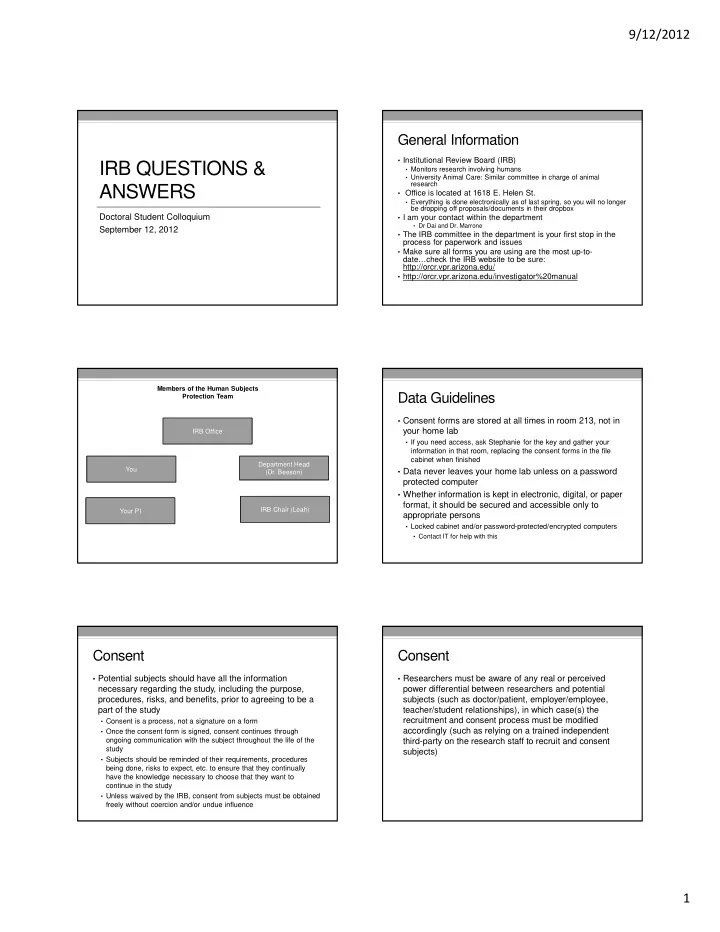
IRB Chair (Leah) Department Head (Dr. Beeson) Your PI You IRB Office Members of the Human Subjects Protection Team

Data Guidelines

  • Consent forms are stored at all times in room 213, not in

your home lab

  • If you need access, ask Stephanie for the key and gather your

information in that room, replacing the consent forms in the file cabinet when finished

  • Data never leaves your home lab unless on a password

protected computer

  • Whether information is kept in electronic, digital, or paper

format, it should be secured and accessible only to appropriate persons

  • Locked cabinet and/or password-protected/encrypted computers
  • Contact IT for help with this

Consent

  • Potential subjects should have all the information

necessary regarding the study, including the purpose, procedures, risks, and benefits, prior to agreeing to be a part of the study

  • Consent is a process, not a signature on a form
  • Once the consent form is signed, consent continues through
  • ngoing communication with the subject throughout the life of the

study

  • Subjects should be reminded of their requirements, procedures

being done, risks to expect, etc. to ensure that they continually have the knowledge necessary to choose that they want to continue in the study

  • Unless waived by the IRB, consent from subjects must be obtained

freely without coercion and/or undue influence

Consent

  • Researchers must be aware of any real or perceived

power differential between researchers and potential subjects (such as doctor/patient, employer/employee, teacher/student relationships), in which case(s) the recruitment and consent process must be modified accordingly (such as relying on a trained independent third-party on the research staff to recruit and consent subjects)

slide-2
SLIDE 2

9/12/2012 2 CITI Training

  • Everyone in the lab, even undergrads that come and go
  • Social and Behavioral Sciences
  • Social and Behavioral Sciences for undergraduates
  • Native American module for all researchers at U of A

Where do I send paperwork when I’m preparing a new proposal?

  • New proposals
  • F200 Document
  • All consent forms
  • All associated documents (see instructions on last page of F200)
  • Submit in hard copy in the IRB dropbox in the mailroom (on top
  • f faculty mailboxes)
  • Send an email to SLHS-IRB@email.arizona.edu and let us

know it’s there

  • We will review it, send it back to you with any changes, and

then send it to Dr. Beeson to review

  • When it is approved by the IRB committee and Dr. Beeson, we

will send it back to you with electronic signatures

  • You will submit it to the IRB electronically per instructions on

last page of F200

  • All forms are downloadable from the IRB website

Where do I send paperwork when I’m doing anything else?

  • Send all modifications, continuing progress reports, etc. to

the SLHS-IRB email address

  • Also send all old consent forms and new, unstamped consent

forms, even if nothing has changed

  • An updated VOTF form
  • Give us up to a week to review it
  • We will send it back to you with any corrections
  • When it is ready to submit to the IRB we will put an

electronic signature on it and send it back to you

  • You will submit it electronically to the IRB via the

instructions on the F213 (or corresponding) form

IRB Hints

New Applications

  • Check Street address is included (not just PO Box).
  • All students must have a sponsoring faculty member listed.
  • Section 2, #4: all consent forms and PHI forms are stored in room 220a

SLHS (bldg. 71)

  • If funding source checked need to attach copy of grant (body, not budget).
  • Section 3, #7: Always aim high in subject numbers. People do drop out or

equipment fails and you cannot use someone’s data.

  • Section 3, # 7: Be specific with inclusion/exclusion criteria and how you will
  • btain this data. For example, “normal hearing” does not work—“normal

hearing based on self-report” does.

  • Section 3, #9: Need site authorization letters for external sites (schools,

doctor offices, etc.). Advertisements need to be attached. Wording for emails, phone conversations needs to be attached.

  • Section 3, #10: Explain explicitly that subjects will be reminded orally that

participation is voluntary and they can withdraw at anytime without

  • consequence. When will this occur? At start of multiple sessions? In

middle of long experiment?

New Application (cont.)

  • Section 3, #10: Consent forms needed for children should be age

appropriate and can be a script that is read and agreement can be nodding with a witness (ages 2-6 as one group, 7-11 as another, and 12- 16 as another).

  • Section3, #11: Make sure protocol is very clear and has time to complete

associated with each section. In other words, if you were ill could your student come in an follow the directions on the protocol to complete the session.

  • Section 3, #12: Fatigue is a risk and needs to be listed.
  • Section 3, #13: Benefits are not money or extra credit.
  • Section 3, #14 and #15: Subject data needs to be coded with a system

that is not traceable to the individual. State explicitly.

  • Section 3, #17: Payment cannot be to parent for child participation,

needs to be reward for child. If payment to parent, can state cost of transportation, parking, etc.

  • Section 3, #22: If funding source is industry or this is a multi-center

study, need to have an explanation of how data will be “shared.”

  • Consent forms should match what’s in the F200 form

IRB Hints

  • Modification of Key Personnel
  • Specific, brief form
  • Updated VOTF
  • Students who move on and off a project each semester do not

need to be listed

  • VOTF
  • All dates within the past 4 years
  • Check CITIs that are about to expire
  • Key personnel
  • Students doing only data analysis do not need to be listed
slide-3
SLIDE 3

9/12/2012 3 IRB Hints

  • Continuing Review
  • Due 45 days prior to expiration of the project: STRICT DEADLINE
  • No changes to protocol are allowed on this form
  • Updates progress from the previous year
  • Check to make sure the numbers in your subject tables add up
  • Make sure an explanation is attached for any “yes” answers
  • Verify that all questions are answered
  • Always include VOTF

IRB Hints

  • Minor Modification
  • Updates to contact information
  • Updates to recruiting materials, surveys
  • Translations
  • F200 update not needed
  • You only need your PI’s signature for this form – no need to send it

to us

  • Modification of Approved Human Research
  • Used for all other changes to protocol
  • Make sure justification is reasonable and clear
  • F200 needs to be updated and submitted with changes highlighted
  • Must be submitted to us for review and signature

WHEN IN DOUBT…ASK!

leahfabianosmith@email.arizona.edu hdai@email.arizona.edu nmarrone@email.arizona.edu

QUESTIONS?