Application for IRB Review for Unfunded Research Tulsa Community - - PDF document

application for irb review for unfunded research
SMART_READER_LITE
LIVE PREVIEW

Application for IRB Review for Unfunded Research Tulsa Community - - PDF document

Application for IRB Review for Unfunded Research Tulsa Community College Institutional Review Board PRINCIPAL INVESTIGATOR: Note: If a P.I. is not a TCC employee, the study must be endorsed by or in collaboration with a TCC employee, and IRB


slide-1
SLIDE 1

Last updated 8/18/2016
Application for IRB Review for Unfunded Research Tulsa Community College Institutional Review Board

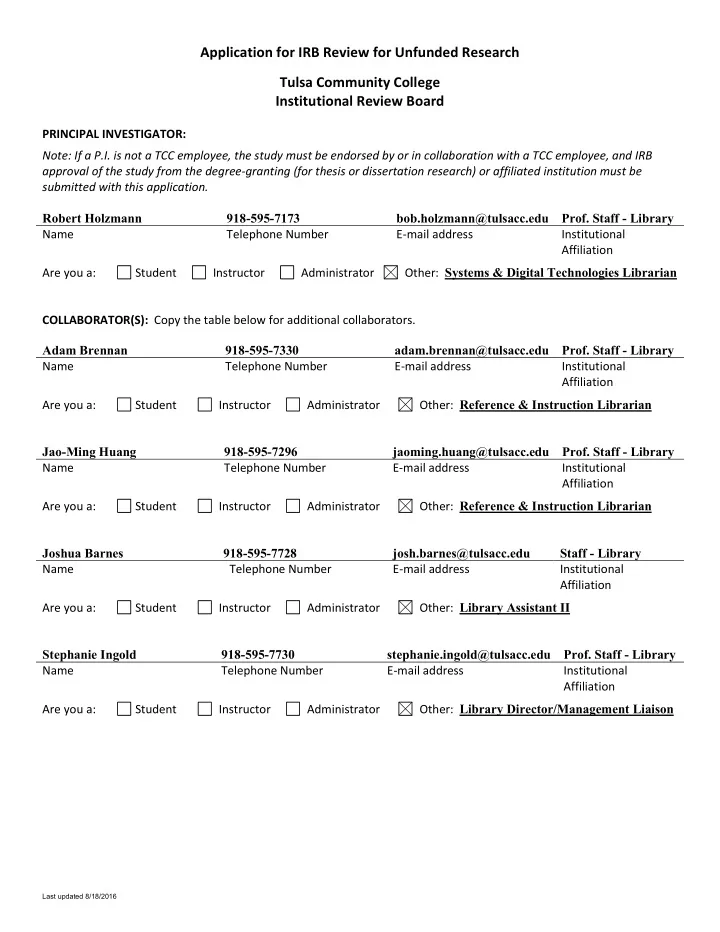
PRINCIPAL INVESTIGATOR: Note: If a P.I. is not a TCC employee, the study must be endorsed by or in collaboration with a TCC employee, and IRB approval of the study from the degree-granting (for thesis or dissertation research) or affiliated institution must be submitted with this application. Robert Holzmann 918-595-7173 bob.holzmann@tulsacc.edu Prof. Staff - Library Name Telephone Number E-mail address Institutional Affiliation Are you a: Student Instructor Administrator Other: Systems & Digital Technologies Librarian COLLABORATOR(S): Copy the table below for additional collaborators. Adam Brennan 918-595-7330 adam.brennan@tulsacc.edu Prof. Staff - Library Name Telephone Number E-mail address Institutional Affiliation Are you a: Student Instructor Administrator Other: Reference & Instruction Librarian Jao-Ming Huang 918-595-7296 jaoming.huang@tulsacc.edu Prof. Staff - Library Name Telephone Number E-mail address Institutional Affiliation Are you a: Student Instructor Administrator Other: Reference & Instruction Librarian Joshua Barnes 918-595-7728 josh.barnes@tulsacc.edu Staff - Library Name Telephone Number E-mail address Institutional Affiliation Are you a: Student Instructor Administrator Other: Library Assistant II Stephanie Ingold 918-595-7730 stephanie.ingold@tulsacc.edu Prof. Staff - Library Name Telephone Number E-mail address Institutional Affiliation Are you a: Student Instructor Administrator Other: Library Director/Management Liaison

slide-2
SLIDE 2

Last updated 8/18/2016

PROJECT OVERVIEW PROJECT TITLE: TCC Library Services Assessment: Correlating Library Use to Academic Objectives for Student Success PROJECT ABSTRACT: The abstract should be a one-paragraph summary of the protocol, including potential benefits, potential risks, and risk management procedures. TCC’s institutional and Library strategic plans have specific goals regarding assessment of services. In a data- informed organization committed to continuous improvement, an effective evaluation plan for assessing services is

  • essential. TCC Library has chartered a workgroup to develop a comprehensive assessment plan, and the

information provided in this document will in part provide an essential piece of the data for that plan. Library assessment will use existing data and information already gathered in systems or data gathered through TCC library service guidelines that staff collects in the daily delivery of library services. Library data gathered will be correlated with student academic data and documented in aggregated reports produced through our Institutional Research and Assessment (IR&A) office. No individual personal or FERPA protected data will be exposed and therefore should not present any risk to the individuals whose data we are using. This recurring periodic evaluation of library services in a statistical correlation relationship study over time should provide a solid assessment of library services and their impact upon student persistence, academic achievement, and completion (graduation or transfer). PROJECT TYPE: Thesis Dissertation Class Project (Select all that apply.) Pilot Project Faculty research project Professional paper or presentation Other: Library assessment project with periodic long-term reports PROPOSED START DATE: 12/2017 or 01/2018 (immediately) upon IRB approval. RESEARCH PROTOCOL RESEARCH QUESTION(S): Provide your research question(s) to be addressed by this proposed study. What impact do library services have upon student success including persistence, academic achievement, and completion? PURPOSE AND BACKGROUND: Provide background information for the study in the box below, including the objective

  • f the proposed research, purpose, hypotheses, and/or any other relevant information.

Historically, assessment of a library’s affect or impact upon academic success has been difficult to correlate with user data. However, recent research indicates that there are now statistical methods available to correlate library use to academic outcomes using hard data. TCC Library has established a workgroup specifically tasked with researching and creating a comprehensive assessment plan for all library services. We plan to incorporate current statistical correlation methods for assessment as part of our plan for recurring periodic assessment and evaluation

  • f library services.

METHODOLOGY: Describe the tasks that participants will be asked to perform. Include a step-by-step description of the procedures you plan to use with your participants. Provide the approximate duration of participation for each

  • procedure. The precise location for each procedure should be specified. If this is an archival study, describe how the

archival data will be accessed. This study or assessment program is archival and will be ongoing. The TCC College-Wide ID (CWID, also referred to as the “T-number”) is the key data field that links library services users to their academic data. Library users provide the CWID at the point of contact for using library services, whether that be through automated systems, online services, or through in-person contact when a non-automated service is used.

slide-3
SLIDE 3

Last updated 8/18/2016

Automated systems and online services record the CWID in system data files or log files at the point of use or

  • access. The following is a list of these types of automated library services:
  • Checkout (circulation)of library materials such as books, videos, course reserves items, etc.
  • Use of online (electronic) resources, such as articles, eBooks, streaming videos, images, etc.
  • Inter-Library Loan (ILL) services.
  • Virtual (online), mobile, telephone, and texting reference chat.
  • Library course-integrated instruction for which the student is registered.
  • TCC courses involving library instruction (Composition, Level 1 Nursing, etc.).
  • Use of TCC student computers located in the libraries.
  • Any new or expanded services provided via automated systems.

Manual recording of the user information is recorded when a service is requested and delivered. The CWID (T- number) is recorded for each service and will be forwarded to TCC IR&A for statistical processing and creation of aggregate impact reports. The following is a list of these types of manually recorded use of library services:

  • Use of study rooms.
  • In-person reference help at the library services desk.
  • Individual research consultations.
  • Any new or expanded services requiring manually recorded use and individual information (CWID).

Articles we researched with details about the statistical methods we would like to use for this study, are attached. STUDY SITES: Metro campus Northeast campus Southeast campus West campus (Select all that apply.) Conference Center Online Other: Owasso and other added locations N/A INSTRUMENTS & MATERIALS: Describe the instruments to be used. Indicate the number and type of items, the time necessary to complete the instruments, and the frequency and method of administration (telephone, online, face-to- face, etc.). You must also provide a copy of the instruments with your completed application. If this is an archival study, describe the archival data you will be examining in this study. This includes listing and describing the variables in the dataset. This study or assessment program is archival and will be ongoing. The input data for those who use library services online or face to face will be the CWID (T-Number), which will be forwarded to TCC IR&A office. IR&A will use this data to identify library users who are students in a degree or certificate program. IR&A will use these inputs to provide a statistical analysis against academic data from other TCC systems including but not limited to data about registration and persistence, grades, completion, and demographics consistent with those used assessment reports. IR&A will use their statistics system and methods to provide the library with various aggregated reports correlating library use to student academic outcomes. No individual private information such as CWIDs, names, etc., nor any individual FERPA protected data will be returned in any of the reports produced for the library. All individual data used is internal to TCC systems and will remain confidential. Variables in the dataset: CWID (T-number) Registration info Grades (GPA) Completion (grad, transfer) Degree/ Certificate majors Credit hours Library user or not Pell recipient and status Demographic variables Socio-economic info Zip code Honors classes SAT / ACT scores Prior college credit High School GPA Concurrent student Satisfactory Academic Status Financial Aid First generation Tulsa Achieves student Advanced Placement Developmental Ed Library services Library programs Library Instruction Library eResources PARTICIPANTS: Describe your population of interest and how many participants you plan to recruit from that

  • population. Explain why this population is the most appropriate for your study. If you will be excluding participants

from your study based on gender, ethnicity, or other demographic information, describe those exclusions and the rationale behind the exclusion. If this is an archival study, describe the participants from which the data was originally collected.

slide-4
SLIDE 4

Last updated 8/18/2016

This study or assessment program is archival and will be ongoing. Data collected for users of library services (including the CWID T-number) is obtained at the point of contact with the service, whether that be through automated system, online services, or through in-person contact with the individual when a non-automated service is requested and delivered. This plan will identify library users who are students in a degree or certificate

  • program. IR&A will use academic and demographic data from other TCC systems including but not limited to

registration, grades, completion (graduation or transfer), and standard demographics consistent with those used in

  • ther TCC assessment.

RECRUITMENT PROCEDURES: Describe the recruitment procedures you will use. You will need to provide a copy of any recruitment material or language with your completed application. If participation in your study will occur through a particular course, program, or organization at TCC, identify those entities and the point person from whom you have received permission to conduct your study with the particular group of students. A letter of support from the instructor, advisor, or Associate Dean should be submitted for any research involving minimal to high levels of risk for participation. If this is an archival study, indicate who will be providing you with the data. This study or assessment program is archival and will be ongoing. Data will be extracted from the library’s automated systems, currently provided by vendors OCLC and Springshare, and from TCC systems supported by TCC Information Technology Infrastructure including but not limited to Banner and CAS. Data that is manually

  • btained at the point of contact with staff when requesting library services face to face will be recorded by staff on

procedural forms related to those services and may be entered into computer files. POTENTIAL BENEFITS: Discussion of potential benefits should be an evaluation of the benefits to individual subjects, the population from which they are drawn, and society/humanity in general. This longitudinal study of library services will affirm and indicate to what extent library services contribute to TCC student success. While some library services may demonstrate a significant contribution to student success, assessment of other library services may indicate areas that need improvement or the need to provide new services. Once there is some historical data established, we should be able to use predictive correlation methods in reports to forecast outcomes. Sustaining quality library services and as well as improvements should contribute to greater academic success for students who use library services, the libraries will increase efforts with services to any student categories for which the assessment indicates lower impact results, and overall improve students success after completion in the workplace or in their subsequent progress in higher education. IMPACT OF RESEARCH ON TCC: Describe how the findings from this study will positively impact Tulsa Community College, its students, faculty, and/or staff, and/or the community it serves. Also, describe how you will disseminate the results of the study upon its conclusion to TCC stakeholders who will be affected by the research. Continuation or expansion of library services that have significant impact upon student success is important when considering continual improvement. For those services that have lesser or minimal impact, improving or identifying new services will be necessary to “close” the performance gap and improve the library’s impact on student services. Students who are academically successful at TCC and who move into the workplace or continue their education contribute to a vibrant community, successful businesses, education, health care, etc., and the economic stability and growth of the city and the region. Results of this plan will be disseminated to higher levels of TCC administration, managers and staff of the libraries that deliver services, state, federal, and private reporting channels, the annual TCC and Library Reports, other colleges and universities, presented at conferences, seminars, and online webinars, and published in library and academic, and other pertinent journals. PRIVACY PROCEDURES Will you record any direct identifiers: names, social security numbers, addresses, telephone numbers, etc.? No Yes If yes, explain why it is necessary to record findings using these identifiers. Describe the coding system you will

slide-5
SLIDE 5

Last updated 8/18/2016

use to protect against disclosure of these identifiers. Describe how subject identifiers will be maintained or destroyed after the study is completed. This is an archival study and the data is already recorded internally on TCC systems. The data identifier used as the key to correlate library use to academic success is the College-Wide ID (CWID), also known as the T-number. This TCC identification number is used internally by staff who deliver services across TCC and is stored within all

  • f the TCC systems that have data about our students. The CWID will be passed on to IR&A and will not be

provided to anyone outside of the research team and IR&A. Since this number will only be used by IR&A as an input to derive the statistical analysis and will not be included in any cumulative or aggregate reporting, we do not propose any additional coding system. Any data details received back from TCC Institutional Research and Assessment will be de-identified. Will you retain a link between the study code numbers and direct identifiers after the data collection is complete? No Yes N/A If yes, explain why this is necessary and state how long you will keep this link. Will you provide a link or identifier to anyone outside the research team? No Yes N/A If yes, explain why and to whom. Will audio, video, film, or digitally captured data be recorded? No Yes If yes, explain how the disposition of the recorded data (tapes/photographs/negatives or digital/electronic media) will be handled. Indicate how recorded data will be erased or destroyed at the conclusion of the study. If you wish to retain the recorded data beyond the conclusion of the study, you must provide justification. Subjects must be informed of the disposition of any recorded data via the informed consent process. Also, clarify how subjects will be identified in audio/video/film/digitally-captured responses. Only that data usually required for the delivery of TCC academic and library services will be recorded as part of the normal service delivery process. Where, how long, and in what format (such as paper, digital or electronic media, video, audio or photographic) will data be kept? Describe what security provisions will be taken to protect this data (password protection, encryption, etc.). Finally, specify when and how the data will be destroyed. All data recorded either automatically in computer systems or manually on library service forms will be managed retained for longer-term use in this study and disposed of according to TCC’s Record Management policy. Will you place a copy of the consent form or other research study information in the participant’s medical, personal or educational record? (This information should be clearly explained in the consent document and/or process.) No Yes N/A If yes, explain why this is necessary. Will you require a Federal Certificate of Confidentiality? No Yes If yes, submit documentation of application (and a copy of the Certificate of Confidentiality award if granted) with this application form. If the data collected contains information about illegal behavior, visit the NIH

slide-6
SLIDE 6

Last updated 8/18/2016

Certificates of Confidentiality Kiosk http://grants1.nih.gov/grants/policy/coc for information about obtaining a Federal Certificate of Confidentiality. Will any record of the subject’s participation in this study be made available to his or her supervisor, teacher, or employer? No Yes If yes, explain why this is necessary. RISK ANALYSIS PROTECTED POPULATIONS: Please check any groups included in the study. Inclusion of any group below requires full board review. As an aggregate archival study there is not risk with regard protected population groups. We are not focusing our assessment study and reporting upon any particular group. Individual information regarding protected populations will remain private and confidential and only reported in the aggregate and only as related to library services and impact upon student academic success. Minors (under 18 years of age) Pregnant Women Elderly (65 & older) Psychologically impaired Cognitively impaired Prisoners Native American Tribes and/or Tribal Organizations Students enrolled in a class in which the instructor is an investigator in the study None of the above POTENTIAL RISKS: Identify potential risks to human subjects by selecting those risks from the list below. Use of deception (Should be described in detail in the METHODOLOGY section above.) Use of confidential records (e.g., education or medical records) Manipulation of psychological or social variables such as sensory deprivation, social isolation, psychological stressors, etc. Any probing for personal or sensitive information in surveys or interviews Presentation of materials which subjects might consider sensitive, offensive, threatening, or degrading Possible invasion of privacy of subject or family Risk of physical harm or injury Social or economic risk Legal risk Employment/occupational risk Other: None of the above Describe the nature and degree of the risk checked above. The described risks/harms must be disclosed in the consent form. This study or assessment program is archival, and is a longitudinal study that will be ongoing. Confidential education and demographic information will be used only as input to create aggregate or cumulative reports. No private, confidential, personal, or FERPA protected information specific to any individual will be included in any reports.

slide-7
SLIDE 7

Last updated 8/18/2016

MANAGEMENT OF RISK: If potential risks have been identified, procedures for minimizing the potential risks must be

  • described. Risk management procedures range from those applicable to a group (such as the exclusion of pregnant or

potentially pregnant women from a study involving a new drug) to those applicable to an individual subject. Special attention should be given to issues of confidentiality. If it is important to collect identifiable information about subjects, the rationale should be provided in the protocol and the mechanism for maintaining confidentiality must be specified, including coding and reporting procedures, storage and access of identifiable data, and approximate date identifying data will be destroyed. If confidentiality has been promised and case histories or anecdotes will be reported, explanation should be given on how narratives will avoid identifying subjects through description of unique information about them. Management of risk does not change the classification of a study from "risk" to "no risk". All confidential and FERPA protected data will be accessed only by those authorized to do so throughout the study, and will not be reported in any way. Individual data will remain protected on TCC’s secure systems and referenced only for the statistical processes that staff will use to produce the reports. As an archival study, there are not potential risks. SUBJECT COMPENSATION: Subjects may be reasonably reimbursed for their participation in an experiment. Compensation to subjects should never be such as to constitute coercive inducement. Please select all possible forms of compensation offered for participation in this study. Course credit (not extra credit) Extra credit in a course Monetary compensation Other: No compensation will be offered If course credit or extra credit will be given as compensation for the study, you must provide the students with an alternative method by which to earn the credit if they choose not to participate in the study. This option must be equivalent in type, effort, and resources necessary to complete. Describe alternative options if credit toward a course grade is used as compensation. Not applicable. No compensation in any form will be offered. INFORMED CONSENT: Legally effective informed consent must be obtained and documented for the participation of any individual who will be placed at any level of risk. Informed consent means the knowing consent of an individual, or his or her legally authorized representative, so situated as to be able to exercise free power of choice without undue inducement

  • r any element of force, fraud, deceit, duress, or other form of constraint or coercion. Legally authorized representative

means an individual, judiciary, or other body authorized under applicable law to consent on behalf of the prospective subject to such subject's participation in the activity. When the proposed investigation involves a subject who is a minor, uncomprehending, or legally incompetent to give consent, the consent form must clearly indicate the procedures are being consented to on behalf of the subject by his or her legally authorized representative. If subject participation is anonymous, IRB recommends including the text of an information sheet or cover letter containing all required elements of informed consent. If subject participation is not anonymous, you MUST include a consent form. For children and youth participants, provide the assent form for the child/youth and the permission form for the parents. These forms should be attached to your application. This is an archival study and informed consent is not applicable and will not be needed.

slide-8
SLIDE 8

Last updated 8/18/2016

RISK LEVEL: The Principal Investigator is responsible for fully understanding the Policy and Procedures of the IRB. Below indicate your judgment as Principal Investigator as to the RISK category of the present study. Note: Ultimately, the risk level is decided by the IRB, NOT THE RESEARCHER. "At Risk" Research "A subject is considered to be 'at risk' if he/she is exposed to the possibility of harm--physical, psychological, sociological, or other--as a consequence of any activity that goes beyond the application of those established and accepted methods necessary to meet his/her needs. The determination of when an individual is 'at risk' requires application of sound professional judgment of the activity in question and the ethical principles contained herein. Responsibility for this determination resides at all levels of institutional and departmental review.” (The Institutional Guide to DHEW Policy on Protection of Human Subjects, Washington, D.C., 1971, p.2.) An illustrative, but not inclusive, list of "at risk" procedures would include experiments involving any aspect, degree, quality, or amount of any of the following: Deception, mental stress, including subjection to public embarrassment, humiliation, discomfort, irritation, or harassment, hypnosis, sensory deprivation, sleep deprivation, normally ingested or inhaled materials in excess or less than normal amounts, injection, ingestion or inhalation of toxic materials, including all drugs, alcohol or placebos; strenuous physical exertion; use of physical stimuli in abnormal amounts (e.g., noise, vibration, shock, heat, magnetic fields, radiation); violation of anonymity or confidentiality of subjects and data; observations recorded about the individual which, if they became known outside the research, could make the subject liable to criminal or civil action or damage the subject's financial or employment status; or abrogation of any civil right. "Minimal Risk" Research Research in which the risks of harm anticipated are not greater, probability and magnitude, than those ordinarily encountered in daily life or during the performance of routine physical or psychological examinations or tests. No research involving any item listed as being "at risk" can be determined to be minimal risk. The IRB may determine that a research proposal submitted, in the judgment of the principal investigator as "minimal risk," is actually "AT RISK." "Exempt" Research Student Research. Research conducted by students solely for a class project is usually not reviewed by the Institutional Review Board. However, if such student research may be reasonably foreseen to involve any risk to human subjects, the instructor must submit the project for review. Discussion in Research Courses. Although research training activities are not reviewed by the IRB, it is the policy that all courses that deal with research procedures include an appropriate discussion of the ethics and procedures for the protection of human subjects.

slide-9
SLIDE 9

Last updated 8/18/2016

SUBMITTING YOUR APPLICATION

  • 1. Save the completed copy of this file in Microsoft Word format.
  • 2. Complete the submission form and upload this document and all supporting documents into the electronic form

at: http://www.tulsacc.edu/about-us/administration/offices/academic-affairs/institutional-review-board-irb.

  • 3. Supporting documents include but are not limited to:
  • Solicitation Announcements
  • Recruitment materials
  • Data Collection Instruments (i.e., interview questions, questionnaires, surveys, tests, etc.)
  • Informed Consent Documents (Parental/Legal Guardian Permission Form, Child Assent Form)
  • Medical Screening Instrument
  • Debriefing Script (for studies involving deception)
  • Letter of approval from affiliated institution’s IRB (for external applicants and/or graduate students)
  • Letter of approval from thesis or dissertation committee (for graduate students)
  • Letter of support from TCC collaborator (for external applicants)
  • 4. Upon receipt of the submitted application, the Principal Investigator(s) and Collaborator(s) will receive a

confirmation email that can be digitally signed by using Reply, typing the name and date in the appropriate space, and sending the reply email back to irb@tulsacc.edu. Upon receipt of ALL electronic signatures, the IRB will begin review of the proposal. ELECTRONIC SIGNATURE POLICY FOR TCC IRB This policy outlines the procedures for use of electronic signatures for research proposals submitted to the Institutional Review Board.

  • An “electronic signature” is an electronic sound, symbol, or process, attached to or logically associated with an

electronic record or adopted by a person with the intent to sign a record.

  • An electronic record or transaction is a record or transaction created, generated, sent, communicated, received,
  • r stored by electronic means.
  • Research applications submitted to the IRB by computer will be considered electronic records and transactions

for purposes of this policy.

  • For purposes of submitting research applications to the Institutional Research board the following shall all be

recognized as an electronic signature:

  • Typed Name
  • E-Mail Address
  • Scanned image of a signature
  • Automatic e-mail signature
  • The authentication for these electronic signatures is based on the College policy that furnishes a unique

username; and the student or faculty member setting his or her own password. The user/applicant logs into the College network using his or her own username and password. Investigators should use their TCC email for authentication

  • The applicant and the IRB agree that electronic signatures can be utilized when submitting research applications

and when the IRB responds to the applicant(s) research application after review by board members.

  • The applicant agrees to the terms of this policy whenever he or she submits electronically a research

application.

  • The burden of refuting the authenticity of the electronic signature will be on the applicant.