IPC Notes bonding, which is an attraction between the positive - - PDF document

ipc notes
SMART_READER_LITE
LIVE PREVIEW

IPC Notes bonding, which is an attraction between the positive - - PDF document

4/13/2020 Water is a polar molecule because it has a separation of charge. It also undergoes Hydrogen IPC Notes bonding, which is an attraction between the positive Hydrogen end Water and the negative oxygen end of the molecule. These two


slide-1
SLIDE 1

4/13/2020 1

IPC Notes

Water

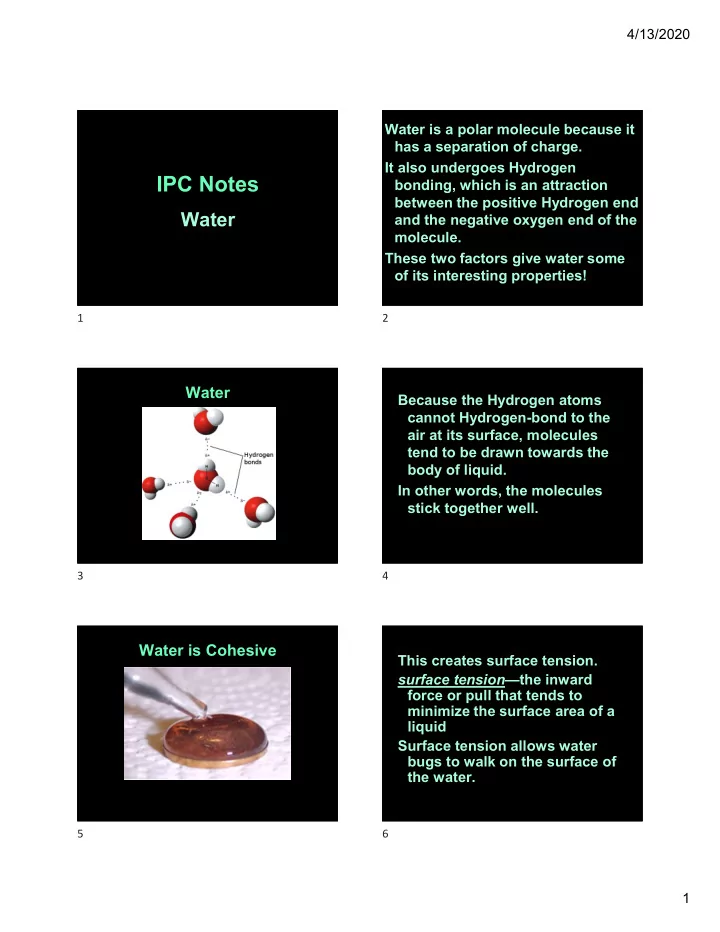
Water is a polar molecule because it has a separation of charge. It also undergoes Hydrogen bonding, which is an attraction between the positive Hydrogen end and the negative oxygen end of the molecule. These two factors give water some

  • f its interesting properties!

Water

Because the Hydrogen atoms cannot Hydrogen-bond to the air at its surface, molecules tend to be drawn towards the body of liquid. In other words, the molecules stick together well.

Water is Cohesive

This creates surface tension. surface tension—the inward force or pull that tends to minimize the surface area of a liquid Surface tension allows water bugs to walk on the surface of the water.

1 2 3 4 5 6

slide-2
SLIDE 2

4/13/2020 2

Surface Tension

A surfactant is a substance that decreases surface tension of a liquid. In water, it does this by interfering with the hydrogen bonding. Detergent is a good example of a surfactant. Water boils and freezes at much higher temperatures than most

  • ther substances that have

similar molar masses. Why? Water molecules are held together by very strong hydrogen bonding. When water freezes, unlike most

  • ther substances, it becomes

less dense and it floats! When water freezes, it forms a very open crystalline structure. It is very important for life on earth that water floats when it freezes. An insulating layer of ice in the winter keeps the oceans from freezing and killing everything. Which phase of water has the lowest density? Which phase has the highest density?

7 8 9 10 11 12

slide-3
SLIDE 3

4/13/2020 3 Water is called the universal solvent because so many different substances will dissolve in it. The negative side of water molecules attract the positive side of a polar molecule. The same thing happens with the negative side. Nonpolar substances are able to dissolve other nonpolar substances, due to the lack of repulsive forces. This leads to the saying “like dissolves like.” Electrolytes are any ionic compound that will conduct electricity when dissolved in water. Non-electrolytes—like sugar— will dissolve but do not conduct electricity. Mixtures where particles settle

  • ut upon standing are called
  • suspensions. Suspensions

have the largest particles! They differ from solutions (which are homogeneous) because their particles are much larger. A colloid is a mixture with particles intermediate in size between a solution and a suspension.

13 14 15 16 17 18

slide-4
SLIDE 4

4/13/2020 4 A colloid can be discerned due to the Tyndall effect. Light scatters as it shines through a colloid. You will see both light and particles. Fog is a good example of a

  • colloid. You don’t want to use

your high beam lights when it is foggy outside.

Colloid

19 20