IP EuroNF Wrzburg July 21-22 2008 1 Network (R)Evolution Future - - PDF document

ip
SMART_READER_LITE
LIVE PREVIEW

IP EuroNF Wrzburg July 21-22 2008 1 Network (R)Evolution Future - - PDF document

The Way 4WARD to a Creation of a Future Internet Henrik Abramowicz Ericsson Research EuroNF Wrzburg July 21-22 2008 Challenging the IP fortress - will this be successful ? IP EuroNF Wrzburg July 21-22 2008 1 Network (R)Evolution


slide-1
SLIDE 1

1

EuroNF Würzburg July 21-22 2008

The Way 4WARD to a Creation of a Future Internet

Henrik Abramowicz Ericsson Research

EuroNF Würzburg July 21-22 2008
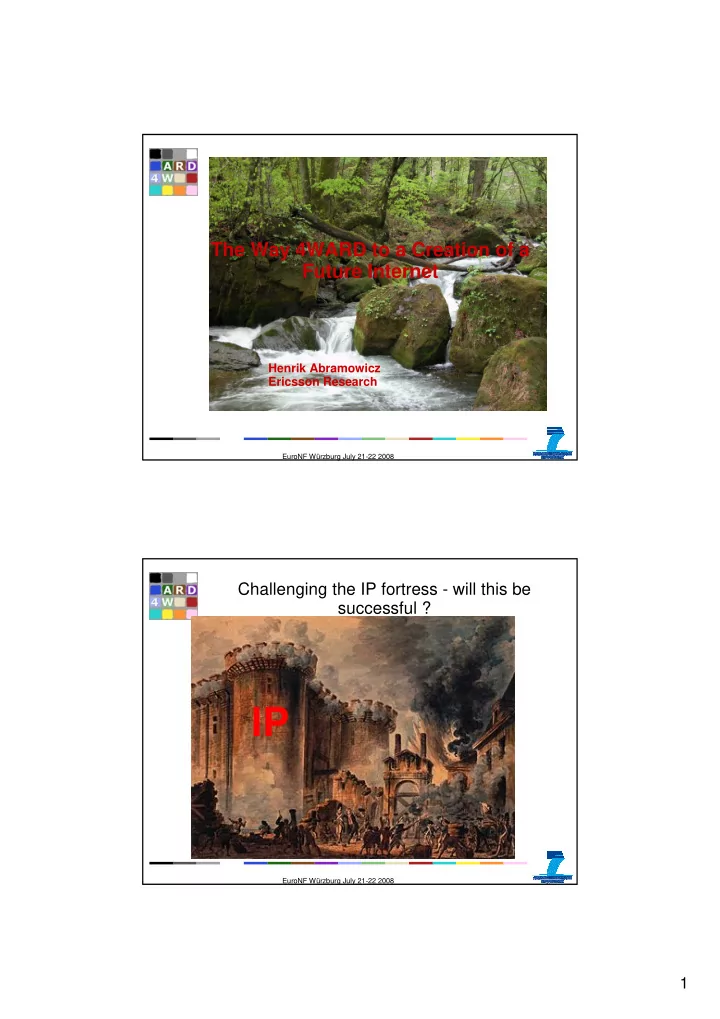
IP

Challenging the IP fortress - will this be successful ?

slide-2
SLIDE 2

2

EuroNF Würzburg July 21-22 2008

Telephony

Interconnecting wires

Internet

Interconnecting hosts

Future Internet

Interconnecting Information

Future Internet

Sensor Net

Network (R)Evolution

R ( E ) v

  • l

u t i

  • n

Overlay Networks Google, Akamai….

Appl: Skype, Joost, Youtube Tech: BitTorrent

Mobile networks

EuroNF Würzburg July 21-22 2008

Mobile networks (r-) evolution

80ies 90ies 2000 2010 Analogue e.g. NMT 1st Gen GSM 2nd Gen UMTS 3rd Gen LTE 4th Gen HSPA

slide-3
SLIDE 3

3

EuroNF Würzburg July 21-22 2008

The Future Network as we know it

Flexible and participatory – user and provider are dynamically attached roles Information centric rather than bit centric at the network level Security that nevertheless keeps the generativity1 of the network intact Low cost to access, deploy and operate ...

1 see Zittrain „The Future of the Internet and how to stop it“ EuroNF Würzburg July 21-22 2008

The Facets of 4WARD

Combination of clean-slate approaches to address the Network of the Future Focus on individual innovations in phase 1 Size: Roughly 23 M€ Time 2 years

A A A

P P P P Foldi ng Point Endpo int Forw arder

Architecture Framework Network Virtualisation In Network Management Network of I nformation Generic Paths

Business Innovation Usage Socio-Economics Policy G

  • v

e r n a n c e

slide-4
SLIDE 4

4

WPx/Slide 7 1 April 2008 WS on Socio-Economics in FI, Bled, K.Wuenstel

W D 4

Business, Society and Regulatory Drivers

Focus of 4WARD: Drive innovations into the network layer to create new socio-economic opportunities Network modeling Network virtualisation Embedded network self-management Functionally rich communication paths Network of information More at the BIRD Workshop on 2 October, organized by 4WARD (Business Innovation, Regulation & Dissemination)

– Discussion on non-technical driver results with external audience, European Commission and regulation organisations.

Policy Governance Regulation Technologies Business Models Socio-economic Service Usage

Requirements Concepts and Technologies BM scenarios & Use Cases Regulation scenarios EuroNF Würzburg July 21-22 2008

4WARD Principles

Tenet 1: Let 1000 Networks Bloom Tenet 2: Let Networks Manage Themselves Tenet 3: Let a Network Path Be an Active Unit Tenet 4: Let Networks Be Information-Centric

slide-5
SLIDE 5

5

EuroNF Würzburg July 21-22 2008

Support the Network Architect

Design Process (including iterations) Design Process (including iterations)

Composition

  • f func-

tionality (CFI)

Inter-

  • perability

Requirements … Requirements …

(Meta) Modeling

“Blue Print”

  • f network

architecture

4WARD WP2 Framework

Network architect

Guidelines, building blocks …

Implementation

iterations

EuroNF Würzburg July 21-22 2008

The Virtual e2e Network

  • Deals with e2e resource

virtualisation of networking resources

  • Includes wireless

virtualisation

  • Opens the possibility for

more radical innovation in the network

  • Enables migration from

current Internet

Management of Virtual Networks

Provisioning of Virtual Networks

(aggregate “ “slices” and form virtual networks)

Substrate Virtualised substrate Virtual Network Virtual Network Virtualisation of Resources

(partitioning of physical infrastructure into “Slices”)

slide-6
SLIDE 6

6

EuroNF Würzburg July 21-22 2008

Analysis and action

Network element Managed domain

Traditional Network Management

EuroNF Würzburg July 21-22 2008

Management command Notification

Network element with embedded management processes Peer-to-peer interaction Managed domain

In-network Management

slide-7
SLIDE 7

7

EuroNF Würzburg July 21-22 2008

A new transport paradigm: the generic path

  • Path generalisations in a functional architecture: How to

– Organize cooperation between nodes in a path

  • Understand their existence, and signaling between nodes

– Structure cross-layer information

  • Find out lower topologies and their capabilities

– Control underlay topologies

  • “Multi-layer routing”
  • Mobility by generic path
  • Evaluation in proof-of-concept testbeds

split/ balance merge/ network code decode join code cooperatively Generic path 1 Generic path 2

EuroNF Würzburg July 21-22 2008

The Network of Information

  • Architecture of a Network
  • f Information
  • Information modelling
  • Basic dissemination

mechanisms and services

  • Non-dissemination and

delay-sensitive services

  • Evaluation of the

approach

A C E B A B E A C

A

E B A D E A D

E

E B D D A C E B A B E A C

A

E B A B E A C

A

E B A D E A D

E

E B D D

slide-8
SLIDE 8

8

EuroNF Würzburg July 21-22 2008 WPx/Slide 15

NetInf architecture overview

NetInf User A NetInf User B NetInf User C “Google” for NetInf objects

Operate on

  • bject by ID

Locate Information Object Locate Bit-level Object NetInf machinery Transport Bit-level

  • bjects

Locate Real World Object Real World Object tracker

NetInf Object operations

  • Create ID
  • Publish ID
  • Remove ID
  • Store/update object
  • Get object
  • Locate object
  • Delete object

Store Bit-level

  • bjects

Move Bit-level object to/from location

Real World User Real World Objects

R e a l W

  • r

l d O b j e c t s u p d a t e s EuroNF Würzburg July 21-22 2008

Internet Evolution

  • HIP
  • Node Id
  • NetInfo
  • Network Virtualisation
  • Generic Transport
  • Network Coding
  • Multi path
  • Current Internet
  • Clean Slate research
  • New Arch. Framework
slide-9
SLIDE 9

9

EuroNF Würzburg July 21-22 2008

Strategies for Internet evolution

Incremental evolution, addition of functionality to current internet without changing the prevalent paradigms

IP routers

Network Virtualisation Overlay techniques: run new protocols on top of IP

EuroNF Würzburg July 21-22 2008

Summary

Inherent integration of self-management Increasing the amount of network features reliably available to end-user applications

– Like mobility, QoS, security but also scalability, deployability

Driving innovation and new business opportunities into the network layer Defining a systems approach to the Future Internet Drive the work from the mobile and wireless perspective We are open and interested in collaboration with related international initiatives