
SLIDE 1
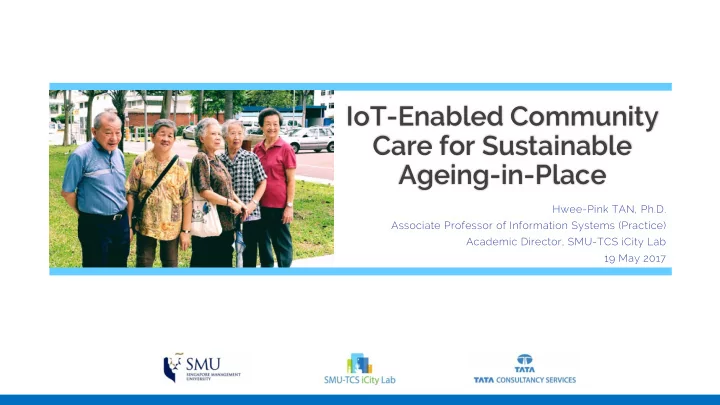
IoT-Enabled Community Care for Sustainable Ageing-in-Place
Hwee-Pink TAN, Ph.D. Associate Professor of Information Systems (Practice) Academic Director, SMU-TCS iCity Lab 19 May 2017
IoT-Enabled Community Care for Sustainable Ageing-in-Place - - PowerPoint PPT Presentation
IoT-Enabled Community Care for Sustainable Ageing-in-Place Hwee-Pink TAN, Ph.D. Associate Professor of Information Systems (Practice) Academic Director, SMU-TCS iCity Lab 19 May 2017 About the SMU-TCS iCity Lab The iCity lab was established
Hwee-Pink TAN, Ph.D. Associate Professor of Information Systems (Practice) Academic Director, SMU-TCS iCity Lab 19 May 2017
2
The iCity lab was established in Aug 2011 to explore and pursue new research areas in Smart Cities to provide long- term competitive advantage to TCS
innovative}
IT and management In view of the successful partnership in the last 6 years, TCS has committed funding to extend the relationship for a further 3 years (Aug 2017 – July 2020) to take the iCity lab to greater heights
3
TAN Hwee Pink Associate Professor of Information Systems (Practice) and Academic Director ANG Chip Hong Senior Associate Director Cheryl KOH TAN Lee Buay Community Coordinators / Research Assistants TAN Hwee Xian Research Scientist Alvin VALERA Research Fellow BAI Liming Research Engineer Pius LEE Senior Research Engineer Nadee G Research Fellow DON Wijay Assistant Manager
Steering Committee
Raghavan V
Head of iCity Initiatives, TCS CTO Office Ananth KRISHNAN CTO, TCS PROF Steven MILLER
Girish RAMACHANDRAN President & Head of TCS Asia Pacific NG Boon Thai Research Engineer
Core Team
Sanjoy Biswas Business Development TCS Asia Pacific
4
Source: The Straits Times, 18 Dec 2015
More likely to die prematurely
More likely to feel depressed
5
Pull-cord alert alarm system (AAS) @ home ~23,000 elderly homes Response from staff/ community
Source: The Straits Times, 26 Apr 2015
An initiative by
6
7
Data-driven care can improve wellness
Source: The Straits Times, 12 April 2012
“Can non-intrusive technologies be used to better enable community care for me to age-in-place?”
Supportive ecosystem beyond technology Accessibility & Unobtrusiveness for sustained use
*SHINESeniors (Nov 14 – Oct 17) is an SMU-led research project supported by the Ministry of National Development and National Research Foundation under the Land and Liveability National Innovation Challenge (L2NIC) Award No. L2NICCFP1-2013-5.
8
Assessment of community care needs of elderly living alone Multi-modal data collection
monitoring
Multi-modal analytics
alert Personalized, As-Needed Community Care ADL-based Care models
Technology Enablers
User-feedback & Refinements
Regional Community Care Enablers
Care findings Requirements
Aging-related Policy Enablers
9
Social-demographic profile, family support, financial status Physical health, mental health, medication, sleep patterns and quality, activities of daily living Social function, overall happiness and wellbeing, liveability, technology Routines and unusual events (hospitalization, faint spells, family visits etc)
Psychosocial Surveys & Regular Ground Observations
10
12.38% 12.38% 13.33% 13.33% 19.05% 29.52% 46.67% 60.95% 64.76% 70.48%
Digestive illnesses Other fractures Chronic back pain Parkinsons Heart attack, angina, chest pain Diabetes Joint pain, arthritis, rheumatism or nerve pain Hyperlipidemia High blood pressure Cataract
Top 10 physical health conditions
(n = 105)
2 4 6 8 10 12 1 2 3 4 5 6 7 8 9 10 11 No of Elderly
No of chronic conditions
SHINES LIONS THK
11
impairment at the time of testing:
10 20 30 40 50 60 1 2 3 4 5 6 7 8 9 10 11 12 14 % of elderly GDS Score
Geriatric Depression (GDS Score)
SHINES LIONS THK 10 20 30 40 50 60 70 5 6 7 8 9 10 % of elderly AMT score
AMT Score
SHINES LIONS THK GL@MP – 14 LIONS - 8 THK - 2 GL@MP – 1 LIONS - 4 THK - 0
12
Motion Sensor Door Contact Le Lege gend: Gateway Sensorized medication box Help button
13
Help request Data analysis & anomaly detection Inferred medication Going out Zonal activity level @ home Overall activity level @home
Anomaly-triggered alert Help button alert
Activity-based Personalized Care Execution Care evaluation Community Care Model Refinements
14
Challenge: How to set the right alert threshold for different elderly with different daily routines A period of prolonged inactivity at home can indicate trouble for the elderly resident When inactivity exceeds a threshold, trigger an alert to caregivers
15
Stays home mostly Frail, pain in legs, fall history Socializes infrequently, with few visitors
Goes out frequently, daily exercise routine Generally fit with no fall history Socializes frequently with family and neighbours, with regular visitors
Early 80s High blood pressure, diabetes and high cholesterol
16
~50% of elderly do not pack their medication ~60% of elderly store medication in plastic bags or containers
17
Sensorized medication box To fit existing habits Detection of medication non-adherence Caregiver group alert & intervention
18
Improved medication adherence after intervention in Sep 2016 (medication reconciliation)
19
Activity level @ bedroom Multi-modal Data analysis Activity level @ kitchen Going out Activity level @ bathroom Overall activity level @home
Poor / worsening wellness level?
Wellness-based Personalized Care Execution Care evaluation Community Care Model Refinements
Wellbeing indices
ss/Soci cial al Isolati tion
20
Loneliness
Social loneliness Emotional loneliness
E.g. There is always someone I can talk to about my day-to-day problems E.g. I experience a sense of emptiness Prevalence among the Marine Parade elderly sample
11% 11% 24 24% 27 27% 38% 38% 5 to 10 11 to 15 16 to 20 21 to 25 13% 3% 40% 0% 27 27% 13% 3% 7% 7% 6 to 10 11 to 15 16 to 20 21 to 25 26 to 30
(Geriatric depression scale) (Pittsburgh sleep quality index) (Abbreviated mental test) (Instrumental activities of daily living)
Depression Sleep Cognition IADLs
Correlated
21
Sensor-derived feature Emotional loneliness Social loneliness Social network Social Isolation Score Average daily away duration
(0.144)
(0.011) 0.31* (0.037)
(0.005*) Away count 0.13 (0.392)
(0.503)
(0.656) 0.08 (0.606) Napping duration
(0.597) 0.32* (0.038)
(0.101)
(0.777) Night time sleep duration
(0.448) 0.24 (0.133)
(0.373)
(0.297 Average time spent in the living room 0.31* (0.049)
(0.973)
(0.149) 0.17 (0.292) Kitchen activity
(0.48) 0.03 (0.854) 0.03 (0.852) 0.10 (0.508)
P values are in parenthesis *** p < 0.001, ** p < 0.01, * p < 0.05
AWAY DURATION, NAPPING DURATION and TIME SPENT IN THE LIVING ROOM are correlated with social isolation dimensions
22
3 care partners, 2 estates, 3 Govt partners
timely assistance to 8 elderly in 13 cases
1 elderly found unwell and warded in time!
personalized intervention achieved reduced isolation
personalized intervention improved adherence in 2 elderly
Hwee-Pink TAN, Ph.D. hptan@smu.edu.sg icity.smu.edu.sg