Ionic Compounds and Ionic Bonding Slide 3 / 130 Slide 4 / 130 - - PDF document

ionic compounds and ionic bonding
SMART_READER_LITE
LIVE PREVIEW

Ionic Compounds and Ionic Bonding Slide 3 / 130 Slide 4 / 130 - - PDF document

Slide 1 / 130 Slide 2 / 130 Ionic Compounds and Ionic Bonding Slide 3 / 130 Slide 4 / 130 Table of Contents: Ionic Compounds and Ionic Bonding Click on the topic to go to that section Periodic Table Review Valence Electrons and the


slide-1
SLIDE 1

Slide 1 / 130 Slide 2 / 130

Ionic Compounds and Ionic Bonding

Slide 3 / 130 Table of Contents: Ionic Compounds and Ionic Bonding

Click on the topic to go to that section

· Periodic Table Review · Valence Electrons and the Octet Rule · Ions · Ionic Bonding · Predicting an Ionic Compound's Formula · Naming Ionic Compounds · Properties of Ionic Compounds · Formulas and Names of Ionic Compounds with Transition Metals · Polyatomic ions · Formula and Names of Compounds with Polyatomic ions (Ternary Ionic Compounds) · Polyatomic Patterns

Slide 4 / 130

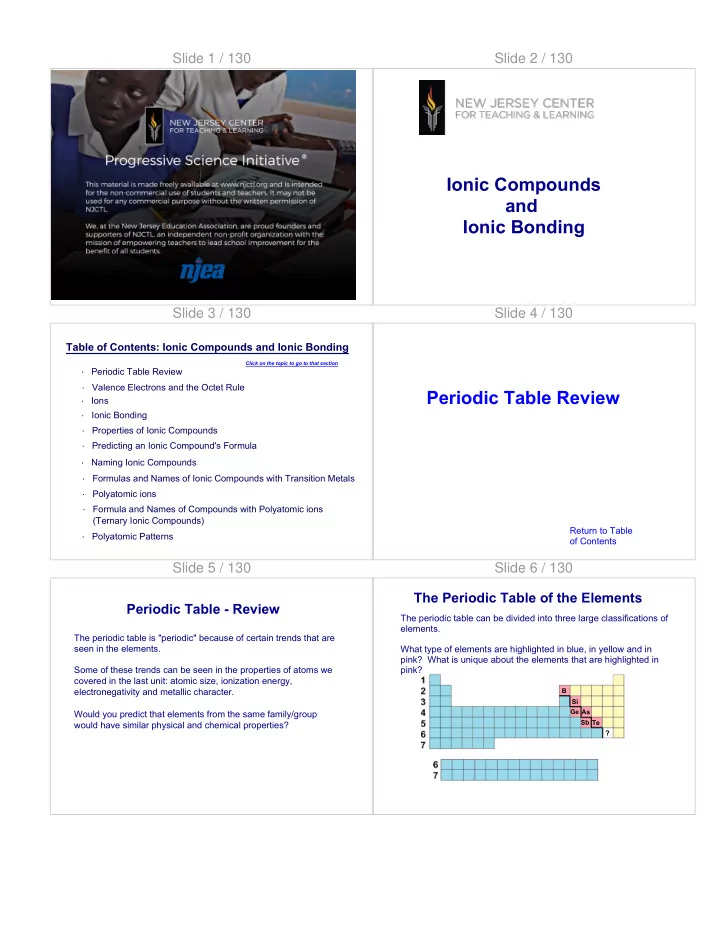
Periodic Table Review

Return to Table

  • f Contents

Slide 5 / 130 Periodic Table - Review

The periodic table is "periodic" because of certain trends that are seen in the elements. Some of these trends can be seen in the properties of atoms we covered in the last unit: atomic size, ionization energy, electronegativity and metallic character. Would you predict that elements from the same family/group would have similar physical and chemical properties?

Slide 6 / 130 The Periodic Table of the Elements

As B Si Te Ge Sb ?

The periodic table can be divided into three large classifications of elements. What type of elements are highlighted in blue, in yellow and in pink? What is unique about the elements that are highlighted in pink?

slide-2
SLIDE 2

Slide 7 / 130

As B Si Te Ge Sb ?

Metallic Character of the Elements

What the relationship between metallic character and effective nuclear charge? Are they directly or inversely related? Is it accurate to say "Element A is more metallic than element B" even if element B is a non-metal? More metallic Less metallic Non-metallic Most metallic

Slide 8 / 130

1 In the periodic table, the elements are arranged in __________. A alphabetical order B order of increasing atomic number

C

  • rder of increasing metallic properties

D order of increasing neutron content

E

reverse alphabetical order

F

I don't know how to answer this.

Slide 9 / 130

2 Elements __________ exhibit similar physical and chemical properties.

A with similar chemical symbols

B with similar atomic masses C

in the same period of the periodic table

D

  • n opposite sides of the periodic table

E

in the same group of the periodic table

Slide 10 / 130

3 Which pair of elements would you expect to exhibit the greatest similarity in their physical and chemical properties? A Li, Na

B

Cs, Ba

C

Ca, Si

D Ga, Ge E C, O

Slide 11 / 130

4 Which one of the following is a nonmetal?

A W B

Sr C Os

D Ir E

S

Slide 12 / 130

5 Potassium is a __________ and chlorine is a __________.

A metal, nonmetal

B metal, metal

C metal, metalloid

D metalloid, nonmetal

E nonmetal, metal

slide-3
SLIDE 3

Slide 13 / 130

Valence Electrons and the Octet Rule

Return to Table

  • f Contents

Slide 14 / 130

Atoms tend towards having complete outer shells of electrons (remember stability). A full outer shell will have: 2 electrons in the s subshell and 6 electrons in the p subshell ( s2p6 configuration) Octet rule: atoms tend towards having a total of 8 electrons 8 valence electrons make an octet

Review: Octet Rule

Which elements on the periodic table have a complete

  • uter shell? What is true about these elements relative

chemical reactivity?

Slide 15 / 130 Valence Electrons

Valence electrons are the electrons in the highest occupied energy level of an element’s atoms. The valence electrons determine the chemical properties of an element. Why do you think this would be true? Atoms in group 3 have 3 valence electrons, atoms in group 17 have 7 valence electrons, etc.

Valence electron

To find the number of valence electrons in an atom of a representative element (elements found in the s and p blocks), simply look at its group number.

Slide 16 / 130

Valence Electrons

1 2 3 4 5 6 7 8 1 - 4 There is one exception: helium has only 2 valence electrons.

Number of valence electrons in neutral atoms:

Slide 17 / 130

6 How many valence electrons does potassium have? A 3 B 1 C D 4 19 E 8

Slide 18 / 130

7 How many valence electrons does Aluminum have?

A

5 B 7

C

3 D 27 E 13

slide-4
SLIDE 4

Slide 19 / 130

8 How many valence electrons does Barium have?

A 1 B 2 C 52

D

3

E

6

Slide 20 / 130

9 Arsenic (As) has 6 valence electrons. True False

Slide 21 / 130

Ions

Return to Table

  • f Contents

Slide 22 / 130

Cations are positive and are formed by elements on the left side of the periodic chart (metals).

Ions

Anions are negative and are formed by elements on the right side of the periodic chart (nonmetals). Ions are atoms or groups of atoms that have become charged by either gaining or losing electrons.

Slide 23 / 130 The Formation of Cations

Metals usually give up/lose valence electrons to become more stable. This often results in a noble gas (8 electron) outer shell. How many electrons does the Na+ ion have?

Na : 1s2 2s2 2p6 3s1 Na +1 : 1s2 2s2 2p6

Loss of valence electrons

Ne atom

1s 2s 2p 3s

Slide 24 / 130 The Formation of Cations

Na atom Na+ ion

loses e- 11p 11e-

11p 10e- The Na+ ion is smaller than the Na atom. Do you remember what factors cause this reduction in size?

slide-5
SLIDE 5

Slide 25 / 130

Cations of Group 1A elements always have a charge of 1+. Cations of Group 2A elements always have a charge of 2+.

The Formation of Cations

Mg Mg2+ 2e- +

Magnesium atom (electrically neutral, charge = 0) Magnesium ion (+2 indicates 2 units of positive charge) (2 in front of e- indicates 2 units of negative charge)

Slide 26 / 130

Nonmetals usually gain valence electrons. This results in a noble gas (8 electrons) outer shell

The Formation of Anions

How many electrons does the Cl- have?

Cl: 1s2 2s2 2p6 3s2 3p5 Cl- 1s2, 2s2, 2p6, 3s2, 3p6

Ar atom

2s 2p 3s 3p

Slide 27 / 130 The Formation of Anions

Cl atom Cl- ion Gains an e- 17P 17e- 17p 18e-

The Cl- ion is larger than the Cl atom. Do you remember what factors cause this increase in size?

Slide 28 / 130 The Formation of Anions

Anions of Group 15 (5A) elements always have a charge of 3- Anions of Group 16 (6A) elements always have a charge of 2- Anions of Group 17 (7A) elements always have a charge of 1- Consider Group 14 (4A) elements, what common charge(s) would you predict for these elements?

Slide 29 / 130

10 Metals tend to __________ electrons and nonmetals tend to __________ electrons.

A

gain, gain

B

lose, lose

C

gain, lose

D

lose, gain

E

neither, they keep their electrons

Slide 30 / 130

11 Anions tend to be __________ and cations tend to be __________. A metals, metals

B

nonmetals, nonmetals

C metals, nonmetals D nonmetals, metals

E

metalloids, metalloids

slide-6
SLIDE 6

Slide 31 / 130

12 Metals lose electrons to form cations

True

False Slide 32 / 130

13 Anions are formed from nonmetals

True

False

Slide 33 / 130

14 Nonmetals tend to lose electrons forming ions

True False

Slide 34 / 130

15 This is the ion formed from a calcium atom

A Ca+ B Ca2+ C

Ca-

D Ca2-

Slide 35 / 130

16 Phosphorous forms an ion with a charge of __________. A 1+

B 2-

C 3+ D 3-

E 2+ Slide 36 / 130

17 Aluminum forms an ion with a charge of __________.

A 2+ B 1- C 3+ D 2-

E 0

slide-7
SLIDE 7

Slide 37 / 130

18 Of the following, __________ contains the greatest number of electrons.

A P3+

B P C P2-

D P3-

E P2+

Slide 38 / 130

19 Oxygen forms an ion with a charge of __________. A 2-

B 2+

C 3-

D 3+

E 6+

Slide 39 / 130

20 Iodine forms an ion with a charge of __________. A 7- B 1+

C 2-

D 2+ E 1-

Slide 40 / 130

21 This is the ion formed from nitrogen

A N-

B N2-

C

N3+

D N3- Slide 41 / 130

22 Predict the charge of the most stable ion of S?

A 3+ B 1- C 6+ D 2+ E 2-

Slide 42 / 130

23 What would be the expected charge on the gallium

(Ga) ion?

A +1 B +2 C +3 D +13 E -5

slide-8
SLIDE 8

Slide 43 / 130

Ionic Bonding

Return to Table

  • f Contents

Slide 44 / 130 Introduction to Chemical Bonds

Ionic - The electrostatic attraction between ions Covalent - The sharing of electrons between atoms Metallic - Each metal atom bonds to

  • ther metals atoms within a "sea" of

electrons (covered in a later unit) There are three basic types of bonds:

Slide 45 / 130

Electronegativity is how strongly an atom attracts electrons. Atoms with a high electronegativity will be able to attract electrons away from atoms with a much lower electronegativity. This removal of electrons can occur when the difference in electronegativity between the two atoms is approximately 1.7 or higher. Once a positive and negative ion are formed, they will be attracted to each other via the electrostatic force:

Ionic Bonding

r2

F = k q1 q2

Note: The heavier nonmetals from 4,6,5th groups ( In, Tl, Sn, Pb, Sb Bi ) may act like metals

Slide 46 / 130 Ionic Bonding

r2 F = k q1 q2 The atom with high electronegativy attracts valence electrons from the atom with lower electronegativity. When the atoms become oppositely charged ions the electrostatic force of attraction brings them together. Electrostatic force of attraction = bond

Neutral atom 7 valence electrons High Electronegativity

+ Cation

  • Anion

Neutral atom 1 valence electron Low Electronegativity

Slide 47 / 130

Compounds composed of cations and anions are called ionic compounds. Although they are composed of ions, ionic compounds are electrically neutral. The electrostatic forces that hold ions together in ionic compounds are called ionic bonds.

Ionic Bonding Slide 48 / 130

When sodium and chlorine are close together, sodium's valence electron flies off and "harpoons" the chlorine atom. The result is a sodium cation (+) next to a chloride anion (-) These oppositely charged two ions attract: they reel one another together to form an ionic bond.

Ionic Bonds

1s2 2s2 2s2 2p6 3s1 1s2 2s2 2p6 3s2 3p5 1s2 2s2 2p6 1s2 2s2 2p6 3s2 3p6 Na Cl Na+ Cl- 1s2 2s2 2p6 1s2 2s2 2p6 3s2 3p6 Ne Ar

slide-9
SLIDE 9

Slide 49 / 130

Na Cl

Ionic Bonds

The electron transfer process in creating an ionic bond: The dots represents the valence electrons in an atom.

click here for an animation of this reaction

Slide 50 / 130 Slide 51 / 130 Slide 52 / 130 Slide 53 / 130 Slide 54 / 130

27 Which of the following compounds would you expect to be ionic?

A H2 O

B

CO2

C

SrCl2

D

SO2

E

H2S

slide-10
SLIDE 10

Slide 55 / 130

Properties of Ionic Compounds

Return to Table

  • f Contents

Slide 56 / 130 Properties of Ionic Compounds

They are crystalline solids at room temperature They have high melting points They conduct electricity when melted (molten) or dissolved in water (aqueous) [*]

Slide 57 / 130

A chemical formula shows the kinds and numbers of atoms in the smallest representative unit of a substance. A formula unit is the lowest whole-number ratio of ions in an ionic compound. Every ionic compound has a 3D array of positive and negative ions.

Formula Units Slide 58 / 130

Predicting an Ionic Compound's Formula

Return to Table

  • f Contents

Slide 59 / 130

Predicting an Ionic Compound Formula

Potassium (K) with an electronegativity of 0.8 and oxygen (O) with an electronegativity of 3.5 will form an ionic compound. What is the formula for an ionic compound

  • f potassium and oxygen?

K O K

Always Metal First (low electonegativity)

How many additional valence electrons does oxygen want? 2 How many valence electrons does potassium have? 1 How many potassium atoms will it take to give oxygen the electrons it needs? 2 The formula unit is K2 O

Slide 60 / 130

Predicting an Ionic Compound Formula

What is the formula for an ionic compound of Mg and N? How many additional valence electrons does N want? 3 How many valence electrons does Mg have to offer? 2 How many Mg atoms will it take to give how many N the electrons it needs? (Find the lowest common multiplier first.) 3 Mg : 2 N The formula unit is Mg3 N2

Mg N N Mg Mg

slide-11
SLIDE 11

Slide 61 / 130

If you don't like finding least common multipliers, you can use this alternative method:

  • 1. Write down the ions side by side along with their
  • charge. Always write the metal first.
  • 2. "Criss-cross" the numerical values of the charges.
  • 3. Reduce subscripts to lowest ratio.

Alternate Method Mg N N Mg Mg

Slide 62 / 130

Example: Write the formula for calcium sulfide. Step 1: Identify the cation & write its common ion Calcium is in group 2 Ca2+ Step 2: Identify the anion & write its formula Sulfur is in group 6 S2-

Step 3: Criss-cross; reduce subscripts if necessary

Ca2+ S

2-

Ca2S2

CaS

Predicting an Ionic Compound Formula Slide 63 / 130

What is the compound formed between Mg and S? The chemical formula would have to be the lowest ratio of ions. What would you predict would be the formula for this compound? MgS Mg+2 S-2

Mg2S2

Predicting an Ionic Compound Formula

Move for Answer

Slide 64 / 130

28 The formula for the ionic compound between Cs and O is:

A

CsO2

B

OCs2

C

Cs2O

D

OCs2

E

I don't know how to do this.

Slide 65 / 130

29 The ionic compound formed between Ca and N is:

A CaN B

Ca2N2

C

Ca3N2

D

Ca2N3

E

I don't know how to do this.

Slide 66 / 130

30 The ionic compound formed between Al and O

A

Al3O2

B

Al2O3

C AlO D

Al2O2

E

I don't know how to do this.

slide-12
SLIDE 12

Slide 67 / 130

31 What is the ionic compound formed between Ca and Al?

A CaAl B

Ca3Al2

C

Al2Ca3

D

No compound is formed.

Slide 68 / 130

32 What is the ionic compound formed between P and Br?

A P3 Br B BrP C This compound is not considered ionic D (BrP)2 E I don't know how to do this.

Slide 69 / 130

33 What is the formula for sodium phosphide?

A SP3 B NaP C Na3 P D NaP3 E I don't know how to do this.

Slide 70 / 130

34 What is the formula for strontium bromide?

A SrBr B SrBr2 C Sr2 Br D BrSr2

Slide 71 / 130

35 The formula for barium sulfide is Ba2S2.

True

False

Slide 72 / 130

Naming Ionic Compounds

Return to Table

  • f Contents
slide-13
SLIDE 13

Slide 73 / 130 Naming Binary Ionic Compounds - Cations

Charge Formula Name

+1 +2 +3

H+ Li+ K+ Cs+ Ag+ Mg2+ Ca2+ Ba2+ Cd2+ Al3+ Hydrogen ion Lithium ion Potassium ion Cesium ion Silver ion Magnesium ion Calcium ion Barium ion Cadmium ion Aluminum ion Many cations have the same name as the original, neutral atom.

Slide 74 / 130

All monoatomic anions end in "-ide". The ions that are produced from Group 7A (or 17) elements are called halide ions. Can you guess the origin of the name halides? Nitride N3- Phosphide P3- Oxide O2- Sulfide S2- Fluoride F- Chloride Cl- Bromide Br- Iodide I-

Group 15 Group 16 Group 17

Naming Binary Ionic Compounds - Anions

Slide 75 / 130

Binary (two-element) compounds are named by writing the name of the cation followed by the name of the anion. The name of the cation is the same as the metal name. The name of the anion is the name of the non-metal with the suffix changed to -ide. Binary ionic compounds end in "-ide." Examples: NaCl = sodium chloride KI = potassium iodide Li2S = lithium sulfide

Naming Binary Ionic Compounds

Move for Answer

Slide 76 / 130

36 The correct name for Na

2S is

A Sodium sulfate

B Sodium sulfide C Di-sodium sulfide

D Sulfur nitride

Slide 77 / 130

37 The correct name for SrO is __________. A strontium oxide B strontium hydroxide C strontium peroxide

D strontium monoxide

E strontium dioxide

Slide 78 / 130

38 The correct name for Al2O3 is __________.

A aluminum trioxide B dialuminum oxide C

dialuminum trioxide

D aluminum oxide

E aluminum hydroxide

slide-14
SLIDE 14

Slide 79 / 130

Names and Formulas of Ionic Compounds with Transition Metals

Return to Table

  • f Contents

Slide 80 / 130

Recall that s-block metals and some p block elements like aluminum have only one possible ionic charge, based on the Octet Rule. However, most transition metals (d block elements) can have more than one ionic charge. For this reason, there is a system for designating the charge on each ion. Sn, Pb from the p-block are called post-transition metals and will form more than one type of ion and behave like transition metals.

Cations formed by Transition Elements Slide 81 / 130 Cations formed by Transition Elements

As B Si Te Ge Sb

?

3+

2+ 2+ 2+ 2+,4+ 2+ 2+ 2+ +1 2+ 4+ 3+ 3+ 5+,7+ 3+ 3+ +2 +1 2+ 2+ 4+ +1,+3 +2,+4

The 2+ charge is very common among the transition metals as they lose their two "s" electrons first, before losing others from their "d"

  • rbital

Slide 82 / 130 Cations Formed by Transition Elements

Silver, cadmium and zinc only form one cation, Ag

+, Cd2+ and Zn2+

Note the two mercury cations, which one is a polyatomic ion? Tin (Sn) and Lead (Pb) act like transition metals and they share two common charges, why do you think this is true? Only common transition metals are shown.

Slide 83 / 130 Silver, Zinc, and Cadmium Ions

Why do these ions only have one possible charge? Let's look at their electron configurations.

The "d" orbital of both zinc and cadmium are full and therefore very stable so the only electrons it will lose are the two "s" electrons... Zn: [Ar]4s23d10 Zn2+: [Ar]3d10 The "d" orbital is also full with silver as it has largely taken an electron from it's own "s" orbital to make stabilize the "d" orbital. Therefore, it

  • nly has 1 electron left to lose.

Ag: [Kr]5s14d10 Ag+ : [Kr]4d10

Slide 84 / 130 Cations formed by Transition Elements

We will use the Stock naming system (Roman numerals) to name transition metals.

Formula Name _____________________________

Cu+1 Copper (I) ion Co+2 Cobalt (II) ion Fe+2 Iron (II) ion Mn+2 Manganese (II) ion Pb+2 lead (II) ion Cr+3 Chromium (III) ion Fe+3 Iron (III) ion What would be the names of Cu 2+ and Mn 7+?

slide-15
SLIDE 15

Slide 85 / 130 Writing Formulas with Transition Metals

The charge on the cation is indicated by the Roman numeral, as shown in this example.

Fe3+

O2-

Fe2O3

Reduce if necessary. Criss-cross charges. Write ion formulas. Fe3+ O2- Iron (III) oxide

Slide 86 / 130 Writing Formulas with Transition Metals

The charge on the cation is indicated by the Roman numeral, as shown in this example. Tin (IV) oxide Write ion formulas. Criss-cross charges. Reduce if necessary. SnO2 Sn2O4 Sn4+ O2- Sn4+ O2-

Slide 87 / 130

39 Which metal is capable of forming more than

  • ne cation?

A K

B Cs

C Ba

D Al E Sn

Slide 88 / 130

40 Which metal is not capable of forming more than one cation?

A Cu

B Au

C Fe

D Sn

E

Al Slide 89 / 130 Formulas with Transition Metals

In order to correctly name a formula containing a transition metal, it is necessary to first determine the charge on the cation. Since all compounds are neutral, then the total positive cation charge must equal the total negative anion charge. In other words:

Total cation charge + Total anion charge = 0 (charge of cation) (# of cations) + (charge of anion) (# of anions) = 0

Slide 90 / 130 Example Formula with Transition Metals

In the case of FeCl3, we make the following substitutions:

(charge of cation) (# of cations) +(charge of anion) (# of anions) = 0 (x) (1) + (-1) (3) = 0

Thus x = 3 and the cation is Fe3+ or iron(III).

slide-16
SLIDE 16

Slide 91 / 130 Formulas with Transition Metals

A short cut method is to "uncriss-cross" the ions, but you must always double check your ions (or you'll get in trouble!).

FeCl3: Fe1 Cl3 Fe3+ Cl1- Cl does form a 1-ion and Fe3+ is Iron (III) Iron (III) Cloride Check the ions Uncriss-cross.

Slide 92 / 130 Formulas with Transition Metals

Cr1 O1

Cr+

O-

CrO:

Uncriss-cross. O forms a 2- ion and Cr+ does not exist! (this formula had to be reduced from Cr2 O2 ) Check the ions Chromium (II) Oxide Here's another practice problem.

Slide 93 / 130

41 The name of FeCl3 is A iron chloride B iron (II) chloride C iron (III) chloride D iron(I)chloride

Slide 94 / 130

42 The correct formula for tin (IV) oxide is:

A SnO2 B SnO C Sn4O4 D Sn4O2 E SnO2

Slide 95 / 130

43 The formula for copper (II) sulfide is

A

CuS2

B

CuS

C Cu2 S2

D (CuS)2 E Cu2S

Slide 96 / 130

44 Which one of the following compounds is copper(I) chloride?

A

CuCl

B

CuCl2

C

Cu2Cl

D

Cu2Cl2

E Cu3Cl2

slide-17
SLIDE 17

Slide 97 / 130

45 The charge on the cation in the salt Fe2O3 is __________.

A 1+ B 2+ C 3+

D 5-

E 6-

Slide 98 / 130

46 What is the charge on zirconium ion in ZrO2 ?

A

2+

B 4+ C

1+

D 2-

[*]

E

3+

Slide 99 / 130

47 The correct name of the compound V2O3 is vanadium(II)oxide.

True False

Slide 100 / 130

48 The correct name for Cu3N is:

A copper nitride B copper (I) nitride C copper (II) nitride D copper(III)nitride E copper(III) nitrogen

Slide 101 / 130

Polyatomic Ions

Return to Table

  • f Contents

Slide 102 / 130

A polyatomic ion is a group of atoms bonded together that have a charge and acts like a single unit or ion. They are not free compounds and like other ions, are not found free in nature. They are found combined with other ions. Sulfate = (SO4)2- Nitrate = (NO3)- Carbonate = (CO3)2- Use ( ) to keep the atoms together. Do not change the subscripts inside the "( )"

Polyatomic Ions

slide-18
SLIDE 18

Slide 103 / 130

Most of the polyatomic ions contain oxygen atoms. Many anions names end with “-ite” or “-ate” In “ite/ate” pairs, the ion with fewer oxygen atoms will have the “ite” ending Examples: sulfite /sulfate nitrite /nitrate Note that the suffix does not indicate the actual number

  • f O atoms.

Polyatomic Ions Slide 104 / 130 Polyatomic Ions

Familiarize yourself with the polyatomic ions on your reference sheet Be careful of -ide, -ite, and -ate!

H+ = proton

  • r hydrogen ion
  • r bicarbonate

]

.

Slide 105 / 130

Formulas and Names of Ionic Compounds with Polyatomic Ions (Ternary Ionic Compounds)

Return to Table

  • f Contents

Slide 106 / 130 Writing Formulas for Ternary Ionic Compounds

Ternary ionic compounds, compounds that contain 3 or more elements, are neutral, just like binary ionic c

  • mpounds.

Therefore, the goal is to find the lowest ratio of cations to anions that will yield a neutral compound. This ratio is represented in a formula unit. Examples of formula units CaCO3 Zn(C2H3O2)2 AgNO3 Na2SO3

Slide 107 / 130 Writing Formulas for Ternary Ionic Compounds (con't)

To write a formula, the criss-cross method can again be used. Example: Write the formula for lithium phosphate. Step 1: Identify the cation & write its formula Lithium is in group 1

  • -> Li+

Step 2: Identify the anion & write its formula Phosphate is a polyatomic ion --> PO43- Step 3: Criss-cross; reduce subscripts if necessary

Li1+ PO43- Li3(PO4)1 or simply Li3(PO4)

Slide 108 / 130

When writing formulas with polyatomic ions, there are two important things to remember: 1) It is helpful to use " ( ) " to keep the atoms together, keeping the charge OUTSIDE the ( ) For example: nitrate (NO3)1- carbonate (CO

3)2-

2) NEVER alter any symbols or subscripts INSIDE the "( )". Once finished, if there is no subscript outside of the "( )", remove the "( )"

Writing Formulas for Ternary Ionic Compounds

Ca2+ (NO3)- Ca(NO3)2

Example: Write the formula for calcium nitrite.

slide-19
SLIDE 19

Slide 109 / 130

Writing Formulas for Ternary Ionic Compounds

Example 1: Write the formula for lithium chlorate. Li+1 (ClO3)-1

= Li(ClO3)

= LiClO3

Note: The ( ) are removed because only 1 chlorate ion is present.

Example 2: Write the formula for manganese(III) carbonate. Mn3+ (CO3)2-

= Mn2(CO3)3

Note: The ( ) are needed here because more than one

carbonate ion are present

Move for Answer Move for Answer Slide 110 / 130

49 The formula for aluminum phosphate is:

A

AlPO4

B

Al3(PO4)

C

Al2(PO4)3

D

Al3(PO4)3

Slide 111 / 130

50 What would be the correct formula for cobalt(III) carbonate?

A Co3CO3 B Co2CO3 C Co2(CO3)3 D Co3(CO3)2 E CoCO3

Slide 112 / 130

51 The formula for sodium hydroxide is

A

Na (OH)2

B

NaOH

C

Na(OH2)

D

Na(HO)

E

NaOH2

Slide 113 / 130

52 The formula for calcium sulfate is

A

CaSO4 B

Ca2(SO4)2

C

Ca(SO3)

D

Ca2(SO3)2

E

CaS

Slide 114 / 130

53 How many nitrate ions are present in the formula of aluminum nitrate? (Write the formula first to find out.)

A 1 B 2 C 3 D 4 E 5

slide-20
SLIDE 20

Slide 115 / 130

54 How many total ions (cations and anions) are present in the formula of lithium acetate?

A 1 B 2 C 3 D 4 E 5

Slide 116 / 130 PRACTICE

Writing Formulas for Ionic Compounds

Complete the table by filling in the formula for the ionic compound formed by each pair of cations and anions, as shown for the first pair.

Slide 117 / 130

Write the formula for the following compounds:

  • 1. Magnesium iodide

MgI2

  • 2. Calcium sulfite

CaSO3

  • 3. Barium hydrogen carbonate

Ba(HCO3)2

  • 4. Iron (III) phosphate

FePO4

PRACTICE Writing Formulas for Ternary Ionic Compounds Move for answer Slide 118 / 130

Ternary ionic compounds contain three or more different elements due to the presence of polyatomic ion(s). Just as in binary ionic compounds, the name of the cation is given first, followed by the name of the anion. Names of ternary compounds often end in -ite or -ate. Examples CaCO3 calcium carbonate Zn(C2H3O2)2 zinc acetate AgNO3 silver nitrate Na2SO3 sodium sulfite

Naming Ternary Ionic Compounds

Move for answer

Slide 119 / 130

55 The correct name for NaClO is A sodium chlorate

B sodium chloride

C sodium chlorite D sodium chloride oxide E sodium hypochlorite

Slide 120 / 130

56 Mg(HCO3)2 is A Magnesium carbonate

B Magnesium hydrogen carbonate C Magnesium hydroxide D Magnesium carboxide E Magnesium dibicarbonate

slide-21
SLIDE 21

Slide 121 / 130

57 Ammonium carbonate is

A

NH4CO3

B

(NH4)2CO3

C

NH4(CO3)2

D

(NH4)2CO2

Slide 122 / 130

Naming Ternary Ionic Compounds

If the formula involves a transition or post transition element, you must first deduce the charge so it can be included in the name. For example: Name Cu2CO3 For example: Name Ni(NO3)2

  • 1. Un-criss cross the charges.
  • 1. Un-criss cross the charges.

Cu2 (CO3) Ni (NO3)2

  • 2. Cu carries a +1 charge
  • 2. Ni carries a +2 charge

So.... this compound is called So.... this compound is called nickel(II) copper(I) carbonate nitrate

Move for answer Slide 123 / 130

58 What would be the proper name for Ga2(SO3)3? A gallium sulfite B gallium (I) sulfite C gallium (III) sulfite D gallium (III) sulfate

Note: Gallium is not a transition metal so it's charge is known and therefore should not be written.

Move for explanation Slide 124 / 130

59 Which would be the correct name for AuF3?

A gold (I) flouride B gold(III) flouride C gold flouride D gold flourine E gold triflouride

Note: Gold is a transition metal so it's charge is not known. You must deduce it and it should be written.

Move for explanation Slide 125 / 130

60 What would be the correct name for Sn(CO3)2?

A tin carbonate B tin(II) carbonate C tin carbide D tin tetracarbonate E tin (IV) carbonate

Slide 126 / 130

Polyatomic Patterns

Return to Table

  • f Contents
slide-22
SLIDE 22

Slide 127 / 130

Polyatomic Patterns

Tips for remembering polyatomic ions using patterns: Boron, Carbon, and Nitrogen polyatomic ions have a maximum of 3 oxygens.

  • 3 -2 -1

Charges: Borate BO33- Carbonate CO32- Nitrate NO31- Borite BO23- Carbonite CO22- Nitrite NO21-

Slide 128 / 130

Polyatomic Patterns

  • 3 -2

Charges:

Phosphate PO43- Sulfate SO42- Phosphite PO33- Sulfite SO32-

Tips for remembering polyatomic ions using patterns: Phosphorus and Sulfur polyatomic ions have a maximum of 4 oxygens.

Slide 129 / 130

  • 1

Perchlorate ClO41- Chlorite ClO21- Chlorate ClO31- Hypochlorite ClO1-

Charge: Tips for remembering polyatomic ions using patterns: All of the halogens follow the same naming pattern: Per-ate = 4 oxygens,

  • --ate = 3 oxygens, ---ite = 2 oxygens, --- hypo-ite = 1 oxygen.

Polyatomic Patterns

Slide 130 / 130