
SLIDE 1
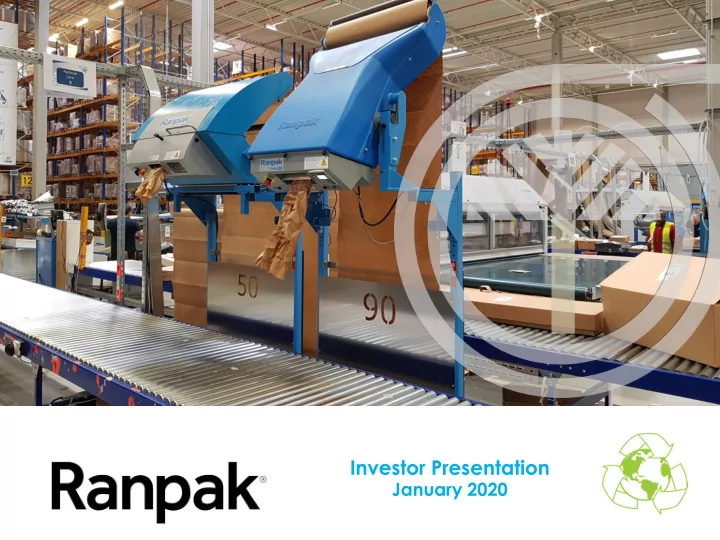
Investor Presentation January 2020 0 Disclaimer CAUTION ABOUT - - PowerPoint PPT Presentation
Investor Presentation January 2020 0 Disclaimer CAUTION ABOUT FORWARD-LOOKING STATEMENTS This presentation contains forward-looking statements within the meaning of Section 27A of the Securities Act of 1933, as amended (the Securities
CAUTION ABOUT FORWARD-LOOKING STATEMENTS This presentation contains “forward-looking statements” within the meaning of Section 27A of the Securities Act of 1933, as amended (the “Securities Act”), and Section 21E of the Securities Exchange Act of 1934, as amended (the “Exchange Act”). Our forward-looking statements include, but are not limited to, statements regarding our or our management team’s expectations, hopes, beliefs, intentions or strategies regarding the future. Statements that are not historical facts, including statements about the parties, perspectives and expectations, are forward-looking
looking statements. The words “anticipate,” “believe,” “continue,” “could,” “estimate,” “expect,” “forecast,” “intend,” “may,” “might,” “plan,” “possible,” “potential,” “predict,” “project,” “should,” “would” and similar expressions may identify forward-looking statements, but the absence of these words does not mean that a statement is not forward-looking. Forward-looking statements in this presentation may include, for example, statements about: our expectations around the performance of the business; our success in retaining or recruiting, or changes required in, our officers, key employees or directors following our initial business combination; our officers and directors allocating their time to other businesses and potentially having conflicts of interest with our business; our public securities’ potential liquidity and trading; the lack of a market for our securities. The forward-looking statements contained in this presentation based on our current expectations and beliefs concerning future developments and their potential effects on us taking into account information currently available to us. There can be no assurance that future developments affecting us will be those that we have anticipated. These forward-looking statements involve a number
forward-looking statements. These risks include, but are not limited to: (1) our inability to secure a sufficient supply of paper to meet our production requirements; (2) the impact of the price of kraft paper on our results of operations; (3) our reliance on third party suppliers; (4) the high degree of competition in the markets in which we operate; (5) consumer sensitivity to increases in the prices of
performance or to meet expectations; (11) our ability to fulfill our public company obligations; and (12) other risks and uncertainties indicated from time to time in filings made with the SEC. Should one or more of these risks or uncertainties materialize, they could cause our actual results to differ materially from the forward-looking statements. We are not undertaking any obligation to update or revise any forward looking statements whether as a result of new information, future events or otherwise. You should not take any statement regarding past trends or activities as a representation that the trends or activities will continue in the future. Accordingly, you should not put undue reliance on these statements. USE OF NON-GAAP FINANCIAL MEASURES This investor presentation includes non-GAAP financial measures for Rack Holdings Inc., including EBITDA, adjusted EBITDA, pro forma adjusted EBITDA, adjusted EBITDA margin, free cash flow, adjusted net sales, net sales, and gross profit on a constant currency basis. Management believes presentation of these non-GAAP measures is useful because they allow management to more effectively evaluate its operating performance and compare the results of its operations from period to period and against its peers without regard to financing methods or capital structure. Management does not consider these non-GAAP measures in isolation or as an alternative to similar financial measures determined in accordance with GAAP. The computations of EBITDA, adjusted EBITDA and free cash flow may not be comparable to other similarly titled measures of other companies. These non-GAAP financial measures should not be considered as alternatives to, or more meaningful than, measures of financial performance as determined in accordance with GAAP or as indicators of operating performance. Ranpak is not in a position to reasonably estimate the expected GAAP net income (loss) for fiscal year 2019. However, it expects to generate a GAAP net loss for such period. FINANCIAL STATEMENTS OF RACK HOLDINGS INC. The financial statement data of Rack Holdings Inc. for fiscal year 2015 included herein have been derived from the financial statements of Rack Holdings that were prepared in accordance with US
Statement on Form S-4, as amended, filed by One Madison with the SEC in connection with the business combination. Accordingly, such financial data may not be directly comparable to the audited financial data of Rack Holdings Inc. for fiscal years 2016, 2017 and 2018 presented herein, which have been audited in accordance with the US PCAOB auditing standards applicable to public companies.
1
2
Machine Installed Base (Exclusively Using Ranpak Consumables)
Addressable market
LTM Pro Forma Net Revenue
LTM Pro Forma Adj. EBITDA
(1) Pro Forma net revenue is a non-GAAP measure, consisting of net sales presented on a constant currency basis for the periods presented and excluding the impact of certain additional specified items. Based on constant currency at € / $ 1.15. (2) Pro forma Adj. EBITDA is pro forma for estimated public company costs in each period, additional management hire, and the acquisition of e3neo. Based on constant currency at € / $ 1.15.
Board of Directors
3
Ranpak Senior Leadership Team Collective experience Collective experience
Omar Asali
Chairman & CEO of Ranpak
Fund Strategies
Robert King
Director of One Madison Corp., Gehl Foods (Chairman), Fresh Pet, and Arctic Glacier
Bottling North America
Tom Corley
Director of One Madison Corp. Chief Retail Officer & President of US Markets, Catalina
Kraft
Michael Gliedman
Managing Director, Blue Strat Advisors
Ass’n
Eric Laurensse
Managing Director Europe
Michael Jones
Director of One Madison Corp.
Lowe’s
Husqvarna
Appliances
Bert Cals
Director of Business Development, Europe
Omar Asali
Chairman & CEO
Michele Smolin
VP – General Counsel
Jean-Yves Sia
Managing Director e3neo
Antonio Grassotti
Managing Director APAC
William Drew
Chief of Staff
Bharani Bobba
Head of Growth Strategies
Salil Seshadri
Chief Investment Officer JS Capital Management, LLC
Team at Soros Fund Management
Alicia Tranen
Founder and General Partner, Boulevard Capital Management
Cantillon Capital
Steve Kovach
Executive Officer of Ranpak Corp
Bret Haldin
VP Global Marketing & Product Development
Joshua Gunn
Global Director of e-Commerce
Trent Meyerhoefer
SVP & CFO
Headquartered in Cleveland, OH with
David Murgio
Chief Sustainability Officer
Jason Cho
Managing Director, Business Development
+ Other additional regional players
50% +
4
Source: Management Estimates, Freedonia. (1) Represents estimates for the North America and Europe systems based segment of protective packaging.
Paper “In-the-Box” Packaging(1) Global Protective Packaging
Bubble 35% Foam 33% Airbags 17% Paper 15% $7 billion global
market
Paper to gain share
from less environmentally friendly substrates
Systems based to
gain share from manual
5
6
7
Wrapping (7% of sales) Cushioning (45% of sales) Automation (4% of sales) Void-Fill (44% of sales)
Focused on filling empty space in secondary
packages
System converts paper to fill empty spaces in
a package and limit object movement
Installed base: 57,186 units Focused on protection of fragile objects
from shocks and vibrations through cushioning
Systems convert paper into cushioning
pads by crimping the paper to trap air between the layers
Installed base: 31,399 units
Focused on designing, manufacturing, and selling automated box sizing equipment for high-volume applications
System minimizes use of in-the-box packaging and automates end of line operation
Focused on securely wrapping
fragile items
System creates paper mesh to
properly protect items
Installed base: 8,883 units
8
Note: Based on audited 2018 financial statements of Rack Holdings Inc. included in the Registration Statement on Form S-4, as amended, filed by One Madison with the SEC on April 23, 2019. (1) North America includes Mexico; Europe includes Western Europe, Central & Eastern Europe, Brazil and e3neo. (2) Other includes Consumer Products, Technical Instruments, Business Services, Chemical/Plastic/Paint/Metal, Printing & Publishing and Other.
By region(1) By category Distribution vs. direct By end markets(2)
Cushioning 45% Void-fill 44% Wrapping 7% Automation 4%
e-Commerce 35% Auto Aftermarket 10% IT / Electronics 8% Machinery 7% Home Goods 6% Industrial 5% Warehousing / Transportation Services 5% Healthcare 5% Other 19%
Distributor 85% Direct 15%
North America 49% Europe 46% Asia 5%
Customers in 50
countries
Historical focus
America and Europe
Rapidly
expanding market in Asia
Full suite of
solutions for protective packaging
Significant IP
protection with 400+ issued patents
Asset-light
distribution model through exclusive relationships with top tier distributors
Longstanding
distributor relationships (most > 15 years)
Over 31,000
end users
Additional
e-Commerce exposure in
markets
e-Commerce growth
and automation tailwinds
9
Source: Company management, industry research. (1) System based portion of the paper market per management estimates.
Fiber Airbags Foam Bubble wrap Loose fill (peanuts) Main application
Cushioning
Void-fill
Wrapping
Void-fill
Cushioning
Insulating
Wrapping
Cushioning
Void-fill Total cost savings Speed / throughput Effectiveness Sustainability Raw material cost stability
Environmental sustainability gaining strong momentum by companies and
consumers globally
85% of Ranpak’s paper packaging in the US consists of either entirely or
partially recycled content
As a dominant pure-play fiber-based provider (estimated 50%+ share in
North American and European markets(1)), Ranpak is well positioned to benefit from fiber share gain
100% Biodegradable 100% Renewable 100% Recyclable
10
(1) Adjusted EBITDA is a non-GAAP measure. Refer to the Appendix to this presentation for a reconciliation of Adjusted EBITDA to net income, the most directly comparable US GAAP measure. (2) Free cash flow conversion (FCF Conversion) is a non-GAAP measure. FCF Conversion defined as Adj. EBITDA - Maintenance Capex / Adj. EBITDA. Refer to the Appendix to this presentation for a reconciliation
>31,000
Broad Customer Base
15 Months
Average Payback Period on Machine Investment
84%
2018 FCF Conversion(2)
32%
2018 Adj. EBITDA Margin(1)
>30%
e-Commerce Exposure
Sales Growth Industry Leading EBITDA Margin High Cash Flow Conversion Attractive Unit Economics Resilience Diverse End Users e-Commerce Growth Engine
Stable
2008A – 2009A
7%
2015A – 2018A CAGR
24 24 27 31 36 45 50 52 54 57 60 64 70 76 82 91 97 102 02A 03A 04A 05A 06A 07A 08A 09A 10A 11A 12A 13A 14A 15A 16A 17A 18A Current
11
Note: Based on unaudited sales prior to 2015 (1) 2015 to 2017 sales figures are pro forma for the e3neo acquisition. Adjusted net sales is a non-GAAP measure, consisting of net sales presented on a constant currency basis for the periods presented and excluding the impact of certain additional specified items. Based on constant currency at € / $ 1.15. Refer to the Appendix to this presentation for a description of the basis of presentation and a reconciliation of Adjusted net sales to net sales for the years 2015 - 2018, the most directly comparable US GAAP measure.
($ in millions, unless otherwise noted)
$85 $89 $100 $112 $128 $149 $158 $144 $156 $176$176 $188 $216$218 $233 $246 $264 $273 02A 03A 04A 05A 06A 07A 08A 09A 10A 11A 12A 13A 14A 15A 16A 17A 18A LTM
% of market ~40% ~5% ~5% ~10% ~2% % of Ranpak sales(1) ~35% ~10% ~8% ~7% ~6%
Low to mid teens GDP plus
B2C B2B
12
Source: Freedonia and US Census. (1) Based on 2018 financial statements of Rack Holdings Inc. included in the Registration Statement on Form S-4, as amended, filed by One Madison with the SEC on April 23, 2019.
Underlying Market e-Commerce Automotive auto aftermarket IT / electronics Machinery Home goods
Integrated
packaging solutions, depending on layout of distribution centers
Low handling time
and cost
Strong protective
qualities, as parts are often heavy, have sharp edges, and a high unit price
Integrated
packaging solution to fit industrial processes
Low need for
protective properties, as goods are often pre-packaged
Cushioning
material with modern image
Delicate parts
require strong protective properties
Void-fill and
wrapping solutions which conform to complex shapes
Provide some
degree of cushioning Requirements Representative customers Examples
Shoes shipped via
Individual car part
shipped from manufacturer to repair shop
Phone part
shipped between manufacturing locations
Machine parts
shipped to another company division
Assembled chair
shipped to retail store Example use case
13
#1 #2
Systems placed at no cost to end user
No capital outlay required for end users to improve efficiency of their business High speed and reduced handling results in higher productivity
Throughput and speed
Paper is faster than air bags Paper produced on demand and at the point of operation reducing handling 9 out of 10 people prefer paper(1)
Efficacy – flexibility and reduced breakage
Total cost of ownership is lower Superior protection offered reduces damages More flexible in application and can be used for cushioning, void fill and wrapping Paper fits into all voids, while air bags can only fill large voids due to their fixed shape Air bags subject to puncture and deflation while paper maintains its integrity
Reliability of machines and service
Quality of systems (reliability and durability) gives end users confidence in their packaging solution Excellent customer service and responsive account representatives
Sustainability
The recycling rate for paper is ~70% vs. ~5% for plastic packaging in the US and Europe(2) Ranpak paper comes from SFI(3) or FSC(4) certified sources and is the only truly renewable packaging resource
#3 #5
(1) CEPI sustainability research 2011. (2) European Paper Recycling Council; American Forest & Paper Association. (3) Sustainable Forestry Initiative. (4) Forest Stewardship Council.
#4
Customers exclusively use Ranpak’s consumables High customer satisfaction due to reliability and
high quality
Reliable provider of fulfillment service
14
Machines provided at low cost to distributors with
bulk of revenue generated from sales of high margin consumables
Attractive unit economics Asset-light model with low working capital enables
high FCF generation
Flexibility to reach thousands of end-users with a
lean salesforce Recurring sales Efficient economic model
Global installed base of more than 100,000 systems End-users are contractually committed to buy
Ranpak’s high margin and specialized consumables
Ranpak owns all of the machines and can reuse /
refurbish them to extend their useful lives
26,000+ End Users 230+ Distributors
End users
230+ Distributors Systems and consumables sold direct and through exclusive distributors Recurring sales
Sales breakdown by relationship length(1) Number of distributor-serviced accounts by size(1) 15
Sells value-added consumables to end-users through an established network of more than 240 exclusive distributors
worldwide
Fragmented end-user base in diverse markets with small average account size pricing power and competitive barriers Why distributors win:
−Partner with leading paper system solution provider to facilitate sales. Extensive ongoing training and marketing to ensure high service levels − Exceptional value proposition for end users: total cost, speed, quality
Long-standing customer partnerships
> $75k 3% $35k - $75k
$10k - $35k 14% $2.5k - $10k 44% < $2.5k 36% < 5 Years 12% 5 - 10 Years 7% 10 - 15 Years 8% > 15 Years 73%
Average account size approximately $8,500
(1) Estimated based on unaudited 2017 financial information of Rack Holdings Inc.
80% under $10k
Low turnover with many relationships over 20 years
16
17
#1 #3
Geographic Expansion
High growth international opportunities - Asia-Pacific (~5% of sales) and South America
New Products and Automation
Increased innovation activity to excite customers ― Next generation Void-fill, Cushioning and Thermal ― Pad’It (Automation) Expand Automation to North America Portfolio expansion and new product lines Thermal offering to serve burgeoning online grocery and meal kit delivery markets
Retailers & Channel Expansion
Retail distribution for wrapping solutions – compete against foam and bubble wrap ― Expand Geami product offering Brick and mortar conversion to omni-channel ― Ship from store / take-with / return hubs for e-Commerce
Improved Branding and Outreach
Improving Ranpak’s digital presence ― New website, digital content, and marketing campaigns ― Improved access to data and ease of doing business for our customers Partnering with NGO’s to drive awareness of Ranpak and benefits of paper vs plastic
Making Machines Smarter
Utilize technology to optimize throughput, machine placement, and servicing needs
#5 #2 #4
Focus on areas with: higher labor costs, internet penetration, IP protection, industrial growth Aggressively pursue growth in China and India, especially related to e- Commerce Leverage relationships with existing multi-national customers Partner with local distributors and end use customers to create a strategic presence
18
Ranpak’s APAC business currently represents
Longer term Near term
Sales offices located in Japan, China and Singapore
Recently reorganized sales personnel and distribution network in China
Given the market size, APAC has the potential to become a substantial part of the portfolio
Paper-based systems led by Geami & WrapPak are compelling alternatives to plastic bubble wraps
Global bubble wrap market $2.6bn NA $0.8bn Geami marketing
Source: Industry research, Statista, and Pitney Bowes
Presentation
Perfect in-the-box presentation enhances the customer unboxing experience
Time savings
Pads are created at high speed with minimal reloading necessary
Cost effective
Less material is needed to provide optimal protection
EMEA $0.8bn APAC $1.1bn vs. Ranpak’s 2018 total wrapping sales of $19m
40 12 10 China USA Japan Parcels (in b)
Parcel Shipping Business is Booming Worldwide (2017)
19
Throughput, machine placement, and servicing
Substantial opportunity in growing grocery, meal kits, and pharma
20
21
Pro Forma Net Sales(1) $246.3 $264.3 $66.5 $59.9 $70.4 $273.3 Pro Forma Gross Profit(2) 114.1 113.1 28.3 25.4 31.1 117.5 Gross Profit Margin % 46.3% 42.8% 42.6% 42.5% 44.2% 43.0% Pro Forma Adj. EBITDA(3) 85.7 85.0 19.4 16.9 22.0 83.4 Pro Forma Adj. EBITDA Margin % 34.8% 32.2% 29.2% 28.2% 31.3% 30.5%
(1) Adjusted net sales is a non-GAAP measure, consisting of net sales presented on a constant currency basis for the periods presented and excluding the impact of certain additional specified items. Based on constant currency at € / $ 1.15. 2017 results are pro forma for the e3neo acquisition. (2) Pro Forma Gross Profit is a non-GAAP measure. Refer to the Appendix to this presentation for a reconciliation. Based on constant currency at € / $ 1.15. (3) Adjusted EBITDA is a non-GAAP measure. Refer to the Appendix to this presentation for a reconciliation of Adjusted EBITDA to net income. Pro forma Adj. EBITDA is pro forma for estimated public company costs in each period, additional management hire, and the acquisition of e3neo. Based on constant currency at € / $ 1.15.
31 32 56 60 9 11 20 40 60 80 100
3Q18 3Q19 Cushioning Void-fill Wrapping
$65.1 $64.7 $69.1 $70.4 $50 $55 $60 $65 $70 $75
GAAP Net Sales Pro Forma Adj. Net Sales 3Q18 3Q19
22
Note: Figures based on Unaudited Preliminary internal company financial statements. Refer to the Appendix to this presentation for a description of the basis of presentation and a reconciliation of non-GAAP figures to the most directly comparable US GAAP measures including pro forma adj net sales to net sales, pro forma adj. gross profit to gross profit, and pro forma adjusted EBITDA to net income. Pro forma adjusted figures based on constant currency of at € / $ 1.15. (1) Pro forma Adj. net sales is a non-GAAP measure, consisting of net sales presented on a constant currency basis for the periods presented pro forma for impact of fair-value purchase accounting adjustment related to deferred revenue for user fees of $0.1 million in 3Q19.
Net sales(1) Installed base +6.1%
($ in millions, machines in thousands)
+7.5% +8.8%
102 95
$20.6 $22.0 31.9% 31.3% 25.0% 27.0% 29.0% 31.0% 33.0% 35.0% $10 $12 $14 $16 $18 $20 $22
3Q18 3Q19 PF Adj EBITDA % Margin
$27.4 $27.2 $29.5 $31.1 $20 $25 $30 $35
GAAP Gross Profit Pro Forma Adj. Gross Profit 3Q18 3Q19
23
Note: Figures based on Unaudited Preliminary internal company financial statements. Refer to the Appendix to this presentation for a description of the basis of presentation and a reconciliation of non-GAAP figures to the most directly comparable US GAAP measures including pro forma adj net sales to net sales, pro forma adj. gross profit to gross profit, and pro forma adjusted EBITDA to net income. Pro forma adjusted figures based on constant currency of at € / $ 1.15. (1) Pro forma Gross Profit Margin is a non-GAAP measure. Refer to the Appendix to this presentation for a reconciliation of Gross Profit to Pro forma Gross Profit / Pro forma net sales (2) Pro forma adjusted EBITDA is a non-GAAP measure. Refer to the Appendix to this presentation for a reconciliation of Adjusted EBITDA to net income. Adjusted EBITDA is earnings before interest expense, income taxes, depreciation and amortization plus other non-core and non-cash adjustments including recruiting fees and non-recurring professional fees. Pro forma Adj. EBITDA is pro forma for estimated public company costs in the prior period, additional management hires, and purchase accounting adjustment related to deferred revenue of $0.1 million.
Gross Profit and Margin(1) Pro Forma Adj. EBITDA(2)
($ in millions)
Margin +70 bps to 42.7% +6.9% Margin +220 bps to 44.2% GAAP Figures 3Q18 3Q19 Net sales $65.1 $69.1 Cost of sales 37.7 39.6 D&A 10.7 10.3
1.9 1.0 Net Income 0.3 (1.6)
2.9% 1.4%
24
(1) Adjusted EBITDA is a non-GAAP measure. Refer to the Appendix to this presentation for a reconciliation of Adjusted EBITDA to net income, the most directly comparable US GAAP measure. (2) Net of estimated offering fees and expenses (3) LTM Pro Forma Adj. EBITDA as of 9/30/19
24
Raised $110 million in gross proceeds from public offering in December 2019 to reduce
leverage
Will continue to de-lever through organic growth and debt paydown to achieve
steady-state leverage target of 3.0x – 3.5x Adjusted EBITDA(1)
Balance Sheet Notes
5 year Revolving credit facility of $45 million (undrawn) 7 year First Lien Term Loan at L + 3.75% (pro forma for equity offering) Pro Forma 9/30/19 $431.7 million term loan outstanding includes euro tranche of
€140mm
Entered into deal contingent interest rate swap on $200mm USD
($ in mm)
9/30/2019 Adjustments(2) Pro Forma Cash & Equivalents $13.6 $13.6 Revolver $0.0 $0.0 Term Loan Facilities $539.0 ($107.3) $431.7 Leverage Net Debt $525.4 $418.1 Net Debt / LTM PF Adj. EBITDA ($83.4M)(3) 6.3x 5.0x
25
Note: Share numbers in millions. As of 9/30/19 and pro forma for issuance of 16.9mm shares in $110mm equity offering at $6.50 per share (1) Does not include 20.1 million warrants with an exercise price of $11.50
# of Shares Vesting Price
0.16 $12.25
3.75 $12.50 2.9 $15.00
26
(1) Adj EBITDA is a non-GAAP metric. FCF Conversion defined as Adj. EBITDA-Maintenance Capex / Adj. EBITDA. Refer to the Appendix to this presentation for a reconciliation of Adjusted EBITDA to net income, the most directly comparable US GAAP measure.
Long-term sales growth – 7.0% 2013A to 2018A CAGR e-Commerce led growth – 30%+ e-Commerce exposure Industry-leading EBITDA margin – 32% 2018A Adjusted EBITDA Margin High cash flow conversion – 84% 2018A FCF conversion(1) High customer retention rates – 31,000+ installed base of customers Asset-light distribution model underpins resilience – stable Adj. EBITDA 2008 to 2009 Razor-razorblade business model – customers buy Ranpak consumables exclusively Attractive unit economics – ~15 months payback period on machine investment
Financial highlights Incremental upside
Outsized market tailwinds Geographic expansion Next generation innovation Fiber gaining share from plastic Thermal/cold chain innovation M&A
The Paper Packaging Experts
™
27
28
Note: 2017 – 2018 financials derived from audited financial statements of Rack Holdings Inc. included in the Registration Statement on Form S-4 filed by One Madison with the SEC on March 1, 2019. (1) Represent unaudited financials. Due to the predecessor and successor accounting periods relating to the closing of the business combination, for the convenience of readers, we have presented the three and nine month periods ended September 30, 2019 on a combined basis (reflecting simple arithmetic combination of the GAAP predecessor and successor periods without further adjustment) in order to present a meaningful comparison against the corresponding periods in the three and nine months ended September 30, 2018 (2) Financial metrics of the Company presented on a constant currency basis, including net sales, gross profits, and Adjusted EBITDA on a constant currency basis. The average foreign exchange rate used by the Company for the three months ended September 30, 2019 and 2018 was $1.15:€1.00.
Annual Quarterly 9 months ended 9/30, $ in millions FY17 FY18 1Q18 1Q19 2Q18 2Q19 3Q18(1) 3Q19(1) 2018 (1) 2019 (1) LTM Net sales Reported net sales 244.1 267.9 61.6 66.1 65.2 56.6 65.1 69.1 191.9 191.8 267.7 Constant currency adjustment 2.1 (3.1) (2.1) 0.5 (1.1) 0.7 (0.4) 1.2 (3.6) 2.4 2.9 Constant currency net sales(2) 246.2 264.7 59.5 66.5 64.1 57.3 64.7 70.3 188.4 194.2 270.5 Automation revenue recognition 0.1 (0.4) (0.4) (0.4) Purchase accounting 2.6 0.1 2.7 2.7 Pro forma net sales(2) 246.3 264.3 59.1 66.5 64.1 59.9 64.7 70.4 188.0 196.9 273.3 Gross profit Reported cost of sales 131.3 153.3 34.8 37.9 37.1 36.2 37.7 39.6 109.7 113.7 157.4 Automation cost of sales recognition (0.3) (0.3) (0.3)
(2.1) (1.0) (3.1) (3.1) Constant currency adjustment 0.9 (1.8) (1.1) 0.3 (0.6) 0.4 (0.2) 0.7 (2.0) 1.4 1.6 Pro forma cost of sales 132.2 151.2 33.4 38.2 36.5 34.5 37.5 39.3 107.4 112.0 155.8 Pro forma gross profit at constant currency(2) 114.1 113.1 25.8 28.3 27.6 25.4 27.2 31.1 80.6 84.9 117.5 % margin 46.3% 42.8% 43.6% 42.6% 43.0% 42.5% 42.0% 44.2% 42.8% 43.1% 43.0% Pro forma Adjusted EBITDA Net income (loss) 27.7 (8.7) (6.8) (3.4) 1.9 (26.1) 0.3 (1.6) (4.6) (31.0) (35.0) Depreciation & amortization 61.1 64.5 16.3 16.1 15.9 15.2 16.0 15.4 48.3 46.7 62.9 Interest expense 30.7 30.9 7.1 8.1 7.8 11.6 8.0 9.5 22.9 29.2 37.3 Income tax benefit (41.4) (7.1) (1.3) (0.6) 0.9 4.7 (5.5) (3.7) (5.9) 0.3 (0.8) Unrealized (gain) / loss on translation 14.2 (4.2) 3.0 (2.1) (6.3) (1.1) (0.8) (3.2) (4.1) (6.4) (6.6) Purchase accounting
1.1 5.8 5.8 Constant currency adjustment at 1.15 0.8 (1.1) (0.7) 0.1 (0.4) (1.6) (0.1) 0.4 (1.2) (1.1) (1.0) Non-cash impairment losses 1.1 1.8 0.3 0.2 0.4 1.4 0.6 0.2 1.4 1.7 2.2 M&A, restructuring and severance 1.6 7.5 0.0 0.8 0.5 7.7 2.0 2.0 2.5 10.5 15.5 PE sponsor costs 2.0 1.6 0.4 0.5 0.5 0.5 0.4 1.3 1.0 1.3 RSU 0.2 1.6 1.8 1.8 Other non-core and non-cash adjustments 1.6 2.7 0.6 0.4 0.5 0.1 0.5 0.5 1.7 1.0 2.0 Adjusted EBITDA(2) 88.5 88.0 18.9 20.2 21.8 17.4 21.4 22.0 62.1 59.5 85.4 Pro forma Automation (0.2) (0.1) (0.1) (0.1)
(2.6) (2.9) (0.7) (0.7) (0.7) (0.5) (0.7) (2.2) (1.2) (2.0) Pro forma Adjusted EBITDA(2) 85.7 85.0 18.1 19.4 21.1 16.9 20.6 22.0 59.8 58.3 83.4 % margin 34.8% 32.2% 30.6% 29.2% 32.9% 28.3% 31.9% 31.3% 31.8% 29.6% 30.5%