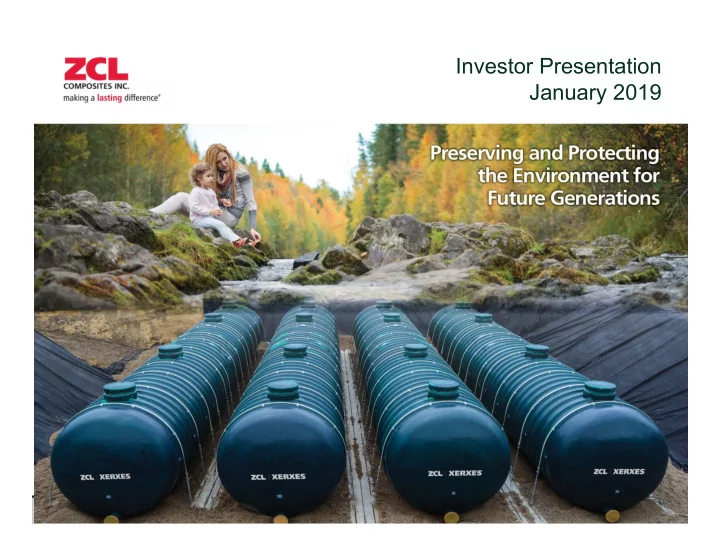
Investor Presentation January 2019 Forward-Looking Information - - PowerPoint PPT Presentation
Investor Presentation January 2019 Forward-Looking Information Advisory Regarding ForwardLooking Statements This document contains forwardlooking statements concerning future events or the Companys future performance, including the
Forward-Looking Information
Advisory Regarding Forward‐Looking Statements
This document contains forward‐looking statements concerning future events or the Company’s future performance, including the Company’s
- bjectives or expectations for revenue and earnings growth, business opportunities in the Fuels, Water & Wastewater, Oil & Gas and other markets,
efforts to reduce administrative and production costs, manage production levels, anticipated capital expenditure trends, activity in fuel and other industries and markets served by the Company and the sufficiency of cash flows and credit facilities available to cover normal operating and capital
- expenditures. Forward‐looking statements are often, but not always, identified by the use of words such as “seek,” “anticipate,” “plan,” “continue,”
“estimate,” “expect,” “may,” “will,” “project,” “predict,” “potential,” “targeting,” “intend,” “could,” “might,” “should,” “believe”, “forecast” and similar expressions. Actual events or results may differ materially from those reflected in the Company’s forward‐looking statements due to a number
- f known and unknown risks, uncertainties and other factors affecting the Company’s business and the industries the Company serves generally.
These factors include, but are not limited to, fluctuations in the level of capital expenditures in the Fuel, Water & Wastewater and Oil & Gas Markets, drilling activity and oil and natural gas prices, and other factors that affect demand for the Company’s products and services, industry competition, the need to effectively integrate acquired businesses, uncertainties as to the Company’s ability to implement its business strategy effectively, political and economic conditions, the Company’s ability to attract and retain key personnel, raw material and labour costs, fluctuations in the U.S. dollar, euro and Canadian dollar exchange rates, and other risks and uncertainties described under the heading “Risk Factors” in the Company’s most recent Annual Information Form, and elsewhere in this document and other documents filed with Canadian provincial securities authorities. These documents are available to the public at www.SEDAR.com. In addition to the factors noted above, management cautions readers that the current economic instability in the world today could have a negative impact on the markets in which the Company operates and on the Company’s ability to achieve its financial targets. Factors such as continuing global economic uncertainty, tighter lending standards, volatile capital markets, fluctuating commodity prices, and other factors could negatively impact the demand for the Company’s products and the Company’s ability to grow or sustain revenues and earnings. Fluctuations in conversion rates of the U.S. dollar to Canadian dollar and euro to Canadian dollar have the potential to impact the Company’s revenues and earnings. The Company believes that the expectations reflected in the forward‐looking statements are reasonable, but no assurance can be given that these expectations will prove to be correct and such forward‐looking statements included in this report should not be unduly relied upon. The forward‐looking statements in this report speak only as of the date of this presentation. The Company does not undertake to update any forward‐ looking statement, whether written or oral, that may be made from time to time by the Company or on the Company’s behalf, whether as a result of new information, future events, or otherwise, except as may be required under applicable securities laws. The forward‐looking statements contained in this document are expressly qualified by this cautionary statement.
Mission Statement Our Mission Is
"To deliver peace of mind through corrosion-resistant solutions that preserve and protect the environment."
- TSX symbol
ZCL
- Basic common shares o/s
30.6M
- Shares held by mgmt & directors
1.4M
- Equity market capitalization
$195M
- Net bank indebtedness (September 30, 2018)
$3.8M
- Dividend per share (quarterly/annual)
$0.135/$0.54
- Yield
7%
- Cash‐based dividend payout ratio
83% of funds from continuing operations
- Total Shareholder Return ‐ Five Year CAGR
25% (share price appreciation and dividends paid to 2017)
- NCIB implemented March 2015
up to 1,500,000 shares (2018/19 approval) 530,500 shares repurchased @ $6.10 in 2015 290,500 shares repurchased @ $10.92 in 2017 391,400 shares repurchased @ $9.04 in 2018
Market Summary
Executive Team
- President & CEO
Ted Redmond
- Chief Financial Officer
Kathy Demuth
- VP Fuel Markets
Tom Tietjen
- VP Water & Wastewater Markets
Jan Arciszewski
- VP Oil & Gas/International Markets
Gerardo Zendejas
- VP Human Resources
Joe Santoro
- VP Manufacturing
Shawn Roach
Board of Directors
- Tony Franceschini, Chair
- Ron Bachmeier
- Bruce Bentley
- Diane Brickner
- Leonard Cornez
- Joseph Gysel
- Darcy Morris
- Ted Redmond
- Ralph Young
Executive Team & Board of Directors
Brand & Market Overview
Core Market Emerging Markets Fuel (~80% of Revenue) Water & Wastewater (~15% of Revenue) Oil & Gas (~5% of Revenue)
Key Competitive Advantages
- People (experienced, knowledgeable, long‐term, loyal employees)
- Strong global brands and reputation in Fuel markets
- Customer alliances and retention
– Contract renewals and pre‐buys – Strong national account customer base – majority of active buyers loyal to ZCL
- Transportation challenges provide economic moats
– North America – protected from foreign competition on USTs
- Broad geographic presence enhances competitiveness of delivered pricing
– Allows ZCL to offer customers the shortest lead times in the industry
- Strong balance sheet and free cash flow generating capability with strong return on
capital employed
- Website as marketing resource for project designers, engineers and end user
customers
North American Coverage
Fuel Markets
Applications
- Downstream Fuel – storage tanks at retail & commercial fuel sites
- Primarily double‐wall FRP underground fuel tanks (triple‐wall available)
Key Differentiators
- 2,500 liters to 200,000 liters, single or multi‐compartmental
- Double‐wall allows continual interstitial monitoring (liquid sensors, air pressure, vacuum or
hydrostatic) – Hydrostatic most common; provides continuous monitoring (not available in steel tanks)
Estimated Market Sizes1
- $200M ‐ $250M addressable market in United States (estimated capture rate > 50%)
- $25M to $35M addressable market in Canada (estimated capture rate > 85%)
Competitors
- Fiberglass – CSI Denali (only other FRP provider)
- Steel – Modern Welding, Highland, Northern Steel, and many regional manufacturers
Customers
- Primarily retail fuel marketers (gas station, convenience store and truck stop operators) and
equipment distributors
Current Market Conditions
- U.S. market activity strong, including distributors, "big box" retailers and larger convenience
store chains
- Improving Canadian market – being led by larger retail fuel marketers as well as distributors
Fuel Markets
- 1. Market sizes expressed in Canadian Dollars; Market sizes and capture rate estimated based on management’s knowledge of industry and historical purchasing activities
- f customer base
Market Growth Focus
- Mature market – focus on demographic shift for new to industry construction
- 1980's tanks reaching end of original 30 year warranty (both steel and FRP), leads to increased rate
- f tank replacement
– State regulatory replacement mandates increasing – Owners choosing to implement replacement plans for risk management purposes – Insurance and bank limitations on age of tanks covered
- Historically high retail profits due to increasing retail fuel volumes provide capital funding for site
expansion – Continued expansion by large regional C‐store chains and nontraditional fuel retailers using fuel based customer loyalty programs to grow market share
- Future fuels (E15, E85, biofuels) – replacement and upgrades
– Growing recognition that biofuels add to concerns about internal corrosion in steel tanks – June 2016 EPA Notice regarding internal corrosion of steel tanks storing diesel fuel (ULSD)
- Diesel Exhaust Fluid (DEF) – highway, off‐road construction, marine
– Bulk storage of DEF will continue to increase
- Decreasing steel market share continues to provide growth opportunities
- Excellent distributor network in place selling to small retailers and commercial accounts
Fuel Markets
Fuel Markets
Downstream Fuel – Estimated Market Share
- Management believes ZCL has gained significant market share1 over the past 10
years – Primarily at the expense of steel with recent gains versus CSI as well
- Steel accounts for <15% of new installations but is still 40% to 50% of today's
installed/in‐service tank base – Represents over 275,000 in service USTs in the U.S. and Canada that are replacement targets
- 1. Market size and market share estimated based on management’s knowledge of industry and historical purchasing activities of customer base
ZCL CSI Steel
Fuel Markets
Downstream Fuel UST Ages
- Some studies1 estimate 15% ‐ 20% of today's installed/in‐service tanks are >30
years old while 50% ‐ 60% are >20 years old – Based on historical sales data and regional studies of installed tank base ages
- This implies ~100,000 tanks >30 years old and ~300,000 tanks >20 years old
– Supports our future growth forecast based on current ~7,500 USTs sold in North America annually
- 1. Sources include a study published in October, 2015 from the Association of State and Territorial Solid Waste Management Officials titled “An Analysis of UST Systems
Infrastructure in Select States”
Applications
- ZCL serves all Water & Wastewater submarkets in which tanks are employed as a
component of the system:
– Water Conservation ‐ Rainwater collection and use, stormwater detention/filtration – Plumbing Engineered Solutions – Grease/oil/solids interceptors and decontamination – Wastewater – Decentralized onsite wastewater treatment, municipal wastewater collection – Fire Protection ‐ Dry hydrant cisterns, sprinkler systems – Industrial Wastewater ‐ Wash down drainage and leachate treatment – Potable Water ‐ Potable water storage
Water & Wastewater Markets
Estimated Market Size1
- Total addressable market size of $400M ‐ $500M in North America, based on primary offering
(5,000 to 100,000 gallons)
- Market segments vary from $20M to $100M
Competitors
- Concrete is dominant (>80%) with hundreds of regional suppliers including DN Tanks, Old
Castel, Jensen Precast, PRECON, Contech and Tanks A Lot
- FRP – CSI Denali and many small regional manufacturers including LF, Canwest, Barski, Granby
(Nemo) and Zurn Green Turtle
- HDPE/Poly (under 5,000 gallons) – Norwesco, Snyder, Darco, Infiltrator, Tank Holding Co,
Beden‐Baugh Products, Fabricated Plastics, CanWest and many national and regional manufacturers
Customers
- Various end users, system integrators and engineering firms
Water & Wastewater Markets
- 1. Market size expressed in Canadian Dollars and estimated based on Lucintel market study commission by ZCL and management’s knowledge of industry
Water & Wastewater Markets
Customer Profile
Market Segment Specifier Profile Owner/Influencer Profile Other Comments Potable Civil, Regulators, Contractors School boards, private, commercial NSF listing gives competitive advantage Industrial EPC or in‐house engineering Food and beverage, dairy, brewery, wineries Limited on temperature, pressure, and degree of chemical exposure Water Conservation Civil, Regulators, Contractors Municipal, commercial, industrial Deep bury, large diameter is sweet spot Wastewater Civil, Regulators, Contractors Commercial, industrial, rural development Light weight design Fire Protection Civil, Mechanical Fire Chiefs, Fire Marshals, airports, military Fire community can be influential PES Plumbing/Mechanical Engineers, Regulators Restaurants, stadiums, building owners, C‐stores Very price driven particularly smaller volumes (<2k gal)
Key Differentiators
- Strong value proposition between 5,000 and 100,000 gallons (particularly 20,000 to 50,000)
- Lower life cycle cost given minimal maintenance required vs. concrete
- Superior corrosion resistance for applications with higher degree of environmental sensitivity
- Watertight, lightweight and easy to install products
Current Market Conditions
- Tied to construction cycle
– Institutional, commercial, industrial and residential building continue to slowly improve
- Broad water market should benefit from increased construction activity and economic growth
- Evolving government regulations for wastewater, stormwater, combined sewer overflow (CSO),
FOG (fats, oils, grease) and fire submarkets will support growth
- Growing awareness of water as a scarce resource with value causing water pricing to increase
– Leads to conservation, recycle, reuse systems with tanks
Water & Wastewater Markets
Market Growth Focus
- FRP poised to gain market share from concrete based on:
– Specifications
- By establishing preferred partner status with major water/wastewater integrated
solutions providers and expanding industry‐specific indirect channel network – Life cycle cost
- Higher value of factory‐manufactured, watertight, lightweight, structurally strong and
easy to install storage vessel delivered to site for same‐day installation
- Compares to long‐term construction project and high maintenance costs of poured‐in‐
place concrete – Sustainability advantages
- Studies prove “carbon footprint” of FRP products is superior to concrete and steel1
- Opportunities to capitalize on evolving regulatory environment
– Environmental awareness: "scarce commodity with value" is a key opportunity – Water reuse/recycle movement is macro driver – Urban stormwater regulations driving new opportunities – Increased regulatory focus on use of grease interceptors provides opportunity
- U.S. drought conditions support growth of rainwater collection
Water & Wastewater Markets
- 1. Sources include 2016 Stanford University Lifecycle Analysis comparing FRP to Concrete
Applications
- Midstream Oil & Gas – sump tanks for pipeline systems
- Upstream Oil & Gas – storage & process vessels at E&P sites
Estimated Market Size1
- $50M addressable market in geographies served by ZCL (Canada & US)
– Current capture rate of ~10%, provides compelling growth opportunity Competitors
- Midstream Oil & Gas – CSI Denali & small regional steel manufacturers
- Upstream Oil & Gas – regional steel manufacturers
Oil & Gas Markets
- 1. Market size expressed in Canadian dollars and estimated based on 2017 BCC study commissioned by ZCL and management’s knowledge of industry
Customers
- Several major pipeline and E&P companies operating in North America
Key Differentiators
- Superior corrosion resistance in an area with a high degree of environmental
sensitivity
- Ability to provide engineered solutions to EPC companies
Current Market Conditions
- Pipeline expansion combined with aged steel pump station sump tank
infrastructure will drive midstream sales growth (pump station sump tanks)
- Production activity in Western Canada and the US continues to trend positively
Oil & Gas Markets
Parabeam
- Manufactured in Helmond, The Netherlands
- 3D woven glass fabric used in new double‐wall tanks and Phoenix System
– Also applications in boats, ships, trucks, cars, trains and as a building material
- Relative advantages include lighter weight, corrosion resistance and insulation properties
- 15%‐20% of output sold externally (remainder used in ZCL products)
Licensing
- Licensees in several international markets for tank manufacturing and Phoenix System
- Agreements include upfront technology licensing fees and ongoing royalties based on sales
– Also generates sales of ZCL products used to produce licensee products (e.g. Parabeam)
Specialty Products
Strategic Planning Process
Profit Improvement Plan Overview
5% Gross Margin Improve ment in 2020
Improve Employee Productivity Control Spending on Warranty, Safety, and Mainte‐ nance Reduce HR, IT, Sales, Marketing, and Mfg. Overhead Reduce Volume of Resin, Glass and Labor Per Tank Plus: Get Revenue back to 2017/2018 levels
Profit Improvement Plan Update
Estimated 2019 Savings from Implemented Actions (from initiatives rolled out since September 1, 2018):
- Reduction in overhead positions and overhead costs ‐ Savings of $600,000+/year
- Not replacing COO Role ‐ Savings of $480,000/year
- Cancelling 3rd Shift at Seguin on Nov. 29th ‐ Savings of $1.2+ Million in 2019 versus 2018
- Plants – moving shift leads from less than 50% direct to 85% direct work – Savings of
$360,000/year
- Small tank structural simplification – Savings of $400,000/year
- Lift lug standardization – Savings of $123,000/year
- Improved resin formulation – Savings of $337,000/year
- Improved multi‐compartment tank manufacturing process ‐ $560,000 compared to 2018,
project to be complete in March 2019
Note: Some of these initiatives were started in 2017 or early 2018 but implemented in manufacturing post Sept. 1st
Other profit improvement activities in process but note that increases in other costs may offset some of the savings
R&D Spending Comparison
Fiscal Year 2017 R&D as a % of Revenue Capex as a % of Revenue Op Margin as a % of Revenue R&D as a % of Op Margin Capex as a % of Op Margin Owens Corning 1.4% 6.6% 13.2% 11% 50% Hexcel 2.4% 16.4% 18.0% 13% 91% Solvay 2.8% 7.7% 9.3% 30% 84% 3M 4.1% 4.7% 24.0% 17% 20% BRP 4.0% 4.2% 7.4% 54% 56% Magna 1.3% 4.8% 7.3% 18% 65% Fortive** 6.2% 2.1% 20.4% 30% 10% ZCL Composites 0.5% 2.6% 16.5% 3% 16%
Source: Sedar; Top 2500 R&D spending companies in the world per The 2017 EU Industrial R&D Investment Scoreboard, European Commission Joint Research Sector **Fortive owns Veeder Root one of the largest suppliers of C‐store equipment including dispensers, gauges
Strategic Plan Overview
1. Plan gets Margins get back to historically strong 2014 to 2017 levels in 2020 and margins reach the previous 2016 peak levels in 2021 2. Short term focus on restoring margins and cash flow 3. Mid term focus on growing revenue by developing new products and services to drive fundamental demand growth – Plan also anticipates further improving our marketing and sales efforts to target, find, and convince customers to switch to FRP and ZCL 4. Plan increases R&D expenditures to significantly increase focus on new product development as well as ramping up the rate of process improvements efforts to reduce costs and increase production margins
Strategic Plan Overview
2019 – Quick Wins 2020 – Digging Deeper 2021 – Bigger Steps
Quick Wins:
- Implement Profit Improvement
Plan
- Complete other revenue
generation or cost reduction items in process Margin Improvement Focus: Focus on low R&D and Capital Cost projects with short timelines that will improve margins and grow revenue New Products: Complete development of first round
- f new products and roll out to
market Process Improvements: Implement some of the medium capital intensity production margin improving projects
- Semi automation of molding process
- Plant layout improvements
Build Acquisition Pipeline Increased networking with possible acquisition candidates to build a real pipeline of possibilities New Products: Complete development of second round of new products and roll out to market Process Improvements: Begin a phased implementation of some of the higher capital cost production margin improvement projects
- Steel molds in U.S. plants
- More plant layout improvements
R&D Continue with R&D on significant product development or margin improvement projects
- Development of new significantly lower
cost manufacturing process Acquisitions Complementary acquisitions to add products in existing markets
Product Development Road Map (2019 to 2021)
- 1. UST Sumps
- 2. Services
- 3. UD Sumps
- 4. Oil/Water Separators
- 5. Others
FUEL
- 1. Larger Tanks
- 2. Water Detention Tank
Systems
- 3. 5’ Tank
- 4. Lower Cost Single Wall
Tank
WATER
- 1. Larger Flare Knock Out
Tanks
- 2. Above Ground Tanks
(that fit with current molding processes)
OIL & GAS
Process Improvement Road Map
- 1. Centralize Field Service
- 2. Material Waste
Reduction
- 3. Mold Improvement and
More Larger Molds
- 4. Molding Process
Improvement, Standardization and Partial Automation
- 5. Improved Component
Sourcing
- 6. Improved Plant Layouts
and Process Flow
2019
- 1. Increased Use of
Adhesives to Reduce Assembly Costs
- 2. Improved Methods for
Cutting Manways and Reservoirs
- 3. Increased use of Steel
Molds to Reduce Mold Repair and Mold Setup Times
- 4. Further Improvements in
Plant Layouts
2020
- 1. Next Generation Tank
Manufacturing
- Advanced Molding
Processes
- Advanced Automation
- f Molding processes
- Materials Optimization
2021+
Outlook
Core Emerging New
Fuel Markets Water & Wastewater Markets Oil & Gas Markets TBD
- Drives our success
through strong cash flow generation
- Downstream (retail)
sub‐market with mid to high single digit CAGR
- Future growth driven
by non‐traditional fuel retailers competing for market share
- On‐going consolidation
supports long term confidence for growth
- Water is the next scarce
resource that will continue to increase in value
- Future organic CAGR of
10%‐20%
- ZCL’s underground
storage tanks part of the water conservation solution for a large existing market
- Gradually improving
construction market across North America and market share gains against incumbent concrete products support growth
- Focus on limited
geographies where ZCL has strong presence and high brand awareness
- M&A – Water
Market focus
- Innovation leads to
new products and markets
- International
Revenue by Market (cont. ops.)
$132M
$152M $165M $184M $188M $179M
Revenue by Market (cont. ops.)
O&G Water Fuel
CAGR
Fuel 9% Water 6%
$132M
$152M $165M $184M $188M $179M
Revenue by Period
$132M
$152M $165M $184M $188M
Orders are Steady
Backlog at Seasonal High Due to Continued Orders but Delayed Customer Shipments in Q3, 2018
Gross Profit & Gross Margin (cont. ops.)
$28.0M
$33.6M $35.2M $43.3M $41.4M
Gross Profit & Gross Margin Impacts
- Increasing resin input costs
- Increased labor costs
- Tightening labor pool in certain facilities
- Implementation challenges of product & process innovation
and plant improvements & standardization have resulted in manufacturing inefficiencies
- List price increases have been realized in only a portion of the
customer base due to increasing competitive pricing pressures
Gross Profit – What we are doing
Profit Improvement Plan
- Limiting non‐essential expenditures, doing plant upgrades at a
manageable rate, not filling vacant overhead positions
- Improving manufacturing processes and thereby reducing
labor and material costs
- Improving employee productivity by reducing turnover and
eliminating 3rd shifts in two plants, and
- As possible, offsetting resin and labour cost increases with
price increases for ZCL products
Adjusted EBITDA (cont. ops.)
$20.3M
$25.9M $28.1M $33.0M $31.2M $25.0M
Earnings Per Share (cont. ops.)
Return on Capital Employed (cont. ops.)
Debt to Adjusted EBITDA
Funds from Operations vs. Capital Spend
Capital Allocation Strategy
- Fund all organic growth opportunities as per our strategic plan
– $4 to $5 million annual spend for maintenance and growth capital – Invest in high return opportunities including operations investments will grow margins or new product investments that will grow revenues
- Continue to pursue and evaluate opportunities to grow through M&A
– Pursue strategic fits and act when the right opportunities materialize that are consistent with our strategy
- Continue to optimize returns to shareholders