
SLIDE 1
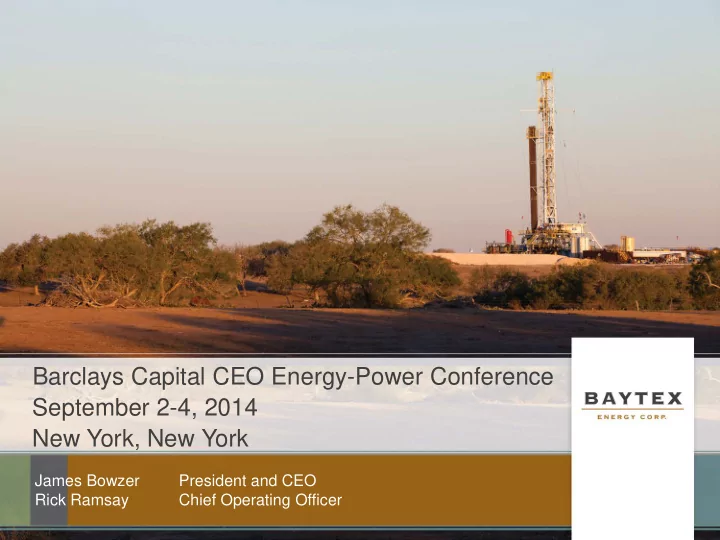
Barclays Capital CEO Energy-Power Conference September 2-4, 2014 New York, New York
James Bowzer President and CEO Rick Ramsay Chief Operating Officer
Barclays Capital CEO Energy-Power Conference September 2-4, 2014 - - PowerPoint PPT Presentation
Barclays Capital CEO Energy-Power Conference September 2-4, 2014 New York, New York James Bowzer President and CEO Rick Ramsay Chief Operating Officer Advisory Forward-Looking Statements In the interest of providing Baytex's shareholders
James Bowzer President and CEO Rick Ramsay Chief Operating Officer
2
Forward-Looking Statements In the interest of providing Baytex's shareholders and potential investors with information regarding Baytex, including management's assessment of Baytex's future plans and operations, certain statements made by the presenter and contained in these presentation materials (collectively, this "presentation") are "forward-looking statements" within the meaning of the United States Private Securities Litigation Reform Act of 1995 and "forward-looking information" within the meaning of applicable Canadian securities legislation (collectively, "forward-looking statements"). The forward-looking statements contained in this presentation speak only as of the date of this presentation and are expressly qualified by this cautionary statement. The information contained in this presentation does not purport to be all-inclusive or to contain all information that potential investors may require. Specifically, this presentation contains forward-looking statements relating to, but not limited to: our business strategies, plans and objectives; our plans for funding our capital expenditures and dividends
reserves life index; single well economics at Eagle Ford, Peace River and Lloydminster, including drilling and completion costs, initial production rates, liquids weighting, capital efficiency ratio, internal rates of return and payout; profit to investment ratios for North American resource plays; our Eagle Ford shale play, including the growth potential of the assets, estimated ultimate recoverable reserves from the wells, our expectation regarding the effect of well downspacing, improving completion techniques and new development targets on the reserves potential of the assets, initial production rates from new wells, drilling efficiency and individual well economics; our belief that the Eagle Ford assets will be an excellent fit with our business model, will provide shareholders with exposure to a low-risk, repeatable, high-return asset with leading capital efficiencies, that the acquired assets have infrastructure in place to provide future production growth, and that such assets will provide material production, long-term growth and high quality reserves with upside potential; our Peace River heavy oil resource play, including development and operational plans, years of drilling inventory remaining, the number and type of wells to be drilled in 2014, reservoir characteristics and well economics for multi-lateral horizontal wells (including well design, drilling and completion costs, initial production rates, estimated recoverable reserves, capital efficiency ratio and finding and development costs); our Lloydminster heavy oil property, including years of drilling inventory remaining, the number and type of wells to be drilled in 2014, and drilling and completion costs, initial production rates, estimated recoverable reserves, capital efficiency ratio and finding and development costs for both vertical and horizontal wells; our operational plans for 2014, including oil and natural gas production and capital expenditures for the second half of 2014 and full-year 2014, the allocation of our capital budget by area, the number of wells to be drilled by area and the amount of capital to be spent drilling wells in the Eagle Ford that will not contribute production until 2015; the results of our asset portfolio review, including the possibility of further asset divestitures; the outlook for Canadian heavy oil prices and the pricing differential between Canadian heavy oil and West Texas Intermediate light oil, including catalysts that could positively impact heavy oil prices in 2014; pricing differentials for Western Canadian Select and Maya heavy crude oils; the development of rail transportation capacity in Western Canada; our ability to optimize the price received for our oil production and to manage our exposure to heavy oil price differentials by transporting our crude oil to market using trucks and railways; the existence, operation and strategy of our risk management program, including the breakdown of our heavy oil sales portfolio by market for Q3/2014 and the portion of future exposures that have been hedged; proposed pipeline infrastructure development and the timing of completing such developments; the demand outlook for Canadian heavy oil in the United States; our liquidity and financial capacity; and the sufficiency of our financial resources to fund our operations. In addition, information and statements relating to reserves are deemed to be forward-looking statements, as they involve implied assessment, based on certain estimates and assumptions, that the reserves described exist in quantities predicted or estimated, and that the reserves can be profitably produced in the future. Cash dividends on our common shares are paid at the discretion of our Board of Directors and can fluctuate. In establishing the level of cash dividends, the Board of Directors considers all factors that it deems relevant, including, without limitation, the outlook for commodity prices, our operational execution, the amount of funds from operations and capital expenditures and our prevailing financial circumstances at the time. Although Baytex believes that the expectations and assumptions upon which the forward-looking statements are based are reasonable, undue reliance should not be placed on the forward-looking statements because Baytex can give no assurance that they will prove to be correct. These forward-looking statements are based on certain key assumptions regarding, among other things: completion of the divestiture of our North Dakota assets; our ability to execute and realize on the anticipated benefits of the acquisition of the Eagle Ford assets; petroleum and natural gas prices and pricing differentials between light, medium and heavy gravity crude oils; well production rates and reserve volumes; our ability to add production and reserves through our exploration and development activities; capital expenditure levels; the receipt, in a timely manner, of regulatory and other required approvals for our operating activities; the availability and cost of labour and other industry services; the amount of future cash dividends that we intend to pay; interest and foreign exchange rates; the continuance of existing and, in certain circumstances, proposed tax and royalty regimes; our ability to develop our crude oil and natural gas properties in the manner currently contemplated; and current
by us at the time of preparation, may prove to be incorrect.
3
Actual results achieved will vary from the information provided herein as a result of numerous known and unknown risks and uncertainties and other factors. Such factors include, but are not limited to: failure to realize the anticipated benefits of the acquisition of the Eagle Ford assets; declines in oil and natural gas prices; risks related to the accessibility, availability, proximity and capacity of gathering, processing and pipeline systems; variations in interest rates and foreign exchange rates; risks associated with our hedging activities; uncertainties in the credit markets may restrict the availability of credit or increase the cost of borrowing; refinancing risk for existing debt and debt service costs; a downgrade of our credit ratings; the cost of developing and operating our assets; risks associated with the exploitation of our properties and our ability to acquire reserves; changes in government regulations that affect the oil and gas industry; changes in income tax or other laws or government incentive programs; uncertainties associated with estimating petroleum and natural gas reserves; risks associated with acquiring, developing and exploring for oil and natural gas and other aspects of our operations; risks associated with large projects or expansion of our activities; risks related to heavy oil projects; changes in environmental, health and safety regulations; the implementation of strategies for reducing greenhouse gases; depletion of our reserves; risks associated with the ownership of our securities, including the discretionary nature of dividend payments and changes in market-based factors; risks for United States and other non-resident shareholders, including the ability to enforce civil remedies, differing practices for reporting reserves and production, additional taxation applicable to non-residents and foreign exchange risk; and other factors, many of which are beyond our control. These risk factors are discussed in Baytex's Annual Information Form, Annual Report on Form 40-F and Management's Discussion and Analysis for the year ended December 31, 2013, as filed with Canadian securities regulatory authorities and the U.S. Securities and Exchange Commission. Readers are cautioned that the foregoing list of risk factors is not exhaustive. New risk factors emerge from time to time, and it is not possible for management to predict all of such factors and to assess in advance the impact of each such factor on our business or the extent to which any factor, or combination of factors, may cause actual results to differ materially from those contained in any forward-looking statements. The above summary of assumptions and risks related to forward-looking statements in this presentation has been provided in order to provide potential investors with a more complete perspective of our current and future operations and as such information may be not appropriate for other purposes. There is no representation by Baytex that actual results achieved will be the same in whole or in part as those referenced in the forward-looking statements and Baytex does not undertake any obligation to update publicly or to revise any of the included forward-looking statements, whether as a result of new information, future events or otherwise, except as may be required by applicable securities law. Oil and Gas Information This presentation contains estimates, as at December 31, 2013, of the volume of our petroleum and natural gas reserves as prepared by our independent qualified reserves evaluators, Sproule Associates Limited ("Sproule"), except for the Eagle Ford assets, which were prepared by an internal non-independent qualified reserves evaluator. These estimates have been prepared in accordance with Canadian reserves disclosure standards and definitions as set forth in National Instrument 51-101 “Standards of Disclosure for Oil and Natural Gas Activities” of the Canadian Securities Administrators (“NI 51-101”). The determination of oil and gas reserves involves the preparation of estimates that have an inherent degree of associated uncertainty. Categories of proved and probable reserves have been established to reflect the level of these uncertainties and to provide an indication of the probability of recovery. The estimation and classification of reserves requires the application of professional judgment combined with geological and engineering knowledge to assess whether or not specific reserves classification criteria have been satisfied. Knowledge of concepts, including uncertainty and risk, probability and statistics, and deterministic and probabilistic estimation methods, is required to properly use and apply reserves definitions. The recovery and reserves estimates described herein are estimates only and there is no guarantee that the estimated reserves will be recovered. Actual reserves and future production from such reserves may be greater or less than the estimates provided herein. The estimates of reserves for individual properties may not reflect the same confidence level as estimates of reserves for all properties, due to the effects of aggregation. For complete NI 51-101 reserves disclosure, please see our Annual Information Form for the year end December 31, 2013 dated March 25, 2014. This presentation contains estimates of the volumes of the "contingent resources" for our oil resource plays in the Bluesky in the Peace River area of Alberta and the Mannville group in northeast Alberta as
McDaniel & Associates Consultants Ltd. ("McDaniel"). "Contingent resources" are not, and should not be confused with, petroleum and natural gas reserves. "Contingent resources" are defined in the Canadian Oil and Gas Evaluation Handbook as: "those quantities of petroleum estimated, as of a given date, to be potentially recoverable from known accumulations using established technology or technology under development, but which are not currently considered to be commercially recoverable due to one or more contingencies. Contingencies may include factors such as economic, legal, environmental, political and regulatory matters or a lack of markets. It is also appropriate to classify as contingent resources the estimated discovered recoverable quantities associated with a project in the early evaluation stage.” The outstanding contingencies applicable to our disclosed contingent resources do not include economic contingencies. Economic contingent resources are those resources that are currently economically recoverable based on specific forecasts of commodity prices and costs. The assigned contingent resources are categorized as economically recoverable based on economics completed at year-end 2012.
4
A range of contingent resources estimates (low, best and high) were prepared by Sproule and McDaniel. A low estimate (C1) is considered to be a conservative estimate of the quantity of the resources that will actually be recovered. It is likely that the actual remaining quantities recovered will exceed the low estimate. Those resources in the low estimate have the highest degree of certainty (a 90% confidence level) that the actual quantities recovered will equal or exceed the estimate. A best estimate (C2) is considered to be the best estimate of the quantity of the resources that will actually be recovered. It is equally likely that the actual remaining quantities recovered will be greater or less than the best estimate. Those resources in the best estimate have a 50% confidence level that the actual quantities recovered will equal or exceed the estimate. A high estimate (C3) is considered to be an optimistic estimate of the quantity of the resources that will actually be recovered. It is unlikely that the actual remaining quantities of resources recovered will equal or exceed the high estimate. Those resources in the high estimate have a lower degree of certainty (a 10% confidence level) that the actual quantities recovered will equal or exceed the estimate. The primary contingencies which currently prevent the classification of the contingent resources as reserves consist of: preparation of firm development plans, including determination of the specific scope and timing of the project; project sanction; access to capital markets; stakeholder and regulatory approvals; access to required services and field development infrastructure; oil prices and price differentials between light, medium and heavy gravity crude oils; future drilling program and testing results; further reservoir delineation and studies; facility design work; limitations to development based on adverse topography or other surface restrictions; and the uncertainty regarding marketing and transportation of petroleum from development areas. There is no certainty that it will be commercially viable to produce any portion of the contingent resources or that we will produce any portion of the volumes currently classified as contingent resources. The estimates of contingent resources involve implied assessment, based on certain estimates and assumptions, that the resources described exists in the quantities predicted or estimated and that the resources can be profitably produced in the future. The recovery and resources estimates provided herein are estimates only. Actual contingent resources (and any volumes that may be reclassified as reserves) and future production from such contingent resources may be greater than or less than the estimates provided herein. References herein to initial test production rates, 30-day IP rates and other short-term production rates are useful in confirming the presence of hydrocarbons; however, such rates are not determinative of the rates at which such wells will commence production and decline thereafter and are not indicative of long term performance or of ultimate recovery. While encouraging, readers are cautioned not to place reliance on such rates in calculating aggregate production for us or the acquired assets. A pressure transient analysis or well-test interpretation has not been carried out in respect of all wells. Accordingly, we caution that the test results should be considered to be preliminary. When converting volumes of natural gas to oil equivalent amounts, Baytex has adopted a conversion factor of six million cubic feet of natural gas being equivalent to one barrel of oil, which is based on an energy equivalency conversion method primarily applicable at the burner tip and does not represent a value equivalency at the wellhead. Oil equivalent amounts may be misleading, particularly if used in isolation. Non-GAAP Financial Measures This presentation refers to funds from operations, total monetary debt and operating netback, which do not have any standardized meaning prescribed by generally accepted accounting principles in Canada ("GAAP"). We define funds from operations ("FFO") as cash flow from operating activities adjusted for financing costs, changes in non-cash operating working capital and other operating
cash flow necessary to fund future dividends to shareholders and capital investments. However, funds from operations should not be construed as an alternative to traditional performance measures determined in accordance with GAAP, such as cash flow from operating activities and net income. Please refer to our most recent management's discussion and analysis of financial condition and results of operations for a reconciliation of funds from operations to cash flow from operating activities. We define total monetary debt as the sum of monetary working capital (which is current assets less current liabilities (excluding non-cash items such as unrealized gains or losses on financial derivatives)), the principal amount of long-term debt and long-term bank loans. Baytex believes that this measure assists in providing a more complete understanding of its cash liabilities. We define operating netback as product sales price less royalties, production and operating expenses and transportation expenses divided by barrels of oil equivalent sales volume for the applicable
to generate cash margin on a unit of production basis.
5
Long-term, Low-Cost Inventory
Conservative Payout Ratio
6
Trading Symbol TSX / NYSE: BTE Average Daily Volume (1) Canada: 568,791 / U.S.: 231,771 Shares Outstanding (Current) 166.1 million Market Capitalization / Enterprise Value $7.9 billion / $10.1 billion Total Monetary Debt (2) $2.2 billion Monthly Dividend / Dividend Yield (3) $0.24 per share / 6.0% Proved + Probable Reserves 432 mmboe Reserve Mix 86% oil and liquids Economic Contingent Resources (best estimate) 764 mmboe Total Company (boe/d) 86,000 – 88,000 74,000 – 76,000 Production Mix 86% oil and liquids 86% oil and liquids E&D Capital Expenditures $440-465 million $765-790 million
(1) Average daily trading volumes for August 1-27, 2014. Volumes are a composite of all exchanges in Canada and the U.S.
(2) Total monetary debt as at June 30, 2014 and adjusted for the estimated net proceeds from the North Dakota asset sale, which is expected to close toward the end of Q3/2014. (3) The dividend yield is calculated by dividing the annualized dividend of C$2.88 by the closing price of Baytex shares of C$47.74 on the TSX on August 27, 2014. (4) Reserves and contingent resources pro forma the Eagle Ford acquisition and North Dakota asset sale. (5) Working interest reserves and contingent resources per NI 51-101 as evaluated by Sproule and McDaniel (6) See “Advisory – Oil and Gas Information” for more information on reserves and contingent resources.
Summary of Securities Reserves and Contingent Resources (4,5,6) Production and E&D CapEx Guidance H2/2014 FY 2014
7
Lloydminster Heavy Oil 36% Peace River Heavy Oil 36% Light Oil 18% Gas 10%
Western Canada 63% Texas 33% North Dakota 4%
Production (H2/2014 Guidance) Company Total = 86,000 – 88,000 boe/d
Heavy Oil 51% Light Oil 22% NGLs 13%
2P Reserves (1) (2) Company Total = 432 MMboe Production by Region
Gas 14% NGLs 17% Light Oil 16% Heavy Oil 53% Gas 14% (1) 2P Reserve break down pro forma Eagle Ford transaction and North Dakota asset sale. (2) See “Advisory – Oil and Gas Information. Western Canada 66% Texas 34%
8
34,022 34,647 34,292 36,222 40,239 41,382 44,341 50,132 53,986 57,196 75,000
20,000 40,000 60,000 80,000 2004 2005 2006 2007 2008 2009 2010 2011 2012 2013 2014
(1) Based on mid point of guidance range of 74,000 – 76,000 boe/d. Gas converted to oil-equivalent at 6 mcf: 1 boe.
Percent Oil 73% 71% 73% 76% 77% 76% 79% 84% 87% 89% 86%
(1)
9
77 86 102 103 116 126 129 140 156 144 159 30 37 39 43 52 61 68 89 96 148 159 50 100 150 200 250 300 350 2003 2004 2005 2006 2007 2008 2009 2010 2011 2012 2013 Oil-Equivalent Reserves (MMboe) Proved Probable
Working interest reserves and contingent resources per NI 51-101 as evaluated by Sproule and McDaniel. See “Advisory – Oil and Gas Information” for more information on contingent resources. RLI’s are based on Q4 production rate for each year.
107 123 141 146 168 187 197
Low (C1) – 593 MMboe Economic Contingent Resource Estimate at December 31, 2013 = Best (C2) – 764 MMboe (adjusted for North Dakota asset sale) High (C3) – 1,118 MMboe
229 252
2P RLI (years) 8.0 9.5 10.1 11.5 11.7 12.2 12.6 13.9 13.0 14.5 14.9 Oil Weighting 83% 78% 79% 83% 85% 84% 89% 91% 92% 93% 90%
292 318
10
Single Well Economics (excluding acreage acquisition costs) (1) Eagle Ford Peace River Heavy Oil Lloydminster Heavy Oil Condensate Volatile Oil Multi-Laterals Verticals Horizontals Completed Well Cost US$7.3M US$7.8M C$2.6M – C$3.4M C$450,000 C$950,000 Production (30-day IP – boe/d) 900-1,000 800-1,000 300-700 30-50 70-80 % Liquids 72% 89% 100% 100% 100% Capital Efficiency ($/boe/d) US$8,000 US$8,700 < C$10,000 C$11,250 C$12,700 Payout (before tax) ~ 1 year ~ 2 years ~ 6 months ~ 1 year ~ 1 year
(1) All wells shown as 100% working interest.
11
0.0x 0.5x 1.0x 1.5x 2.0x 2.5x 3.0x Seal Cold Heavy Multi-Lateral - Hz SE Sask Viewfield Bakken - Hz Ante Creek Montney (75% oil) - Hz Marcellus (dry gas) - Hz Kaybob Montney Oil - Tier 1 - Hz Marcellus (SW PA, wet gas) - Hz Lloyd Area Heavy - Vt AB Bakken (east, shallow) - Hz Eagle Ford Sugarkane (gas condensate) - Hz Western AB Valhalla Doig - Hz Marcellus (NW PA, super rich gas) - Hz Eagle Ford Sugarkane (oil) - Hz Foothills Cardium Oil - Hz NE BC Montney (liquids rich gas) - Hz Lloyd Heavy - Hz NE BC Montney (dry gas) - Hz SW Sask Shaunavon (Upper) - Hz Hoadley Glauconite - Hz PRA Montney Oil - Hz Tower Montney Oil - Hz Dodsland Viking - Hz Kaybob Montney Gas - Hz Kaybob Montney Oil - Tier 2 - Hz Harmattan Lwr Mannville (Crown Royalty) - Hz Eagle Ford (gas condensate) - Hz Uinta Basin Green River/Wasatch - Vt SW Sask Shaunavon (Lower) - Hz Granite Wash - Hz West Pembina Cardium - Hz Wapiti Montney Gas - Hz Redwater Viking - Hz SE Sask Midale - Hz Fort Berthold Bakken Long - Hz Deep Basin Falher - Hz Musreau/Resthaven Montney - Hz Deep Basin Wilrich (5 Bcfe) - Hz Sanish/Parshall Three Forks - Hz Deep Basin Cardium - Hz Cana Woodford - Hz Rosevere Rock Creek - Hz East Pembina Cardium - Hz Inga Doig Gas - Hz Deep Basin Notikewin - Hz Anadarko Mississippian (East) - Hz Lochend (West) Cardium (Crown) - Hz Provost Viking - Hz Anadarko Mississippian (West) - Hz Ante Creek Montney (50% oil) - Hz Eagle Ford (oil) - Hz Harmattan Cardium (Crown Royalty) - Hz
Profit Investment Ratio Profit to Investment Ratio is defined as the present value of the future cash flows (after-tax, 9% discount rate) divided by the initial investment. The above chart represents the Top 50 North American Resource Plays as ranked by Scotia Capital, as at March 2014 (in aggregate, Scotia Capital has ranked over 90 resource plays). Commodity assumptions: WTI oil US$90.00/bbl, NYMEX gas US$4.75/mcf, heavy oil differential to WTI 20%.
12
13
Overview of Acreage
Sugarkane Field in the core of the liquids-rich Eagle Ford shale.
largely delineated which is expected to facilitate future production growth.
across the acreage position, including centralized processing facilities, disposal wells and infield gathering systems.
acreage is held by production
14
Wood Mackenzie breaks the Eagle Ford into nine distinct sub-play areas: (1) Northeast Oil, (2) Black Oil, (3) Karnes Trough Condensate, (4) Edwards Condensate, (5) Southeast Gas, (6) Southwest Gas, (7) Maverick Condensate, (8) Maverick Oil and (9) Hawkville Condensate. Baytex’s Eagle Ford acreage falls largely within the Karnes Trough sub-play area.
15
Source: Wood Mackenzie. Wood Mackenzie breaks the Eagle Ford into nine distinct sub-play areas: (1) Northeast Oil, (2) Black Oil, (3) Karnes Trough Condensate, (4) Edwards Condensate, (5) Southeast Gas, (6) Southwest Gas, (7) Maverick Condensate, (8) Maverick Oil and (9) Hawkville Condensate. Baytex’s Eagle Ford acreage falls largely within the Karnes Trough sub-play area. Sub-play analysis and type well break-even represents the entire acreage in the sub-play areas and may not be representative of Baytex’s Eagle Ford position.
Sub-Play Analysis Type Well Breakeven
16
spacing; current development is now 60-acre spacing (volatile oil) and 40-acre spacing (condensate gas)
horizons in the Austin Chalk and Upper Eagle Ford formations, downspacing and improving completion techniques
actively delineated by industry in the core of the play
(30-day IP rates)
Eagle Ford Type Log
17
24 18 18 15 15 12 12 12 13 14 11
10 20 30
200 400 600 800 1,000 1,200 1,400 2011 2012 2013 2014E
rates by approximately 97% since Q4/2011 with 180-day cumulative recovery increasing 57% over the same time period
well costs
Source: Marathon Oil investor presentation, May 20, 2014. The information presented is based on Marathon’s operated Eagle Ford acreage, not just the properties in which Baytex holds an interest, and therefore may not be representative of Baytex’s Eagle Ford position.
Production (30-day IP, boe/d) Cumulative Recovery (boe) Drilling Efficiency (Spud to TD – days)
18
formations, downspacing and improving completion techniques
facilities, disposal wells, and infield gathering systems
pricing; a portion of the oil benefits from premium LLS based pricing
(1) 30-day IP rates are useful in confirming the presence of hydrocarbons, however such rates are not determinative of the rates at which such wells will commence production and decline thereafter and are not indicative of long term performance or of ultimate recovery.
19
20
* Best estimate contingent resources. Low estimate = 450 million barrels; high estimate = 796 million barrels. See “Advisory – Oil and Gas Information” for more information about contingent resources.
Production (Q2/2014) 26,100 bbl/d 2P Reserves (YE13) (1) 114 mmbbls Drilling Inventory (2) ~ 5 years
Area Statistics 2014 Development
2014 Drilling Program ~ 36 multi-lateral horizontal wells 28 stratigraphic and service wells
(1) 2P Reserve breakdown = 67 million barrels
(primary) and 47 million barrels (thermal).
(2) Drilling inventory in years based on identified
drilling locations (cold horizontal multi-lateral wells) and 2014 drilling plans.
21
Reservoir Characteristics (1)
Formation Bluesky Depth 600 – 700 metres Oil Quality 11 °API Average Porosity 28% Permeability 0.5 – 5.0 darcies Oil Saturation 70% Recovery Factor 5 – 7%
(1) Baytex internal estimates.
Well Economics (1)
Well Design 8-10 laterals Completed Well Cost $2.6-$3.4 MM Production (30-day IP) 300-700 bbl/d EUR 275-550 mbbl Capital Efficiency $5,000-$9,000 per bbl/d Development Cost $6.00-$9.50/bbl
22
Area Statistics 2014 Development
* Best estimate contingent resources, based on the Mannville Group in northeast Alberta, including Cold
estimate = 323 million barrels. See “Advisory – Oil and Gas Information” for more information about contingent resources.
Production (Q2/2014) 19,900 bbl/d 2P Reserves (YE13) (1) 114 mmbbls Drilling Inventory (2) ~ 6.5 years Drilling ~ 95 net wells % Horizontal/Vertical 73% / 27%
(1) Includes SAGD projects at Gemini (44 million barrels) and
Kerrobert (12 million barrels)
(2) Drilling inventory in years based on identified drilling
locations and 2014 drilling plans.
23
Vertical Wells Horizontal Wells
Completed Well Cost $450,000 Production (30-day IP) 30-50 bbl/d EUR 30-50 mbbl Capital Efficiency $11,250 per bbl/d Development Cost $11.25/bbl Completed Well Cost $950,000 Production (30-day IP) 70-80 bbl/d EUR 60-80 mbbl Capital Efficiency $12,700 per bbl/d Development Cost $13.60/bbl
25
26
27
Heavy Oil Sales Portfolio based on anticipated sales volumes for Q3/2014, as at July 3rd, 2014
Q3 / 2014 % Hedged 51% Fixed Price US$96.45/bbl Q4 / 2014 % Hedged 50% Fixed Price US$95.43/bbl FY 2015 % Hedged 19% Fixed Price US$94.60/bbl WTI Financial Hedging
Percentage of hedged volumes are based on 2014 production guidance, net of royalties (i.e. hedgeable volumes). See notes to financial statements for individual contracts.
Q3 2014 Heavy Oil Sales Portfolio
29
Eagle Ford
the drilling of new wells with first production not expected until early 2015
2014 Guidance Summary Q1/2014 Actual Q2/2014 Actual H1/2014 Actual H2/2014 Guidance FY 2014 Guidance (1) Production (boe/d) 59,502 66,934 63,239 86,000-88,000 74,000-76,000 Capital Expenditures ($ millions) $172 $149 $321 $440-465 $765-790 (1) Numbers may not add due to rounding
Base Business
budget with full-year expenditures reduced by ~ $25 million
unchanged and represent ~ 27% of H2/2014 spending
Lloydminster: ~ 95 wells
potential divestiture candidates
30
inventory – oil focus
efficiency
growth projects
100 200 300 2006 2007 2008 2009 2010 2011 2012 2013
Superior Asset Base Income Payout Proven Track Record
meaningful dividend
to shareholders in the last 10 years
management
value creation
2P Reserves (mmboe)
25 50 2006 2007 2008 2009 2010 2011 2012 2013
Production (mboe/d)
James L. Bowzer President & Chief Executive Officer (587) 952-3000 Rodney D. Gray Chief Financial Officer (587) 952-3160 Brian G. Ector Senior Vice President, Capital Markets and Public Affairs (587) 952-3237 Suite 2800, Centennial Place 520 – 3rd Avenue S.W. Calgary, Alberta T2P 0R3 T: (587) 952-3000 1-800-524-5521 www.baytexenergy.com