
SLIDE 1
Peter J. Murray
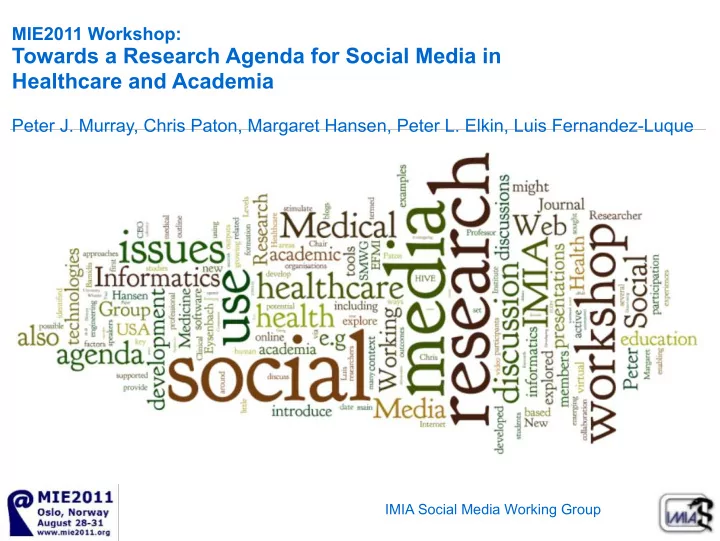
MIE2011 Workshop:
Towards a Research Agenda for Social Media in Healthcare and Academia
Peter J. Murray, Chris Paton, Margaret Hansen, Peter L. Elkin, Luis Fernandez-Luque
IMIA Social Media Working Group
Introductions Short presentations Discussion Next steps? IMIA - - PowerPoint PPT Presentation
MIE2011 Workshop: Towards a Research Agenda for Social Media in Healthcare and Academia Peter J. Murray, Chris Paton, Margaret Hansen, Peter L. Elkin, Luis Fernandez-Luque Peter J. Murray IMIA Social Media Working Group Peter J. Murray RN, PhD,
Peter J. Murray
MIE2011 Workshop:
Towards a Research Agenda for Social Media in Healthcare and Academia
Peter J. Murray, Chris Paton, Margaret Hansen, Peter L. Elkin, Luis Fernandez-Luque
IMIA Social Media Working Group
Peter J. Murray RN, PhD, MSc, CertEd, FBCS CITP
CEO, IMIA Introduction/moderation of worksop and discussion; overview of social media
IMIA Social Media Working Group IMIA Social Media Working Group
Introductions Short presentations Discussion Next steps?
IMIA Social Media Working Group IMIA Social Media Working Group
With acknowledgements to some colleagues and collaborators who cannot be here in person ...
IMIA Social Media Working Group IMIA Social Media Working Group
Goals of the workshop
issues in the use of social media in healthcare, health informatics, and in related academic disciplines
social media within healthcare and academia, and (2) the use of social media as research tools.
IMIA Social Media Working Group IMIA Social Media Working Group
Issues
Issues will include, but not be limited to:
research;
devices such as video iPod, iPad) for education and for enabling academic research;
researchers, and leveraging social tools for data collection;
WGs) of the intersection of health informatics with social media;
research.
IMIA Social Media Working Group IMIA Social Media Working Group
IMIA Social Media Working Group IMIA Social Media Working Group
IMIA Social Media Working Group
Set up at Medinfo2010 GA (Cape Town) International membership Strong Spanish-speaking membership Active in supporting IMIA's 'bridging role' to other
Help define/promote/evaluate and research IMIA's social media use
IMIA Social Media Working Group IMIA Social Media Working Group
IMIA Social Media Working Group - why?
Why not? - because everyone else uses it? To explore its use – does SM have potential, or is it all just empty rhetoric – the next 'bubble'? IMIA's exploration of social media use:
and the wider community
IMIA Social Media Working Group IMIA Social Media Working Group
IMIA Social Media Working Group IMIA Social Media Working Group
IMIA Social Media Working Group IMIA Social Media Working Group
IMIA Social Media Working Group IMIA Social Media Working Group
IMIA Social Media Working Group IMIA Social Media Working Group
Peter Elkin's messages
Web 3.0 is coming - and this deals with semantic search and connections. The (US) FDA has decided what to regulate in terms of mobile computing which includes Usability of those applications Online teaching is now changing education as a social phenomenon.
Chris Paton BMBS BMedSci MBA FACHI
Senior Clinical Research Fellow, National Institute for Health Innovation, University of Auckland, New Zealand Researching Social Media in Healthcare
IMIA Social Media Working Group IMIA Social Media Working Group
is it Web 2.0?...
in 21 months
“If you click edit and you see some Wiki syntax and some bizarre table structure - a lot of people are literally afraid.”
Jimmy Wales, Founder of Wikipedia, 2011
Margaret Hansen Ed.D., R.N. Associate Professor
Illustration of the use of video iPods, iPads, and wiki-educator in research/education.
IMIA Social Media Working Group IMIA Social Media Working Group
Millennial Social Medical Intern Research Participants
Video iPods in Medical Education
Pilot Randomized Controlled Trial: New Zealand Base To determine whether instructional videos via iPods regarding urinary catheterization would increase undergraduate medical students’ confidence and enhance skills competencies Pilot trainee interns; 10 control; 11 intervention ~intervention= 3 mos video iPod access ~control= no access to technology Results: Control group decline in skill competency over time; whereas, skill level remained stable for the intervention group. ~Intervention group’s confidence levels for performing female catheterization increased significantly over time
Video iPods in Nursing Education
Pilot Randomized Controlled Trial: California Base To determine whether instructional videos via iPods regarding urinary catheterization would increase nursing students’ confidence and enhance skills competencies Pilot nursing students; 9 control; 7 intervention ~intervention= 2 week video iPod access ~control= no access to technology Results: Close to zero variation for skill competency for both groups; Confidence levels did not significantly change over time ~ however, anecdotal notes imply students desire to have high self confidence in performing both male and female urinary catheterizations
What do we make from all of this?
~Time-on-Learning can be tracked in the future ~Determine where and when the students view the instructional videos ~Gather information from formative evaluations ~Provide listener/viewer some sort of interactivity
questions/provide appropriate feedback ~Recommend longer time with the video iPods ~Offer more than one type of skill for the learner and compare and contrast outcomes
iPad uPad?
~Voted #1 of top ten innovations and most tweeted about technology topics in 2010 ~Short time on the market, however, it is being used in healthcare, business and education ~Graduate students introduced to the iPad Fall 2010 and used it to assist them with their patient teaching project in Clinical Sites ~Research potential Annecdotal notes: ~The iPad is visually transfixing ~Cutting edge apps, such as Heart Pro, ECG iPocket cards, Nimble, OsiriX HD, Blausen Human Atlas
Wiki Educator
Graduate students have been creating instructional projects using Wiki Educator for the past two years. They are being used in clinical setting for staff and patient teaching Here is one example: Wiki Educator: Autism Spectrum Disorders
Luis Fernandez-Luque @luisluque
PhD Student, Researcher, Northern Research Institute & Tromsø Telemedicine Laboratory, Tromsø, Norway Health Videos and Social Media
IMIA Social Media Working Group IMIA Social Media Working Group
IMIA Social Media Working Group
visited web in the world.
daily
are watched every day on Facebook (up 2.5x year/year)
IMIA Social Media Working Group
7M views
20K videos
blogging
pandemic), awareness (diabetes day), emotional support, healthy habits.
IMIA Social Media Working Group
IMIA Social Media Working Group
The jungle:
IMIA Social Media Working Group
Should we use YouTube for Public Health, TV or printed press? How effective is YouTube? Should I recommend YouTube or Vimeo? What is next?
IMIA Social Media Working Group
more are).
are worse).
information retrieval, etc.
Discussion
The interactive bit – over to you ... Next steps?
IMIA Social Media Working Group IMIA Social Media Working Group
For further contact: peterjmurray@gmail.com c.paton@auckland.ac.nz luis.luque@norut.no maggie2hansen@gmail.com
IMIA Social Media Working Group IMIA Social Media Working Group