
SLIDE 1
Bijzonder actualiteitscollege Leergang Pensioenrecht 28 juni 2011
Introduction to the American Pension System
Professor Paul M. Secunda Associate Professor of Law Marquette University Law School Milwaukee, Wisconsin USA
Chapter Three
Introduction to the American Pension System Professor Paul M. - - PDF document
Bijzonder actualiteitscollege Leergang Pensioenrecht 28 juni 2011 Introduction to the American Pension System Professor Paul M. Secunda Associate Professor of Law Marquette University Law School Milwaukee, Wisconsin USA Chapter Three FOUR
Professor Paul M. Secunda Associate Professor of Law Marquette University Law School Milwaukee, Wisconsin USA
Chapter Three
Social Security alone does not provide adequate retirement For large majority of US workers, Social Security will lead to about 40% income replacement ratio (SSA 2011). Yet, to maintain a comfortable lifestyle in post-retirement years, a US worker will need at least 70% to 80% income replacement ratio
As proportion of retirement income replaced by Social Security decreases, proportion replaced by
Consequently, many higher-salaried US employees must receive much larger percentage of retirement from
adequate retirement Or, of course, additional personal savings (third pillar)
June 28, 2011
continuing income after retirement
June 28, 2011
makes while working
issue; intergenerational transfers)
Security benefits
when they were born. If they were born in 1929 or later, workers need 40 credits (10 years of work)
June 28, 2011
Social Security), benefit will be lower than if you wait until later to retire
1960 or later
do, can increase future Social Security benefits in two ways
– Each additional year of work adds another year of earnings to Social Security
– Also, benefit will increase automatically by a certain percentage from the time
June 28, 2011
employees of non-profits
because their states and the Social Security Administration entered into special agreements called “Section 218 agreements”
July 1991 when Social Security was extended to state and local employees who were not covered by an agreement and were not members of their agency’s public pension system.
income up to $106,800 for 2010 at a rate of 6.2% for both the employee and employer
$1,177 at the beginning of 2011or $14,124 per year. The poverty line for
for a worker retiring at age 66 in 2011, the amount is $2,366 per
every year after age 21
lower than if had worked steadily.
June 28, 2011
average wages since the year the earnings were received
during the 35 years in which the worker earned the most
"primary insurance amount" (PIA), is determined
retirement age—65 or older, depending on date of birth
June 28, 2011 June 28, 2011
June 28, 2011
June 28, 2011
DEFINED BENEFIT PLANS DEFINED CONTRIBUTION PLANS Benefits determined by set formula (e.g., 2 percent times years of service times final average pay) Benefits determined by contributions and investment earnings (e.g., 10 percent of annual pay) Funding flexibility Possible discretion in funding Reward older and longer service employees (backloaded) Significant accruals at younger ages Employees face financial penalties for working past normal retirement age No disincentives for working past normal retirement age Long vesting period (e.g., 5 years) Often a short vesting period (e.g., 1 year) Employer bears the investment risk Employee bears the investment risk Employee has no investment discretion Employee has investment discretion High rates of return Significantly lower average rates of return Often not portable Portable Require actuarial valuation Does not require actuarial valuation Relatively low employee understanding and appreciation Relatively high employee understanding and appreciation Unfunded liability exposure No unfunded liability exposure Provide benefits targeted to income replacement level Does not provide benefits targeted to income replacement level Usual form of benefit payment is monthly income (annuity) Usual form of benefit payment is lump sum distribution Employees cannot borrow Employees may be able to borrow
June 28, 2011
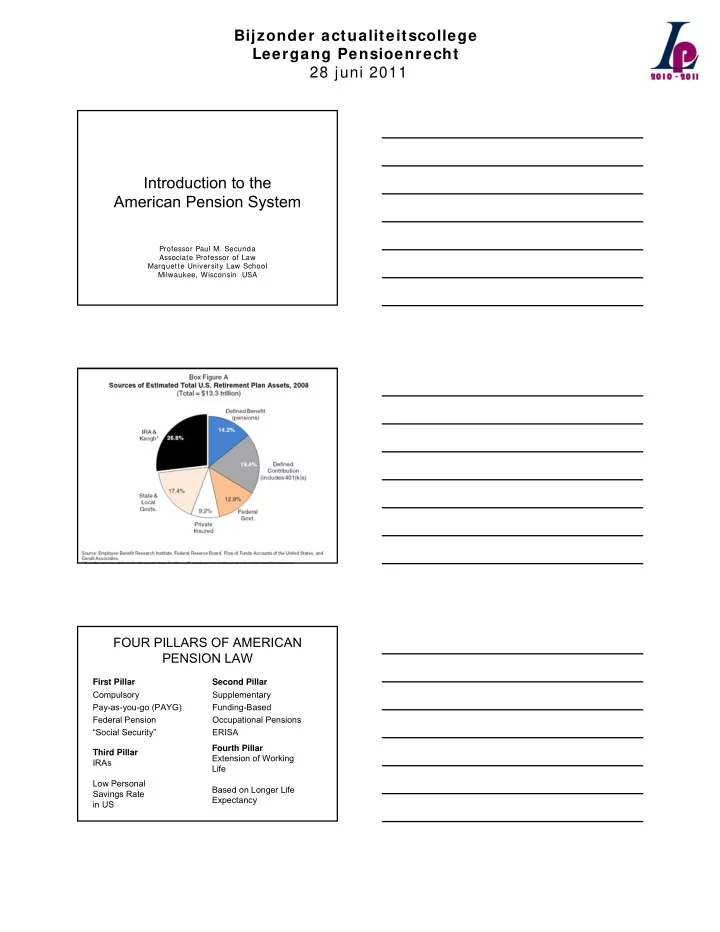
– IRAs hold 27% of all retirement income in United States – IRAs classified into four types (EBRI):
– Average and median IRA individual balance (all accounts from the same person combined) was $69,498 and $20,046 at end of 2008. – 11.1 million unique individuals with total assets of $732.9 billion as of year-end 2008.
2008) (source: Bureau of Economic Analysis, U.S. Department of Commerce)