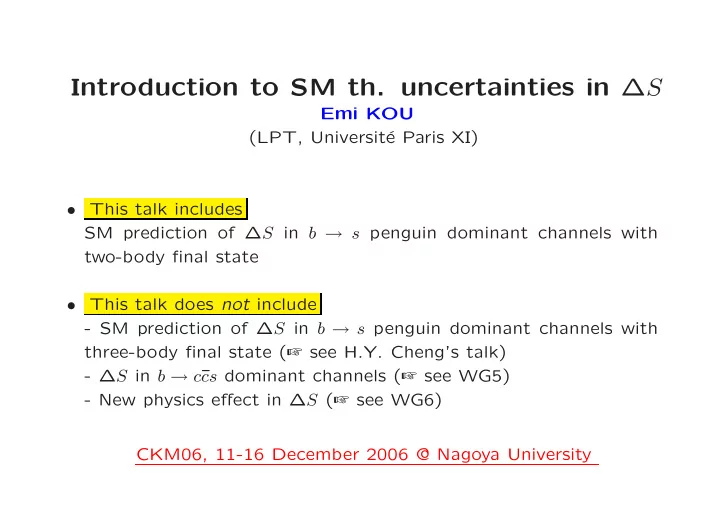
SLIDE 1 Introduction to SM th. uncertainties in ∆S
Emi KOU (LPT, Universit´ e Paris XI)
SM prediction of ∆S in b → s penguin dominant channels with two-body final state
- This talk does not include
- SM prediction of ∆S in b → s penguin dominant channels with
three-body final state (☞ see H.Y. Cheng’s talk)
cs dominant channels (☞ see WG5)
- New physics effect in ∆S (☞ see WG6)
CKM06, 11-16 December 2006 @ Nagoya University
SLIDE 2 Experimental status of Sb→s
sin(2βeff) ≡ sin(2φe
1 ff)
HFAG
DPF/JPS 2006
HFAG
DPF/JPS 2006
HFAG
DPF/JPS 2006
HFAG
DPF/JPS 2006
HFAG
DPF/JPS 2006
HFAG
DPF/JPS 2006
HFAG
DPF/JPS 2006
HFAG
DPF/JPS 2006
HFAG
DPF/JPS 2006
HFAG
DPF/JPS 2006 b→ccs φ K0 η′ K0 KS KS KS π0 KS ρ0 KS ω KS f0 K0 π0 π0 KS K+ K- K0
1 2 3 World Average
0.68 ± 0.03
BaBar
0.12 ± 0.31 ± 0.10
Belle
0.50 ± 0.21 ± 0.06
Average
0.39 ± 0.18
BaBar
0.58 ± 0.10 ± 0.03
Belle
0.64 ± 0.10 ± 0.04
Average
0.61 ± 0.07
BaBar
0.66 ± 0.26 ± 0.08
Belle
0.30 ± 0.32 ± 0.08
Average
0.51 ± 0.21
BaBar
0.33 ± 0.26 ± 0.04
Belle
0.33 ± 0.35 ± 0.08
Average
0.33 ± 0.21
BaBar
0.20 ± 0.52 ± 0.24
Average
0.20 ± 0.57
BaBar
0.62 +
. 2 3 5 0 ± 0.02
Belle
0.11 ± 0.46 ± 0.07
Average
0.48 ± 0.24
BaBar
0.62 ± 0.23
Belle
0.18 ± 0.23 ± 0.11
Average
0.42 ± 0.17
BaBar
Average
BaBar Q2B
0.41 ± 0.18 ± 0.07 ± 0.11
Belle
0.68 ± 0.15 ± 0.03 +
. 2 1 1 3
Average
0.58 ± 0.13
H F AG H F A G
DPF/JPS 2006 PRELIMINARY
Current status of Sb→s ➤ b → s¯ ss dominant mode
- B → φKS: 0.39 ± 0.18
- B → η′KS: 0.61 ± 0.07
➤ b → s¯ uu dominant mode
- B → πKS: 0.33 ± 0.21
- B → ρKS: 0.20 ± 0.57
- B → ωKS: 0.48 ± 0.24
☞ SφKS,η′KS will be mea- sured at a few % precision with 50ab−1 data. One day, as Sb→s is found to deviate from SJ/ψKS by a tiny amount, are we going to be able to distinguish between physics beyond SM and SM theoretical uncertainty?
SLIDE 3 To which extent, SJ/ψKS = Sb→s in SM?
af(t) = Γ(B → f) Γ(B → f) = Sf sin ∆MBt − Cf cos ∆MBt Sf = 2 Im(±q
pρ)
|q
pρ|2 + 1 ,
Cf = 1 − |q
pρ|2
1 + |q
pρ|2;
ρ = A(B → f) A(B → f) B → J/ψKS
b d B d b B0 t t W W Vtb V ∗
td
V ∗
td
Vtb b d B c d s c W J/ψ KS Vcb V ∗
cs
Im(q
p) = Im(V ∗
tbVtd
VtbV ∗
ts) = sin 2φ1
Im(ρ) = Im VcbV ∗
cs
V ∗
cbVcs = 0
Pollutions
- u-penguins
- u-rescattering
Im(ρ) = Im VubV ∗
us
V ∗
ubVus = sin φ3
☞ effect < 10−2 − 10−3
B → s dominant
b d B d b B0 t t W W Vtb V ∗
td
V ∗
td
Vtb b d B s d s s t g W φ KS Vtb V ∗
ts
Im(q
p) = (V ∗
tbVtd
VtbV ∗
ts) = sin 2φ1
Im(ρ) = Im VcbV ∗
cs
V ∗
cbVcs = 0
Pollutions
us trees
- u-penguins
- u-rescattering
Im(ρ) = Im VubV ∗
us
V ∗
ubVus = sin φ3
SLIDE 4 Au
f/Ac f dependence of Sf
A(B → f) = V ∗
tbVtsat f + V ∗ cbVcsac f + V ∗ ubVusau f
= V ∗
cbVcsAc f + V ∗ ubVusAu f
where Ac
f= ac f − at f and Au f= au f − at f.
ρ = A(B→f)
A(B→f) = 1 − 2iǫKM Au
f
Ac
f sin φ3 + O(ǫ2
KM)
where ǫKM = V ∗
ubVus
V ∗
cbVcs ≃ 0.025.
☞ figure: Au
f/Ac f = |Au f/Ac f|eiδ
0.2 0.4
0.2 0.4
→ (70◦, 0.2) → (70◦, 0.1)
(φ3, |Au/Ac|)
δ < ∆Sf Cf
η′KS φKS πKS ωKS ρKS
Estimate of ∆S ≡ Sb→s−SJ/ψKS requires precise information on Au
f/Ac f
☞ various theoretical methods have been developed.
SLIDE 5 b → s¯ ss v.s. b → s¯ uu
Ac
f = ac f − at f,
Au
f = au f − at f
at
f
= t-penguin ac
f
= c-penguin, c-rescattering au
f
= u-penguin, u-rescattering, b → u¯ us tree b → s¯ ss channels ☞ Roughly ∆Sb→s¯
ss < 3 %.
Au
f/Ac f = at f/at f =1
−au
f/at f + ac f/at f
- LD=1/mb suppressed (SD tree=0)
+O((ac
f/at f)2, (au f/at f)2)
b → s¯ uu channels ☞ Roughly ∆Sb→s¯
uu < 10 %.
Au
f/Ac f =
au
f/at f
SD tree=1/αs −at
f/at f
+O((ac
f/at f), (ac f/au f), (at f/au f))
The rough estimates of theor. uncertainties are equivalent to or larger than the exp. precision that will be achieved in future. We may need more theor. input to distinguish SM errors from BSM...
SLIDE 6 Tendency of exp. data is against th.?!
Measured values of ∆Sb→s are mostly negative while many theoretical models predict them positive!
sin(2βeff) ≡ sin(2φe
1 ff)
HFAG
DPF/JPS 2006
HFAG
DPF/JPS 2006
HFAG
DPF/JPS 2006
HFAG
DPF/JPS 2006
HFAG
DPF/JPS 2006
HFAG
DPF/JPS 2006
HFAG
DPF/JPS 2006
HFAG
DPF/JPS 2006
HFAG
DPF/JPS 2006
HFAG
DPF/JPS 2006 b→ccs φ K0 η′ K0 KS KS KS π0 KS ρ0 KS ω KS f0 K0 π0 π0 KS K+ K- K0
1 2 3 World Average
0.68 ± 0.03
BaBar
0.12 ± 0.31 ± 0.10
Belle
0.50 ± 0.21 ± 0.06
Average
0.39 ± 0.18
BaBar
0.58 ± 0.10 ± 0.03
Belle
0.64 ± 0.10 ± 0.04
Average
0.61 ± 0.07
BaBar
0.66 ± 0.26 ± 0.08
Belle
0.30 ± 0.32 ± 0.08
Average
0.51 ± 0.21
BaBar
0.33 ± 0.26 ± 0.04
Belle
0.33 ± 0.35 ± 0.08
Average
0.33 ± 0.21
BaBar
0.20 ± 0.52 ± 0.24
Average
0.20 ± 0.57
BaBar
0.62 +
. 2 3 5 0 ± 0.02
Belle
0.11 ± 0.46 ± 0.07
Average
0.48 ± 0.24
BaBar
0.62 ± 0.23
Belle
0.18 ± 0.23 ± 0.11
Average
0.42 ± 0.17
BaBar
Average
BaBar Q2B
0.41 ± 0.18 ± 0.07 ± 0.11
Belle
0.68 ± 0.15 ± 0.03 +
. 2 1 1 3
Average
0.58 ± 0.13
H F AG H F A G
DPF/JPS 2006 PRELIMINARY
In the case of pQCD and QCDF ∆S ≃ 2ǫKM cos 2φ1 sin φ3 cos δ|
Au
f
Ac
f |
☞ In perturbative computation, δ is relatively small and Au
f/Ac f ≃ 1 − tree/penguin
☞ The sign and size of −tree/penguin B → φKS: zero B → η′KS: negligible B → πKS: large positive B → ωKS: large positive B → ρKS: large negative
SLIDE 7 Tendency of exp. data is against th.?!
Measured values of ∆Sf are mostly negative while many theoretical mod- els predict them positive!
sin(2βeff) ≡ sin(2φe
1 ff)
HFAG
DPF/JPS 2006
HFAG
DPF/JPS 2006
HFAG
DPF/JPS 2006
HFAG
DPF/JPS 2006
HFAG
DPF/JPS 2006
HFAG
DPF/JPS 2006
HFAG
DPF/JPS 2006
HFAG
DPF/JPS 2006
HFAG
DPF/JPS 2006
HFAG
DPF/JPS 2006 b→ccs φ K0 η′ K0 KS KS KS π0 KS ρ0 KS ω KS f0 K0 π0 π0 KS K+ K- K0
1 2 3 World Average
0.68 ± 0.03
BaBar
0.12 ± 0.31 ± 0.10
Belle
0.50 ± 0.21 ± 0.06
Average
0.39 ± 0.18
BaBar
0.58 ± 0.10 ± 0.03
Belle
0.64 ± 0.10 ± 0.04
Average
0.61 ± 0.07
BaBar
0.66 ± 0.26 ± 0.08
Belle
0.30 ± 0.32 ± 0.08
Average
0.51 ± 0.21
BaBar
0.33 ± 0.26 ± 0.04
Belle
0.33 ± 0.35 ± 0.08
Average
0.33 ± 0.21
BaBar
0.20 ± 0.52 ± 0.24
Average
0.20 ± 0.57
BaBar
0.62 +
. 2 3 5 0 ± 0.02
Belle
0.11 ± 0.46 ± 0.07
Average
0.48 ± 0.24
BaBar
0.62 ± 0.23
Belle
0.18 ± 0.23 ± 0.11
Average
0.42 ± 0.17
BaBar
Average
BaBar Q2B
0.41 ± 0.18 ± 0.07 ± 0.11
Belle
0.68 ± 0.15 ± 0.03 +
. 2 1 1 3
Average
0.58 ± 0.13
H F AG H F A G
DPF/JPS 2006 PRELIMINARY
Results of pQCD and QCDF
- H. Li and, S. Mishima (PRD72 2005, PRD74 2006)
- M. Beneke, M. Neubert (NPB 2003)
M Beneke (PLB620 2005)
pQCD QCDF φKS 0.02+0.01
−0.01
0.04+0.01
−0.01
η′KS 0.01+0.01
−0.01
πKS 0.07+0.05
−0.04
0.07+0.02
−0.03
ωKS 0.13+0.08
−0.08
0.17+0.03
−0.07
ρKS −0.08+0.08
−0.012
−0.17+0.01
−0.06 see also A.R. Williamson, J. Zupan, PRD74 2006
This pattern of ∆Sf must be tested by exp. more precisely in the future
SLIDE 8
If rescattering is large...
H.Y. Cheng, C.K. Chua, A. Soni (PRD71 2005)
However, a large rescattering effect which produces a large strong phase may break the pattern predicted by perturbative computation. ∆Sf SD SD+LD φKS 0.02+0.00
−0.04
0.03+0.01+0.01
−0.04−0.01
η′KS 0.01+0.00
−0.04
0.00+0.00+0.00
−0.04−0.00
ηKS 0.07+0.02
−0.04
0.07+0.02+0.00
−0.05−0.00
πKS 0.06+0.02
−0.04
0.04+0.02+0.01
−0.03−0.01
ωKS 0.12+0.05
−0.06
0.01+0.02+0.02
−0.04−0.01
ρKS −0.09+0.03
−0.07
0.04+0.09+0.08
−0.10−0.11
☞ The pattern of perturbative com- putation is broken especially in VP channels. Test of rescattering effect
∆S −C =≃ cos2φ1 cos δ
☞ |∆S/C| ≃ 1 in perturbative com- putation since δ is relatively small. ☞ Prediction with LD effect... ∆SφKS/(−CφKS) = −1.3 ∆Sη′KS/(−Cη′KS) = −0.05 ∆SηKS/(−CηKS) = −2.0 ∆SπKS/(−CπKS) = 1.2 ∆SωKS/(−CωKS) = −0.08 ∆SρKS/(−CρKS) = −0.08
SLIDE 9 Role of branching ratio measurements
✐ Precise measurements of branching ratios of SU(3) related channels can be used to constrain |Au
f/Ac f|.
- Y. Grossman, Z. Ligeti, Y.Nir, H.R. Quinn, PRD68 2003
- M. Gronau, J.L. Rosner, J. Zupan, PLB596 2004, PRD74, 2006
talk by Z. Ligeti in CKM05 ✶ see also talk by M. Pierini in CKM05
✐ Perturbative methods often contain large theoretical uncertainties from the perturbative/non-perturbative input parameters. However, one can constrain many of those by using branching ratio measurements. Even if we have ambiguity in the strong phase δ, the constraint on ∆Sf may be improved by achieving a high precision determination
f/Ac f| from branching ratios.
SLIDE 10
Some comments on Sη′KS and SηKS
✐ The problem of the large branching ratio of B → η′K can be discussed separately?! (see also Zupan’s talk) Most of the solutions to this problem (singlet penguin, singlet form factor, U(1) breaking effect etc.) are based on penguin type operator. Thus, this may not increase ∆Sη′KS. ✐ U(1) breaking contributions must be carefully included.
J.M. Gerard, E.K. PRL 2006
1) In η − η′ system, U(1) breaking effect is large, larger than SU(3) breaking. SU(3) analysis may contain additional uncer- tainty from U(1) breaking. 2) The pseudoscalar mixing angle θ is often fixed at (−15.7 ± 1)◦ or −19.5◦. However, we must be aware that ηKS mode shows a strong θ dependence and theoretical error coming from θ must be carefully included.
SLIDE 11
Conclusions
❑ In SM, possible deviations of SφKS and Sη′KS from SJ/ψKs are found to be less than a few %. ❑ Measured values of ∆Sb→s are mostly negative while perturbative computation seems to predict them positive for most of decay modes. ❑ Perturbative computations seem to predict opposite sign for ∆SωKS and ∆SρKS. However, a large FSI effects may change this pattern. Size of FSI effect must be carefully tested by using both direct and mixing CP asymmetry. ❑ Precise measurements of various branching ratios are important to further reduce theoretical uncertainties in ∆Sb→s.