Introduction to ASF+SDF ASF+SDF Goal: defining languages & - - PowerPoint PPT Presentation

introduction to asf sdf asf sdf
SMART_READER_LITE
LIVE PREVIEW

Introduction to ASF+SDF ASF+SDF Goal: defining languages & - - PowerPoint PPT Presentation

Introduction to ASF+SDF ASF+SDF Goal: defining languages & manipulating programs Mark van den Brand SDF: Syntax definition Formalism Paul Klint Jurgen Vinju lexical & context-free syntax ASF: Algebraic Specification


slide-1
SLIDE 1

Introduction to ASF+SDF 1

Introduction to ASF+SDF

Mark van den Brand Paul Klint Jurgen Vinju

Introduction to ASF+SDF 2

ASF+SDF

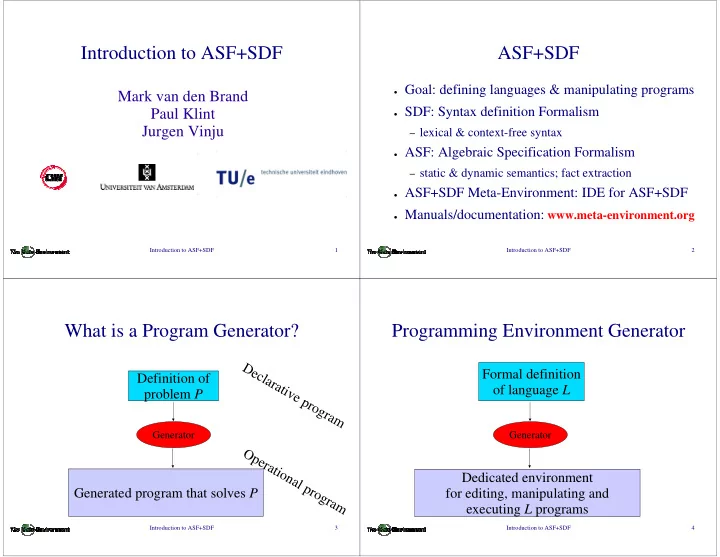
  • Goal: defining languages & manipulating programs
  • SDF: Syntax definition Formalism

– lexical & context-free syntax

  • ASF: Algebraic Specification Formalism

– static & dynamic semantics; fact extraction

  • ASF+SDF Meta-Environment: IDE for ASF+SDF
  • Manuals/documentation: www.meta-environment.org

Introduction to ASF+SDF 3

What is a Program Generator?

Definition of problem P

Generator

Generated program that solves P Declarative program Operational program

Introduction to ASF+SDF 4

Programming Environment Generator

Formal definition

  • f language L

Generator

Dedicated environment for editing, manipulating and executing L programs

slide-2
SLIDE 2

Introduction to ASF+SDF 5

Programming Environment Generator = collection of program generators

Definition of L static semantics Definition of L syntax Definition of L dynamic semantics Parser Generator

L-parser

Typechecker Generator

L-typechecker

Evaluator Generator

L-evaluator

Integrated L-programming environment

Introduction to ASF+SDF 6

Interactive Development Environment for Language definitions

ASF+SDF Meta-Environment

Stand-alone, generated, environment

Formal definition of language L (written in ASF+SDF) Generator Generated L programming environment

ASF+SDF Meta-Environment

Introduction to ASF+SDF

ASF+SDF Meta-Environment

  • An interactive development environment for

generating tools from formal language definitions

  • Based on:

– Full context-free grammars – Conditional term rewriting

  • Language definitions written in ASF+SDF

– SDF: Syntax definition Formalism – ASF: Algebraic Specification Formalism

Introduction to ASF+SDF 8

Typing ...

slide-3
SLIDE 3

Introduction to ASF+SDF 9

  • Anatomy of ASF+SDF specifications
  • Introduction to ASF+SDF

10

Anatomy of an ASF+SDF Module

ModuleName ImportSection* ExportOrHiddenSection*

  • ConditionalEquation*

Name of this module; may be followed by parameters Names of modules imported by this module; May be followed by renamings Grammar elements that are visible from the

  • utside () or only inside the module

(). )

  • Unconditional:

!"#$

Conditional:

!

% &

  • ############

"#$

Introduction to ASF+SDF 11

Plan

  • Booleans
  • Steps towards a Pico environment

– Step 1: define syntax – Step 2: define a typechecker – Step 3: define an evaluator – Step 4: define a compiler

  • Traversal functions

– Step 5: define a fact extractor

Introduction to ASF+SDF 12

BoolCon: Boolean Constants

'

  • (()

(()

The constants and , literals should always be quoted The sort of Boolean constants, sorts Should always start with a capital letter

slide-4
SLIDE 4

Introduction to ASF+SDF 13

Booleans (1)

' '

  • )

Import Boolean constants The sort of Boolean expressions Each Boolean constant is a Boolean expression, also-called injection rule or chain rule

Introduction to ASF+SDF 14

Booleans (2)

(*()+, (-()+, ./ 01) (0((1()+2,

  • (-())

(*()

The infix operators and -and or *. Both are left-associative ( ) The prefix function 0 and 1 may be used as brackets in Boolean expressions; they are ignored after parsing

  • has higher priority than

* Example:

  • *

is interpreted as: 0 -1*

Introduction to ASF+SDF 15

Booleans (3)

  • ./ 01)

(0((1()+2,

  • (-()+,)

(*()+,

Shorthand for defining the infix

  • perators and () and ().

Both are left-associative (). These rules are promoted to context-free syntax rules

Introduction to ASF+SDF 16

Booleans (4)

  • '
  • ((3456!7)

The start symbol of a grammar. Without a start symbol the parser does not know how to start parsing an input sentence Import the standard comment conventions for equations Declares the variables , %, &, 8, 88, %8, etc.