Introduction Emergency Operations Center (EOC): Secure location in - - PowerPoint PPT Presentation

introduction
SMART_READER_LITE
LIVE PREVIEW

Introduction Emergency Operations Center (EOC): Secure location in - - PowerPoint PPT Presentation

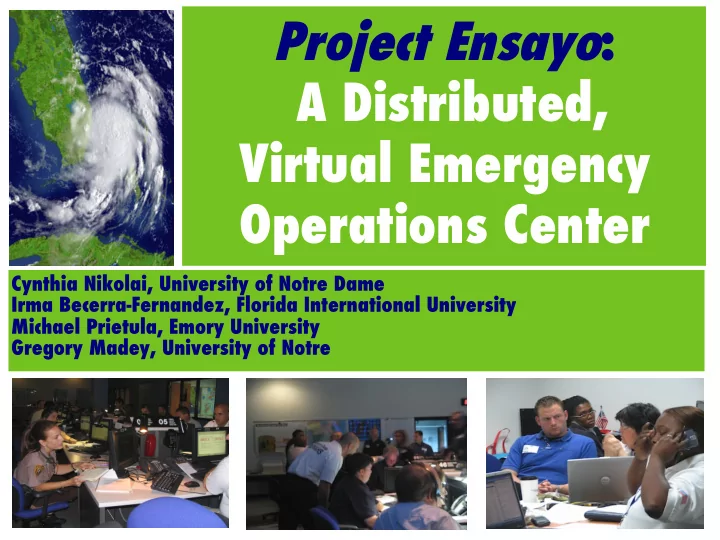
Project Ensayo : A Distributed, Virtual Emergency Operations Center Cynthia Nikolai, University of Notre Dame Irma Becerra-Fernandez, Florida International University Michael Prietula, Emory University Gregory Madey,


slide-1
SLIDE 1

Project Ensayo: A Distributed, Virtual Emergency Operations Center

Cynthia Nikolai, University of Notre Dame Irma Becerra-Fernandez, Florida International University
  • Michael Prietula, Emory University
  • Gregory Madey, University of Notre
slide-2
SLIDE 2 2

Overview

  • Introduction to EOCs
  • Technologies employed
  • vEOC architecture
  • vEOC infrastructure
  • Work So Far
  • Sample Screenshots
  • Acknowledgements
slide-3
SLIDE 3 3

Introduction

  • Emergency Operations Center (EOC):

Secure location in which individuals come together to prepare for, manage, and coordinate recovery activities in response to an emergency situation (eg hurricane, pandemic, earthquake, tsunami)

slide-4
SLIDE 4 4

Introduction

  • In our research, we are working

with Miami-Dade County, FL, to build a virtual EOC for

  • - Training emergency
  • management personnel
  • - Facilitating emergency
  • management exercises
  • - Research into emergency

management decision making

slide-5
SLIDE 5 5

Technologies Employed

  • XHTML, CSS, JavaScript, dynamic HTML,

Ajax

  • PHP, MySQL, Jetty, Dojo
  • Reverse Ajax
  • Zend PHP Development Platform
  • Virtual machines: all development and

deployment is being accomplished in virtual machines

slide-6
SLIDE 6 6

vEOC Architecture

slide-7
SLIDE 7 7

vEOC Infrastructure

slide-8
SLIDE 8 8

Interactive Advisor

  • Provides real-time feedback to the

trainee based on his/her crisis management decisions.

  • Analyzes the decisions of the trainee and

compares the decision to the correct decision based upon standard operating procedures (SOPs) and current subject matter expert

  • pinion. It then offers the trainee feedback and

advice on his/her decision.

slide-9
SLIDE 9 9

Analytics Module

  • The place where we do

necessary calculations to support other modules.

slide-10
SLIDE 10 10

Report Module

  • The central location for the code

that generates report templates and reports. This also enables

  • ne to save, create, import,

export, and search through reports.

slide-11
SLIDE 11 11

Mapping/GIS Module

  • The place where we incorporate

GIS/mapping capabilities.

slide-12
SLIDE 12 12

Dashboard Module

  • Provides real-time feedback to

the trainee concerning the effect of his/her decisions on various aspects of different resources.

  • Can be turned off for exercise
  • r research purposes
slide-13
SLIDE 13 13

User Interface Module

  • The location where the

sections of code reside that deal with the display of information on the server to the user.

slide-14
SLIDE 14 14

Scripting Module

  • Stores the code that deals

with implementing automatic sending of injects from the script stored on the server to the clients who are participating in the exercise.

slide-15
SLIDE 15 15

Chat/IM Module

  • Deals with a local chat
  • function. To implement this,

we use Reverse AJAX to create a real-time collaboration environment.

slide-16
SLIDE 16 16

vEOC User Views

  • Trainee
  • Prepares for emergency situations; practices decision

making by interacting with vEOC

  • Observer
  • Prepares for emergency situations by watching the

trainees and other personnel in the EOC

  • Scenario Manager
  • Creates scripts to train emergency personnel; moderates

training

slide-17
SLIDE 17 17

vEOC User Views (cont’d)

  • Staff Member
  • Upper level EOC staff members; they print reports and

analyze the performance and decision making of the EOC personnel

  • Administrator
  • Maintains the vEOC software; also sets up and moderates

user profiles

  • Researcher
  • Individuals interested in studying various aspects of

decision making and emergency response

17
slide-18
SLIDE 18 18

Key Features

local remote real simulated location people
slide-19
SLIDE 19 19

Key Features (cont’d)

  • Intelligent Agents
  • Interactive Advisor
  • Dashboard
  • Research Data Collection
slide-20
SLIDE 20 20

Work So Far

  • Foundational vEOC

Architecture and Infrastructure

  • EOC Representative

Console

  • Scenario Manager

Console

slide-21
SLIDE 21 21

Site Map

General Login Main Desktop Secondary Login
slide-22
SLIDE 22 22

Trainee Desktop

Main Panel

 Main place in which a user interacts in the virtual EOC  Includes exercise background, status boards, current conditions, links, references, and reports

Exercise Panel

 Main place in which a user interacts with the exercise  Includes history of injects, communication tools, interactive advisor, and additional media

2 Main Control Panels

slide-23
SLIDE 23 23

Sample Console

slide-24
SLIDE 24 24

Scenario Manager Desktop

 Main place in which a user develops and controls and exercise  Includes a file library, exercise controller panel, dashboards, script developer, evaluation measures, links, references, and various reports 1 Main Control Panel
slide-25
SLIDE 25 25

Exercise Controller

 Main place in which a user controls the exercise  Includes play, stop, pause, fastforward, nextblock, and ability to modify scripts on the fly as the exercise is running

Main Desktop

slide-26
SLIDE 26 26

Script Developer

 Main place in which a user creates and edits exercise and training scripts  Includes the ability to add and edit various scripts and injects Main Desktop
slide-27
SLIDE 27 27

Resource Request Form

Main place where users go to make a resource request

slide-28
SLIDE 28 28

Situational Reports

Main place where users go to create a situational report for the current situation
slide-29
SLIDE 29 29

Acknowledgments

  • The Miami-Dade EOC:
  • David Perez, Frank Reddish, Troy Johnson,

Curtis Sommerhoff, Soheila Ajabshir, and the Planning and Logistics Sections

slide-30
SLIDE 30 30

Acknowledgments (cont’d)

  • Our collaborators at Florida International

University:

  • Arvind Gudi and Pepe Rocha
  • The Zahm Research Travel Fund, University of

Notre Dame

  • NSF Award Num: CNS-0855164
slide-31
SLIDE 31 31

Summary

  • Introduction to EOCs
  • Technologies employed
  • vEOC architecture
  • vEOC infrastructure
  • Work So Far
  • Sample Console
  • Acknowledgements
slide-32
SLIDE 32 32

Questions

?

slide-33
SLIDE 33 33

Contact Information

  • Cynthia Nikolai - cnikolai@nd.edu
  • Irma Becerra-Fernandez -

becferi@fiu.edu

  • Michael Prietula -

mj.prietula@emory.edu

  • Greg Madey - gmadey@nd.edu