
SLIDE 1
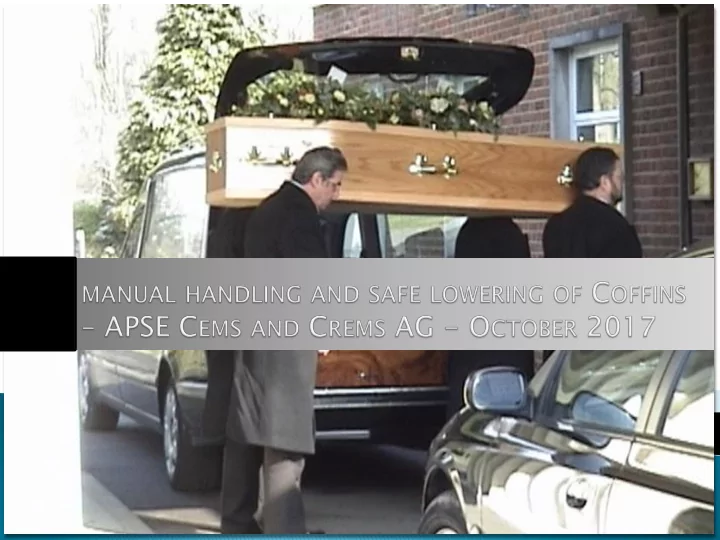
Introduction David MacColl Bereavement Services Manager Glasgow - - PowerPoint PPT Presentation
Introduction David MacColl Bereavement Services Manager Glasgow City Council 2 Crematoria 32 Cemeteries Circa 6000 Services each year More years in the business than I care to mentionstill learning though Purpose
David MacColl – Bereavement Services Manager Glasgow City Council
More years in the business than I care to mention……still learning though
surrounding the safe carriage of coffins from the hearse to the catafalque/put-logs
1. Legal Requirements 2. Manual Handling by our staff 3. Manual handling by non-employees within grounds that we control 4. Categories of coffin weight 5. Authority safety and training procedures 6. Funeral Director and Others safety and training procedures 7. Custom and practices by all concerned 8. Adverse publicity 9. HSE Notices
Health and Safety at Work Act 1974 Management of Health and Safety Regs 1992 Manual Handling regulations 1992 Provision and use of work equipment Regs 1998 Occupiers’ Liability (Scotland) Act 1960
Safe lift weights for a man and woman
Each authority has a duty to
ensure that their employees are not injured whilst lifting and handling.
Most authorities will have in
place suitable training for this and employees will be generally aware of their own duties in relation to Health and Safety.
Who does this effect
Bereaved Family members Funeral Directors
Issues to be considered
Training Health and Safety injury's
The discussion paper
considers the guidance provided in the Health and Safety Laboratory report which provides average and heavy weights for coffins and a body.
35kg (5.7st) average coffin 50kg (8st)
top end coffin
76kg (12st) average body
weight
107kg (17.8st)“heavier” body An average weight would mean
that an average coffin and average body would weigh 111kg (approximately 17.5 stones).
A top end coffin and heavier
body would weigh 157kg (Approximately 25.5 stones).
possible
scale to determine if they are suitable)
Categor
gory y A – Normal mal = U Up to and Incl cluding uding 111kg
Categor
gory y B – Medium um = Ov Over er111kg kg to 157kg
Ca
Categor
gory y D - Bariatri tric c = Ov Over r ?k ?kg
All authorities should already have RA for the work
undertaken in cemeteries and crematoriums. These will probably need reviewed once all aspects of this discussion paper are considered.
Whilst again understanding that each authority is
responsible for their own Health and Safety, it would be best for members to agree a template for a model RA and to develop methods of safe work across the services.
There are clear benefits with this approach, as it gives
stakeholders a better understanding of the arrangements required when entering a cemetery or crematorium, whether this is in the North or South of the country
1 Lifting and carrying heavy coffin.
The Funeral director must supply coffin weights before burial takes place. Coffin weight must be considered prior to any lifting operations taking place. There are 4 weight categories which have to be considered; A. Normal up to and including 111kg. B. Medium 111kg to 157kg C. High 157kg-200kg D. Very High over 200kg Both A and B categories could be considered if there was a request to carry coffin at shoulder height. The recommendation would be that all categories need to be carried at elbow to knuckle height. Category C would not be considered for carrying at shoulder height. Category D would require mechanical means to move coffin. Load bearing frames need to be setup at the rear of the hearse to allow the coffin to be removed without any lifting, the coffin would be slid across the frame to ensure that the weight is evenly distributed; this would allow the coffin to be secured before moving mechanically to the graveside. The Funeral Director is responsible for presenting the coffin to the grave and onto the putt logs. The Hearse will be manoeuvred as close as possible to the grave side. Coffin Carrying Sticks are available to be used to take the load, or mechanical aid where required. The coffin will be removed from the Hearse by the Funeral Director. Team lifting & handling techniques must be used when carrying the coffin and in accordance with the advised weight categories. The coffin will be lifted using a sufficient number of carrying sticks and carried at elbow to knuckle height unless previously requested and in accordance with advised weight categories. A sufficient number of people are required to perform this operation. This will consist off a sufficient number of trained and experienced people supplied by Funeral Director and a sufficient number of trained and experienced employees supplied by East Ayrshire Council. All Council employees assisting with the task must have received Manual Handling training. Extreme care must be taken when lifting or carrying a heavy coffin. No one should attempt to move a coffin alone. The coffin will be placed on suitable Putt Logs (cross sticks) On the grave site. There shall be a sufficient number
5 2 10 MED
2 Lowering the coffin into the grave.
There will be a sufficient number of lowering Straps used to lower the coffin into the grave. The Funeral Director is responsible for lowering the coffin in to the grave. The coffin lowering party will be placed around the open grave by the Funeral Director. The Funeral director needs to provide the cord bearers with suitable instruction on how to lower the coffin into the grave. The Funeral Director will give the signal to take the strain and the cross sticks will be removed to allow the coffin to be lowered in to the grave. The coffin should be lowered slowly and evenly to the bottom of the grave. The straps should be let go and the lowering party should carefully step away from the graveside.
5 1 5 LOW
3 Slips – Trips – Falls
All employees involved in the task should ensure that they are wearing the appropriate PPE and Safety Footwear Cemetery staff must ensure that all tripping hazards are identified and where possible removed from the route that the coffin bearers will travel. Cemetery staff must ensure that grave area is made safe, in accordance with their COTS training, to protect all involved in the task from any potential Slip, Trip hazards. Timber boards will be placed around the grave to accommodate the lowering party to ensure that there is a level and stable footing. Observe the weather conditions and take the appropriate remedial action to protect all involved in the task and cemetery users from any potential Slip, Trip & Fall hazards. In wet weather, ensure that any mud is cleaned up and check and clean the area prior to the arrival of the cortege. In cold weather grit and ensure paths are free from snow and ice.
5 1 5 LOW
It is important that we as land and premises owners
ensure that safe methods of work are in place when using our facilities.
Do we insist on Risk Assessments? Do we insist on Method Statements? Do we insist that funeral directing businesses are
responsible for all aspects of handling and ensuring the coffin is laid to rest at the bottom of the grave or placed
Do we insist that coffin gross weights are supplied on
continue to provide assistance?
Do we supply or require that funeral directing
businesses supply mechanical equipment for moving and lifting and handling coffins over a certain weight?
National Association Funeral Directors (NAFD) Society of Allied Independent Funeral Directors
Local Authority's Suppliers
According to the HSE Guidance Paper
reduce/remove MH Issues
journey’ experience