Introduction Plant disease Susceptible plant Pathogen can develop - - PDF document

introduction
SMART_READER_LITE
LIVE PREVIEW

Introduction Plant disease Susceptible plant Pathogen can develop - - PDF document

Oral Presentation CRDC 5 22/07/54 CRDC-5 (22 July 2011) Phenotypic analysis of transcriptional regulators associated transcriptional regulators associated with environmental stress tolerance in the yeast Saccharomyces cerevisiae Miss Chalinee


slide-1
SLIDE 1

Oral Presentation CRDC 5 22/07/54 1

Phenotypic analysis of transcriptional regulators associated

CRDC-5 (22 July 2011)

transcriptional regulators associated with environmental stress tolerance in the yeast Saccharomyces cerevisiae

Miss Chalinee Tangsombatvichit Division of Biochemical Technology School of Bioresources and Technology King Mongkut’s University of Technology Thonburi

Introduction

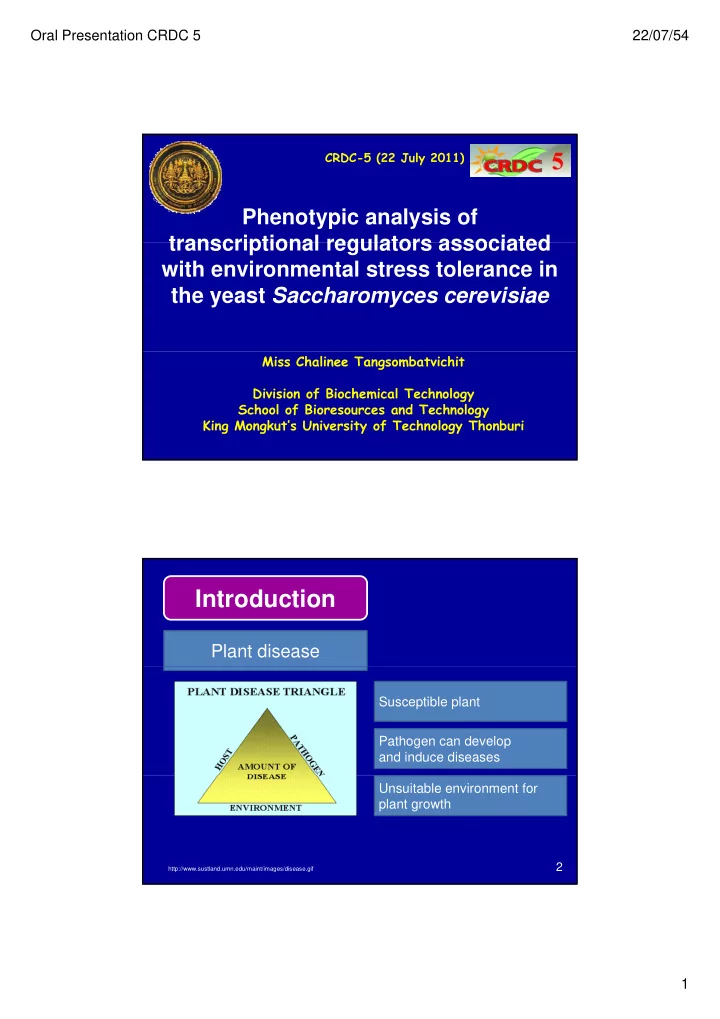
Plant disease

Susceptible plant Pathogen can develop and induce diseases Unsuitable environment for plant growth

http://www.sustland.umn.edu/maint/images/disease.gif

2

slide-2
SLIDE 2

Oral Presentation CRDC 5 22/07/54 2

Cell division and fungal development

http://www.phschool.com/science/biology_place/biocoach/images/transcription/euovrvw.gif http://scienceblogs.com/pharyngula/upload/2006/07/transcriptionfactor.jpg

3

Zinc cluster proteins

Sub-classes of eukaryotic zinc finger proteins

Gal4p Hap1p Leu3p

Major class of transcriptional regulator Consensus amino acid sequence as shown Cys-X2-Cys-X6-Cys-X5-12-Cys-X2-Cys-X6-8-Cys Identified exclusively in fungi

MacPherson et al., 2006. Microbiology and Molecular Biology Review, Vol. 70, pp. 583-604.

4

slide-3
SLIDE 3

Oral Presentation CRDC 5 22/07/54 3

Non Pathogenic fungi

Fungal organism

Saccharomyces Kluyveromyces Schizosaccharomyces Saccharomyces cerevisiae Kluyveromyces lactis Schizosaccharomyces pombe

MacPherson et al., 2006. Microbiology and Molecular Biology Review, Vol. 70, pp. 583-604.

5

Pathogenic fungi Candida albicans Aspergillus nidulans Fusarium oxysporum Candida albicans Aspergillus nidulans

MacPherson et al., 2006. Microbiology and Molecular Biology Review, Vol. 70, pp. 583-604.

Fusarium oxysporum

6

slide-4
SLIDE 4

Oral Presentation CRDC 5 22/07/54 4

Fungal pathogen in plant

Fusarium oxysporum Fusarium oxysporum : widespread in economic plants such as tomato, pepper, maize or banana etc. : Soil borne : Filamentous fungi : Mycotoxin : Vascular wilt

7

Roles of zinc cluster proteins in Fusarium sp.

Imazaki et al., 2007. Fow2, a Zn(II)2Cys6-type transcription regulator, controls plant infection of the vascular wilt fungus Fusarium oxysporum. Molec. Microbiol. 63: 737 753 737-753.

  • Fig. 1 Pathogenicity of Fow2 mutants.

g g y Melon plants with a single true leaf were inoculated with bud cell suspension by the root dip method. Fow2 mutant WT Fow2 mutant WT

8

slide-5
SLIDE 5

Oral Presentation CRDC 5 22/07/54 5

Fow2 mutant WT

  • Fig. 2 Invasive hyphae of wild-type and Fow2 mutant strains within hypocotyls.

Cross-sections of hypocotyls were observed with a fluorescence microscope. DIC, differential interference contrast images; GFP, GFP fluorescence images

9

Ramos et al., 2007. The gene coding for a new transcription factor (ftf1) of Fusarium

  • xysporum is only expressed during infection of common bean. Fungal Gent. Biol.

44: 864-876.

Isolated virulent genes from highly virulent strains of Fusarium

  • xysporum during infection of common bean

Found virulent gene FTF1 (Fusarium transcription factor 1) which encodes zinc cluster protein of common bean FTF1 is presented and involved in plant disease.

10

slide-6
SLIDE 6

Oral Presentation CRDC 5 22/07/54 6

The yeast S. cerevisiae genetic model organism

Genome sequencing of yeast Saccharomyces cerevisiae identified a total of 55 putative zinc p cluster proteins and many have unknown roles ???

Schjerling, P. and Holmberg, S., 1996. Nucleic Acids Research, Vol. 24, pp. 4599-4607.

11

Roles of zinc cluster proteins in S. cerevisiae

Sugar metabolism Gene Name Characteristic GAL4 Activator of genes involved in galactose metabolism MAL33 Activator of genes involved in maltose metabolism Stress response Gene Name Characteristic ASG1 Activator of stress response genes, involved in respiration,

MacPherson et al., 2006. Microbiology and Molecular Biology Review, Vol. 70, pp. 583-604.

ASG1 Activator of stress response genes, involved in respiration,

  • r antifungal drug resistance

HAL9 Involved in salt tolerance STB5 Activator of genes involved in multidrug resistance and

  • xidative stress response

12

slide-7
SLIDE 7

Oral Presentation CRDC 5 22/07/54 7

Multidrug resistance Gene Name Characteristic PDR1 Activators and repressors involved in multidrug resistance RDR1 Repressor of genes involved in the control of multidrug resistance RDS2 Activator and repressor involved in gluconeogenesis and glyoxylate cycle genes, or drug sensitivity YRR1 Activator of genes involved in multidrug resistance

http://www.yeastgenome.org/ MacPherson et al., 2006. Microbiology and Molecular Biology Review, Vol. 70, pp. 583-604.

13

Objective

T b th l f k i l t t i ti l To observe the roles of unknown zinc cluster transcriptional regulators that responses to environmental stress > heat tolerance > salt tolerance in the wild-type and zinc cluster deletion strains of S. cerevisiae via phenotypic analysis

14

slide-8
SLIDE 8

Oral Presentation CRDC 5 22/07/54 8

Methodology

Table 1 S. cerevisiae strains used in this study Strain name Deletion* FA aa 24-167 FB aa 25-166 FC aa 23-206 FI aa 27-200 FZI 25 122 FZI aa 25-122 FZJ aa 115-319 FZO aa 25-166 FZP aa 25-196

15

Phenotypic analysis

Culture yeast strains in YPD overnight Measured OD600nm start at 0.1 Spot assay under different environmental conditions Serial dilution and spot on plates

16

slide-9
SLIDE 9

Oral Presentation CRDC 5 22/07/54 9 Heat Salt stress

Growth conditions

No salt 0.5M LiCl 1 0M NaCl 30OC 37OC sensitivity Salt stress 1.0M NaCl 1.5M KCl 39OC

17

Results

Temperature (OC) Table 2 Growth assay of wild-type and zinc cluster deletion strains under increased temperature Strain name Temperature (OC) 30 37 39 Wild-type ++ ++ + FA ++ ++ + FB ++ ++ + FC ++ ++ + FI ++ ++ + FI ++ ++ + FZI ++ ++ + FZJ ++ ++ + FZO ++ ++ + FZP ++ + X ++ normal growth + moderate growth X impaired growth 18

slide-10
SLIDE 10

Oral Presentation CRDC 5 22/07/54 10 Wild-type FZP 30OC

cell

FZP 39OC Wild-type FZP

  • Fig. 3 Phenotypic analysis of wild-type and zinc cluster FZP strains

were grown at various temperature of 30OC or 39OC 19 Strain name Salt concentration No 0.5M 1.0M 1.5M Table 3 Growth assay of wild-type and zinc cluster deletion strains during growth on media containing salts No salt 0.5M LiCl 1.0M NaCl 1.5M KCl Wild-type ++ + + + FA ++ + + + FB ++ + + + FC ++ + + + FI ++ + + + FZI ++ + + + FZJ FZJ ++ + + + FZO ++ + + + FZP ++ + X X ++ normal growth + moderate growth X impaired growth 20

slide-11
SLIDE 11

Oral Presentation CRDC 5 22/07/54 11 Wild-type FZP No salt

cell

Wild-type FZP Wild-type FZP 1.0M NaCl 1.5M KCl FZP

  • Fig. 4 Phenotypic analysis of wild-type and zinc cluster FZP strain

were grown on media containing no salt, 1.0M NaCl or 1.5M KCl 21

  • Fig. 5 Schematic proposed model for transcriptional regulator named FZP

is involved in heat tolerance or osmotic stress response in the yeast 22

slide-12
SLIDE 12

Oral Presentation CRDC 5 22/07/54 12

Conclusion

Th d l ti FZP t i h d i i d th t t t 1 The deletion FZP strain showed impaired growth at temperature

  • f 39OC but not 30OC when compared with wild-type.

1 In the presence of salt, the deletion FZP strain also revealed impaired growth on media containing high salt concentration of 1 0M 2 impaired growth on media containing high salt concentration of 1.0M NaCl or 1.5M KCl but not 0.5M LiCl 23 The zinc cluster transcriptional regulator named FZP may 3 regulate genes encoding for enzymes involved in heat tolerance or salt stress response. 24

slide-13
SLIDE 13

Oral Presentation CRDC 5 22/07/54 13

Expected benefit

Our phenotypic analysis indicates new functions for zinc cluster transcription factor of S. cerevisiae and may be useful for designing new antifungal agent for control of fungal infection in economic plants. 25

Acknowledgements

: Assoc Prof Dr Bernard Turcotte : Assoc.Prof.Dr. Bernard Turcotte : Assoc.Prof.Dr. Kanok Rattanakanokchai : Dr. Nitnipa Soontorngun

slide-14
SLIDE 14

Oral Presentation CRDC 5 22/07/54 14

Thank you for your attention!