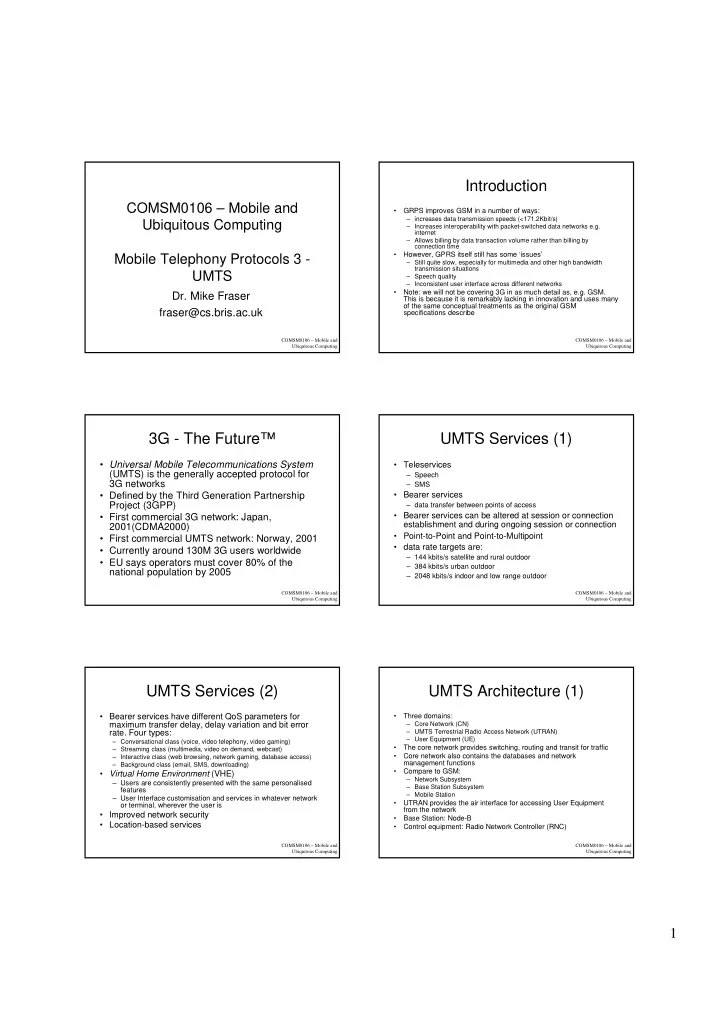
Introduction COMSM0106 Mobile and GRPS improves GSM in a number - - PDF document

introduction
SMART_READER_LITE
LIVE PREVIEW

Introduction COMSM0106 Mobile and GRPS improves GSM in a number - - PDF document

Introduction COMSM0106 Mobile and GRPS improves GSM in a number of ways: increases data transmission speeds (<171.2Kbit/s) Ubiquitous Computing Increases interoperability with packet-switched data networks e.g. internet


slide-1
SLIDE 1

1

COMSM0106 – Mobile and Ubiquitous Computing

COMSM0106 – Mobile and Ubiquitous Computing Mobile Telephony Protocols 3 - UMTS

  • Dr. Mike Fraser

fraser@cs.bris.ac.uk

COMSM0106 – Mobile and Ubiquitous Computing

Introduction

  • GRPS improves GSM in a number of ways:

– increases data transmission speeds (<171.2Kbit/s) – Increases interoperability with packet-switched data networks e.g. internet – Allows billing by data transaction volume rather than billing by connection time

  • However, GPRS itself still has some ‘issues’

– Still quite slow, especially for multimedia and other high bandwidth transmission situations – Speech quality – Inconsistent user interface across different networks

  • Note: we will not be covering 3G in as much detail as, e.g. GSM.

This is because it is remarkably lacking in innovation and uses many

  • f the same conceptual treatments as the original GSM

specifications describe

COMSM0106 – Mobile and Ubiquitous Computing

3G - The Future™

  • Universal Mobile Telecommunications System

(UMTS) is the generally accepted protocol for 3G networks

  • Defined by the Third Generation Partnership

Project (3GPP)

  • First commercial 3G network: Japan,

2001(CDMA2000)

  • First commercial UMTS network: Norway, 2001
  • Currently around 130M 3G users worldwide
  • EU says operators must cover 80% of the

national population by 2005

COMSM0106 – Mobile and Ubiquitous Computing

UMTS Services (1)

  • Teleservices

– Speech – SMS

  • Bearer services

– data transfer between points of access

  • Bearer services can be altered at session or connection

establishment and during ongoing session or connection

  • Point-to-Point and Point-to-Multipoint
  • data rate targets are:

– 144 kbits/s satellite and rural outdoor – 384 kbits/s urban outdoor – 2048 kbits/s indoor and low range outdoor

COMSM0106 – Mobile and Ubiquitous Computing

UMTS Services (2)

  • Bearer services have different QoS parameters for

maximum transfer delay, delay variation and bit error

  • rate. Four types:

– Conversational class (voice, video telephony, video gaming) – Streaming class (multimedia, video on demand, webcast) – Interactive class (web browsing, network gaming, database access) – Background class (email, SMS, downloading)

  • Virtual Home Environment (VHE)

– Users are consistently presented with the same personalised features – User Interface customisation and services in whatever network

  • r terminal, wherever the user is
  • Improved network security
  • Location-based services

COMSM0106 – Mobile and Ubiquitous Computing

UMTS Architecture (1)

  • Three domains:

– Core Network (CN) – UMTS Terrestrial Radio Access Network (UTRAN) – User Equipment (UE)

  • The core network provides switching, routing and transit for traffic
  • Core network also contains the databases and network

management functions

  • Compare to GSM:

– Network Subsystem – Base Station Subsystem – Mobile Station

  • UTRAN provides the air interface for accessing User Equipment

from the network

  • Base Station: Node-B
  • Control equipment: Radio Network Controller (RNC)
slide-2
SLIDE 2

2

COMSM0106 – Mobile and Ubiquitous Computing

UMTS Architecture (2)

  • What’s new here compared

to GSM? On the surface, not much, e.g.:

  • RNC (c.f. GSM BSC)
  • Node B (c.f. GSM BTS)
  • In practice, UMTS will

require separate hardware due to speed, frequency and

  • perational issues

COMSM0106 – Mobile and Ubiquitous Computing

UMTS Architecture (3)

  • Circuit switched and packet switched domains
  • Circuit switched:

– Mobile services Switching Centre (MSC) – Visitor location register (VLR) – Gateway MSC

  • Packet switched:

– Serving and Gateway GPRS Support Nodes (SGSN, GGSN

  • Shared:

– EIR, HLR, VLR, AUC

  • MSC, VLR and SGSN merge to become a UMTS MSC
  • The architecture of Core Network may change when new services are

introduced

– Number Portability Database (NPDB) enables user to change the network while keeping old phone number – Gateway Location Register (GLR) used to optimise subscriber handling between network boundaries

COMSM0106 – Mobile and Ubiquitous Computing

ATM Transmission

  • The Asynchronous Transfer Mode (ATM)

is defined for UMTS core transmission

  • ATM Adaptation Layer type 2 (AAL2)

handles circuit switched connection (for voice)

  • ATM Adaptation Layer type 5 (AAL5)

handles packet switched connection (for data)

COMSM0106 – Mobile and Ubiquitous Computing

WCDMA (1)

  • Code-Division Multiple-

Access (CDMA) :

– every communicator will be allocated the entire spectrum all of the time

  • Opposed to (some)

GSM systems which use TDMA (time), FDMA (frequency) or both

COMSM0106 – Mobile and Ubiquitous Computing

WCDMA (2)

  • Wideband Code-Division Multiple-

Access (WCDMA) is Direct Sequence CDMA system

– user data is multiplied with quasi- random bits derived from WCDMA spreading codes

  • WCDMA has two basic modes of
  • peration

– Frequency Division Duplex (FDD) – Time Division Duplex (TDD)

  • Different users can simultaneously

transmit at different data rates and data rates can even vary in time

  • This is where the speed comes in

COMSM0106 – Mobile and Ubiquitous Computing

Node-B and RNC

  • Node-B (as per BTS):

– Air interface Transmission / Reception – Modulation / Demodulation – Error Handing – Power Control

  • RNC (as per BSC):

– Radio Resource Control – Admission Control – Channel Allocation – Power Control Settings – Handover Control – Ciphering – Segmentation / Reassembly – Broadcast Signalling – Open Loop Power Control

slide-3
SLIDE 3

3

COMSM0106 – Mobile and Ubiquitous Computing

User Equipment (1)

  • The UMTS standard does not restrict User

Equipment functionality

  • Terminals work as air interface counter

part for Node-B/RAN

  • Most UMTS identity types taken directly

from GSM specifications, e.g.:

– International Mobile Subscriber Identity (IMSI) – International Mobile Station Equipment Identity (IMEI)

COMSM0106 – Mobile and Ubiquitous Computing

User Equipment (2)

  • UMTS mobile station can operate in one of three modes involving packet-switching

(PS) and circuit switching (CS):

– PS/CS mode:

  • Station is attached to both the PS domain and CS domain, and is capable of simultaneously operating

PS and CS services

– PS mode:

  • Station is attached to the PS domain only
  • This does not prevent CS-like services to be offered over the PS domain (like Voice over IP)

– CS mode:

  • Station is attached to the CS domain only and may only operate services of the CS UMTS IC card has

same physical characteristics as GSM SIM card. It has several functions:

  • Support of one User Service Identity Module (USIM) application (optionally more that
  • ne)
  • Support of one or more user profile on the USIM
  • Update USIM specific information over the air
  • Security functions
  • User authentication
  • Secure downloading of new applications

COMSM0106 – Mobile and Ubiquitous Computing

Conclusions

  • Have now looked at most common

protocols for local area-high bandwidth and wide area-low (but improving) bandwidth

  • Next: last lecture on wireless networking!

– Alternative methods for wireless networking – Alternative we missed by looking at WiFi and phones

  • After that: Sensors and sensorship