Introduction The Impact of STEM Education from a National - - PDF document

introduction
SMART_READER_LITE
LIVE PREVIEW

Introduction The Impact of STEM Education from a National - - PDF document

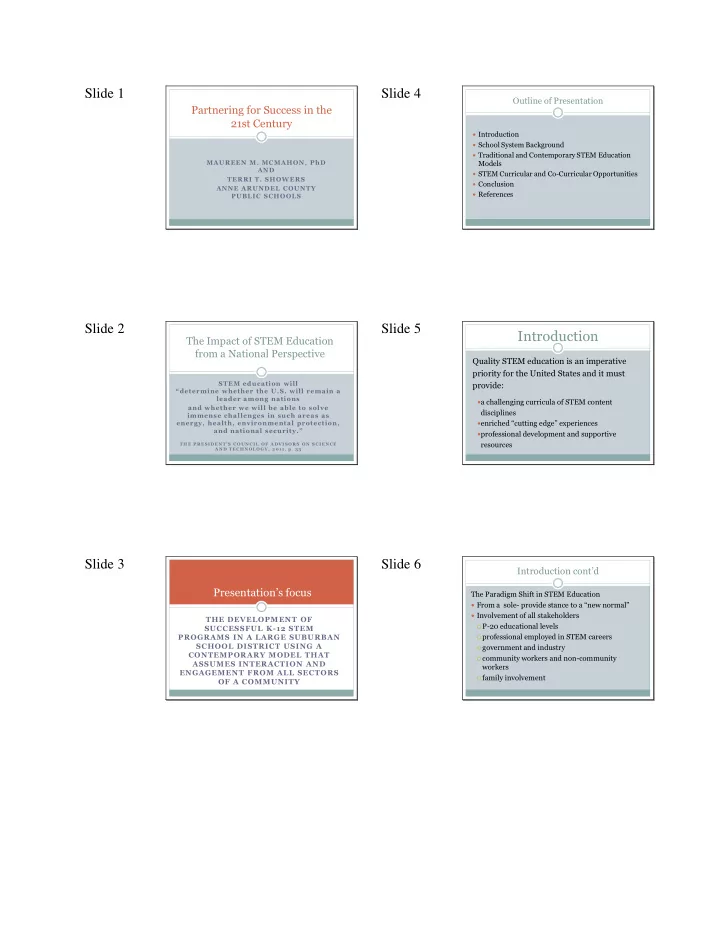
Slide 1 Slide 4 Outline of Presentation Partnering for Success in the 21st Century Introduction School System Background Traditional and Contemporary STEM Education MAUREEN M. MCMAHON, PhD Models AND STEM Curricular and


slide-1
SLIDE 1

Slide 1

MAUREEN M. MCMAHON, PhD AND TERRI T. SHOWERS ANNE ARUNDEL COUNTY PUBLIC SCHOOLS

Partnering for Success in the 21st Century

Slide 2

STEM education will “determine whether the U.S. will remain a leader among nations and whether we will be able to solve immense challenges in such areas as energy, health, environmental protection, and national security.”

TH E P R E S I DE N T’ S C O UN C I L O F ADVI S O R S O N S C I E N C E AN D TE C H N O LO GY, 2 0 1 1, p. 3 3

The Impact of STEM Education from a National Perspective

Slide 3

THE DEVELOPMENT OF SUCCESSFUL K-12 STEM PROGRAMS IN A LARGE SUBURBAN SCHOOL DISTRICT USING A CONTEMPORARY MODEL THAT ASSUMES INTERACTION AND ENGAGEMENT FROM ALL SECTORS OF A COMMUNITY

Presentation’s focus

Slide 4

Outline of Presentation

 Introduction  School System Background  Traditional and Contemporary STEM Education

Models

 STEM Curricular and Co-Curricular Opportunities  Conclusion  References

Slide 5 Introduction

Quality STEM education is an imperative priority for the United States and it must provide:

a challenging curricula of STEM content

disciplines

enriched “cutting edge” experiences professional development and supportive

resources

Slide 6

Introduction cont’d

The Paradigm Shift in STEM Education

 From a sole- provide stance to a “new normal”  Involvement of all stakeholders

P-20 educational levels professional employed in STEM careers government and industry community workers and non-community

workers

family involvement

slide-2
SLIDE 2

Slide 7

Anne Arundel County Public School System

 Among the 50 largest school systems in the country  Approximately 75,000 students  113 Schools

  • 78 elementary schools
  • 19 middle schools
  • 12 high school
  • two charter schools, one early education center
  • r one special educational center

 divided into twelve feeder systems

Slide 8

Annapolis, Maryland

 Strategically located

Baltimore, Maryland – Washington, D.C.

corridor

 Two major military installations  Institutions of higher education  STEM industries, businesses, and museums  For-profit as well as non-profit organizations

Slide 9

Traditional and Contemporary STEM Education Models

Traditional model of STEM education

 STEM education was initiated from within the

school system silos

 few outside entities offered support  financial support was available  school system had leadership role of STEM

education

 community stakeholders’ role was limited

Slide 10

Traditional School-Community Interaction Model K-12 Schools

Higher Education Community Organizations Government

Families & Other Community Stakeholders

Media

Slide 11

Contemporary School-Community Interaction Model Silos of interdisciplinary study changed to trans- disciplinary STEM study Professional development opportunities

  • technology applications
  • co-curricular instructional tools and

applications

Slide 12

Contemporary School-Community Interaction Model cont’d STEM curriculum and assessments are aligned All STEM stakeholders share in an equal collaborative partnership

slide-3
SLIDE 3

Slide 13

Business & Industry Higher Education Community Organizations K-12 Schools Government Families & Other Community Stakeholders Media Contemporary School-Community Interaction Model

Slide 14

Benefits of the Contemporary School- Community Interaction Model  Inundated with resources from various

places

 Shared responsibility for STEM student

learning

 Sustained win-win partnerships among

the stakeholders

Slide 15

Benefits of the Contemporary School- Community Interaction Model cont’d  Improved STEM workforce pipeline  Enhanced educational instruction  New relationship formed among different

community organizations

 Increased STEM career knowledge for

families

Slide 16

Additional Benefits of the Contemporary School-Community Interaction Model

 Increased diversity among our stakeholders  Developed rapport and communication among all

families

 Improved STEM education district-wide  Extended support from stakeholders to build models

district-wide

Slide 17

Students in a seminar on BMI, Building Information Management Photo- Courtesy of Mr. Ryan Sackett, Technology Education Dept. Chair PLTW Instructor, South River High School

Slide 18

Anne Arundel County Public Schools: STEM Programs of Choice

Advanced Studies and Programs Division

STEM clubs are offered in four grade level clusters:

K-2, 3-5, 6-8, and 9-12 Examples include:

 National Aeronautics and Space Administration (NASA)  SEAPerch Underwater Robotics  Underwater Remotely Operated Vehicle  Mathematics, Engineering, Science Achievement (MESA)

slide-4
SLIDE 4

Slide 19

Anne Arundel County Public Schools: STEM Programs of Choice cont’d

Additional STEM Offerings at every school

 Co-curricular  Advanced Placement course offerings (high schools)

Examples include:

 Project Lead the Way (PLTW) engineering  PLTW Gateway Engineering Program (middle schools)  Project Based-Learning

Slide 20

Anne Arundel County Public Schools: Additional STEM Programs of Choice cont’d

Six magnet schools

 3 International Baccalaureate Programme schools  1 BioMedical Allied Health high school magnet  2 STEM high school magnets

Twelve high schools

 Advanced Studies program courses in mathematics

and science

Slide 21

Anne Arundel County Public Schools: Additional STEM Programs of Choice cont’d

Advanced Studies program courses in mathematics and science

 All 12 high schools

Engineering

 Military Service Academy  Local community college

Slide 22

Quality STEM Community-based Experiences

co-curricular activities job shadowing/internships panel discussions summer bridge/camps family nights special courses

STEM Curricular and Co-curricular Opportunities

Slide 23

STEM Academic Competitions

Local and Regional Advanced STEM Clubs

By Kids For Kids MESA Science Fair SkillsUSA 24 Game Destination Imagination SEAPerch Competition

Slide 24

The STEM Programs

The Division of Advanced Studies and Programs

 promotes and evaluates programs

STEM Magnet High Schools Curriculum

reflects rigor supports the knowledge-based economy receives suggestions from community-based

stakeholders

slide-5
SLIDE 5

Slide 25

The STEM Job Shadowing/Internships and Community Challenges

Outcomes:

 expose students to professional work environments  enable students to conduct research  provide students to collaborate with their mentors  impact students’ future decisions

Slide 26

  • demonstrates how 1+1 can be greater than 2
  • increases student and family engagement
  • affects student achievement
  • affects stakeholders’ organizations
  • targets collaborative work in the K -12 sector

Contemporary School-Community Interaction Model

Slide 27

Program development will :

  • include the formal evaluation of community-

based programs

  • look longitudinally at the retention rates of

students in the STEM pipeline

Future Steps

Slide 28

STEM education for the 21 st century must be innovative, relevant, and

  • rigorous. It must enable students to

continue to see themselves as digital natives in this technology-rich, fast- paced world.

Conclusion

Slide 29

Anne Arundel County in Annapolis, Maryland is using the contemporary STEM education model to show how partnering leads to successful STEM education for all students.

Conclusion cont’d

Slide 30

References

Burbank, M., & Hunter, R. (2008). The community advocate model: Linking communities, school districts, and universities to support families and exchange

  • knowledge. Journal of Community Engagement and Scholarship , 1 (1), 47-55.

Retrieved from http://ehis.ebscohost.com/ehost/pdfviewer/pdfviewer?vid=13&hid=22&sid=57 8bbc45-4729-46e9-8a45-097b46ebf542%40sessionmgr4 Bybee, R. W. (2010). Advancing STEM education: A 2020 vision. Technology and Engineering Teacher, 70(1), 30-35. Retrieved from http://ehis.ebscohost.com/ehost/pdfviewer/pdfviewer?sid=8f8840e6-6a4a- 408e-86c9-abccc9133f53%40sessionmgr10&vid=6&hid=23 Hoyle, D. (2010). Adjunct Programs. Retrieved from Anne Arundel County Public Schools: http://www.aacps.org/admin/templates/gifted.asp?articleid=473&zoneid=35

slide-6
SLIDE 6

Slide 31

References cont’d

_____________. Advanced Studies and Programs. Retrieved from Anne Arundel County Public Schools: http://www.aacps.org/admin/templates/magnet.asp?articleid=959&zoneid=51 _____________. Anne Arundel Public Schools Fast Facts. Retrieved from Anne Arundel County Public Schools: http://aacps.org/aacps/boe/ADMIN/PINFO/fastfacts.pdf _____________. STEM Magnet High Schools. Retrieved from Anne Arundel County PublicSchools: http://www.aacps.org/admin/templates/stemnews.asp?articleid=404&zoneid=5 Hyslop, A. (2010). CTE's role in science, technology, engineering and

  • mathematics. Techniques:Connecting Education and Careers, 85(3), 16-20.

Retrieved from http://www.eric.ed.gov/PDFS/EJ888189.pdf

Slide 32

References cont’d

Marshall, S. P. (2010). Re-Imagining specialized STEM academies: Igniting and nurturing decidedly different minds, by design. Roeper Review ,32, 48-60. doi:10.1080/02783190903386884 Nugent, G., Kunz, G., Rilett, L., & Jones, E. (2010). Extending engineering education to K-12. The Technology Teacher , 14-19, Retrieved from http://ehis.ebscohost.com/ehost/pdfviewer/pdfviewer?sid=70c8eb08-c532- 4570-9ec7-ab5a23841d29%40sessionmgr12&vid=4&hid=20 The President's Council of Advisors on Science and Technology. (2011). K-12 Science, technology, engineering, and math (STEM) education for America's

  • future. Tech Directions , 70(6), 33-36. Retrieved from

http://ehis.ebscohost.com/ehost/pdfviewer/pdfviewer?vid=5&hid=1&sid=3f1093 81-3c9d-4360-a335-35acb8178e9b%40sessionmgr11