INTRODUCTION Tribo-Mechanical Evaluations of The aim of this - - PDF document

introduction
SMART_READER_LITE
LIVE PREVIEW

INTRODUCTION Tribo-Mechanical Evaluations of The aim of this - - PDF document

INTRODUCTION Tribo-Mechanical Evaluations of The aim of this investigation was to integrate the potential benefits The aim of this investigation was to integrate the potential benefits of two process technologies of thermal spraying and


slide-1
SLIDE 1

1

Tribo-Mechanical Evaluations of HIPed Thermal Spray Cermet Coatings

  • V. Stoica
  • V. Stoica

Heriot Heriot-

  • Watt University

Watt University,

, UK

UK

Rehan Ahmed Heriot Watt University, UK

  • T. Itsukaichi
  • T. Itsukaichi

Fujimi Inc., Japan Fujimi Inc., Japan

  • S. Tobe
  • S. Tobe

Ashikaga Inst. of Tech., Japan Ashikaga Inst. of Tech., Japan

  • R. Gadow, M. Escribano
  • R. Gadow, M. Escribano

University of Stuttgart, Germany University of Stuttgart, Germany

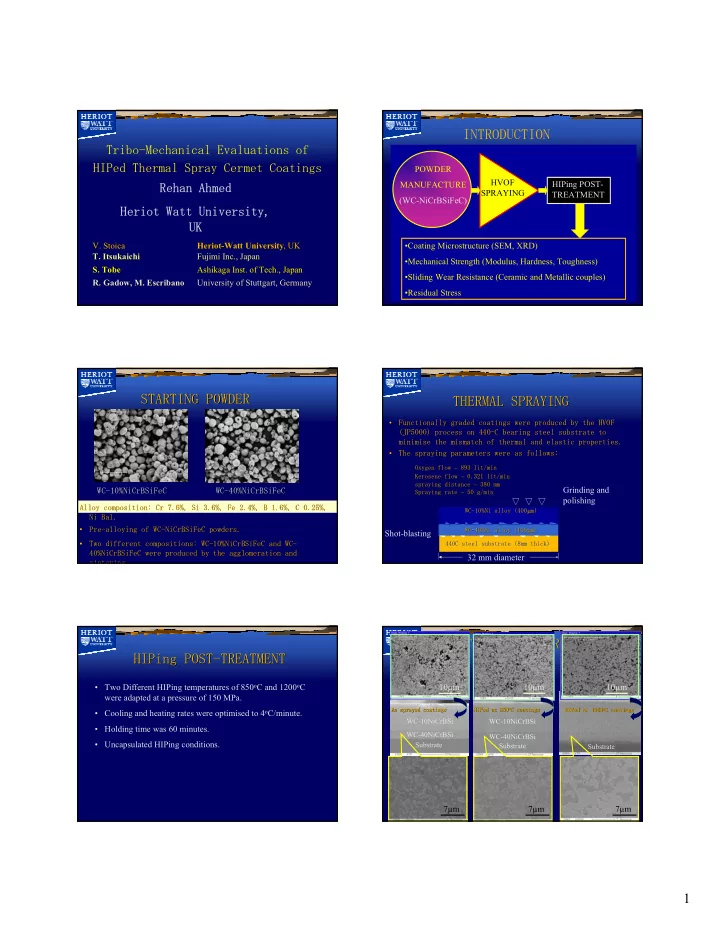
INTRODUCTION

The aim of this investigation was to integrate the potential benefits

  • f two process technologies of thermal spraying and HIPing to

improve coatings tribo-mechanical performance. The specific objectives were to improve coating strength and wear resistance by :

  • Improved intersplat cohesion by HIPing post-treatment.
  • Transform the mechanism of coating adhesion from mechanical

interlock to metallurgical bonding.

  • Improve the homogeneity and crystallinity of coating microstructure.
  • The aim of this investigation was to integrate the potential benefits
  • f two process technologies of thermal spraying and HIPing to

improve coatings tribo-mechanical performance. The specific objectives were to improve coating strength and wear resistance by :

  • Improve intersplat cohesion.
  • Transform the mechanism of coating adhesion from mechanical

interlock to metallurgical bonding.

  • Improve the homogeneity and crystallinity of coating

microstructure. POWDER MANUFACTURE (WC-NiCrBSiFeC) HVOF SPRAYING HIPing POST- TREATMENT

  • Coating Microstructure (SEM, XRD)
  • Mechanical Strength (Modulus, Hardness, Toughness)
  • Sliding Wear Resistance (Ceramic and Metallic couples)
  • Residual Stress

STARTING POWDER STARTING POWDER

  • Pre

Pre-

  • alloying of

alloying of WC WC-

  • NiCrBSi

NiCrBSiFeC FeC powders. powders.

  • Two different compositions: WC

Two different compositions: WC-

  • 10%

10%NiCrBSi NiCrBSiFeC FeC and WC and WC-

  • 40%

40%NiCrBSi NiCrBSiFeC FeC were produced by the were produced by the agglomeration and agglomeration and sintering sintering

WC WC-

  • 10%NiCrBSiFeC

10%NiCrBSiFeC WC WC-

  • 40%NiCrBSiFeC

40%NiCrBSiFeC

Alloy composition: Cr 7.6%, Si 3.6%, Fe 2.4%, B 1.6%, C 0.25%, Alloy composition: Cr 7.6%, Si 3.6%, Fe 2.4%, B 1.6%, C 0.25%, Ni Bal. Ni Bal.

WC WC-

  • 10%Ni alloy (400

10%Ni alloy (400µ µm) m) 440C steel substrate (8mm thick) 440C steel substrate (8mm thick)

THERMAL SPRAYING THERMAL SPRAYING

  • Functionally graded coatings were produced by the HVOF

Functionally graded coatings were produced by the HVOF (JP5000) process on 440 (JP5000) process on 440-

  • C bearing steel substrate to

C bearing steel substrate to minimise the mismatch of thermal and elastic properties. minimise the mismatch of thermal and elastic properties.

  • The spraying parameters were as follows:

The spraying parameters were as follows:

Oxygen flow Oxygen flow – – 893 lit/min 893 lit/min Kerosene flow Kerosene flow – – 0.321 lit/min 0.321 lit/min spraying distance spraying distance – – 380 mm 380 mm Spraying rate Spraying rate – – 50 g/min 50 g/min

Shot-blasting

WC WC-

  • 40%Ni alloy (100

40%Ni alloy (100µ µm) m)

Grinding and polishing 32 mm diameter

  • Two Different HIPing temperatures of 850oC and 1200oC

were adapted at a pressure of 150 MPa.

  • Cooling and heating rates were optimised to 4oC/minute.
  • Holding time was 60 minutes.
  • Uncapsulated HIPing conditions.

HIPing POST HIPing POST-

  • TREATMENT

TREATMENT COATING MICROSTRUCTURE COATING MICROSTRUCTURE

Substrate WC-40NiCrBSi WC-10NiCrBSi

As sprayed coatings As sprayed coatings

Substrate WC-40NiCrBSi WC-10NiCrBSi

HIPed at 850 HIPed at 850o

  • C coatings

C coatings

Substrate

HIPed at 1200 HIPed at 1200o

  • C coatings

C coatings

7µm 7µm 7µm 10µm 10µm 10µm

slide-2
SLIDE 2

2

  • WC
  • WC
  • WC
  • WC
  • WC
  • WC
  • WC
  • Ni3B
  • W2C
  • Ni
  • W2C
  • FeW3C
  • W

As-sprayed coating

  • W2C

XRD EVALUATIONS XRD EVALUATIONS

Powder vs. Sprayed Coating Powder vs. Sprayed Coating

10 20 30 40 50 60 70 80 90

  • WC
  • WC
  • WC
  • WC
  • WC
  • WC
  • NiB
  • Ni
  • Ni

Starting powder

WC WC

  • WC
  • WC
  • WC
  • WC
  • WC

HIPed at 1200oC

  • WC
  • WC
  • Ni
  • Ni2Si
  • Ni2W4C
  • Ni3B
  • Ni5Si2
  • FeW3C
  • Ni2W4C
  • Ni4B3
  • Ni4B3
  • FeW3C

WC

  • WC
  • Ni
  • WC
  • WC
  • WC
  • WC
  • WC
  • WC
  • Ni3B
  • W2C
  • W2C
  • FeW3C

10 20 30 40 50 60 70 80 90

W

  • W2C

As-sprayed coating

  • WC
  • WC
  • WC
  • WC
  • WC
  • WC
  • Ni
  • Ni2W4C
  • FeW3C
  • W2C

HIPed at 850oC

XRD EVALUATIONS XRD EVALUATIONS

Sprayed and HIPed coatings Sprayed and HIPed coatings

MIROHARDNESS EVALUATIONS MIROHARDNESS EVALUATIONS

Substrate WC-40%NiCrBSi WC-10%NiCrBSi

200 400 600 800 1000 1200 1400

50 150 250 350 450

As-sprayed HIPed at 850 HIPed at 1200

Vickers Hardness Distance from Surface (µm)

INDENTATION MODULUS =E(1 INDENTATION MODULUS =E(1-

  • ν

ν2

2)

)

As-Sprayed HIPed at 850oC HIPed at 1200oC

50 100 150 200 250 300 350 400 450 50 100 150 200 250 300 350 400

Distance from Surface (µm) Indentation Modulus (GPa) WC-40%NiCrBSi WC-10%NiCrBSi

Surface

As sprayed coatings As sprayed coatings HIPed at 850C coatings HIPed at 850C coatings HIPed at 1200C coatings HIPed at 1200C coatings

SEM observations: HVOF coatings SEM observations: HVOF coatings Cryogenic fractured coatings Cryogenic fractured coatings

micro-cracks pores pores

As As-

  • sprayed coating

sprayed coating

INDENTATION TOUGHNESS INDENTATION TOUGHNESS

200 µm

HIPed at 850 HIPed at 850o

  • C coating

C coating

200 µm

HIPed at 1200 HIPed at 1200o

  • C coating

C coating

200 µm Cracks

slide-3
SLIDE 3

3

Sliding direction Sliding direction

SLIDING WEAR TESTS SLIDING WEAR TESTS

Reciprocating ball on plate apparatus Reciprocating ball on plate apparatus

Normal load Normal load

Ball Coating

Test conditions Test conditions

Dry Dry/Lubricate d 0.012m/s Sliding Speed 12 and 22 N Load 440C Steel Si Si3

3N

N4

4 ceramic

ceramic Counter Body (balls)

0.002 0.004 0.006 0.008 0.01 0.012 0.014

HIPed at 1200oC

Volume loss (mm3)

As-sprayed HIPed at 850oC Coatings Vs steel, 12N load Coatings Vs steel, 22N load Coatings Vs ceramic, 12N load Coatings Vs ceramic, 22N load

SLIDING WEAR: SLIDING WEAR: COATING VOLUME LOSS COATING VOLUME LOSS SLIDING WEAR: WEAR SCARS SLIDING WEAR: WEAR SCARS

As As-

  • sprayed coating

sprayed coating HIPed at 850 HIPed at 850oC coating C coating HIPed at 1200 HIPed at 1200oC coating C coating

Three dimensional interferometric plots of the coatings Three dimensional interferometric plots of the coatings tested against ceramic balls (load tested against ceramic balls (load – – 22N) 22N)

0.2 0.4 0.6 0.8 1

Total volume loss, 12N load Total volume loss, 22N load As-sprayed HIPed at 850oC HIPed at 1200oC

Total volume loss (mm3)

SLIDING WEAR: TOTAL VOLUME LOSS SLIDING WEAR: TOTAL VOLUME LOSS

Total volume loss Total volume loss – – Coatings Vs steel balls Coatings Vs steel balls

SLIDING WEAR: TOTAL VOLUME LOSS SLIDING WEAR: TOTAL VOLUME LOSS

Total volume loss Total volume loss – – Coatings Vs ceramic balls Coatings Vs ceramic balls

0.02 0.04 0.06 0.08 0.1 As-sprayed HIPed at 850oC HIPed at 1200oC

Ball volume loss, 12N load Coating volume loss, 12N load Ball volume loss, 22N load Coating volume loss, 22N load Total volume loss (mm3)

Why improvement in wear resistance?

FRICTION FRICTION

0.2 0.4 0.6 0.8 1 1.2 1.4 100 200 300 400 500 600 As-sprayed HIPed at 850oC HIPed at 1200oC

Friction coefficient

Time (mins)

Coatings Vs steel balls (load Coatings Vs steel balls (load -

  • 22N)

22N)

0.2 0.4 0.6 0.8 1 1.2 1.4 100 200 300 400 500 600

Time (mins)

Coatings Vs ceramic balls (load Coatings Vs ceramic balls (load -

  • 22N)

22N)

As-sprayed HIPed at 850oC HIPed at 1200oC

Friction coefficient

slide-4
SLIDE 4

4 SLIDING WEAR: WEAR MECHANISMS SLIDING WEAR: WEAR MECHANISMS

As As-

  • sprayed coatings

sprayed coatings HIPed at 850 HIPed at 850oC coating C coating HIPed at 1200 HIPed at 1200oC coating C coating

SEM micrographs within the wear tracks of the SEM micrographs within the wear tracks of the coatings tested against steel (load coatings tested against steel (load – – 12N) 12N)

RESIDUAL STRESS MEASUREMENT RESIDUAL STRESS MEASUREMENT

  • 1400
  • 1200
  • 1000
  • 800
  • 600
  • 400
  • 200

20 40 60 80 100 120 140 160 180 200 220

Residual stress (MPa) Distance from the surface (µm)

As-sprayed HIPed at 850C HIPed at 1200C

CONCLUSIONS CONCLUSIONS

1.

  • 1. Uncapsulated HIPing can be successfully applied to

Uncapsulated HIPing can be successfully applied to post post-

  • treat thermally sprayed coatings.

treat thermally sprayed coatings. 2.

  • 2. HIPing post

HIPing post-

  • treatment can improve the sliding wear

treatment can improve the sliding wear resistance of thermal spray cermet coatings. resistance of thermal spray cermet coatings. 3.

  • 3. Wear resistance improves with the increase in HIPing

Wear resistance improves with the increase in HIPing temperature. temperature. 4.

  • 4. Improvement in sliding wear resistance is thought to

Improvement in sliding wear resistance is thought to

  • riginate from the increase in coating
  • riginate from the increase in coating’

’s hardness, s hardness, elastic modulus and fracture toughness. elastic modulus and fracture toughness. 5.

  • 5. HIPed coatings show WC recovery and formation of

HIPed coatings show WC recovery and formation of complex carbides. complex carbides. 6.

  • 6. Results indicate higher elastic modulus after HIPing

Results indicate higher elastic modulus after HIPing due to higher bonding between lamellas. due to higher bonding between lamellas.

WORK IN PROGRESS WORK IN PROGRESS

Influence of HIPing pressure, HIPing vs. Vacuum

Heat Treatment.

Influence of Coating Materials, especially WC-Co Coating Substrate Bonding Mechanism. Measurement of Adhesive and Cohesive strength. Optimisation of HIPing Parameters Influence on Fatigue and Impact performance