Introduction Email: tkosar@buffalo.edu Web: : - - PDF document

introduction
SMART_READER_LITE
LIVE PREVIEW

Introduction Email: tkosar@buffalo.edu Web: : - - PDF document

CSE 421/521 - Operating Systems Contact Information Fall 2012 Instructor: Prof. Tevfik Kosar Office: 338J Davis Hall Lecture - I Phone: 645-2323 Introduction Email: tkosar@buffalo.edu Web: :


slide-1
SLIDE 1

1

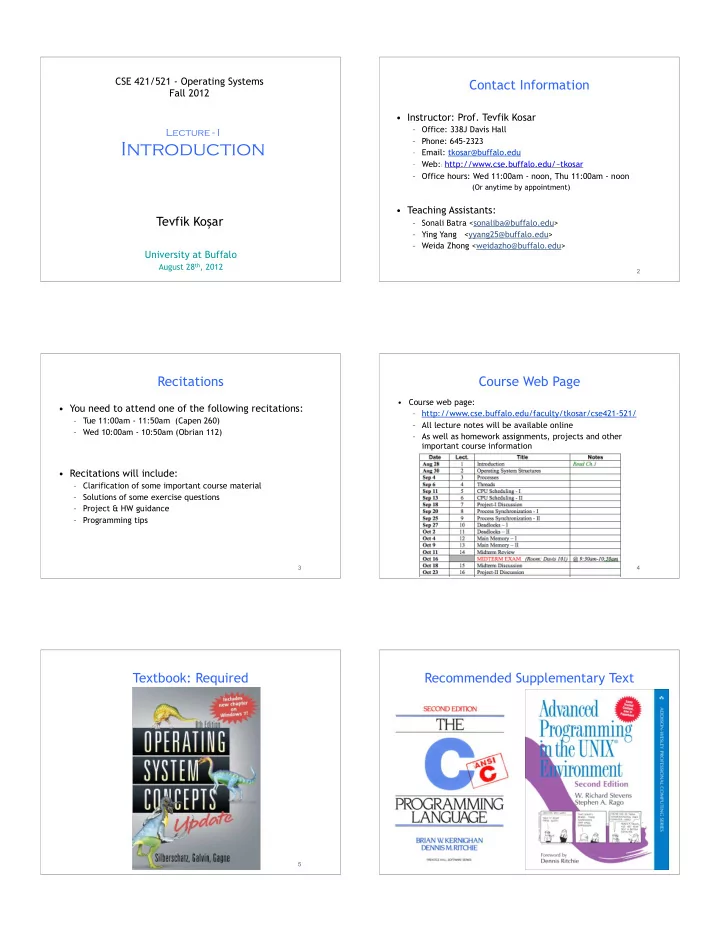
CSE 421/521 - Operating Systems Fall 2012

Tevfik Koşar

University at Buffalo

August 28th, 2012

Lecture - I

Introduction

2

Contact Information

  • Instructor: Prof. Tevfik Kosar

– Office: 338J Davis Hall – Phone: 645-2323 – Email: tkosar@buffalo.edu – Web:: http://www.cse.buffalo.edu/~tkosar – Office hours: Wed 11:00am - noon, Thu 11:00am - noon

(Or anytime by appointment)

  • Teaching Assistants:

– Sonali Batra <sonaliba@buffalo.edu> – Ying Yang <yyang25@buffalo.edu> – Weida Zhong <weidazho@buffalo.edu>

3

Recitations

  • You need to attend one of the following recitations:

– Tue 11:00am - 11:50am (Capen 260) – Wed 10:00am - 10:50am (Obrian 112)

  • Recitations will include:

– Clarification of some important course material – Solutions of some exercise questions – Project & HW guidance – Programming tips

4

Course Web Page

  • Course web page:

– http://www.cse.buffalo.edu/faculty/tkosar/cse421-521/ – All lecture notes will be available online – As well as homework assignments, projects and other important course information

5

Textbook: Required

6

Recommended Supplementary Text

slide-2
SLIDE 2

7

Recommended Supplementary Text

8

Grade Components

  • The end-of-semester grades will be composed of:

– Pop Quizzes : 5% (4-5) – Homework : 10% (4) – Projects : 30% (3) – Midterm : 25% (1) – Final : 30% (1)

* You are expected to attend the classes and actively contribute via asking and/or answering questions.

9

Grading Scale

  • Final grades will be given according to this scale:

* I will use “curve” to adjust grades (up) to this scale. * There will be separate curves for graduate & undergraduate students.

10

Rules

  • No use of laptops/phones during the lectures!
  • No late homework/project submissions accepted!
  • Exams will be closed book.
  • You are only responsible from material covered in the

class, homework, and projects.

  • Academic dishonesty will be treated “very” seriously!

Passive vs Active Learning

Passive learning: learning through reading, hearing & seeing Active learning: learning through saying and doing

After 2 weeks, we tend to remember: Passive learning

  • 10% of what we read
  • 20% of what we hear
  • 30% of what we see (i.e. pictures)
  • 50% of what we hear and see

Active learning

  • 70% of what we say
  • 90% of what we say and do

11

How to Become an Active Learner

  • Recall prior materials
  • Answer a question
  • Guess the solution first (even guessing wrong will help

you to remember the right approach)

  • Work out the next step before you have to read on
  • Think of an application
  • Imagine that you were the professor and think about how

you would give a test on the subject material so that key concepts and results will be checked.

  • Summarize a lecture, a set of homework or a lab in your
  • wn words concisely.

12

slide-3
SLIDE 3

13

What Expect to Learn?

  • Key Concepts of Operating Systems

– Design, Implementation, and Optimization

  • Topics will include:

– Processes, Threads and Concurrency – CPU and I/O Scheduling – Memory and Storage Management – File System Structures – Synchronization and Deadlocks – Protection and Security – Distributed Computing & Related Issues

14

Introduction

15

What is an Operating System?

  • A program that manages the computer hardware.
  • An intermediary between the computer user and the

computer hardware.

  • Manages hardware and software resources of a

computer.

16

Computer System Overview

! A computer system consists of (bottom-up):

  • 1. hardware
  • 2. firmware (BIOS)
  • 3. operating system
  • 4. system programs
  • 5. application programs
  • 6. users

17

Computer System Overview

  • 1. Hardware

" provides basic computing resources " CPU, memory, disk, other I/O devices

  • 2. Firmware (BIOS)

" software permanently stored on chip (but upgradable) " loads the operating system during boot

  • 3. Operating system

" controls and coordinates the use of the hardware among the various application programs for the various users

18

Computer System Overview

  • 4. System programs

" basic development tools (shells, compilers, editors, etc.) " not strictly part of the core of the operating system

  • 5. Application programs

" define the logic in which the system resources are used to solve the computing problems of the users " database systems, video games, business programs, etc.

  • 6. Users

" people, other computers, machines, etc.

slide-4
SLIDE 4

19

Role of an Operating System

! The

Silberschatz “pyramid” view

Silberschatz, A., Galvin, P. B. and Gagne. G. (2003) Operating Systems Concepts with Java (6th Edition).

Abstract view of the components of a computer system

20

Role of an Operating System

! The Tanenbaum “layered” view

Tanenbaum, A. S. (2001) Modern Operating Systems (2nd Edition).

A computer system consists of hardware, system programs and application programs

21

Role of an Operating System

! The Stallings “layered & stairs” view Layers and views of a computer system

22

Role of an Operating System

! The Molay “aquarium” view

! the only not-layered view ! everything must transit through the O/S or “kernel”

How are they all connected?

disks printers users applications

The kernel manages all connections

Molay, B. (2002) Understanding Unix/Linux Programming (1st Edition).

user space kernel space

Key Point

  • An operating system is a program that acts as an

intermediary between users/applications and the computer hardware.

23 24

Operating System Goals

  • From the user perspective:

– Executes user programs and make solving user problems easier – Makes the computer system convenient to use

  • hides the messy details which must be performed
  • presents user with a virtual machine easier to use
  • From the System/HW Perspective:

– Manages the resources – Uses the computer hardware in an efficient manner

  • time sharing: each program gets some time to use a resource
  • resource sharing: each program gets a portion of a resource
slide-5
SLIDE 5

OS Services for Users

  • Program Execution

– The OS loads programs and data into memory, initializes I/O devices and files, schedules the execution of programs

  • Access to I/O Devices

– The OS hides I/O device details from applications (direct I/O access is forbidden) and offers a simplified I/O interface

  • Controlled Access to Files & Directories

– The OS organizes data into files and directories, controls access to them (i.e. create, delete, read, write) and preserves their integrity

25

OS Services for Users

  • Communications

– The OS allows exchange of information between processes, which are possibly executing on different computers

  • Error Detection and Response

– The OS properly handles HW failures and SW errors with the least impact to running applications (i.e. terminating, retrying,

  • r reporting)

26

OS Services for System/HW

  • Resource Allocation

– The OS allocates resources to multiple users and multiple jobs running at the same time

  • Operation Control

– The OS controls the execution of user programs and operations

  • f I/O devices
  • System Access

– The OS ensures that all access to resources is protected, including authorization, conflict resolution etc.

  • Accounting and Usage Statistics

– The OS keeps performance monitoring data

27

Summary

  • What is an OS?
  • Role of an OS
  • Operating System Goals

– User View vs System View

  • Operating System Services

– For Users and HW

28

  • Reading Assignment: Chapter 1 from Silberschatz.

Questions?

29

Acknowledgements

  • “Operating Systems Concepts” book and supplementary

material by A. Silberschatz, P . Galvin and G. Gagne

  • “Operating Systems: Internals and Design Principles”

book and supplementary material by W. Stallings

  • “Modern Operating Systems” book and supplementary

material by A. Tanenbaum

  • R. Doursat and M. Yuksel from UNR