Introduction Meeting with Clients: How does the client make their - - PowerPoint PPT Presentation

introduction meeting with clients
SMART_READER_LITE
LIVE PREVIEW

Introduction Meeting with Clients: How does the client make their - - PowerPoint PPT Presentation

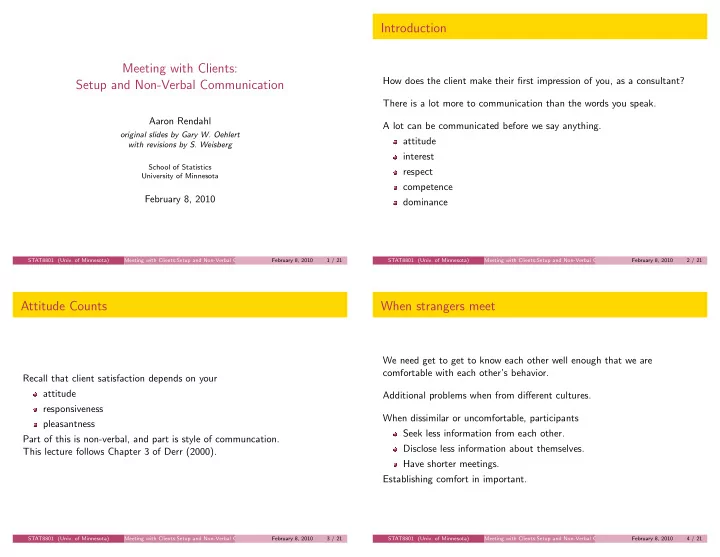
Introduction Meeting with Clients: How does the client make their first impression of you, as a consultant? Setup and Non-Verbal Communication There is a lot more to communication than the words you speak. Aaron Rendahl A lot can be


slide-1
SLIDE 1

Meeting with Clients: Setup and Non-Verbal Communication

Aaron Rendahl

  • riginal slides by Gary W. Oehlert

with revisions by S. Weisberg

School of Statistics University of Minnesota

February 8, 2010

STAT8801 (Univ. of Minnesota) Meeting with Clients:Setup and Non-Verbal CommunicationFebruary 8, 2010 1 / 21

Introduction

How does the client make their first impression of you, as a consultant? There is a lot more to communication than the words you speak. A lot can be communicated before we say anything. attitude interest respect competence dominance

STAT8801 (Univ. of Minnesota) Meeting with Clients:Setup and Non-Verbal CommunicationFebruary 8, 2010 2 / 21

Attitude Counts

Recall that client satisfaction depends on your attitude responsiveness pleasantness Part of this is non-verbal, and part is style of communcation. This lecture follows Chapter 3 of Derr (2000).

STAT8801 (Univ. of Minnesota) Meeting with Clients:Setup and Non-Verbal CommunicationFebruary 8, 2010 3 / 21

When strangers meet

We need get to get to know each other well enough that we are comfortable with each other’s behavior. Additional problems when from different cultures. When dissimilar or uncomfortable, participants Seek less information from each other. Disclose less information about themselves. Have shorter meetings. Establishing comfort in important.

STAT8801 (Univ. of Minnesota) Meeting with Clients:Setup and Non-Verbal CommunicationFebruary 8, 2010 4 / 21

slide-2
SLIDE 2

First Contact

First impressions count! They establish tone. Watch Dr. Derr and Mr. Johnson meet in Video 1.

STAT8801 (Univ. of Minnesota) Meeting with Clients:Setup and Non-Verbal CommunicationFebruary 8, 2010 5 / 21

What did we see?

Tell me about: Physical layout of the room. Attention. The greeting. Eye contact. Physical contact. Small talk. Client comfort.

STAT8801 (Univ. of Minnesota) Meeting with Clients:Setup and Non-Verbal CommunicationFebruary 8, 2010 6 / 21

Improved Version

Watch improved version (video 3) What changed? How is this better?

STAT8801 (Univ. of Minnesota) Meeting with Clients:Setup and Non-Verbal CommunicationFebruary 8, 2010 7 / 21

Physical layout

Don’t speak across the desk (implies superiority). Use open setting or Seated together around a round table (just like Camelot). Piled high desk and/or chairs puts clients off. (Ooops) Peek in Prof. Weisberg’s office for a good setting.

STAT8801 (Univ. of Minnesota) Meeting with Clients:Setup and Non-Verbal CommunicationFebruary 8, 2010 8 / 21

slide-3
SLIDE 3

The greeting

If you expect greeting A and get greeting B, things may go rapidly downhill. Pay attention to client. Make eye contact. Move towards the client in greeting. Speak to the client. Smile. Shake hands. Usher the client in.

STAT8801 (Univ. of Minnesota) Meeting with Clients:Setup and Non-Verbal CommunicationFebruary 8, 2010 9 / 21

Here be dragons!

I said shake hands, but some cultures Bow. Bring hands together. Slap hands. Kiss cheeks. Rub noses. Greeting is culture-specific and you need to make allowances. Eg, Muslim women may not shake hands with males.

STAT8801 (Univ. of Minnesota) Meeting with Clients:Setup and Non-Verbal Communication February 8, 2010 10 / 21

Non-verbal communication

Watch video 2b, with no sound OK, this is clearly the bad consultant. What made it bad?

STAT8801 (Univ. of Minnesota) Meeting with Clients:Setup and Non-Verbal Communication February 8, 2010 11 / 21

Second try

Now let’s let Dr. Derr have another chance. Watch video (4b) and see if you can tell the difference. What changed?

STAT8801 (Univ. of Minnesota) Meeting with Clients:Setup and Non-Verbal Communication February 8, 2010 12 / 21

slide-4
SLIDE 4

Eye contact

Three bears problem: Too little may give impression of passiveness, submission, discomfort,

  • r disinterest.

Too much may give impression of dominance, aggression, or altogether too much interest. Need to get it just right. But just right is a personal/cultural trait, so you need to pay attention to how your client reacts.

STAT8801 (Univ. of Minnesota) Meeting with Clients:Setup and Non-Verbal Communication February 8, 2010 13 / 21

Personal space

How big is your bubble? Everyone’s is different. Getting too close can seem invasive, aggressive, threatening. Keeping too far seems inattentive, disinterested, or angry. Touch can be friendly and reassuring, or aggressive and too friendly. You have to “feel your way” (groan!) through this issue. Everyone has a different idea of space. Technical issues will suffer until this is settled.

STAT8801 (Univ. of Minnesota) Meeting with Clients:Setup and Non-Verbal Communication February 8, 2010 14 / 21

Facial expression

Smile. Be responsive. Stay awake. Facial expression can also give you a clue about how your client is doing.

STAT8801 (Univ. of Minnesota) Meeting with Clients:Setup and Non-Verbal Communication February 8, 2010 15 / 21

Posture

This is again culturally dependent! Leaning slightly forward (open posture) shows interest. Leaning back, crossing arms, crossing legs (closed posture) shows disinterest or defensiveness.

STAT8801 (Univ. of Minnesota) Meeting with Clients:Setup and Non-Verbal Communication February 8, 2010 16 / 21

slide-5
SLIDE 5

Closed clients

If your client is taking a closed posture, try to figure out what why he or she is uncomfortable. It could be almost anything: Are you invading her space? Did you say something he didn’t understand? Are negotiations on budget going badly? ... Try to identify problems early and correct them early.

STAT8801 (Univ. of Minnesota) Meeting with Clients:Setup and Non-Verbal Communication February 8, 2010 17 / 21

Non-verbal messages

Non-verbal messages are important Perhaps as important as anything you say. Trouble if verbal cues don’t match non-verbal cues — client is more likely to believe the non-verbal cues. Posture Gestures Eye contact Facial expression. Show that you are interested, listening, understanding.

STAT8801 (Univ. of Minnesota) Meeting with Clients:Setup and Non-Verbal Communication February 8, 2010 18 / 21

Cultural discussion

How late can you be for the first meeting without offending the client? How late can the client be for the first meeting without offending you? How should you greet the client? How far apart should you and your client sit?

STAT8801 (Univ. of Minnesota) Meeting with Clients:Setup and Non-Verbal Communication February 8, 2010 19 / 21

Cultural discussion

How much eye contact should you make with the client? How much eye contact should the client make with you? How do you indicate agreement or understanding with what the client has said? What form of touching is acceptable (if any)?

STAT8801 (Univ. of Minnesota) Meeting with Clients:Setup and Non-Verbal Communication February 8, 2010 20 / 21

slide-6
SLIDE 6

Summary

Non-verbal communication is very important. Non-verbal communication is culture-specific. Use non-verbal communication to improve interaction with your client.

STAT8801 (Univ. of Minnesota) Meeting with Clients:Setup and Non-Verbal Communication February 8, 2010 21 / 21