INTRACEREBRAL HEMORRHAGE: STROKE RECOVERY TRAJECTORY AND OUTCOMES - - PDF document

intracerebral hemorrhage stroke recovery trajectory and
SMART_READER_LITE
LIVE PREVIEW

INTRACEREBRAL HEMORRHAGE: STROKE RECOVERY TRAJECTORY AND OUTCOMES - - PDF document

2 0 1 9 - 0 5 - 2 4 INTRACEREBRAL HEMORRHAGE: STROKE RECOVERY TRAJECTORY AND OUTCOMES 1 Racing Against the Clock: Hyperacute/Acute Interprofessional Best Practices Day Lauren Mai , MD, FRCPC Department of Clinical Neurological


slide-1
SLIDE 1

2 1 9

  • 5
  • 2

4 1

INTRACEREBRAL HEMORRHAGE: STROKE RECOVERY TRAJECTORY AND OUTCOMES

Racing Against the Clock: Hyperacute/Acute Interprofessional Best Practices Day Lauren Mai, MD, FRCPC Department of Clinical Neurological Sciences, Assistant Professor, Western University June 5, 2019

Objectives

  • Review the definition of intracerebral hemorrhage and its most common

causes.

  • Explore prognostic tools for ICH mortality and functional outcomes
  • Examine some the pattern of the ICH recovery trajectory and recognize the

perihematoma in ICH as a potential source of delayed stroke recovery

  • Introduce the Canadian Stroke Best Practice Recommendations that can

support the rehabilitation of an ICH survivor

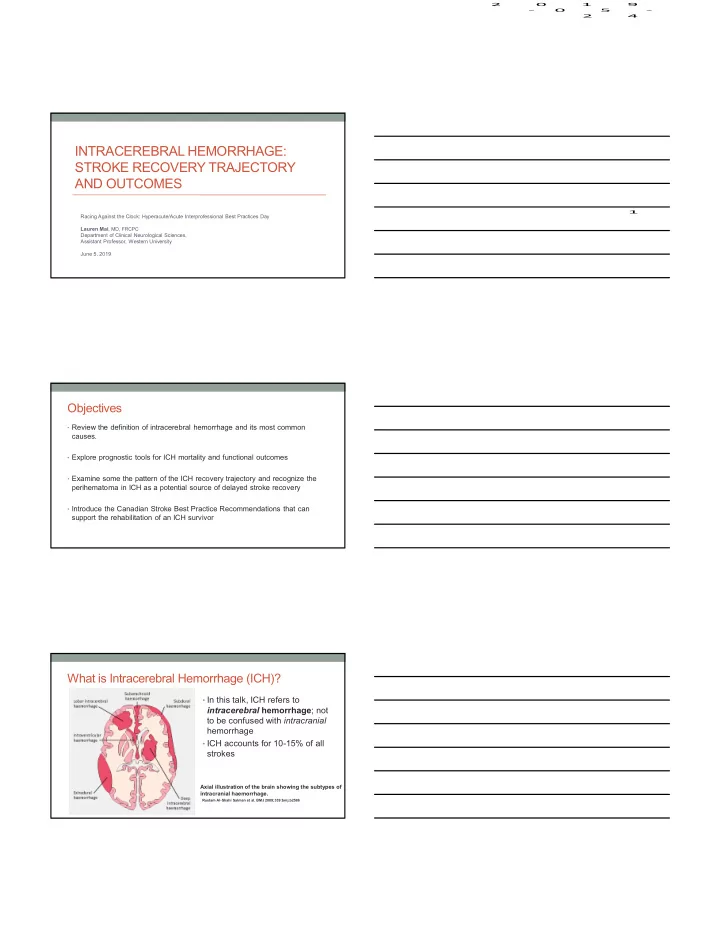
What is Intracerebral Hemorrhage (ICH)?

  • In this talk, ICH refers to

intracerebral hemorrhage; not to be confused with intracranial hemorrhage

  • ICH accounts for 10-15% of all

strokes

Axial illustration of the brain showing the subtypes of intracranial haemorrhage.

Rustam Al-Shahi Salman et al. BMJ 2009;339:bmj.b2586

slide-2
SLIDE 2

2 1 9

  • 5
  • 2

4 2

Causes of Intracerebral Hemorrhage

Hypertensive 35% Amyloid Angiopathy 20% Anticoagulation 14% Vascular malformation 5% Systemic disease 5% Other/ Undetermined 21%

  • Stroke. 2012 Oct;43(10):2592-7.

deep lobar

ICH Outcomes: High Mortality

  • The 30-day mortality from ICH ranges from 35 to 52%.
  • ~50% of these deaths occur in the first two days
  • Poon MT, et al. J Neurol Neurosurg Psychiatry. 2014;85(6):660.
  • Systematic review and meta-analysis
  • One-year survival rate: 46%
  • Five-year survival rate: 29%

Rordorf G, McDonald C. Spontaneous intracerebral hemorrhage: Treatment and prognosis. UptoDate. 2019.

Outcomes: High Mortality

  • ICH Score:
  • clinical grading scale for risk

stratification (mortality) on presentation with ICH

  • Higher mortality with:
  • Lower Glasgow Coma Score
  • Older age (≥80)
  • Larger ICH blood volume (≥30)
  • Intraventricular hemorrhage
  • Infratentorial origin of bleed
  • Stroke. 2001 Apr;32(4):891-7

https://www.mdcalc.com/intracerebral-hemorrhage-ich-score

slide-3
SLIDE 3

2 1 9

  • 5
  • 2

4 3

DNAR orders as independent predictor of mortality: self- fulfilling prophecy

  • Zahuranec, et al. “Early care

limitations independently predict mortality after intracerebral hemorrhage.”

  • 270 cases of non-traumatic ICH
  • 43% mortality at 30 days, 55% mortality
  • ver the study
  • Early decision (<24 hrs) for DNR,

withdrawal of care, or deferral of other life sustained interventions was associated with doubling of the hazard for death (HR 2.17, 95% CI 1.38, 3.41) at 30 days, despite adjusting for age, gender, ethnicity, GCS, ICH volume, intraventricular hemorrhage, and infrantentorial hemorrhage

Neurology 2007;68:1651-1657.

Do-Not-Attempt-Resuscitation (DNAR) orders as independent predictors of mortality: a self-fulfilling prophecy?

  • Creutzfeldt CJ, et al. Crit Care Med 2011; 39(1):158-162. “Do-Not-Attempt-

Resuscitation Orders and Prognostic Models for Intraparenchymal Hemorrhage”

  • Modelled 424 patients with ICH:
  • 44% had a favourable outcome, 38% died in hospital; 43% had DNAR orders
  • Observed probability of a favourable outcome (mRS ≤ 3) was:
  • significantly higher than predicted in non-DNAR patients,
  • significantly lower in DNAR patients.
  • Hemphill JC III, et al. Stroke 2004;35:1130-1134. “Hospital Usage of Early Do-

Not-Resuscitate Orders and Outcome After Intracerebral Hemorrhage”

  • In-hospital mortality after ICH is significantly influenced by the rate at which treating

hospitals use DNR orders, even after adjusting for case mix.

slide-4
SLIDE 4

2 1 9

  • 5
  • 2

4 4

ICH: Goals of Care

  • Acute Stroke Management: Section 10. Advanced Care Planning
  • Patients surviving a stroke, as well as their families and informal caregivers, should be

approached by the stroke health care team to participate in advance care planning [Evidence Level C]. (International Journal of Stroke, 13(9), 949–984.)

  • Outcome Prediction and Withdrawal of Technological Support: Recommendation
  • Aggressive care early after ICH onset and postponement of new DNAR orders until at least

the second full day of hospitalization is probably recommended (Class IIa; Level of Evidence B). Patients with preexisting DNAR orders are not included in this recommendation. (Stroke. 2015;46:2032-2060)

Long-term functional prognosis after ICH

  • Result of systematic review and pooled-analysis of four population-based

studies:

  • Functional independence (mRS 0-2) was achieved in:
  • 32.8 to 42.4% of all ICH (53.7 to 83.7% of survivors) at 6 months
  • 16.7-24.6% of all ICH (53.8 to 57.1% of survivors) at 1 year
  • If you survive ICH, chances of functional independence aren’t that grim!

Poon MTC, et al. J Neurol Neurosurg Psychiatry 2014;85(6):660.

Functional Outcomes: FUNC score

  • FUNC score helps to

predict the likelihood of being functionally independent at 90 days

  • Validated in “survivors only”

cohort to get around the potential bias introduced by early withdrawal of care: similar reliability

https://www.mdcalc.com/functional-outcome-patients-primary- intracerebral-hemorrhage-func-score

  • Stroke. 2008;39:2304-2309.
slide-5
SLIDE 5

2 1 9

  • 5
  • 2

4 5

Functional Outcomes: FUNC score

  • Stroke. 2008;39:2304-2309.

How can we optimize functional recovery?

  • “Stroke rehabilitation is a progressive, dynamic, goal-orientated process

aimed at enabling a person with impairment to reach their optimal physical, cognitive, emotional, communicative, social and/or functional activity level.”

Hebert D, Teasell R, et al.

  • CSBPR. Stroke

Rehabilitation 2015

Assessing for Stroke Rehab

  • Acute Stroke Unit Care (8.1.iii.c.)

Alongside the initial and ongoing clinical assessments regarding functional status, a formal and individualized assessment to determine the type of ongoing post-acute rehabilitation services required should occur as soon as the status of the patient has stabilized, and within the first 72 hours post-stroke, using a standardized protocol (including tools such as the alpha-FIM) [Evidence Level B].

International Journal of Stroke, 13(9), 949–984.

slide-6
SLIDE 6

2 1 9

  • 5
  • 2

4 6

Assessing for Stroke Rehab

  • Stroke Rehabilitation: Initial Stroke Rehabilitation Assessment
  • 1.iv) For patients who do not initially meet criteria for rehabilitation, rehabilitation needs

should be reassessed weekly during the first month and at intervals as indicated by their health status thereafter [Evidence Level C].

  • This recommendation may be particularly applicable to survivors of ICH due to the delayed

recovery seen in this stroke population.

Hebert D, Teasell R. CSBPR. Stroke Rehabilitation 2015

Delayed Recovery in Intracerebral Hemorrhage: the Perihematoma

MCA superior division infarction Anvekar B. 2012 <www.neuroradiologycases.com> Stroke 2011; 42(1):73-80

Delayed Recovery in Intracerebral Hemorrhage: the Perihematoma

Primary Injury: mechanical destruction by hematoma Hg degradation, Iron neurotoxicity (days to weeks) Thrombin => inflammatory cascade (days) Vasogenic edema from plasma proteins (days) Ionic edema (hours) Kim H, et al. World Neurosx. 2016; 94:32-41.

slide-7
SLIDE 7

2 1 9

  • 5
  • 2

4 7

Delayed Recovery in Intracerebral Hemorrhage: the Perihematoma

Temporal profile of perihematomal edema growth after spontaneous ICH. Stroke 2011; 42(1):73-80.

Knowledge of recovery trajectories from population studies: South London Stroke Register

Bhalla, et al. Stroke. 2013;44:2174-2181

  • N=3730 (14.8% ICH) from

January 1995 to Dec 2011

  • Mean improvement in Barthel

index from 7 days to 3 months was higher in ICH (5.81) compared to ischemic stroke (2.58; p<0.001).

  • Significant difference by

stroke subtype remains after multivariable linear regression adjusting for case mix

South London Stroke Register: Substudy of patient- specific recovery

  • Barthel index captured at 1, 2, 3, 4, 6, 8, 12,

26 and 52 weeks post-stroke

  • N=355 with at least 2 data points, average
  • f 5.8 time points for each subject
  • Patients with ischemic stroke had

significantly improved recovery curves at 1 week after stroke (+7.024 BI points) compared to patients with hemorrhagic stroke, but, patients with hemorrhagic stroke gained more BI points after week 1 compared to their ischemic stroke counterparts

Toschke, et al. Eur J Neurol. 2009; 17:219-225.

slide-8
SLIDE 8

2 1 9

  • 5
  • 2

4 8

Knowledge of recovery trajectories from population studies: ChinaQUEST

  • Stroke. 2010;41:1877-1883
  • Data available in 6354 patients.

Ischemic stroke: n=4782 (75%) ICH: n= 1572 (25%)

  • Significant difference between the

stroke subtypes when comparing the slope of recovery (p<0.001) (Wald test).

How does functional outcome change after ICH?

  • Neurology. 2009 Oct 6; 73(14): 1088–1094.

Figure 2 Change in modified Rankin Scale (mRS) score during first year after intracerebral hemorrhage (ICH)

How well do patients with ICH recover with inpatient rehab compared to those with ischemic stroke?

  • Katrak PH, et al. PM R. 2009; 1:427–433.
  • Consecutive stroke admissions: 129 ICH patients and 589 ischemic stroke
  • ICH vs Ischemic:
  • More severely disabled at admission
  • Achieved greater FIM efficiency and a greater Motor Assessment Scale (MAS)
  • Stroke type remained a significant factor for FIM gain even when adjusting for admission FIM,

length of stay, age, and days from stroke onset to rehab admission

  • Kelly PJ, et al. Arch Phys Med Rehabil 2003;84:968-72.
  • Retrospective study of consecutive stroke admissions over a 4-year period; N=1064 (193

ICH)

  • Lower admission FIM score in ICH
  • FIM gain was greater in ICH than IS (28 vs. 23.3; p=0.002)
  • ICH patients with the most severely disabling strokes had significantly greater recovery than

cerebral infarction patients with stroke of similar severity

slide-9
SLIDE 9

2 1 9

  • 5
  • 2

4 9

Functional Outcome after Inpatient Stroke Rehabilitation

  • Case-control study
  • N= 270 first-time stroke:
  • 135 ischemic stroke
  • 135 ICH
  • Matched comparison: stroke

severity, basal disability, age (within 1 year), sex, and onset-admission interval

  • Hemorrhagic stroke conferred a high

therapeutic response on Barthel Index (OR: 2.48, 95% CI 1.13 to 5.20) compared to ischemic stroke

Paolucci S, et al. Stroke 2003;34:2861-2865.

ICH Recovery Trajectory: Some Conclusions

  • Functional gains/recovery in ICH often delayed; often starting after the first

week

  • Patients with ICH may require repeat assessments for eligibility and goals of rehabilitation
  • Compared to survivors of ischemic stroke, survivors of ICH make steeper

gains after the acute phase

  • ICH functional recovery continues up to 12-months post stroke

How do we support stroke recovery?

  • Managing Stroke Transitions of Care, CSBP 2015
  • A focus on patient-centred care
  • patient, family members and caregivers should be involved in decision-making, goal setting, care

planning

  • Monitor caregiver capacity, coping, and risk for depression
  • Stroke affects the whole family unit!
  • Call to action for all healthcare professionals to deliver education and support on an
  • ngoing basis
  • Examples of support::
  • Written discharge instructions (follow-up care, goals)
  • Access a contact person for care continuity
  • Links to local resources: stroke survivor groups, meal provider agencies, etc.
  • Access to restorative care and active rehabilitation
  • Advance care planning, palliative care as appropriate
slide-10
SLIDE 10

2 1 9

  • 5
  • 2

4 1

How do we support stroke recovery?

Assess Learning Needs Deliver Education Monitor/ Reinforce Education Provided Promote Self- Management

Patient, Family and Caregiver Education

Invite caregivers to attend therapy session Medication information and management What’s your

  • rganization’s plan for

delivering education? Cameron JI, et al. CSBP 2015. www.strokebestpractices.ca

Supporting Stroke Recovery: Patient, Family and Caregiver Education

  • What are some possible patient education topics?
  • What are important family and caregiver topics?

Cameron JI, et al. CSBP 2015. www.strokebestpractices.ca

slide-11
SLIDE 11

2 1 9

  • 5
  • 2

4 1 1

How do we support stroke recovery?

  • Good interprofessional care planning and communication
  • Are appropriate discharge plans in place?
  • Planned appointments
  • Communication of ongoing recovery needs and goals
  • Support community reintegration following stroke
  • Vocation: work, volunteering, school
  • Return-to-work plans
  • Social worker: benefit options, financial concerns
  • Leisure
  • Can rehabilitation needs goals be targeted to pre-stroke leisure activities?
  • Return to driving?
  • Screen at 1-month for residual sensory/motor/cognitive deficits. OT driving assessments.
  • Rehabilitation and Restorative Care
  • Stroke survivors with ongoing rehabilitation goals should continue to have access to specialized

stroke services (e.g. PT, OT, SLP), even if in LTC setting. Cameron JI, et al. CSBP 2015. www.strokebestpractices.ca

The most common cause of intracerebral hemorrhage:

  • A) Cerebral amyloid angiopathy
  • B) Vascular malformations
  • C) Hypertension
  • D) Subdural bleeds related to anticoagulation
  • E) Post-thrombolytic (tPA) bleeds into ischemic infarct (probably because they

keep extending the window!)

A 70 year old man presents to ER via EMS after collapsing with right weakness. In this case, which of the following would be a risk factor for increased mortality related to ICH?

  • A) Supratentorial location of bleed
  • B) Arriving with a Glascow Coma Score of 13
  • C) Age of 70
  • D) ICH volume
  • E) Intraventricular hemorrhage
slide-12
SLIDE 12

2 1 9

  • 5
  • 2

4 1 2

Mortality in ICH is high. Among for survivors of ICH, the chances of achieving a favourable outcome (mRS 0-2) at 1-year are approximately:

  • A) 55%
  • B) 40%
  • C) 30%
  • D) 15%
  • E) 5% (Only choose this answer if you are very pessimistic!)

Recommended Resources:

  • www.strokebestpractices.ca
  • ebrsr.com
  • strokeengine.ca

Summary

  • ICH carries a high mortality in the acute phase (35-52
  • ICH survivors make substantial functional recoveries but in a delayed and

protracted fashion compared to ischemic stroke cohorts; around 55% of survivors will make a favourable outcome; the FUNC score is a helpful prognostic tool

  • Intracerebral hemorrhage survivors are likely to require repeat assessments

for rehab candidacy

  • Perihematomal edema, which peaks ~8-14 days, may account for delayed recovery in

ICH.

  • Canadian Stroke Best Practice Recommendations call for patient-centred care

and education to best support recovery; we all have a role!