INTRABEAM SCA INTRABEAM SCATTERING TTERING M. Martini (CERN) Part - - PowerPoint PPT Presentation

intrabeam sca intrabeam scattering ttering
SMART_READER_LITE
LIVE PREVIEW

INTRABEAM SCA INTRABEAM SCATTERING TTERING M. Martini (CERN) Part - - PowerPoint PPT Presentation

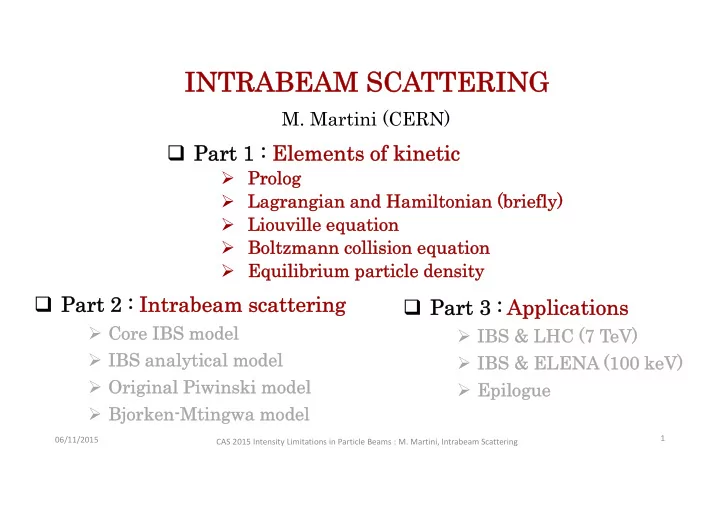
INTRABEAM SCA INTRABEAM SCATTERING TTERING M. Martini (CERN) Part 1 : Part 1 : Elements of kinetic Elements of kinetic Prolog Prolog Lagrangian Lagrangian and Hamiltonian (briefly) and Hamiltonian (briefly) Liouville


slide-1
SLIDE 1

 Part 1 : Part 1 : Elements of kinetic Elements of kinetic

  • Prolog

Prolog

  • Lagrangian

Lagrangian and Hamiltonian (briefly) and Hamiltonian (briefly)

  • Liouville

Liouville equation equation

  • Boltzmann collision

Boltzmann collision equation equation

  • Equilibriu

Equilibrium partic m particle den le density ity

INTRABEAM SCA INTRABEAM SCATTERING TTERING

06/11/2015 1

 Part 2 : Part 2 : Intrabeam Intrabeam scattering scattering

  • Core IBS model

Core IBS model

  • IBS analytical model

IBS analytical model

  • Original Piwinski

Original Piwinski model model

  • Bjorken-M

Bjorken-Mtingwa ingwa model

  • del

 Part 3 : Part 3 : Applications Applications

  • IBS &

IBS & LHC (7 T LHC (7 TeV) V)

  • IBS &

IBS & ELENA ELENA (100 keV) (100 keV)

  • Epilog

Epilogue

CAS 2015 Intensity Limitations in Particle Beams : M. Martini, Intrabeam Scattering

  • M. Martini (CERN)
slide-2
SLIDE 2

2

  • IBS in charged particle beams causes small changes of the colliding particles momenta by addition of

multiple random small‐angle scattering events leading to : 1. A relaxation to a thermal (energy) equilibrium via reallocation of the whole beam phase volume between the 3 transverse and longitudinal beam phase volumes (emittances). 2. A continuous diffusion growth of the global beam phase volume without equilibrium, and reduction of the beam lifetime when the particles hit the aperture.

  • Touschek effect is the particle losses due to single collision events at large scattering angles for which
  • nly the energy transfer from transverse to longitudinal planes is examined.
  • IBS simulation consists to compute the particle momentum variation by coulomb scattering with the
  • ther particles of the beam and get the growth rates for the 3 degrees of freedom.
  • IBS theory was later extended to include :
  • Amplitude & dispersion derivatives and lattice parameter variations around the lattice
  • Horizontal‐vertical betatron linear coupling.

06/11/2015

Prologue Prologue

Intrabeam Scattering (IBS) is a multiple Coulomb scattering of charged particle beams (alternatively IBS is a diffusion process in all 3 transverse & longitudinal beam dimensions)

CAS 2015 Intensity Limitations in Particle Beams : M. Martini, Intrabeam Scattering

slide-3
SLIDE 3

3 06/11/2015

Prologue Prologue

IBS in week focusing or smooth ring lattices can be related with scattering of gas molecules in a closed box where the walls mimics the quadrupole focusing forces and the RF voltage keep the particles together. The scattering of the molecules leads to the Maxwell‐Boltzmann distribution of the 3 velocity components , , in which is the molecule mass, the temperature, the Boltzmann's constant ( is normalized to 1) : , , 1 2/ / / The difference between IBS and gaz molecule scattering in a box is due to the ring orbit curvature :

  • Curvature yields a dispersion so that a sudden change of energy will change the betatron amplitudes

and initiate a synchro‐betatron oscillation coupling.

  • Curvature also leads to the negative mass instability i.e. if a particle accelerates above transition it

becomes slower and behaves as a particle with negative mass and thus an equilibrium of particles above transition energy can’t exist (transition energy is got once

/ / or / /

  • 0).
  • Above transition the IBS effect is to increase the three bunch dimensions.
  • Below transition an equilibrium particle distribution can exists (week focusing/smooth lattices).

CAS 2015 Intensity Limitations in Particle Beams : M. Martini, Intrabeam Scattering

slide-4
SLIDE 4
  • Small angle multiple Coulomb scattering effect
  • Redistribution of beam momenta
  • Beam diffusion with impact on the beam quality (Brightness ,

luminosity, etc)

  • Small angle multiple Coulomb scattering effect
  • Redistribution of beam momenta
  • Beam diffusion with impact on the beam quality (Brightness ,

luminosity, etc)

  • Different approaches for the probability of scattering
  • Classical Rutherford cross section
  • Quantum approach
  • Relativistic “Golden Rule” for the 2‐body scattering process
  • Different approaches for the probability of scattering
  • Classical Rutherford cross section
  • Quantum approach
  • Relativistic “Golden Rule” for the 2‐body scattering process
  • Several theoretical models and their approximations developed
  • ver the years
  • Classical models of Piwinski (P) and Bjorken‐Mtingwa (BM)
  • High energy approximations Bane, CIMP, etc
  • Integrals with analytic solutions
  • Several theoretical models and their approximations developed
  • ver the years
  • Classical models of Piwinski (P) and Bjorken‐Mtingwa (BM)
  • High energy approximations Bane, CIMP, etc
  • Integrals with analytic solutions

The Intrabeam scattering effect

06/11/2015 4 CAS 2015 Intensity Limitations in Particle Beams : M. Martini, Intrabeam Scattering

slide-5
SLIDE 5

5

Lagrangian Lagrangian and Hamiltonian (briefly) and Hamiltonian (briefly)

06/11/2015

  • We restrict to systems of particles with 3 degrees of freedom described via Cartesian

coordinates ⋯ , , , , and ≡ ⋯ , , ,

  • Assume the system exists in a conservative force field with kinetic energy , and

potential such as ≡ /. The Lagrangian is defined as :

  • , , ≝ · , ,

≝ / , , ≝ , , From which Hamilton’s equations are derived : Lagrange’s equations stem from the variational principle: : conjugate momentum to r 0 if , ⟶ constant energy

  • , ,
  • is then recast in an

Hamiltonian form

CAS 2015 Intensity Limitations in Particle Beams : M. Martini, Intrabeam Scattering

slide-6
SLIDE 6

6

Lagrangian Lagrangian and Hamiltonian (briefly) and Hamiltonian (briefly)

06/11/2015

If the total force acting on a system contains a conservative (Hamiltonian) part and a non‐conservative (non‐strictly‐Hamiltonian) part , , representing friction, inelastic processes… ( ). The Lagrangian of the system is then written as :

  • , , ≝ , ,

From , , · , , the (non‐Hamiltonian) equations follow :

  • since
  • 1

2

  • CAS 2015 Intensity Limitations in Particle Beams : M. Martini, Intrabeam Scattering
slide-7
SLIDE 7

7

Liouville Liouville equation equation

  • −space : 6N−dim phase space coordinates, a single point (microstate) represents N

particles labelled by 3N positions ⋯ and momenta ⋯ with , , and , ,

  • ∶ copies of a specific microstate N particles each copy described by a

different representative point in −space

  • , , ∶ number of microstates in the volume element ∏
  • about any

coordinate values , at time

  • , , : density of representative microstates (“coarse‐graining” density (,,) is obtained

by disregarding variation of below small resolution in ‐space)

06/11/2015

, , lim

, ,

  • Formal density definition

Coarse‐graining density , , Δ Δ , ,

  • CAS 2015 Intensity Limitations in Particle Beams : M. Martini, Intrabeam Scattering
slide-8
SLIDE 8

8

Liouville Liouville equation equation

  • A microstate of N particles with coordinates , , ⋯ at time will be

found at with new coordinates

,

,

  • The microstate density , , at time will become (, , ) at
  • The phase space volume at will change into at
  • , , , , because , follow Hamilton’s equations for

conservative forces and thus no trajectories cross do not escape the 6N‐1 dim surface enclosing the microstates, being itself a microstate !)

06/11/2015

(, , (, ,

The relation between ≝ with border ≝ and ≝ , border ≝ is

Δ , , Δ , ,

  • ,
  • , 3 3

, , , , 1 ⋯

CAS 2015 Intensity Limitations in Particle Beams : M. Martini, Intrabeam Scattering

slide-9
SLIDE 9

9

Liouville Liouville equation equation

06/11/2015

Using

,

, and the Hamilton’s equations the determinant

  • f the Jacobian matrix writes (1st order)

⋱ ⋮

  • 1

⋮ ⋱ ⋮ ⋯ 1

  • 1
  • 1

Liouville’s theorem stems from the conservation

  • f the phase space volume in Γ−space
  • CAS 2015 Intensity Limitations in Particle Beams : M. Martini, Intrabeam Scattering
slide-10
SLIDE 10

10

Liouville Liouville equation equation

06/11/2015

(, , (, , Equivalently writes in differential form using the Hamilton’s equations and Poisson bracket : (, ,

  • Liouville’s formula

Liouville’s theorem The microstate density (, , in Γspace behaves like an incompressible fluid

  • , ≝
  • , 0
  • ·

·

CAS 2015 Intensity Limitations in Particle Beams : M. Martini, Intrabeam Scattering

slide-11
SLIDE 11

11

Liouville Liouville equation equation

06/11/2015

Consider the (non‐strictly‐Hamiltonian) equations of motion for non‐conservative forces :

  • 1
  • Liouville’s theorem “violated” !? : incompressibility condition of (, , not satisfied i.e.

(, , 1 · (, ,

written in differential form this lead to the equivalent results:

  • ·

· ·

  • ·
  • 1
  • (, , (, ,
  • ·
  • , ·

CAS 2015 Intensity Limitations in Particle Beams : M. Martini, Intrabeam Scattering

slide-12
SLIDE 12

12

Liouville Liouville equation equation

06/11/2015

Microstate subset , , inside the 6N−dim volume of border at in Γspace will occupy a distorted volume of border at t

Liouville (also called collisionless Boltzmann) equation

  • Detailed account of the density (, , would

require knowledge of 6 particle trajectories with initial conditions for all microstates of the sub‐ensemble (~10?!) in the (Γ−space) volume element .

  • Practically it would be more suitable to place the phase

trajectories of the N particles in the same 6−dim phase space −space : a single point represents one particle labelled by 3 positions , , and 3 momenta , , .

  • To reach this objective the 6N−dim microstate density

, ⋯ , , ⋯ , must be reduced a 6−dim particle

density

, , in −space .

  • This should be done via the BBGKY hierarchy framework

to go from the N‐particles (in Γspace) to the N‐times 1‐particle in −space description.

( )

  • =

, ,

C( ) C() ()

6N‐dim space

(,,) microstates

CAS 2015 Intensity Limitations in Particle Beams : M. Martini, Intrabeam Scattering

slide-13
SLIDE 13

13

Liouville Liouville equation equation

06/11/2015

  • The full phase space density , , contains too much information than needed to describe the

equilibrium properties of particles (e.g. 1‐particle density is enough to compute a gas pressure).

  • The N‐particle density , , ⋯ , , in 6N−dim Γ−space is to be reduced to a single particle

density

, , in 6−dim −space ∶ the state of each particle being represented by a single point.

, , / refers to the expectancy of finding any one of the N particles at time with location

and momentum , computed from , , ⋯ , , by means of the formulae :

  • , ,
  • , , , ⋯ , , ,
  • is normalized to and to 1
  • , ,
  • ≡ , ,
  • with for any function , : , , , . Using the first pair of delta

functions to compute one set of integrals we get, assuming a symmetric density when permuting particles :

CAS 2015 Intensity Limitations in Particle Beams : M. Martini, Intrabeam Scattering

slide-14
SLIDE 14

Liouville formula needs then to be adapted to Boltzmann collision equation when considering particle interactions

14

Boltzmann collision equation Boltzmann collision equation

06/11/2015 CAS 2015 Intensity Limitations in Particle Beams : M. Martini, Intrabeam Scattering

Particle subset , , inside space at t due to collisions in the time

  • As a result of collisions during the time interval particles

that were inside the volume in the 6‐dim space may be removed from it and particles outside may end up inside it.

  • The net gain or loss of particles as a result of collisions during

inside is denoted :

  • , ,
  • where

/ means the rate of change of . Hence the

….’Liouville’equation turns into the collision Boltzmann equation

  • =

6‐dim space

, ,

  • =

() ( ) entering particle leaving particle

  • ·

·

  • ≡ ·

·

(,,) particles

non conservative force field

slide-15
SLIDE 15

15

Boltzmann collision equation Boltzmann collision equation

06/11/2015

Heuristic assumptions are made to « derive » the Boltzmann collision equation :

  • does not vary visibly over the distance of interparticle force range and over

the time scale of the interaction.

  • Disregard external force effects on the collision cross‐section size.
  • Consider only binary collisions.
  • “Molecular chaos” assumption : the interacting particle momenta (velocities),

before collision, are assumed to be uncorrelated, i.e.

  • the joint probability of having, at position and time , particles 1 & 2 of momenta

and is equal to

, , , , (supposing that collisions are local in

space so that the 2 particles sit at the same point).

  • Generally the joint probability density would be equal to

, , , , 1Κ , , ,

where Κ , , , is a correlation function.

  • To by‐pass the molecular chaos approximation the alternative is to work with the equations of the

BBGKY hierarchy (Bogoliubov, Born, Green, Kirkwood, Yvon).

CAS 2015 Intensity Limitations in Particle Beams : M. Martini, Intrabeam Scattering

slide-16
SLIDE 16

16

Boltzmann collision equation Boltzmann collision equation

06/11/2015

Let’s start with an Hamiltonian , with no interacting collision potential between particle pairs (e.g. Coulomb scattering potential). This Hamiltonian will just contain :

  • Particle kinetic energy (for non relativistic charged particles)
  • External potential Φ (e.g. electromagnetic field for charged particle beam)

,

  • 2 Φ
  • From Liouville’s formula in terms of Poisson bracket and

replacing the 6N−dim density in Γ−space by the 6−dim density

in −space we get :

,

  • Φ
  • ,
  • Φ
  • The external force (e.g. in a plasma) includes the Lorentz force

due to externally applied fields. collisionless Boltzmann equation

CAS 2015 Intensity Limitations in Particle Beams : M. Martini, Intrabeam Scattering

slide-17
SLIDE 17

17

Boltzmann collision equation Boltzmann collision equation

06/11/2015

  • For : particles are shared in 2 groups, the 1st of momenta in

the interval about and the 2nd of all other momenta denoted , the particles ejected from are the number of collisions that the ’s have with all other ’s in . To compute all collisions between pairs of particles that eject one of them out of the interval about are considered, i.e.

  • One particle is in near , the other in near

,

  • The ’s in suffer a collision with the ’s in in time .

Collision terms : The interaction result is characterized by the net rate at which collisions increase or decrease the particle number entering the 6‐dim phase‐space slice in time (named ) defined as : where are the particle number injected/ejected in by collisions in

  • For : consider all pair‐particle collisions that send one

particle into the momentum interval about in time which is the inverse of the original collision

, ⇄ , particle has momentum in particle frame 3‐dim volume element

CAS 2015 Intensity Limitations in Particle Beams : M. Martini, Intrabeam Scattering

slide-18
SLIDE 18

18

Boltzmann collision equation Boltzmann collision equation

06/11/2015 CAS 2015 Intensity Limitations in Particle Beams : M. Martini, Intrabeam Scattering

The number of particles injected/ejected into by collisions in time are :

  • , ,

, , ,

  • ,

, , ,

  • ,
  • ,

, , , , , , ,

All particles shown (see fig. above) in the cylinder of height and base area suffer a collision with the particle in time (idem for

, ).

Also since From Liouville equation the net number of particles that enter the 6‐dim phase element keeping

  • n a particle trajectory during is zero. Likewise the collisionless Boltzmann equation writes :

  • Φ
slide-19
SLIDE 19

19

Boltzmann collision equation Boltzmann collision equation

06/11/2015

  • ,

, , , , , , ,

, ,

  • Hence the above term can be cast into the form :
  • The quantity ≡ having dimensions of area can be written as /Ω Ω in which

/Ω is the differential cross‐section (see below).

  • Replacing / by the velocity (non relativistic particles) the collision term writes:
  • Ω

Ω

  • ,

, , , , , , ,

Putting

/ in the collisionless Boltzmann equation yields the Boltzmann collision equation :

  • Φ
  • Ω

Ω

  • ,

, , , , , , ,

CAS 2015 Intensity Limitations in Particle Beams : M. Martini, Intrabeam Scattering

slide-20
SLIDE 20

20

Boltzmann collision equation Boltzmann collision equation

06/11/2015

Kinematics of collisions :

  • A cylindrical polar coordinates is taken to do the above integral : the scattering angle refers to the

‐axis parallel to (before ), the perpendicular plane is parametrized by the ‐axis parallel to the impact parameter (unit vector) and by the angle ,

is the distance of closest approach.

  • Non‐relativistic collision of 2 particles of mass

and momenta , , seen from a frame in which one particle is at rest at 0.

  • The out‐going momenta ,
  • are given from the

conditions :

1. Conserved momentum : 2. Conserved energy :

  • Ω

,

  • ≡ (constant modulus)

where , is a solid angle unit vector

CAS 2015 Intensity Limitations in Particle Beams : M. Martini, Intrabeam Scattering

slide-21
SLIDE 21

Boltzmann collision equation Boltzmann collision equation

06/11/2015

  • Differential cross‐section :

m

  • This is the number of particles scattered per unit time, unit incident flux and oriented solid angle

, the absolute value ⋯ comes because usually decreases when increases

  • Geometrically the next figures show a scattering process with Ω sin and σ where

depends on the interparticle force law, the relative momentum and impact parameter

  • Rutherford scattering :
  • Small yield large ( 0 → ∞)

σ Ω

  • 4
  • 1

sin /2 σ/Ω /

21 CAS 2015 Intensity Limitations in Particle Beams : M. Martini, Intrabeam Scattering

slide-22
SLIDE 22

22

Equilibrium particle density Equilibrium particle density

06/11/2015

  • : At equilibrium the 1−particle density

, has no explicit time dependence :

  • Maxwell‐Boltzmann distribution: Similarly at equilibrium the collision integral vanishes :

where the l.h.s. refers to momenta before collision the r.h.s. to the those after collision. The equality is satisfied by any additive invariant quantities during the collision, e.g. and are constants, from which the Maxwell‐Boltzmann velocity density (for Φ 0) follows :

  • / 0 ⟶ ,

0 ⟶ with , /2 Φ

  • ,

, , ,

  • ln

, ln , ln ,

  • ln

,

  • ln

, /2 Φ

  • , /

For a gaz of particles in a box volume for , an overall drift, the Boltzmann constant (the integral of

  • ver the 3‐dim box volume is equal to since

must be normalized to ) :

  • 2

/

/

/

  • 1

2/ / /

CAS 2015 Intensity Limitations in Particle Beams : M. Martini, Intrabeam Scattering

slide-23
SLIDE 23

 Part 2 : Part 2 : Intrabeam Intrabeam scattering scattering

  • Core IBS model

Core IBS model

  • IBS analytical model

IBS analytical model

  • Original Piwinski

Original Piwinski model model

  • Bjorken-M

Bjorken-Mtingwa ingwa model

  • del

INTRABEAM SCA INTRABEAM SCATTERING TTERING

06/11/2015 23 CAS 2015 Intensity Limitations in Particle Beams : M. Martini, Intrabeam Scattering

 Part 3 : Part 3 : Applications Applications

  • IBS &

IBS & LHC (7 T LHC (7 TeV) V)

  • IBS &

IBS & ELENA ELENA (100 keV) (100 keV)

  • Epilog

Epilogue

slide-24
SLIDE 24
  • Theoretical models calculate the IBS growth rates:
  • Complicated integrals averaged around the rings
  • Depend on optics and beam properties
  • Theoretical models calculate the IBS growth rates:
  • Complicated integrals averaged around the rings
  • Depend on optics and beam properties

 They have been well benchmarked for hadron machines

  • For lepton machines the work is in progress
  • Need to benchmark the IBS effect in the presence of SR and QE
  • Studies and publications from: ATF(2001), CesrTA, SLS, SPEAR3
  • Main drawbacks:

▫ Gaussian beams assumed ▫ Betatron coupling not trivial to be included ▫ Impact on damping process (especially in strong IBS regimes)?

  • Tracking codes SIRE (A. Vivoli) and CMAD‐IBStrack (M. Pivi, T. Demma)
  • Based on the classical Rutherford cross section

 They have been well benchmarked for hadron machines

  • For lepton machines the work is in progress
  • Need to benchmark the IBS effect in the presence of SR and QE
  • Studies and publications from: ATF(2001), CesrTA, SLS, SPEAR3
  • Main drawbacks:

▫ Gaussian beams assumed ▫ Betatron coupling not trivial to be included ▫ Impact on damping process (especially in strong IBS regimes)?

  • Tracking codes SIRE (A. Vivoli) and CMAD‐IBStrack (M. Pivi, T. Demma)
  • Based on the classical Rutherford cross section

The Intrabeam scattering effect

) , , , , ( 1

sn yn xn sn yn xn i

  • ptics

f N T        

06/11/2015 24 CAS 2015 Intensity Limitations in Particle Beams : M. Martini, Intrabeam Scattering

slide-25
SLIDE 25

25 06/11/2015 CAS 2015 Intensity Limitations in Particle Beams : M. Martini, Intrabeam Scattering

  • Following Piwinski’s calculations of beam size growth/decrease rates due to IBS effect are sketched.
  • The presented kinematics & dynamics of charge particle pair collisions refer to Piwinski 1974 & 1986.

7. The averaged emittances allow to work out the growth or decrease rates of the bunch sizes. 1. Transform the momenta of the colliding particles from the LAB to the centre of mass (CM) frame 2. Calculate the changes in momenta due to an elastic collision. 3. Transform of the momenta back to the LAB frame. 4. Relate the changes in momenta to changes in transverse & longitudinal emittances. 6. Average over the particle momentum & position distributions in a bunch. 5. Average over the scattering angle distribution using the classical Rutherford cross‐section.

Transverse & longitudinal beam growth rate estimate : A strategy in 7 steps

Core Core IBS model IBS model

Continuation… from Part 1

slide-26
SLIDE 26

26

Core Core IBS model IBS model

06/11/2015

In line with Piwinski the relative longitudinal and transverse momentum changes after a collision between two particles (labelled 1, 2) can be cast (after some hard‐working task) into the form :

  • 2 2 sin

sin cos 1 2 1 4 cos 2 sin sin cos 1 2 1 4 cos 2 sin sin cos 1

  • 2 ≡
  • , is the back momenta Lorentz transform from momenta in ad‐hoc CM frame (

, , )‐axes to the LAB frame ( , , )‐axes (, , , is the mean particle momentum, unit vector, the Lorentz factor, &

  • the axial & azimuthal collision angles in CM, 2 ≡ is the angle between particle momenta in LAB)
  • ,
  • are the rotated momenta after collision with angles

& (expressed in LAB frame).

  • , are the momenta before collision written as , ,1, ,

, , via (

, , )‐coordinates in LAB frame and ,,cos ,, 0, sin , via ( , , )‐coordinates in CM frame (cf. next Fig.)

, ,

  • ,

defining

Strategy step 1‐3: momenta kinematics

CAS 2015 Intensity Limitations in Particle Beams : M. Martini, Intrabeam Scattering

slide-27
SLIDE 27

27

Core Core IBS model IBS model

06/11/2015

Particle momenta before collision ( , ) and after (

  • ,
  • ) in the CM frame (
  • ,
  • ,
  • ) (
  • being the Lorentz‐

transformed longitudinal axis from LAB to CM frame)

  • Particle momenta , before collision in LAB frames (

, , )

  • Relation between initial , and final ,
  • is quite complex
  • The overlaid (

, , ) frame is aligned on CM particle motion

The change of particle momentum after collision leads to a parallel change of the particle invariants (i.e. longitudinal & transverse emittances) which result supposing that transverse particle positions are not altered during the interaction time (assumed to be short enough).

LAB CM CM

Strategy step 1‐3: momenta kinematics

CAS 2015 Intensity Limitations in Particle Beams : M. Martini, Intrabeam Scattering

slide-28
SLIDE 28

28

Core Core IBS model IBS model

06/11/2015

2

2

  • 2
  • The radial particle movement from the closed orbit is the sum of betatron & momentum deviation.
  • The invariants are the beam emittances , & (for bunched beams) in which ,, , , , are the

Twiss parameters, with ,,,

1, 2,, , Ω is the synchrotron frequency :

∆/ ≡ /

∆/

≡ /

  • 2
  • ∆/ Ω

∆/

  • The change , of , works out as (swap with for ) :

Assuming there is no vertical dispersion i.e.

0 and that , & , stay constant during the short

collision time so that only ,

  • & ,
  • vary with the momentum change. Since ∆// as the

mean momentum is constant without acceleration, the variations ,

, can be written in

term of betatron amplitudes as follows : (e.g. ∆/ ∆/ / ≡ 0 ⟹ /) Strategy step 4: emittance changes

CAS 2015 Intensity Limitations in Particle Beams : M. Martini, Intrabeam Scattering

slide-29
SLIDE 29

29

Core IBS model Core IBS model

06/11/2015

  • 2
  • /
  • /

/

  • /

2 ∆

  • The changes , & of , & after collision can be rewritten (in which
  • and by

disregarding the time variation of Ω during the collision) as :

  • For a scattering process Piwinski introduced the derivative , /̅ i.e. the mean emittance change
  • f a 1st particle by averaging with all betatron angles (or momentum spread) of a 2nd particle.
  • Further averages over positions, betatron angles (or momentum deviations) of the 1st particle must

be done to get the total mean emittance change of all particles : i.e. integrate over the phase space with the probability density law (

) in the LAB & CM frames. In formula this writes as follows :

Strategy step 5: scattering angle averages

  • 2
  • 2
  • 2
  • The beam phase space volume change

can be found by averaging the particle invariant variation over the collisions.

CAS 2015 Intensity Limitations in Particle Beams : M. Martini, Intrabeam Scattering

slide-30
SLIDE 30

30

Core Core IBS model IBS model

06/11/2015

  • ̅
  • Ω
  • sin

̅ The outer 〈⋯〉 denotes an average round the optics parameters,

/Ω is the Rutherford differential

cross‐section for the scattering into a solid angle element Ω

  • ,

) in the CM frame. The proper time

intervals in CM & LAB frames are ̅ & with ̅, 2̅ is the relative velocity of two colliding particles with

  • 0 in CM frame. is defined as a probability density product using 12 variables

and can be expresses in LAB into the form (defining for short ,≡Δ,/,) :

, ,

,

  • ,
  • ,
  • ,

≡ Among the 12 variables 3 are dependent since during the short collision time the 2 particle positions are assumed not to change i.e. : The distribution will be examined in more details later. Strategy step 5: scattering angle averages

CAS 2015 Intensity Limitations in Particle Beams : M. Martini, Intrabeam Scattering

slide-31
SLIDE 31

31

Core Core IBS model IBS model

06/11/2015

The scattering angle distribution is now considered. The Rutherford differential cross‐section for a non‐ relativistic Coulomb collision of 2 ions of charge and atomic mass in a CM frame (i.e. ̅ ≪ 1) is : with

/22̅ is the ion kinetic energy, 2̅ is the relative momentum

between the hitting ions for which

0 in CM,

/4 is the classical proton radius.

  • Ω
  • 4
  • 1

sin /2

  • 2
  • 1

sin /2

  • 1

sin /2 in which is the average particle velocity in the LAB frame. The two integrals over

& needed to

evaluate part of the average time‐derivative of / are computed replacing / & ,/ by their expressions given in terms of parameters , , , ,

, yielding after rather lengthy calculations :

To evaluate ̅ the above expression

2̅ in the CM frame must be Lorentz transformed

back to the LAB frame to link ̅ with . All calculations done it is found in first approximation : ̅ 2 1

  • 2

Strategy step 5: scattering angle averages

CAS 2015 Intensity Limitations in Particle Beams : M. Martini, Intrabeam Scattering

slide-32
SLIDE 32

32

Core Core IBS model IBS model

06/11/2015

The smallest angle

is defined by the maximum impact parameter fixed by the beam height :

tan

  • 2
  • ,

, ≡

  • Ω
  • sin
  • sin
  • sin

/2 1 cos 2

  • 2
  • 2
  • sin
  • 4
  • 2 1

4 2 3

  • 2

To calculate analytically these 2 integrals it is assumed that

  • /
  • ≫1 (i.e.

≪1) then :

  • sin

1 cos

  • sin

/2

  • 8 ln sin
  • 2

8 ln 2

  • 4 ln

4

  • 4 ln 4̅
  • Strategy step 5:

scattering angle averages

CAS 2015 Intensity Limitations in Particle Beams : M. Martini, Intrabeam Scattering

slide-33
SLIDE 33

33 06/11/2015

  • sin
  • sin

/2

  • 4 1 cos

16 ln sin

  • 2

16 ln 2

  • 8 ln 4̅
  • After reorganizing the integrals it follows :

Similarly the integrals ,

, and , , for the vertical and longitudinal momenta can be worked

  • ut assuming no vertical dispersion and then put together, yielding the transverse and longitudinal

scattering integrals :

Core Core IBS model IBS model

Strategy step 5: scattering angle averages

2ln 2

,

,

  • Ω
  • sin

4

  • 4
  • 2
  • ln
  • is the Coulomb logarithm in LAB frame (cf Bjorken Mtingwa)

but ̅ is in CM. Its logarithmic dependence makes it slowly change over a big range of the elements involved in its definition.

≡ ln 2

  • CAS 2015 Intensity Limitations in Particle Beams : M. Martini, Intrabeam Scattering
slide-34
SLIDE 34

34

Core Core IBS model IBS model

06/11/2015

,

,

  • ,

,

  • ,

,

  • sin
  • Ω
  • 4̅ ln

4

  • 4
  • 2
  • 4
  • 4

The computation of the mean change of the invariants , & of all particles due to the multiple particle collisions requires to average the above three integrals of the two colliding particles over the 12 variables, reduced to 9 as (,, ,, ,) are dependent, via the probability densities (

).

Strategy step 5: scattering angle averages

CAS 2015 Intensity Limitations in Particle Beams : M. Martini, Intrabeam Scattering

slide-35
SLIDE 35

35

Core Core IBS model IBS model

06/11/2015

Changing the 9 variables of the joint probability law into the new ones , , , ,

, , , , :

, , , ,

, , , ,

  • ⟼ , , , ,

, , , ,

by means of the substitutions we get, via the Jacobian of the transformation the volume element (the «variables» , , disappear as they depend upon , , via their tight constraints) : , ∓ /2 ,

  • /2

,

  • /2

, /2

,

  • with
  • ̅
  • ,

,

  • ,

,

  • ,

,

  • ̅

being now symmetrical with respect to , , it follows that the integrals cancel for the linear terms in

, , of the integrand.

Hence the formal expression for the mean change of the invariants , & can be cast into the form where

/ stands for and / :

Strategy step 6: particle beam averages

CAS 2015 Intensity Limitations in Particle Beams : M. Martini, Intrabeam Scattering

slide-36
SLIDE 36

36 06/11/2015

  • ̅
  • 2
  • ln
  • 2

2

  • 2 6
  • 2

̅ ̅

  • This formula for the mean change of the invariants , & makes no assumption about the density

distribution

.

  • To derive IBS analytical models (not in closed form!) it is usually assumed that betatron amplitudes,

angles, momentum deviations and synchrotron coordinates are Gaussian distributed for bunched beams, the synchrotron coordinate being uniformly distributed for unbunched beams.

Core Core IBS model IBS model

Strategy step 6: particle beam averages

CAS 2015 Intensity Limitations in Particle Beams : M. Martini, Intrabeam Scattering

slide-37
SLIDE 37

37 06/11/2015

Let’s define Gaussian distributions

& (with ≡ &

≡and assuming 0) for the

betatron amplitudes & angles and

for momentum and bunch length deviations (bunched beams) :

IBS analytical IBS analytical model model

  • 1
  • 2,,
  • exp ,, ,
  • ,
  • 1
  • 2
  • 2
  • 1 4
  • 1

2,, exp ,

  • 2,
  • 2,
  • constant is a tilted ellipse with is correlation coefficient / 1

. The probability distribution

must be well‐matched to the Courant‐Snyder invariant

2 which is the

phase space area divided by i.e. area/. Strategy step 6: particle beam averages

,

, are rms values of the related variables, the

rms bunch length, ∆ the synchrotron coordinate,

i.e. the position relative to the synchronous particle. Ditto in vertical plane

. CAS 2015 Intensity Limitations in Particle Beams : M. Martini, Intrabeam Scattering

slide-38
SLIDE 38

38 06/11/2015

The emittance describes the phase space area usedby the beam, i.e. for a phase space area covering a fraction of a Gaussian beam with rms value the emittance at % of particles in phase space is :

  • 2
  • ln 1

e.g. the emittance at 39, 86, 95 % are 1, 4, 6

/. Notice that

the beam width containing a projected beam fraction 95% onto the betatron horizontal amplitude axis is 2 6 yielding the “projected emittance” ̃ 4

/ (not the same as above !).

Using the related betatron amplitude and angle rms values and

  • / the probability

can be rewritten (also ,

  • being unchanged) as :
  • 2,
  • exp
  • 2,
  • ,
  • 2,,
  • ,
  • Strategy step 6:

particle beam averages

IBS analytical IBS analytical model model

86%

= 6 6

  • =

CAS 2015 Intensity Limitations in Particle Beams : M. Martini, Intrabeam Scattering

slide-39
SLIDE 39

39 06/11/2015

In the CM frame all derivatives / are reduced by because of the Lorentz contraction along (e.g.

  • /γ,
  • /γ), the transverse sizes & relative momentum spread are unchanged (e.g.

,

  • ,

) and the bunch length turns into .

IBS analytical IBS analytical model model

Accelerator & storage ring moving coordinates

  • The relative velocity between 2 scattering ions being 2̅ the

probability for a collision in

and per unit time in the CM

frame is 2̅

/Ω . Hence the scattering probability per

unit time in a storage ring is, with ̅ : 2̅

  • Ω
  • Integrating in the CM frame the mean invariant changes over the variables , , ,

, , (integrals

  • ver , , & 2̅ is still to be done).

Strategy step 6: particle beam averages

CAS 2015 Intensity Limitations in Particle Beams : M. Martini, Intrabeam Scattering

slide-40
SLIDE 40

40 06/11/2015

  • Now the ‘s must be inserted into the mean invariant changes , & for further integration.
  • For this replace the above 7 probability densities ,,
  • , ,,
  • ,

,,

  • by their expressions

given in terms of the 9 variables , , , ,

, , , , and use ̅ /2, i.e.

  • /2,

/2

  • ,

/2

  • /2
  • The integrations over the 6 variables ,

, , , , can be done with the help of the integral (in

which and can be any of the 6 variables … ) :

  • exp 2

/

  • exp /
  • Before the integration all the variables have to be Lorentz transformed to the CM frame, and after

integration they must be transformed back to the LAB frame. Considering all the beam particles, the “final” result is, after tedious manipulations (3 more integrals over , , must still be solved!) : Strategy step 6‐7: beam averages & IBS rise times

IBS analytical IBS analytical model model

CAS 2015 Intensity Limitations in Particle Beams : M. Martini, Intrabeam Scattering

slide-41
SLIDE 41

41 06/11/2015

  • exp

4

1

  • 4
  • 2
  • 4
  • ln

16

  • 2

2

  • 2 6
  • 2
  • /
  • where for a bunched beam :

To solve the 3 remaining integrals over , , further approximations would be required !

  • 32

IBS analytical IBS analytical model model

Strategy step 6‐7: beam averages & IBS rise times

CAS 2015 Intensity Limitations in Particle Beams : M. Martini, Intrabeam Scattering

slide-42
SLIDE 42

42 06/11/2015

In his initial model (1974), besides cancelling ,

, , , Piwinski makes use of the smoothed focusing

approximation to derive IBS formulae for approximate mean lattice parameters. After hard‐working manipulations the IBS growth rates write (for bunched beams, ⋯ denotes a mean value) : Strategy step 7: IBS rise times

  • 1
  • ≡ 1
  • is the mean ring radius, the betatron tune, the

transition energy, the momentum compaction factor.

1

  • 1
  • 1
  • 1

2

  • 1

2

  • 1

2

  • 2
  • , ,
  • 2 1

, ,

  • , ,
  • 2 1

, ,

  • , , 8
  • ln

2 1 1

  • 1 3
  • 2
  • 1

1 0.577 Euler’s constant, , , is integrated numerically. , ,,

/

  • ,

,/,

/

1 2 exp /2

Original Piwinski Original Piwinski model model

CAS 2015 Intensity Limitations in Particle Beams : M. Martini, Intrabeam Scattering

slide-43
SLIDE 43

43 06/11/2015

Original Piwinski Original Piwinski model model

  • Above transition energy the particle property is often identify by a negative mass comportment.
  • Association with a gas in a closed box is not valid and the overall oscillation energy can increase.
  • The beam behaviour can be described via a global invariant which can be cast into a form close to the

sum of the mean invariant change , & over the collisions for all particles, i.e. multiplying / by 1

/ ) in the summation yields a non invariant quantity because / varies.

  • Smoothed focusing approx. for the tune, momentum compaction factor and transition energy yields :

Invariants

  • 1
  • constant
  • ̅
  • 1

1

  • 1

1

  • constant
  • Below transition (0) the sum of the 3 (positive) invariants is limited and hence the 3 oscillation

energies, so the “emittances” are redistributed in all 3 phase planes holding the whole phase space invariant, the distribution is stable : equilibrium exist (like gaz molecules in a closed box).

  • Above transition (0) the overall oscillation energy can increase as 0 : no possible equilibrium.

1

  • 1
  • (slip factor)

CAS 2015 Intensity Limitations in Particle Beams : M. Martini, Intrabeam Scattering

slide-44
SLIDE 44

06/11/2015 44

Bjorken-Mtingwa Bjorken-Mtingwa model

  • del

Γ is the 6‐dim phase‐space volume, the particle number per bunch, , , & , , the positions & momenta of the particles within the bunch, , , , the rms bunch width, height, length, momentum spread, , , the rms transverse & longitudinal emittances (only bunched beam are discussed). The transverse & longitudinal phase space components write (̅ being the mean longitudinal particle position i.e. that of the synchronous particle): Gaussian 6‐dim phase‐space distributions for the beam are considered which can be expressed into the form : , Γ , Γ , , + 2

  • 2
  • 2
  • 2
  • 2

̅

2

  • Phase space distribution & 6D phase space volume
  • Emittances (, , ) & Angles ‐ momentum spread

̅ ∆ ̅ ∆ ̅ & ̅

CAS 2015 Intensity Limitations in Particle Beams : M. Martini, Intrabeam Scattering

slide-45
SLIDE 45

06/11/2015 45

Bjorken-Mtingwa Bjorken-Mtingwa model

  • del

Bjorken & Mtingwa approach of IBS theory was via the S‐matrix formalism related to quantum electrodynamics. (QED). Hence they use the Fermi scattering “Golden Rule” to compute physical parameters for interactions between particles & fields, by evaluating the relevant Feynman diagram with the Feynman rules.

  • 1

2

  • , ,
  • 2
  • Golden Rule for two‐body scattering in the CM frame

In a 2−body scattering process particles 1 & 2 with 4‐momenta ,≝,

(i.e. energy‐momentum 4‐vector , )

interact each other to give after collision two 4‐momenta ,

≝, ( → ) whose interaction rate is :

  • CM

CAS 2015 Intensity Limitations in Particle Beams : M. Martini, Intrabeam Scattering

is the Coulomb scattering amplitude containing the physics of the process (S‐matrix). Here denotes a

contravariant vector which with the covariant vector

make a product invariant thru Lorentz

transform (1, 1, 0) : metric 4momentum energy 3momentum

≝≡ , , , , ≝≡ , , , , · ≝

  • ·

· ≝ ·

slide-46
SLIDE 46

06/11/2015 46

Bjorken-Mtingwa Bjorken-Mtingwa model

  • del
  • Golden Rule for two‐body scattering in the CM frame
  • The aim here is to determine the amplitude for a Coulomb scattering between 2 electrons of mass

via the exchange of a virtual photon of 4‐momentum , by means of the Feynman rules.

  • To simplify the computations with respect to a “real‐life” QED 4‐body process → (electrons spin

1, massless photon spin 0) spin 0 for both particles and boson is assumed (toy model).

  • The coupling constant in QED which specify the interaction strength between electrons and photons is related to

the fine structure constant as : 4.

  • A boson propagator is associated with the wavy line in the Feynman diagram and represents the transfer of

momentum from one to the other via the virtual photon (see e.g. Griffith’s book for details) : ≡ 4

CAS 2015 Intensity Limitations in Particle Beams : M. Martini, Intrabeam Scattering

In SI units

  • and in HL Heaviside‐Lorentz units (1)
  • Hence for elastic collisions (momentum & kinetic energy are conserved) writes as :
  • 1
slide-47
SLIDE 47

06/11/2015 47

Bjorken-Mtingwa Bjorken-Mtingwa model

  • del
  • Golden Rule for two‐body scattering in the CM frame
  • ‐2 ·
  • 2
  • cos

2

1 cos sin /2 CAS 2015 Intensity Limitations in Particle Beams : M. Martini, Intrabeam Scattering

Calculations are far to be finished, moreover they are not easy (cf Bjorken‐Mtingwa, 1983). So the final and well known formulae for the 3 growth‐rates are just given below without proof. On the other hand their use is easy. To see the link of with a collisional process rewrite explicitly

:

  • ,,

Ω

  • 2

because of momentum & energy conservation. Finally the amplitude takes the form (/4 in HL units ) :

4

  • sin /2
  • sin /2
  • ≡ ,

Ω

is thus the differential cross section of the two electron collisional process. Before ending / is rewritten introducing the 6‐dim beam distribution , into it, yielding :

slide-48
SLIDE 48

06/11/2015 48

Bjorken-Mtingwa Bjorken-Mtingwa model

  • del

The IBS growth rates

in the 3 directions (horiz), (vert) and (long) are for bunched beams :

1

  • ln
  • 8
  • det
  • Tr Tr 3 Tr
  • 1

∅ ∅ /

  • 1

∅ / ∅ 1

  • 1

in which the bracket 〈⋯〉 denotes an average over the lattice period, with and :

∅, ,, ,

,

, , ,

, ∅,

  • ,

After the bracket expansion the growth rates are simplified via relevant approximations and tedious computations into the form , , :

1

  • 8
  • /

  • The 9 coefficients , , , , , , , , (not reproduced here) depend on the lattice optics parameters.

CAS 2015 Intensity Limitations in Particle Beams : M. Martini, Intrabeam Scattering

  • Final steps of IBS theory providing quantifiable growth rates
slide-49
SLIDE 49

0.0 0.2 0.4 0.6 0.8 1.0 10.5 11.0 11.5 12.0 12.5 sec

IBS Coulomb logarithm

variant 1 nominal variant 2

Coulomb logarithm (ELENA ring 100keV)

06/11/2015 49

Bjorken-Mtingwa Bjorken-Mtingwa model

  • del

is the speed of light, , the Lorentz factors & , , ,

the optics parameters. The longitudinal emittance

is defined by the product m or by the momentum as eVs (bunched beam).

  • is defined in terms of the impact parameter

(the larger of the classical distance of closest approach

  • r the quantum mechanical diffraction limit from the nuclear radius
  • ) and

(the smaller of the

mean rms beam size

/ or the Debye length). Here 20 10 ≲ ≲ 20).

  • The Bjorken‐Mtingwa IBS model assumes a 6‐dim Gaussian beam density.

min ln

  • ln
  • min ,
  • max
  • ,
  • 7.434
  • 2
  • ρ

10 64

  • 1

2

  • 1.44 10

2

  • 1.973 10

8

  • M. Zisman, S. Chattopadhyay,
  • J. Bisognano, “ZAP user’s manual”, 1986

CAS 2015 Intensity Limitations in Particle Beams : M. Martini, Intrabeam Scattering

  • Final steps of IBS theory providing quantifiable growth rates
slide-50
SLIDE 50

INTRABEAM SCA INTRABEAM SCATTERING TTERING

06/11/2015 50

 Part 3 : Part 3 : Applications Applications

  • IBS &

IBS & LHC (7 T LHC (7 TeV) V)

  • IBS &

IBS & ELENA ELENA (100 keV) (100 keV)

  • Epilog

Epilogue

CAS 2015 Intensity Limitations in Particle Beams : M. Martini, Intrabeam Scattering

slide-51
SLIDE 51

IBS Calculations

Steady State emittances The IBS growth rates in

  • ne turn (or one time step)

Complicate integrals averaged around the ring Horizontal, vertical and longitudinal equilibrium states and damping times due to SR damping If ≠0 If = 0

  • Steady state exists if we are below transition or in the

presence of SR damping

  • should be much smaller than the IBS growth times
  • Good scanning of optics is important in order not to

skip large IBS kick points

06/11/2015 51

Continuation… from Part 2

CAS 2015 Intensity Limitations in Particle Beams : M. Martini, Intrabeam Scattering

slide-52
SLIDE 52

LHC and SLHC beam parameter with improved variants

06/11/2015 52

IBS & LHC (7 T IBS & LHC (7 TeV) V)

N 10 1.15 1.15 1.70 2.36 ,

  • rms m

3.75 2.54 2.65 2.60 ∗ m 0.55 0.30 0.25 0.15 ,

∗ m 16.58 10.11 9.40 7.21 mm 75.50 75.50 75.50 75.50 / 10 1.13 1.13 1.13 1.13 rms eVs 0.62 0.62 0.62 0.62 Crossing angle rad 285 337 355 454 Δ head‐on** 1.00 1.09 1.43 1.37 uminosity 10 cms 1.00 2.00 4.65 10.29 LHC Luminosity with nominal beam intensity SLHC Luminosity Case 1 Case 2 Case 3 Case 4 Initial IR triplet IR phase 1 triplet : ∗ 0.30 m reduced emittance Ultimate N : ∗ 0.25 m reduced emittance Ultimate N : ∗ 0.15 m reduced emittance

  • 1st case : nominal beam and LHC parameters at top energy give the nominal luminosity of 10cms
  • 2nd case: new optics will rise the crossing angle to 337 rad and the luminosity to 2 10cms
  • 3rd case : will raise the head‐on beam‐beam tune shift to 1.43 and the luminosity to 4.65 10cms
  • 4th case : with an intensity of 2.36 10 protons/bunch a top luminosity of ~10cms can be got

** Δ normalized to the value of the nominal beam

γ

2

CAS 2015 Intensity Limitations in Particle Beams : M. Martini, Intrabeam Scattering

slide-53
SLIDE 53

IBS effects in the SLHC

06/11/2015 53

IBS & LHC (7 T IBS & LHC (7 TeV) V)

∆/ ∆/ ∆/ 1st case Initial IR triplet 16% 9% ‐0.0001% 2nd case IR phase 1 triplet (∗ 0.30 m) reduced emittance 24% 21% ‐0.001% 3rd case Ultimate N (∗ 0.25 m) reduced emittance 32% 27% ‐0.001% 4th case Ultimate N (∗ 0.15 m) reduced emittance 44% 37% ‐0.001%

IBS (Bjorken‐Mtingwa model) and synchrotron radiation calculation to estimate the LHC & SLHC beam emittances evolution during 7 TeV physics coasts are done for the 4 nominal & reduced emittance beam cases

IBS emittance growth after a 10 hours beam coast

  • IBS growth rates :
  • Longitudinal emittance :

1 ,,

  • 8∆/

,, ∆/ LHC : above transition ring ≫ ~.

CAS 2015 Intensity Limitations in Particle Beams : M. Martini, Intrabeam Scattering

slide-54
SLIDE 54

IBS effects in the SLHC

06/11/2015 54

IBS & LHC (7 T IBS & LHC (7 TeV) V)

  • A constant beam intensity for the duration of the beam storage period is assumed in the computations.
  • The next 2 figures show the evolution of the longitudinal & horizontal emittances over a 10 hours beam coast.
  • IBS growth‐rates ,,
  • were calculated iteratively by step ∆ of 5 minutes updating the emittances at each iteration :

,, 1 ,, ∆/,, 1 ,,

  • 1 ln ,, /

CAS 2015 Intensity Limitations in Particle Beams : M. Martini, Intrabeam Scattering

slide-55
SLIDE 55

IBS & synchrotron radiation damping effects in the SLHC

06/11/2015 55

IBS & LHC (7 T IBS & LHC (7 TeV) V)

  • The synchrotron radiation turns into a visible effect for the LHC/SLHC proton beams at 7 TeV collision energy. Emittances shrink

with damping times of : . h in the longitudinal and . h in the 2 transverse planes.

  • Synchrotron radiation damping (SRD) is modelled substituting in the previous formula ,, by

,,

  • ,,
  • The next 3 figures show the evolution of the longitudinal & transverse emittances over a 10 hours beam coast.
  • SRD dominates the IBS growth in the longitudinal & vertical planes for the 4 cases, in horizontal the emittance damps over the all

coast only for case 1 while, for cases 2‐4 it grows at some point in time during the coast.

CAS 2015 Intensity Limitations in Particle Beams : M. Martini, Intrabeam Scattering

slide-56
SLIDE 56

IBS & synchrotron radiation damping effects in the SLHC

06/11/2015 56

IBS & LHC (7 T IBS & LHC (7 TeV) V)

Table : Emittance changes after a 10 hours beam coast resulting from the effects of IBS and synchrotron radiation damping

∆/ ∆/ ∆/ 1st case Initial IR triplet ‐36% ‐20% ‐32% 2nd case IR phase 1 triplet (∗ 0.30 m) reduced emittance ‐27% ‐5% ‐32% 3rd case Ultimate N (∗ 0.25 m) reduced emittance ‐19% 3% ‐32% 4th case Ultimate N (∗ 0.15 m) reduced emittance ‐8% 14% ‐32% IBS emittance changes after a 10 hours beam coast

  • Longitudinal & vertical : cases 1‐4: emittances of all the luminosity scenarios are kept within target specifications.
  • Horizontal : emittances stay in requirements cases 1‐2: (nominal 10 & first IR upgrade 2 10 cms luminosities,

case 3: ~3% blow‐up expected (ultimate intensity 2.36 10) & case 4: ~14% (~10 cmspeak luminosity). Globally for most scenarios the evolution of emittances during the 10 hours coast is kept inside the design values

Conclusion

CAS 2015 Intensity Limitations in Particle Beams : M. Martini, Intrabeam Scattering

slide-57
SLIDE 57

ELENA deceleration cycle

06/11/2015 57

  • 1st plateau : 4 bunches injection at 100 MeV/c from AD followed by beam cooling.
  • 2nd plateau : Deceleration down to 35 MeV/c and cooling again.
  • 3rd plateau : Last deceleration down to 13.7 MeV/c, beam cooled down to emittances needed for ELENA experiments.

End of bunch rotation End of cooling

300 ms where IBS is active

Momentum Beam intensity Physical H,V (95%) ∆p/p (95%) Bunch length (95%)  13.7 MeV/c 2.5 107 (1 bunch) 5 mm.mrad 3 10‐4 10.1 m (circumf/3) Momentum (energy) Bunch intensity Physical H,V (95%) ∆p/p (95%) Bunch length (95%) 13.7 MeV/c (100 keV) 6.25 106 (4 bunches) 4 mm.mrad 3 10‐4 1.3 m

IBS & ELENA IBS & ELENA (100 keV) (100 keV)

ELENA ring ELENA (Extra Low Energy Antiproton) is a compact ring for cooling and more deceleration of . MeV antiprotons sent by the Antiproton Decelerator to give dense beams at keV energies

30 m circumference

ELENA : below transition ring . ~.

CAS 2015 Intensity Limitations in Particle Beams : M. Martini, Intrabeam Scattering

slide-58
SLIDE 58

Ejection momentum/energy 13.7MeV/c 100 keV Injected/ejected beam intensity 3 107 2.5 107 Number of extracted bunches 4 Extracted bunch intensity 6.25 106

Nominal beam parameter and variant study

06/11/2015 58

,

1 , ∆/ 0.325 75 , ∆/ 0.075 ‰ 7.510

,

Initial nominal beam emittances with variants on the 100 keV plateau

 m % m ∆/ ‰ /% ‰ 

  • eVs

%

eVs ,

  • ,

%

  • Nominal beam

0.325 1.3 0.075 0.3 2.4 10‐

4

9.6 10‐4 1.0 4.0 Variant 1 0.325 1.3 0.025 0.1 0.8 10‐

4

3.2 10‐4 0.5 2.0 Variant 2 0.325 1.3 0.125 0.5 4.0 10‐

4

16 10‐4 2.5 10.0

IBS & ELENA IBS & ELENA (100 keV) (100 keV)

CAS 2015 Intensity Limitations in Particle Beams : M. Martini, Intrabeam Scattering

slide-59
SLIDE 59

Growth-rate 1/L vs (p/p, H ) for H = V & BL= 0.325 m Growth-rate 1/H vs (H, V) for p/p =0.075 ‰ & BL=0.325 m

06/11/2015 59

Longitudinal IBS

IBS & ELENA IBS & ELENA (100 keV) (100 keV)

Growth-rate 1/V vs (H, V) for p/p =0.075 ‰ & BL= 0.325 m

Horizontal IBS Vertical IBS Bjorken‐Mtingwa IBS calculation model

CAS 2015 Intensity Limitations in Particle Beams : M. Martini, Intrabeam Scattering

slide-60
SLIDE 60

06/11/2015 60

IBS growth times evolution

ELENA initial rms beam emittances and IBS growth times at 100 keV ejection BL m p/p ‰ L eVs H m V m L ms H s V s Nominal beam 0.325 0.075 2.4 10‐4 1.0 1.0 2.40 0.67 ‐0.27 Variant 1 0.325 0.025 0.8 10‐4 0.5 0.5 0.09 0.13 ‐0.04 Variant 2 0.325 0.125 4.0 10‐4 2.5 2.5 24.0 5.92 ‐2.44

IBS & ELENA IBS & ELENA (100 keV) (100 keV)

0.0 0.2 0.4 0.6 0.8 1.0

30 20 10

10 20 30 sec sec

IBS growth times

V nominal V variant 1

0.0 0.2 0.4 0.6 0.8 1.0 10

4

0.01 1 100 sec sec

IBS growth times log plot

L variant 1 L nominal L variant 2 V variant 1 H variant 2

0.0001 ‐10 ‐20 ‐30

IBS growth times IBS growth time log plots

IBS growth‐times L,H,V evolution ( )

CAS 2015 Intensity Limitations in Particle Beams : M. Martini, Intrabeam Scattering

slide-61
SLIDE 61

06/11/2015 61

IBS & ELENA IBS & ELENA (100 keV) (100 keV)

CAS 2015 Intensity Limitations in Particle Beams : M. Martini, Intrabeam Scattering

slide-62
SLIDE 62

06/11/2015 62

Comments on variant performance & study extra variants

 m % m ∆/ ‰ /% ‰ 

  • eVs

%

eVs ,

  • ,

%

  • variant 3

0.325 1.3 0.250 1 8 10‐4 32 10‐4 1.0 4.0 variant 4 0.325 1.3 0.375 1.5 12 10‐4 48 10‐4 1.0 4.0 variant 5 0.325 1.3 0.500 2 16 10‐4 60 10‐4 1.0 4.0 Three more variant scenarios with higher relative momentum spreads

Assuming one or several bunches circulate for ~1 s on the 100 keV plateau : the above plots show that none of the 3 scenarios are fully satisfactory because the bunch length and momentum spread will suffer too much blow‐up due to IBS : Nominal : bunch length and momentum spread growth after 1 s on the 100 keV plateau is Big ! BL(1s) =1.9 m , p/p(1s) =0.4 ‰ (95% bunch length=7.4 m instead of 1.3 m !) Variant 1 : bunch length and momentum spread increases after 1 s on the 100 keV plateau is Huge ! BL(1s) =4.7 m, p/p(1s) =0.4 ‰ (95% bunch length=18.8 m !) Variant 2 : bunch length and momentum spread increases after 1 s on the 100 keV plateau is still too Large ! BL(1s) =1.1 m, p/p(1s) =0.4 ‰ (95% bunch length=4.3 m !)

IBS & ELENA IBS & ELENA (100 keV) (100 keV)

CAS 2015 Intensity Limitations in Particle Beams : M. Martini, Intrabeam Scattering

slide-63
SLIDE 63

06/11/2015 63

Additional IBS variant beam study

Plots of the beam parameter evolution for the three new variant scenarios

Evolution of the momentum spread and bunch length (left) and transverse emittances (right)

IBS & ELENA IBS & ELENA (100 keV) (100 keV)

0.0 0.2 0.4 0.6 0.8 1.0 1.0 1.2 1.4 1.6 1.8 sec mm.mrad

IBS rms physical transverse emittance growth

0.0 0.2 0.4 0.6 0.8 1.0 0.2 0.3 0.4 0.5 0.6 0.7 0.8 sec m, per mille

IBS rms bunch lenght and momentum spread growth

BL(0)=0.325 m p/p BLvariant 5 p/p BL variant 3 p/p BL variant 4 H,V variant 4 H,V variant 3 H,V variant 5

IBS rms bunch length and momentum spread growth IBS rms physical transverse emittance growth

CAS 2015 Intensity Limitations in Particle Beams : M. Martini, Intrabeam Scattering

slide-64
SLIDE 64

06/11/2015 64

Summary of the IBS variant beam performance

BL(t)/BL(0) p/p(t)/p/p(0) L(t)/L (0) H(t)/H (0) V(t)/V (0) Growth factor at t= 1 s 0.3 s 1 s 0.3 s 1 s 0.3 s 1s 0.3 s 1 s 0.3 s Nominal beam 5.7 4.4 5.7 4.4 32.5 19.0 1.31 1.13 0.94 0.91 variant 1 14.5 11.3 14.5 11.3 205.0 125.3 1.25 1.54 1.05 0.92 variant 2 3.3 2.4 3.3 2.4 11.0 5.9 1.07 1.03 0.93 0.96 variant 3 2.19 1.75 2.19 1.75 4.78 3.04 1.65 1.29 1.15 0.98 variant 4 1.59 1.32 1.59 1.32 2.54 1.75 1.81 1.36 1.27 1.05 variant 5 1.30 1.13 1.30 1.13 1.69 1.29 1.92 1.40 1.38 1.12 IBS beam growth factor : beam parameter at time over the initial one at along the 100 keV plateau

The table shows that among the 3 new scenarios investigated the variant 5 is the best because the bunch length and momentum spread will suffer only 30% blow‐up due to IBS after 1s on the 100 keV plateau (13% blow‐up after 0.3s) Nominal : the bunch length and momentum spread growth after 1 [s] on the 100 keV plateau is Big ! BL(1s) =1.9 m , p/p(1s) =0.4 ‰ (95% bunch length=7.4 m instead of 1.3 m at t=0 !) Variant 5 : the bunch length and momentum spread growth after 1 [s] looks Fine BL(1s) =0.4 m, p/p(1s) =0.6 ‰ (95% bunch length=1.7m !)

CAS 2015 Intensity Limitations in Particle Beams : M. Martini, Intrabeam Scattering

slide-65
SLIDE 65

06/11/2015 65

Epilogue Epilogue

CAS 2015 Intensity Limitations in Particle Beams : M. Martini, Intrabeam Scattering

  • Exchange of energies between horizontal & vertical oscillation & synchrotron oscillation due to IBS

was first studied by Piwinski (1974).

  • The derivatives of the amplitude function & dispersion

& were implemented into a CERN code

by Piwinsky & Sacherer (1977) and used for rise‐time calculations in diverse proton storage rings.

  • Likewise IBS rise‐times were also derived by Bjorken‐Mtingwa (1983) using a quantum field theory

approach giving a broad description of IBS theory.

  • Between 2005 & 2012 the derivatives of vertical function & dispersion

& were implemented

by Bjorken‐Mtingwa, Carli, Piwinski, Zimmermann. Mathematica Notebooks were written.

  • IBS theory was extended to horizontal & vertical oscillation linear coupling (skew quadrupoles or

solenoids) by Piwinski (1990). The process is applied to the generalized emittances specified thru the

  • scillation eigenvectors (e.g. as calculated by MADX). IBS with coupling was fully implemented into

a Mathematica Notebook by Carli (2012) and used for ELENA antiproton IBS studies at 100 keV energy.

slide-66
SLIDE 66

Books

  • D. Griffiths, Introduction to elementary particles, Wiley‐Vch, 2010.
  • M. Kardar, Statistical physics of particles, Cambridge University Press, 2007
  • J. W. Halley, Statistical mechanics, Cambridge University Press, 2007
  • R.L. Liboff, Kinetic theory, Springer, 2003
  • N.S. Dikansky, D.V. Pestrikov, The physics of intense beam and storage ring, AIP Press, 1994
  • K. Huang, Statistical mechanics, John Wiley & Sons, Inc., 1987
  • P. C. Clemmow, J.P. Dougherty, Electrodynamics of particles and plasmas, Addison‐Wesley, 1969

06/11/2015 66

References References

Article and proceedings

  • A. Piwinski, Proc. 9th Int. Conf. on High Energy Accelerators, 1974.
  • L.R. Evans, B. Zotter, CERN/SPS/80‐15, 1980.
  • J. Bjorken and S. Mtingwa, Part. Accel. 13, 115, 1983.
  • M. Martini, CERN PS/84‐9 AA, 1984.

CAS 2015 Intensity Limitations in Particle Beams : M. Martini, Intrabeam Scattering

slide-67
SLIDE 67
  • A. Piwinski, Proc. Joint US‐CERN School on Part. Accel., Texas,1986.
  • F. Ruggiero, Kinetic theory of charged particle beams, CERN Accelerator School and Uppsala University,

Advanced Accelerator Physics, Uppsala, Sweden, 1989.

  • A. Piwinski, DESY 90‐113, 1990.
  • A. H. Sørensen, Intrabeam scattering, US‐CERN School on Particle Accelerators, Hilton Head Island, USA, 1990.
  • A. Piwinsky, Intra‐beam scattering, CERN‐92‐01, Switzerland, 1992.
  • F. Zimmermann, Refine model of intrabeam scattering, Proc. of HB2006, Tsukuba, Japan, 2006.
  • A Vivoli, M. Martini, Intra‐beam scattering in the CLIC damping rings. (CERN‐ATS‐2010‐094. CLIC‐Note‐834,

June 2010.

  • P.R. Zenkevich, O. Boine‐Frenkenheim, A. E. Bolshakov, A new algorithm for the kinetic analysis of inta‐beam

scattering in storage rings, NIM A, 2005.

  • D. Tong, Kinetic theory, University of Cambridge Graduate Course, Cambridge, UK, 2012. Ch. Carli, Private

communication, 2012.

  • F. Antoniou, Y. Papaphilippou, Lattice Design of Intrabeam Scattering dominated LERs, 1st Workshop on Low

Emittance Ring Lattice Design, Barcelona, 2015.

06/11/2015 67

References References

CAS 2015 Intensity Limitations in Particle Beams : M. Martini, Intrabeam Scattering