Intervention 26th March 25th April 2019 8 basic strokes - - PowerPoint PPT Presentation

intervention
SMART_READER_LITE
LIVE PREVIEW

Intervention 26th March 25th April 2019 8 basic strokes - - PowerPoint PPT Presentation

Intervention 26th March 25th April 2019 8 basic strokes introduced via an interlude during 3 continuous lessons and with colloquial names Repeat with body gestures > Handwrite down with the names in pinyin


slide-1
SLIDE 1

Intervention

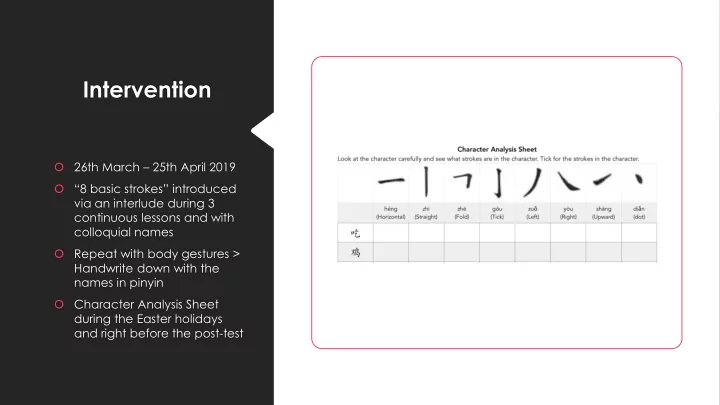
 26th March – 25th April 2019  “8 basic strokes” introduced via an interlude during 3 continuous lessons and with colloquial names  Repeat with body gestures > Handwrite down with the names in pinyin  Character Analysis Sheet during the Easter holidays and right before the post-test

slide-2
SLIDE 2

Data

 Participants: 27 students (10 male; 17 female) on Year 7 MEP –

  • fficially learning Chinese since January 2019

 Pre-test (Tuesday 26th March) & Post-test (Thursday 25th April) 

  • 1. Recognition of the spoken form

  • 2. Recognition of the written form / production of spoken form

  • 3. Production of written form

 At the end of lessons: Writing previously learnt words with the correct stroke order > Learning new words through questioning/guessing > Pronunciation practice > Listen and understand key words > Analyse new/key characters into components  Pre-test: 红色的、黄色的、绿色的、黑色的、白色的  Post-test: 吃猪肉、吃鸡肉、吃牛肉、吃羊肉、吃鸭肉  Two set of 22 valid samples (EAL factor controlled)
slide-3
SLIDE 3

Findings

 Recognition of the written form as controlled factor  Evaluation criteria for production of the written form: O: Errors that do not hinder clarity > Minor errors in characters such as a misformed stroke in a character, or errors of proportion/balance/alignment between the radicals within a character Z: Errors that hinder clarity without preventing meaning being conveyed > errors in forming a character such as characters with an extra or missing stroke (Cf. Mark Scheme for Foundation Writng Paper Question 1, New Edexcel GCSE)

slide-4
SLIDE 4

41% 40% 21% 11% 52% 33% 0% 27% 47% 6% 32% 22% 59% 33% 32% 83% 16% 45% 红 黑 黄 白 绿 Average

PRE-TEST

X Z O 80% 21% 53% 29% 24% 41% 7% 21% 0% 7% 11% 9% 13% 58% 47% 64% 65% 49% 猪 鸡 牛 羊 鸭 Average

POST-TEST

X Z O

  • In average: Slight increase of O
  • In average: Significant decrease of Z
slide-5
SLIDE 5

100% 89% 100% 100% 100% 100% 87% 71% 80% 94% 100% 89% 100% 100% 100% 100% 60% 57% 90% 76% 0% 20% 40% 60% 80% 100% 120% 红 黑 黄 白 绿 猪 鸡 牛 羊 鸭

CONTROLLED CRITERIA: RECOGNITION OF THE WRITTEN FORM & PRODUCTION OF THE WRITTEN FORM

Recognition of the spoken form Production of the spoken form

  • Overall, the competence of RSF seems to co-exist with RWF and PWF
  • Accoridng to the pre-test, the competence of PSF seems to co-exist strongly wih the RWF and PWF
  • Accoridng to the post-test, the competence of PSF seems to co-exist less strongly with the RWF and PW
slide-6
SLIDE 6

100% 100% 100% 94% 89% 100% 100% 100% 90% 94% 100% 100% 100% 94% 89% 100% 100% 100% 90% 94% 70% 56% 60% 63% 56% 100% 67% 86% 70% 71% 100% 100% 93% 94% 89% 100% 93% 100% 90% 88% 红 黑 黄 白 绿 猪 鸡 牛 羊 鸭

CONTROLLED CRITERIA: RECOGNITION OF THE WRITTEN FORM & PRODUCTION OF THE WRITTEN FORM

MidYIS Math - A MidYIS Non-Verbal - A MidYIS Skills - A MidYIS Vocabulary - A

  • MidYIS: A computer-adaptive assessment created by CEM, pupils aged 11-14, provides informaiton

and predict performance

  • Maths: Logical thinking, manipulating numbers and numerical concepts (speed and fluency)
  • Non-Verbal: Cross-Sections, Block Counting and Pictures ; ability in 3-D visualisation, spatial aptitude,

pattern recognition and logical thinking

  • Skills: « Proof Reading » and « Perceptual Speed and Accuracy »
  • Vocabulary: Word fluency and understanding