
SLIDE 1
ORIGINAL RESEARCH PAPER EPIDEMIOLOGY, PRESENTATION AND PATHOLOGICAL FINDINGS OF RETROPERITONEAL TUMORS, AND LITERATURE REVIEW
Lokesh Arora
MBBS, DNB, Sri venkateswara institute of medical sciences, Tirupati
Musunuru Brahmeswara Rao*
MBBS, MS, MCH, Sri venkateswara institute of medical sciences, Tirupati *Corresponding Author
Vutukuru Venkatarami Reddy MBBS, MS, DNB, Sri venkateswara institute of medical sciences, Tirupati Chandrakasan Chandra maliteeswaran
MBBS, MS, DNB, Sri venkateswara institute of medical sciences, Tirupati
ABSTRACT
INTRODUCTION: In this retrospective study, our aim is to study epidemiology of retroperitoneal tumors and correlate clinical presentation of patients with radiological and final pathological findings. METHODS: All the patients with the diagnosis of retroperitoneal tumor are included. Known Lymphoma or the patients with enlarged peripheral lymph nodes and metastatic tumors are excluded. RESULTS; Total of 27 patients presented with retroperitoneal tumors. Mean age at presentation was 48.07±13.40. 17(62.96%) out of 27 patients were females. Most common presentation was (18, 66.7%) Pain abdomen, followed by lump abdomen (11,40.7%). Most common tumor in our series is sarcoma, (14.8%). CONCLUSION: In our analysis of 27 patients, Retroperitoneal tumors are found predominantly in females in 5th decade of life. Majority of the patients presented with non specific pain abdomen. Radiological assessment is key to diagnosis, with CT scan playing a major role in preoperative diagnosis.
KEYWORDS
Retroperitoneal tumor, adreno cortical carcinoma, chylolymphatic cyst, dysgerminoma, gist, leiomyosarcoma, liposarcoma, malignant fibrous histiocytoma, mullerian cyst, neuroendocrine tumor, pheochromocytoma INTRODUCTION Primary retroperitoneal neoplasms include uncommon tumors that emerge inside the retroperitoneum yet, outside the retroperitoneal
1
- rgans.
The retroperitoneum can have a wide range of pathologies, including benign and malignant neoplasms that can be either primary or
- metastatic. Out of which, malignant tumors are more common, and
2
sarcomas are commonest malignant tumor of retroperitoneum. While the retroperitoneum is certainly not a genuine anatomic
- compartment. muscle sheaths posteriorly, adventitia of great vessels
medially and the peritoneum itself anteriorly can be considered as
3
boundaries. Anatomy: the retroperitoneum is extended anteriorly to peritoneal extensions anchoring the colon, small bowel, duodenum, part of pancreas and liver, extending from the diaphragm to the pelvic floor. The floor of the space is formed by the fascia overlying the quadratus
4
lumborum and psoas major muscles. Because of the inaccessibility of the region and since these tumors regularly give no or non-specific manifestations until they have
2
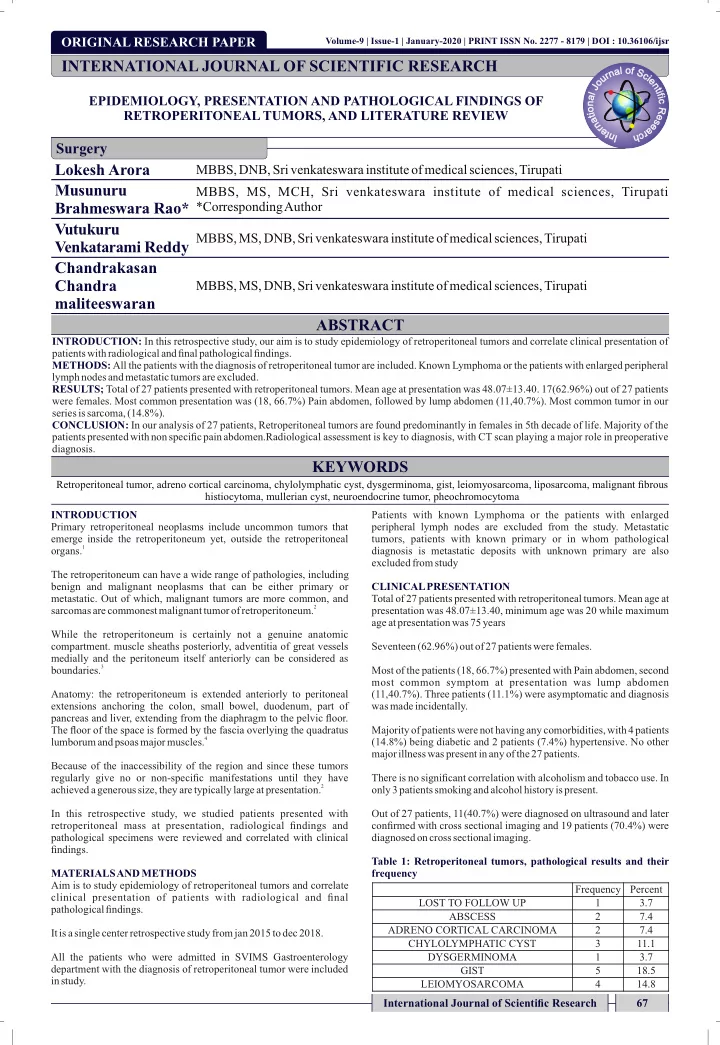
achieved a generous size, they are typically large at presentation. In this retrospective study, we studied patients presented with retroperitoneal mass at presentation, radiological findings and pathological specimens were reviewed and correlated with clinical findings. MATERIALS AND METHODS Aim is to study epidemiology of retroperitoneal tumors and correlate clinical presentation of patients with radiological and final pathological findings. It is a single center retrospective study from jan 2015 to dec 2018. All the patients who were admitted in SVIMS Gastroenterology department with the diagnosis of retroperitoneal tumor were included in study. Patients with known Lymphoma or the patients with enlarged peripheral lymph nodes are excluded from the study. Metastatic tumors, patients with known primary or in whom pathological diagnosis is metastatic deposits with unknown primary are also excluded from study CLINICAL PRESENTATION Total of 27 patients presented with retroperitoneal tumors. Mean age at presentation was 48.07±13.40, minimum age was 20 while maximum age at presentation was 75 years Seventeen (62.96%) out of 27 patients were females. Most of the patients (18, 66.7%) presented with Pain abdomen, second most common symptom at presentation was lump abdomen (11,40.7%). Three patients (11.1%) were asymptomatic and diagnosis was madeincidentally. Majority of patients were not having any comorbidities, with 4 patients (14.8%) being diabetic and 2 patients (7.4%) hypertensive. No other major illness was present in any of the 27 patients. There is no significant correlation with alcoholism and tobacco use. In
- nly 3 patients smoking and alcohol history is present.