International Behavioral Health Trauma Team Presentation to the LLUH - - PowerPoint PPT Presentation

international behavioral health trauma team
SMART_READER_LITE
LIVE PREVIEW

International Behavioral Health Trauma Team Presentation to the LLUH - - PowerPoint PPT Presentation

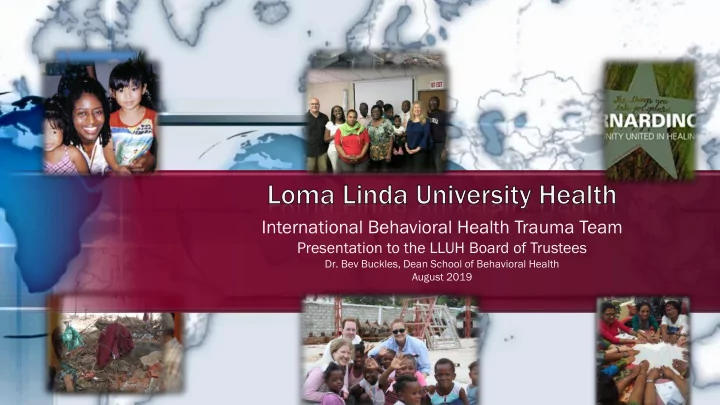
International Behavioral Health Trauma Team Presentation to the LLUH Board of Trustees Dr. Bev Buckles, Dean School of Behavioral Health August 2019 L O In harmon rmony y with our r heritag itage e and global bal M A mission on: L

slide-1
SLIDE 1

International Behavioral Health Trauma Team

Presentation to the LLUH Board of Trustees

  • Dr. Bev Buckles, Dean School of Behavioral Health

August 2019

slide-2
SLIDE 2

L O M A L I N D A U N I V E R S I T Y H E A L T H

In harmon rmony y with our r heritag itage e and global bal mission

  • n:

▪ Mission: ion: To continue ntinue the teachi ching ng and healing ing ministr try y of f Jesus Chris rist ▪ Vision

  • n and Purpos

rpose: : Transf nsfor

  • rming

ming lives throu

  • ugh,

h, educa cation ion, , behavi vior

  • ral

al health thcare are and resear arch

slide-3
SLIDE 3

L O M A L I N D A U N I V E R S I T Y H E A L T H

▪ Tran ans-Eu Europ

  • pea

ean n Division ion asks ks Dr. . Joan n Coggin in to provid ide servic vices s to Careg regiver ers s in Bosnia nia and Croat

  • atia

ia ▪ Idea of developing a “ready response” system begins ns. ▪ LLUIBHTT begins…interdisciplinary team of behavioral vioral health th prof

  • fess

ssionals ionals (faculty culty, clinicians, nicians, alumni, mni, students) ents)

slide-4
SLIDE 4

L O M A L I N D A U N I V E R S I T Y H E A L T H

▪ Direct ect servic vices s response ponse to disast ster ers ▪ 1999 9 —Direct rect services vices contrac ntract with ADRA Inter er-Americ erica followi wing ng Hurric rricane ane Mitc tch ▪ 2004 4 —Devasta astati ting ng mudslides es in Dominica ica Republ blic ic and Ha Haiti i required uired a new model ▪ Tran ansit itioned ioned to a capacit acity y building ing model

slide-5
SLIDE 5
slide-6
SLIDE 6

L O M A L I N D A U N I V E R S I T Y H E A L T H

slide-7
SLIDE 7

L O M A L I N D A U N I V E R S I T Y H E A L T H

▪ Onsite servic ices s (tra raining ning and/or /or direct ect servic vices) s) in 48 48 Countr untrie ies s ▪ 93 Clinica ical l and Educat ational ional Inter erventions ntions

  • 61 interna

nati tion

  • nal

al; 32 in US (30 region

  • nal

al)

  • 5171 Services

ices to Indivi ividua duals s (direct ect and indirect) ect)

  • 4244 Tra

rainin ing g Pa Particip cipants ts

  • Devel

elopme

  • pment

nt of ADRA RA Inter er-Am America erica Team

▪ Does not

  • t reflect

flect servic vice impact ct post training ining

  • e.g.

g., 68 individu iduals s trained ed in China na provided ded services ices to 20,000) 0)

▪ Fund nding ing fr from

  • m contr

ntracts acts and grant ant indirect rects

slide-8
SLIDE 8

L O M A L I N D A U N I V E R S I T Y H E A L T H

“We are divinely made.”

▪ Critica tical l Incid cident nt Stre ress ss Debri riefin fing ▪ Psych chologica

  • logical First

st Aid ▪ Comm mmunity unity Resilienc ncy y Model el (CRM) M)

▪ Wellne ness ss skills s based sed on neurob

  • bio

iology

  • gy
slide-9
SLIDE 9

L O M A L I N D A U N I V E R S I T Y H E A L T H

Educa ucate e participa ticipants nts abou

  • ut

t th the norma rmal str tress ess respo ponse nse and d how to use e techniq hniques ues to regula ulate e (soo

  • oth

the) e) th the e str tress ess respo ponse nse

Uses s a set et of six Wellness lness Skill lls s to rese set t th the e natural tural balance nce

  • f th

the nervous us system

Wellness lness Skill lls s are e not

  • t th

thera erapy, , are non-stigm tigmati tizing zing, , and d are re easy sy to learn rn

Brings gs awaren wareness ess to a perso son’s s abili lity ty regula ulate e his or her respo ponse nses s to past, t, present sent, , or futu ture re str tressor essors

“It is biology not human weakness.”

slide-10
SLIDE 10

L O M A L I N D A U N I V E R S I T Y H E A L T H

slide-11
SLIDE 11

L O M A L I N D A U N I V E R S I T Y H E A L T H

Cortex: x: Thinki king ng – Seat of Executive Functioning -

Planning, Reasoning, Judgment, Impulse Control

Limbic c Area: Emoti

  • tiona
  • nal – Expression and

mediation of emotions and feelings, including emotions linked to connection with others Amyg ygdala/Hippo ppoca campus pus – Assess risk….survival focus

Surviv ival al Brain – Carries out "fight, flight, & freeze"

Instinctual stinctual/unco uncons nsci cious us – Digestion, reproduction, circulation, breathing

slide-12
SLIDE 12

L O M A L I N D A U N I V E R S I T Y H E A L T H

▪ Data a collec llected in 11 countri untries; s; 496 Trainee nees/ s/Par artici ticipants pants

  • Commu

mmuni nity ty respon

  • nder

ders s – some e menta tal health th profess ssion ionals als

  • Mean

n age 39; 57% female; ale; 71% with a trauma ma histor

  • ry

▪ Cons nsis istent ent Signific ficant nt Finding ings

  • Susta

taine ned d increa ease se in understan standi ding, ng, percei eived ed abiliti ilities, es, confidence idence in providin ing g CRM M service ices; s; abilit ity to tra rain ot

  • thers

ers with h the same e results ts as master trainers ers (fidel delity ty and sympt mptoms

  • ms

affect) ect)

  • Signif

ifica icant nt reducti ction

  • n in sympt

ptoms

  • ms of anxie

iety ty, depress ession ion, and post-traumat traumatic ic dysre regulati gulation

  • n

▪ Data a suppor

  • rts

ts CRM is Effecti ective, e, Transf nsferable, erable, and Sustaina tainable ble

slide-13
SLIDE 13

Rapid id MH Assess essmen ment

  • Add

Supporting Text Here

Phase se I CRM M Inter erventi tion

  • n

Phase se II CRM CRM Training aining

  • Add

Supporting Text Here

Phase se III CRM CRM Training aining

  • Add

Supporting Text Here

Phase e IV Training aining Exper ertise tise

  • Supporting

Text Here

Support in Waterloo near the end of the Ebola pandemic Rapid MH assessment indicated population too traumatized disseminate skills to others CRM intervention to reduce symptoms and identify/prepare future trainers CRM intervention to reduce symptoms and identify/prepare future trainers N=40, 2 groups, 2 days, 20 persons in each group address trauma (4 trainers) Significant results across all measures CRM Training for 22 individuals recruited from original 40 4 day intensive training, including fidelity skills test Significance for all measures, greater change in clinical ranges 22 CRM Trainees delivered CRM skills 30 each/5 months Provided CRM to 834 community members High levels of satisfaction and perceived effectiveness LLU shadowed Trainees in conducting training Mentored 3 groups of trainees with 4-5/group CRM Trainees provided 2-day CRM training to 54 participants No significant difference in participant outcomes (LLU

  • vs. CRM Trainees)

The Example of Sierra Leone

slide-14
SLIDE 14

L O M A L I N D A U N I V E R S I T Y H E A L T H

▪ Hi High Disseminati nation

  • n Pot
  • tentia

ntial

  • Effecti

ectivel ely and qui quickly ckly used d to expand and skills s to large e numbers ers

▪ Tran ansf sferable erable

  • Effecti

ectivel ely taught ght to non-men menta tal health th profess essiona

  • nals
  • Data

a shows ws CRM is effecti ective e when dissemi emina nated ed by non-me ment ntal al tra rainee ees s

▪ Cultural turally y Adaptab able

  • Well receiv

ived ed across ss count ntries es, cultures, ures, religion ions s and langua uages ges

▪ Susta tainab inable le

  • Demonstrat
  • nstrated

ed short- and long-term erm effecti ectiven eness ess and susta taina nabilit ity

  • Comm

mmuni niti ties es adapt pt skills s beyon

  • nd

d cri risis is to meet et changin ging g needs ds

slide-15
SLIDE 15

L O M A L I N D A U N I V E R S I T Y H E A L T H

▪ Fur urth ther er Integra egration tion of f CRM within n LLUH UH

  • East

t Campus pus ICU U Young ng Ad Adult t Type I Diabet abetes es Pa Patien ents ts

  • East

t Campus pus Sickle Cell Pa Patien ents ts

  • Staff

f tra raining ing to promot

  • te

e wellne ness ss and self-care care

▪ Expan ansi sion

  • n of

f Capaci acity ty Building ng

  • Further

her Susta taina nabilit ity model devel elopme

  • pment

nt

  • Imp

mplem emen enta tati tion

  • n of special

ecialized ized curr rricu cula (pop populati tion n specif cific) ic)

▪ Regiona

  • nal Teams

s and Trai aine nee e Registr try ▪ Expan ansi sion

  • n of

f Missi sion

  • n Servic

vice e Opportun tuniti ties s for r Alumni ni ▪ Expa pansi nsion

  • n of

f Team m Op Oppo portunit tunitie ies s for r Stude dents nts