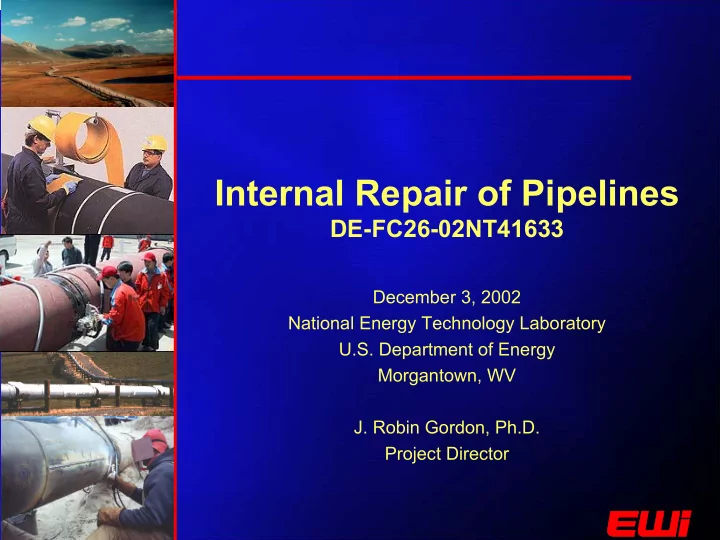
Internal Repair of Pipelines DE-FC26-02NT41633 December 3, 2002 - - PowerPoint PPT Presentation

internal repair of pipelines
SMART_READER_LITE
LIVE PREVIEW

Internal Repair of Pipelines DE-FC26-02NT41633 December 3, 2002 - - PowerPoint PPT Presentation

Internal Repair of Pipelines DE-FC26-02NT41633 December 3, 2002 National Energy Technology Laboratory U.S. Department of Energy Morgantown, WV J. Robin Gordon, Ph.D. Project Director Background It is predicted that natural gas


slide-1
SLIDE 1

Internal Repair of Pipelines

DE-FC26-02NT41633

December 3, 2002 National Energy Technology Laboratory U.S. Department of Energy Morgantown, WV

  • J. Robin Gordon, Ph.D.

Project Director

slide-2
SLIDE 2

2

Background

It is predicted that natural gas consumption in the

US will increase by more than 50% over the next decade

In addition, new federal regulations will require

pipeline operators to place increased emphasis

  • n pipeline integrity management.

The demands for increased throughput and

pipeline integrity will place increased demands on the existing pipeline system and require the development of new and improved repair technology.

slide-3
SLIDE 3

3

Background Continued

The standard method of repairing a pipeline is to

excavate the damaged area to permit access and repair the damage by:

– Cutting out the damaged section and adding a replacement section – Adding a full encirclement sleeve or clock spring – Welding directly onto the pipeline

The latter two repair techniques can be

undertaken whilst the line remains in service.

slide-4
SLIDE 4

4

Pipeline Repair

In-Service Pipeline Repair

– Full Encirclement Sleeves

In-Service Welding FEA Thermal Analysis

slide-5
SLIDE 5

5

Pipeline Repair

In-Service Pipeline Repair

– Direct Weld Deposition

In-Service Welding Completed Weld

slide-6
SLIDE 6

6

Pipeline Repair

In-Service Pipeline Repair

– Clockspring Repair

Cross-Section Clock Spring Installation

slide-7
SLIDE 7

7

Background Continued

Whilst standard repair technology works well in

situations where the pipe can be readily excavated, it is not applicable in a number of situations:

– River or estuary crossings – Pipelines running through swampland or similar terrain – Sub-sea pipelines – Environmentally sensitive and heavily populated urban areas.

In such cases, an alternative option is to repair the

pipeline from the inside (internal repair).

slide-8
SLIDE 8

8

Project Objectives

Evaluate, develop and validate internal repair

methods for pipelines

Perform a laboratory demonstration of internal

pipeline repair

Develop a functional specification for a

combined prototype system to perform internal inspection and repair of pipelines

slide-9
SLIDE 9

9

Internal Pipeline Repair Methods

Weld Repair

– Arc, Laser, Explosion, Thermite, Hyperbaric……

Internal Liners

– Composite Reinforced Plastic, Steel Coil, Shape Memory, ..

Electro-Deposition

– Electroless Ni Plating, ……

Expandable Sleeves

– Solid Expandable Tubulars, ……

Surfacing

– Thermal Spray, Surface H/T, Friction Surfacing, …..

slide-10
SLIDE 10

10

Benefits

Enable operators to repair inaccessible pipelines

using new innovative internal repair technology.

– Permit the repair and continued operation of pipelines that may otherwise have to be retired from service. – Reduce the possibility of environmental damage.

In high consequence, densely–populated locations

  • r environmentally sensitive areas, it is estimated

that Internal Repair could reduce pipeline repair costs by as much as 50%.

– A single “cut out and replace” pipeline repair can cost as much as $1M depending on difficulties and disruptions caused by conventional excavation.

slide-11
SLIDE 11

11

Detailed Project Workscope

Task 1: Research Management Plan

– Develop a detailed project workscope, budget and schedule

Task 2: Technology Status Assessment

– Perform a critical technology review to determine the current state-of-the-art of pipeline repair technology.

Task 3: Review Operators Experience & Repair Needs

– Survey Pipeline Companies to determine their repair needs and performance requirements for internal pipeline repairs.

Task 4: Evaluate Potential Repair Methods

– Evaluate potential repair methods to assess their feasibility and suitability for internal pipeline repair.

slide-12
SLIDE 12

12

Detailed Project Workscope

Task 5: Optimize and Validate Internal Repair Methods

– Optimize feasible repair procedures and verify pipeline performance by full-scale tests.

Task 6: Develop Functional Specification

– Develop a functional specification for an internal pipeline repair system. The specification will cover repair and system operating requirements for a prototype system.

Task 7: Demonstrate Internal Pipeline Repair Technology

– Perform a laboratory demonstration of the innovative pipeline repair technology.

Task 8: Final Reporting

– Prepare detailed final report.

slide-13
SLIDE 13

13

Deliverables

Research Management Plan Technology Status Assessment Summary of Industry Needs for Internal

Repair Technologies

Review & Evaluation of Technologies Full-Scale Validation Test Summary Functional Specification for an Innovative

Pipeline Repair System

slide-14
SLIDE 14

14

Project Schedule

Project Duration : 24 Months

slide-15
SLIDE 15

15

Budget

$756,751 Total $225,000 Cost Match $531,751 DOE Funds Grant Program, Function or Activity

slide-16
SLIDE 16

16

Project Team

Subcontractor Advisory & Oversight Lead Organization

slide-17
SLIDE 17

17

Project Team

Edison Welding Institute (EWI)

– EWI is the largest R&D organization in North America dedicated to Materials Joining Technology. EWI is an internationally recognized leader in the development of in- service pipeline repair technology and laser-based scanning technology for pipeline inspection and assessment.

Pacific Gas and Electric (PG&E)

– PG&E is one of the largest combined electric and gas utilities in the nation with more than 40,000 miles of natural gas pipeline.

Pipeline Research Council International (PRCI)

– PRCI is an internationally recognized consortium of 23 pipeline operating companies that funds, plans, manages, and executes pipeline technology development projects.

slide-18
SLIDE 18

18

Project Cost Share

  • The project will benefit from over $300k of direct

cost share through parallel R&D projects:

– A $50k EWI project to evaluate the feasibility of repairing pipelines using composite internal liners. – A $50k PRCI project to review operators experience and define repair needs. – A $200k PRCI project to develop automated weld procedures to repair pipeline damage by direct deposition.

slide-19
SLIDE 19

19

Project Cost Share

In addition the project will benefit from the following

experience and indirect cost share:

– Over $2M of previous work conducted by PG&E to develop an internal pipeline inspection system and evaluate the feasibility of internal repair of pipelines. – Over $2M of previous work conducted at EWI to develop and validate in-service repair methods for pipelines. – Review and Technical oversight of the PRCI Materials Technical Committee. This technical oversight, including travel to and from the review meetings by PRCI representatives will be provided at no cost to the project.

slide-20
SLIDE 20

20

PG&E IPNS System

The internal pipeline inspection system provides the capability to size and map internal damage in pipelines and may be an ideal platform for an internal pipeline repair system.

slide-21
SLIDE 21

21

Key Project Staff

Robin Gordon - EWI (Project Director)

– Tel: (614) 688-5125 E-mail: robin_gordon@ewi.org

Bill Bruce - EWI (Principal Investigator)

– Tel: (614) 688-5059 E-mail: bill_bruce@ewi.org

Nancy Porter - EWI (Project Manager)

– Tel: (614) 688-5194 E-mail: nancy_porter@ewi.org

Mike Sullivan - PG&E (PG&E Principal Investigator)

– Tel: (925) 866-5393 E-mail: MDS4@pge.com

Dave Dorling - TransCanada / PRCI (PRCI Liaison)

– Tel: (403) 948-8147 E-mail: david_dorling@transcanada.com

slide-22
SLIDE 22

22

Summary

Project Objectives

– Evaluate, develop and validate internal repair methods for pipelines. – Perform a laboratory demonstration of internal pipeline repair – Develop a functional specification for an internal repair system

Project Schedule

– 24 Months

Project Team

– Edison Welding Institute (EWI) – Pacific Gas and Electric (PG&E) – Pipeline Research Council International (PRCI)

Cost Match

– $300k of direct cost match (Parallel R&D Programs) – Over $4M of indirect cost match & experience