Intermediate Math Circles - When You Arrive If you have been here - - PowerPoint PPT Presentation

intermediate math circles when you arrive
SMART_READER_LITE
LIVE PREVIEW

Intermediate Math Circles - When You Arrive If you have been here - - PowerPoint PPT Presentation

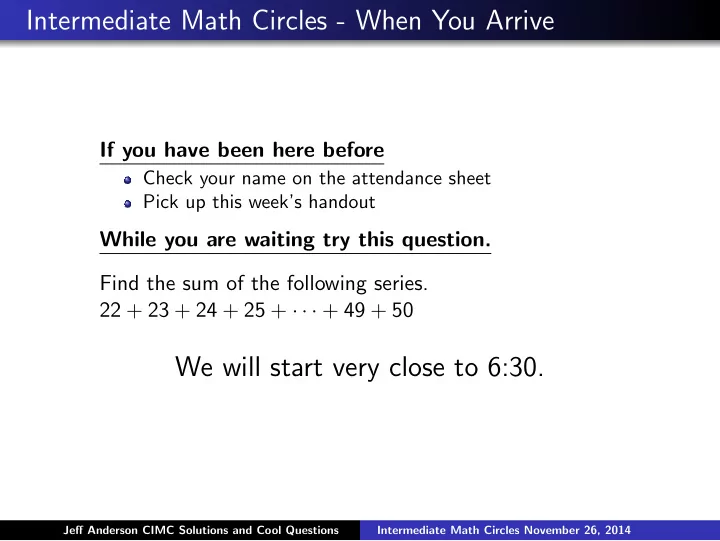
Intermediate Math Circles - When You Arrive If you have been here before Check your name on the attendance sheet Pick up this weeks handout While you are waiting try this question. Find the sum of the following series. 22 + 23 + 24 + 25 +


slide-1
SLIDE 1

Intermediate Math Circles - When You Arrive

If you have been here before

Check your name on the attendance sheet Pick up this week’s handout

While you are waiting try this question. Find the sum of the following series. 22 + 23 + 24 + 25 + · · · + 49 + 50

We will start very close to 6:30.

Jeff Anderson CIMC Solutions and Cool Questions Intermediate Math Circles November 26, 2014

slide-2
SLIDE 2

Intermediate Math Circles November 26, 2014

Jeff Anderson CIMC Solutions and Cool Questions

Centre for Education in Mathematics and Computing Faculty of Mathematics University of Waterloo Waterloo, Canada www.cemc.uwaterloo.ca jeff.anderson@uwaterloo.ca

November 26, 2014

Jeff Anderson CIMC Solutions and Cool Questions Intermediate Math Circles November 26, 2014

slide-3
SLIDE 3

Intermediate Math Circles - Night at a Glance

1 Look at some Math to do our Warmup Question. 2 Take up 2 CIMC Questions. 3 Look at some Brain Math to keep you sharp.

  • Start promptly at 6:30, End 8:30, Break 10 minutes near 7:30
  • Washrooms are located to the left and right.

Jeff Anderson CIMC Solutions and Cool Questions Intermediate Math Circles November 26, 2014

slide-4
SLIDE 4

Intermediate Math Circles - Reminders

Topics Tonight is the last session for the Fall. Math Circles will resume on February 4 Please sign the list on the table if you are not coming back in February. Pascal, Cayley, Fermat Contests February 24 Fryer, Galios, Hypatia April 16

Jeff Anderson CIMC Solutions and Cool Questions Intermediate Math Circles November 26, 2014

slide-5
SLIDE 5

Johann Carl Friedrich Gauss

Jeff Anderson CIMC Solutions and Cool Questions Intermediate Math Circles November 26, 2014

slide-6
SLIDE 6

Johann Carl Friedrich Gauss

1 Lived from 1777-1855. Jeff Anderson CIMC Solutions and Cool Questions Intermediate Math Circles November 26, 2014

slide-7
SLIDE 7

Johann Carl Friedrich Gauss

1 Lived from 1777-1855. 2 Gauss was a German Mathematician and Physical Scientist. Jeff Anderson CIMC Solutions and Cool Questions Intermediate Math Circles November 26, 2014

slide-8
SLIDE 8

Johann Carl Friedrich Gauss

1 Lived from 1777-1855. 2 Gauss was a German Mathematician and Physical Scientist. 3 Contributed to number theory, statistics, differential geometry,

geophysics, electrostatics, optics and astronomy.

Jeff Anderson CIMC Solutions and Cool Questions Intermediate Math Circles November 26, 2014

slide-9
SLIDE 9

Johann Carl Friedrich Gauss

1 Lived from 1777-1855. 2 Gauss was a German Mathematician and Physical Scientist. 3 Contributed to number theory, statistics, differential geometry,

geophysics, electrostatics, optics and astronomy.

4 Recommended Sophie Germain to receive her honorary degree. Jeff Anderson CIMC Solutions and Cool Questions Intermediate Math Circles November 26, 2014

slide-10
SLIDE 10

Johann Carl Friedrich Gauss

1 Lived from 1777-1855. 2 Gauss was a German Mathematician and Physical Scientist. 3 Contributed to number theory, statistics, differential geometry,

geophysics, electrostatics, optics and astronomy.

4 Recommended Sophie Germain to receive her honorary degree. 5 Has a CEMC math contest for Grade 7 and 8 students named

after him.

Jeff Anderson CIMC Solutions and Cool Questions Intermediate Math Circles November 26, 2014

slide-11
SLIDE 11

But my favourite Gauss story is.....

Jeff Anderson CIMC Solutions and Cool Questions Intermediate Math Circles November 26, 2014

slide-12
SLIDE 12

But my favourite Gauss story is.....

S = 1 + 2 + 3 + · · · + 99 + 100

Jeff Anderson CIMC Solutions and Cool Questions Intermediate Math Circles November 26, 2014

slide-13
SLIDE 13

But my favourite Gauss story is.....

S = 1 + 2 + 3 + · · · + 99 + 100 S = 100 + 99 + 98 + · · · + 2 + 1

Jeff Anderson CIMC Solutions and Cool Questions Intermediate Math Circles November 26, 2014

slide-14
SLIDE 14

But my favourite Gauss story is.....

S = 1 + 2 + 3 + · · · + 99 + 100 S = 100 + 99 + 98 + · · · + 2 + 1 2S = 101 + 101 + 101 + · · · + 101 + 101

Jeff Anderson CIMC Solutions and Cool Questions Intermediate Math Circles November 26, 2014

slide-15
SLIDE 15

But my favourite Gauss story is.....

S = 1 + 2 + 3 + · · · + 99 + 100 S = 100 + 99 + 98 + · · · + 2 + 1 2S = 101 + 101 + 101 + · · · + 101 + 101 2S = 100(101)

Jeff Anderson CIMC Solutions and Cool Questions Intermediate Math Circles November 26, 2014

slide-16
SLIDE 16

But my favourite Gauss story is.....

S = 1 + 2 + 3 + · · · + 99 + 100 S = 100 + 99 + 98 + · · · + 2 + 1 2S = 101 + 101 + 101 + · · · + 101 + 101 2S = 100(101) S = 100(101) 2

Jeff Anderson CIMC Solutions and Cool Questions Intermediate Math Circles November 26, 2014

slide-17
SLIDE 17

But my favourite Gauss story is.....

S = 1 + 2 + 3 + · · · + 99 + 100 S = 100 + 99 + 98 + · · · + 2 + 1 2S = 101 + 101 + 101 + · · · + 101 + 101 2S = 100(101) S = 100(101) 2 S = 5050

Jeff Anderson CIMC Solutions and Cool Questions Intermediate Math Circles November 26, 2014

slide-18
SLIDE 18

More Gauss.

But then Gauss went further...

Jeff Anderson CIMC Solutions and Cool Questions Intermediate Math Circles November 26, 2014

slide-19
SLIDE 19

More Gauss.

But then Gauss went further... S = 1 + 2 + · · · + (n-1) + n

Jeff Anderson CIMC Solutions and Cool Questions Intermediate Math Circles November 26, 2014

slide-20
SLIDE 20

More Gauss.

But then Gauss went further... S = 1 + 2 + · · · + (n-1) + n S = n + (n-1) + · · · + 2 + 1

Jeff Anderson CIMC Solutions and Cool Questions Intermediate Math Circles November 26, 2014

slide-21
SLIDE 21

More Gauss.

But then Gauss went further... S = 1 + 2 + · · · + (n-1) + n S = n + (n-1) + · · · + 2 + 1 2S = n+1 + n+1 + · · · + n+1 + n+1

Jeff Anderson CIMC Solutions and Cool Questions Intermediate Math Circles November 26, 2014

slide-22
SLIDE 22

More Gauss.

But then Gauss went further... S = 1 + 2 + · · · + (n-1) + n S = n + (n-1) + · · · + 2 + 1 2S = n+1 + n+1 + · · · + n+1 + n+1 2S = n(n+1)

Jeff Anderson CIMC Solutions and Cool Questions Intermediate Math Circles November 26, 2014

slide-23
SLIDE 23

More Gauss.

But then Gauss went further... S = 1 + 2 + · · · + (n-1) + n S = n + (n-1) + · · · + 2 + 1 2S = n+1 + n+1 + · · · + n+1 + n+1 2S = n(n+1) S = n(n + 1) 2

Jeff Anderson CIMC Solutions and Cool Questions Intermediate Math Circles November 26, 2014

slide-24
SLIDE 24

More Gauss.

But then Gauss went further... S = 1 + 2 + · · · + (n-1) + n S = n + (n-1) + · · · + 2 + 1 2S = n+1 + n+1 + · · · + n+1 + n+1 2S = n(n+1) S = n(n + 1) 2 The sum of the first n natural numbers is n(n + 1) 2

Jeff Anderson CIMC Solutions and Cool Questions Intermediate Math Circles November 26, 2014

slide-25
SLIDE 25

Practice Problems

Find the sum of the natural numbers from 1 to 2014.

Jeff Anderson CIMC Solutions and Cool Questions Intermediate Math Circles November 26, 2014

slide-26
SLIDE 26

Practice Problems

Find the sum of the natural numbers from 1 to 2014.

2014(2015) 2

= 2029105

Jeff Anderson CIMC Solutions and Cool Questions Intermediate Math Circles November 26, 2014

slide-27
SLIDE 27

Warmup Problem

Evaluate 22 + 23 + 24 + 25 + · · · + 49 + 50

Jeff Anderson CIMC Solutions and Cool Questions Intermediate Math Circles November 26, 2014

slide-28
SLIDE 28

Warmup Problem

Evaluate 22 + 23 + 24 + 25 + · · · + 49 + 50 = (1 + 2 + · · · + 49 + 50) − (1 + 2 + · · · + 20 + 21)

Jeff Anderson CIMC Solutions and Cool Questions Intermediate Math Circles November 26, 2014

slide-29
SLIDE 29

Warmup Problem

Evaluate 22 + 23 + 24 + 25 + · · · + 49 + 50 = (1 + 2 + · · · + 49 + 50) − (1 + 2 + · · · + 20 + 21) = 50(51)

2

− 21(22)

2

= 1275 − 231 = 1044

Jeff Anderson CIMC Solutions and Cool Questions Intermediate Math Circles November 26, 2014

slide-30
SLIDE 30

Practice Problems

Find the sum of all multiples of 5 from 5 to 2015. i.e. Sum 5 + 10 + 15 + · · · + 2010 + 2015

Jeff Anderson CIMC Solutions and Cool Questions Intermediate Math Circles November 26, 2014

slide-31
SLIDE 31

Practice Problems

Find the sum of all multiples of 5 from 5 to 2015. i.e. Sum 5 + 10 + 15 + · · · + 2010 + 2015 = 5(1 + 2 + 3 + · · · + 402 + 403) = 5 × 403(404)

2

= 407030

Jeff Anderson CIMC Solutions and Cool Questions Intermediate Math Circles November 26, 2014

slide-32
SLIDE 32

Proof by Induction

1 First we show it works to start. i.e. Works for 1.

LS=1 RS= 1(1+1)

2

= 1

Jeff Anderson CIMC Solutions and Cool Questions Intermediate Math Circles November 26, 2014

slide-33
SLIDE 33

Proof by Induction

1 First we show it works to start. i.e. Works for 1.

LS=1 RS= 1(1+1)

2

= 1

2 Assume it works for k.

i.e. 1 + 2 + 3 = · · · + (k − 1) + k = k(k+1)

2

Jeff Anderson CIMC Solutions and Cool Questions Intermediate Math Circles November 26, 2014

slide-34
SLIDE 34

Proof by Induction

1 First we show it works to start. i.e. Works for 1.

LS=1 RS= 1(1+1)

2

= 1

2 Assume it works for k.

i.e. 1 + 2 + 3 = · · · + (k − 1) + k = k(k+1)

2

3 Use the assumption to prove it works for k + 1.

i.e. 1 + 2 + 3 = · · · + k + (k + 1) = (k+1)(k+2)

2

Jeff Anderson CIMC Solutions and Cool Questions Intermediate Math Circles November 26, 2014

slide-35
SLIDE 35

Proof by Induction

1 First we show it works to start. i.e. Works for 1.

LS=1 RS= 1(1+1)

2

= 1

2 Assume it works for k.

i.e. 1 + 2 + 3 = · · · + (k − 1) + k = k(k+1)

2

3 Use the assumption to prove it works for k + 1.

i.e. 1 + 2 + 3 = · · · + k + (k + 1) = (k+1)(k+2)

2

LS= 1 + 2 + 3 = · · · + k + (k + 1) = (1 + 2 + 3 = · · · + k) + (k + 1)

Jeff Anderson CIMC Solutions and Cool Questions Intermediate Math Circles November 26, 2014

slide-36
SLIDE 36

Proof by Induction

1 First we show it works to start. i.e. Works for 1.

LS=1 RS= 1(1+1)

2

= 1

2 Assume it works for k.

i.e. 1 + 2 + 3 = · · · + (k − 1) + k = k(k+1)

2

3 Use the assumption to prove it works for k + 1.

i.e. 1 + 2 + 3 = · · · + k + (k + 1) = (k+1)(k+2)

2

LS= 1 + 2 + 3 = · · · + k + (k + 1) = (1 + 2 + 3 = · · · + k) + (k + 1) = k(k+1)

2

+ (k + 1)

Jeff Anderson CIMC Solutions and Cool Questions Intermediate Math Circles November 26, 2014

slide-37
SLIDE 37

Proof by Induction

1 First we show it works to start. i.e. Works for 1.

LS=1 RS= 1(1+1)

2

= 1

2 Assume it works for k.

i.e. 1 + 2 + 3 = · · · + (k − 1) + k = k(k+1)

2

3 Use the assumption to prove it works for k + 1.

i.e. 1 + 2 + 3 = · · · + k + (k + 1) = (k+1)(k+2)

2

LS= 1 + 2 + 3 = · · · + k + (k + 1) = (1 + 2 + 3 = · · · + k) + (k + 1) = k(k+1)

2

+ (k + 1) = k(k+1)

2

+ 2(k+1)

2

= k2+3k+2

2

= (k+1)(k+2)

2

= RS Therefore we have proven that 1 + 2 + 3 + · · · + n = n(n+1)

2

Jeff Anderson CIMC Solutions and Cool Questions Intermediate Math Circles November 26, 2014

slide-38
SLIDE 38

Try these 3 versions.

1 1+2+3+· · ·+149+150+200+201+202+· · ·+299+300 2 9 + 12 + 15 + · · · + 99 + 102 3 4 + 7 + 10 + · · · + 298 + 301 Jeff Anderson CIMC Solutions and Cool Questions Intermediate Math Circles November 26, 2014

slide-39
SLIDE 39

Question 1

1 + 2 + 3 + · · · + 149 + 150 + 200 + 201 + 202 + · · · + 299 + 300

Jeff Anderson CIMC Solutions and Cool Questions Intermediate Math Circles November 26, 2014

slide-40
SLIDE 40

Question 1

1 + 2 + 3 + · · · + 149 + 150 + 200 + 201 + 202 + · · · + 299 + 300 = (1 + 2 + 3 + · · · + 299 + 300) − (151 + 152 + · · · + 198 + 199)

Jeff Anderson CIMC Solutions and Cool Questions Intermediate Math Circles November 26, 2014

slide-41
SLIDE 41

Question 1

1 + 2 + 3 + · · · + 149 + 150 + 200 + 201 + 202 + · · · + 299 + 300 = (1 + 2 + 3 + · · · + 299 + 300) − (151 + 152 + · · · + 198 + 199) = ( 300(301)

2

)−((1+2+· · ·+198+199)−(1+2+· · ·+149+150))

Jeff Anderson CIMC Solutions and Cool Questions Intermediate Math Circles November 26, 2014

slide-42
SLIDE 42

Question 1

1 + 2 + 3 + · · · + 149 + 150 + 200 + 201 + 202 + · · · + 299 + 300 = (1 + 2 + 3 + · · · + 299 + 300) − (151 + 152 + · · · + 198 + 199) = ( 300(301)

2

)−((1+2+· · ·+198+199)−(1+2+· · ·+149+150)) = 45150 − ( 199(200)

2

− 150(151)

2

)

Jeff Anderson CIMC Solutions and Cool Questions Intermediate Math Circles November 26, 2014

slide-43
SLIDE 43

Question 1

1 + 2 + 3 + · · · + 149 + 150 + 200 + 201 + 202 + · · · + 299 + 300 = (1 + 2 + 3 + · · · + 299 + 300) − (151 + 152 + · · · + 198 + 199) = ( 300(301)

2

)−((1+2+· · ·+198+199)−(1+2+· · ·+149+150)) = 45150 − ( 199(200)

2

− 150(151)

2

) = 45150 − (19900 − 11325) = 36575

Jeff Anderson CIMC Solutions and Cool Questions Intermediate Math Circles November 26, 2014

slide-44
SLIDE 44

Question 2

9 + 12 + 15 + · · · + 99 + 102

Jeff Anderson CIMC Solutions and Cool Questions Intermediate Math Circles November 26, 2014

slide-45
SLIDE 45

Question 2

9 + 12 + 15 + · · · + 99 + 102 = 3(3 + 4 + 5 + · · · + 33 + 34)

Jeff Anderson CIMC Solutions and Cool Questions Intermediate Math Circles November 26, 2014

slide-46
SLIDE 46

Question 2

9 + 12 + 15 + · · · + 99 + 102 = 3(3 + 4 + 5 + · · · + 33 + 34) = 3((1 + 2 + 3 + 4 + 5 + · · · + 33 + 34) − (1 + 2))

Jeff Anderson CIMC Solutions and Cool Questions Intermediate Math Circles November 26, 2014

slide-47
SLIDE 47

Question 2

9 + 12 + 15 + · · · + 99 + 102 = 3(3 + 4 + 5 + · · · + 33 + 34) = 3((1 + 2 + 3 + 4 + 5 + · · · + 33 + 34) − (1 + 2)) = 3( 34(35)

2

− 3)

Jeff Anderson CIMC Solutions and Cool Questions Intermediate Math Circles November 26, 2014

slide-48
SLIDE 48

Question 2

9 + 12 + 15 + · · · + 99 + 102 = 3(3 + 4 + 5 + · · · + 33 + 34) = 3((1 + 2 + 3 + 4 + 5 + · · · + 33 + 34) − (1 + 2)) = 3( 34(35)

2

− 3) = 1776

Jeff Anderson CIMC Solutions and Cool Questions Intermediate Math Circles November 26, 2014

slide-49
SLIDE 49

Question 3

4 + 7 + 10 + · · · + 298 + 301

Jeff Anderson CIMC Solutions and Cool Questions Intermediate Math Circles November 26, 2014

slide-50
SLIDE 50

Question 3

4 + 7 + 10 + · · · + 298 + 301 = (3 + 1) + (6 + 1) + (9 + 1) + · · · + (297 + 1) + (300 + 1)

Jeff Anderson CIMC Solutions and Cool Questions Intermediate Math Circles November 26, 2014

slide-51
SLIDE 51

Question 3

4 + 7 + 10 + · · · + 298 + 301 = (3 + 1) + (6 + 1) + (9 + 1) + · · · + (297 + 1) + (300 + 1) = (1×3+1)+(2×3+1)+(3×3+1)+· · ·+(99×3+1)+(100×3+1)

Jeff Anderson CIMC Solutions and Cool Questions Intermediate Math Circles November 26, 2014

slide-52
SLIDE 52

Question 3

4 + 7 + 10 + · · · + 298 + 301 = (3 + 1) + (6 + 1) + (9 + 1) + · · · + (297 + 1) + (300 + 1) = (1×3+1)+(2×3+1)+(3×3+1)+· · ·+(99×3+1)+(100×3+1) = 3 × (1 + 2 + 3 + · · · + 99 + 100) + 100 × 1

Jeff Anderson CIMC Solutions and Cool Questions Intermediate Math Circles November 26, 2014

slide-53
SLIDE 53

Question 3

4 + 7 + 10 + · · · + 298 + 301 = (3 + 1) + (6 + 1) + (9 + 1) + · · · + (297 + 1) + (300 + 1) = (1×3+1)+(2×3+1)+(3×3+1)+· · ·+(99×3+1)+(100×3+1) = 3 × (1 + 2 + 3 + · · · + 99 + 100) + 100 × 1 = 3 × 5050 + 100 = 15250

Jeff Anderson CIMC Solutions and Cool Questions Intermediate Math Circles November 26, 2014

slide-54
SLIDE 54

CIMC A6

  • A6. A positive integer is a prime number if it is greater than 1 and

has no positive divisors other than 1 and itself. The integer 43797 satisfies the following conditions: each pair of neighbouring digits (read from left to right) forms a two-digit prime number, and all of the prime numbers formed by these pairs are different. What is the largest positive integer that satisfies both of these conditions?

Jeff Anderson CIMC Solutions and Cool Questions Intermediate Math Circles November 26, 2014

slide-55
SLIDE 55

A6 solution

Start with the two digit primes: 11,13,17,23,29,31,37,41,43,53,59,61,67,71,73,79,83,89,97

Jeff Anderson CIMC Solutions and Cool Questions Intermediate Math Circles November 26, 2014

slide-56
SLIDE 56

A6 solution

Start with the two digit primes: 11,13,17,23,29,31,37,41,43,53,59,61,67,71,73,79,83,89,97 Split them into the not too useful primes with an even digit and the very useful totally odd primes. Even: 23,29,41,43,61,67,83,89 Odd: 11,13,17,19,31,37,53,59,71,73,79,97

Jeff Anderson CIMC Solutions and Cool Questions Intermediate Math Circles November 26, 2014

slide-57
SLIDE 57

A6 solution

Start with the two digit primes: 11,13,17,23,29,31,37,41,43,53,59,61,67,71,73,79,83,89,97 Split them into the not too useful primes with an even digit and the very useful totally odd primes. Even: 23,29,41,43,61,67,83,89 Odd: 11,13,17,19,31,37,53,59,71,73,79,97 So something like 311371973 or 8971373119 would be good numbers.

Jeff Anderson CIMC Solutions and Cool Questions Intermediate Math Circles November 26, 2014

slide-58
SLIDE 58

A6 solution

Start with the two digit primes: 11,13,17,23,29,31,37,41,43,53,59,61,67,71,73,79,83,89,97 Split them into the not too useful primes with an even digit and the very useful totally odd primes. Even: 23,29,41,43,61,67,83,89 Odd: 11,13,17,19,31,37,53,59,71,73,79,97 So something like 311371973 or 8971373119 would be good numbers. In the odd group which digit is most common? Which even goes on the front?

Jeff Anderson CIMC Solutions and Cool Questions Intermediate Math Circles November 26, 2014

slide-59
SLIDE 59

A6 solution

Start with the two digit primes: 11,13,17,23,29,31,37,41,43,53,59,61,67,71,73,79,83,89,97 Split them into the not too useful primes with an even digit and the very useful totally odd primes. Even: 23,29,41,43,61,67,83,89 Odd: 11,13,17,19,31,37,53,59,71,73,79,97 So something like 311371973 or 8971373119 would be good numbers. In the odd group which digit is most common? Which even goes on the front? And the answer is...... 619737131179

Jeff Anderson CIMC Solutions and Cool Questions Intermediate Math Circles November 26, 2014

slide-60
SLIDE 60

CIMC B1

  • 1a. Determine the average of the six integers 22,23,23,25,26,31.

Jeff Anderson CIMC Solutions and Cool Questions Intermediate Math Circles November 26, 2014

slide-61
SLIDE 61

CIMC B1

  • 1a. Determine the average of the six integers 22,23,23,25,26,31.

The average of the 6 integers given is 22 + 23 + 23 + 25 + 26 + 31 6 = 150 6 = 25.

Jeff Anderson CIMC Solutions and Cool Questions Intermediate Math Circles November 26, 2014

slide-62
SLIDE 62

CIMC B1

  • 1b. the average of the three numbers y + 7, 2y − 9, 8y + 6 is 27.

What is the value of y?

Jeff Anderson CIMC Solutions and Cool Questions Intermediate Math Circles November 26, 2014

slide-63
SLIDE 63

CIMC B1

  • 1b. the average of the three numbers y + 7, 2y − 9, 8y + 6 is 27.

What is the value of y? Since the average of the three numbers y + 7, 2y − 9 and 8y + 6 is 27, then the sum of the three numbers is 3(27) = 81. Therefore, (y + 7) + (2y − 9) + (8y + 6) = 81 or 11y + 4 = 81, and so 11y = 77 or y = 7.

Jeff Anderson CIMC Solutions and Cool Questions Intermediate Math Circles November 26, 2014

slide-64
SLIDE 64

CIMC B1

  • 1c. Four positve integers, not necessarily different and each less

than 100, have an average of 94. Determine, with explanation, the minimum possible value for one of these integers.

Jeff Anderson CIMC Solutions and Cool Questions Intermediate Math Circles November 26, 2014

slide-65
SLIDE 65

CIMC B1

  • 1c. Four positve integers, not necessarily different and each less

than 100, have an average of 94. Determine, with explanation, the minimum possible value for one of these integers. Since the average of four integers is 94, then their sum is 4(94) = 376. Since the sum of the integers is constant, then for one of the integers to be as small as possible, the other three integers must be as large as possible.

Jeff Anderson CIMC Solutions and Cool Questions Intermediate Math Circles November 26, 2014

slide-66
SLIDE 66

CIMC B1

  • 1c. Four positve integers, not necessarily different and each less

than 100, have an average of 94. Determine, with explanation, the minimum possible value for one of these integers. Since the average of four integers is 94, then their sum is 4(94) = 376. Since the sum of the integers is constant, then for one of the integers to be as small as possible, the other three integers must be as large as possible. Then we should let the other 3 integers be 99 as that is the largest allowed.

Jeff Anderson CIMC Solutions and Cool Questions Intermediate Math Circles November 26, 2014

slide-67
SLIDE 67

CIMC B1

  • 1c. Four positve integers, not necessarily different and each less

than 100, have an average of 94. Determine, with explanation, the minimum possible value for one of these integers. Since the average of four integers is 94, then their sum is 4(94) = 376. Since the sum of the integers is constant, then for one of the integers to be as small as possible, the other three integers must be as large as possible. Then we should let the other 3 integers be 99 as that is the largest allowed. Then 99 + 99 + 99 + x = 376 x = 79

Jeff Anderson CIMC Solutions and Cool Questions Intermediate Math Circles November 26, 2014

slide-68
SLIDE 68

Holiday Brain Math

One thing we are always trying to improve on to become better Mathemeticians is to have active minds that see patterns well www.krazydad.com This is a wonderful site for all sorts of puzzles.

Jeff Anderson CIMC Solutions and Cool Questions Intermediate Math Circles November 26, 2014