Interference between s -wave superconductor and Sr 2 RuO 4 Y. Maeno, - - PowerPoint PPT Presentation

interference between
SMART_READER_LITE
LIVE PREVIEW

Interference between s -wave superconductor and Sr 2 RuO 4 Y. Maeno, - - PowerPoint PPT Presentation

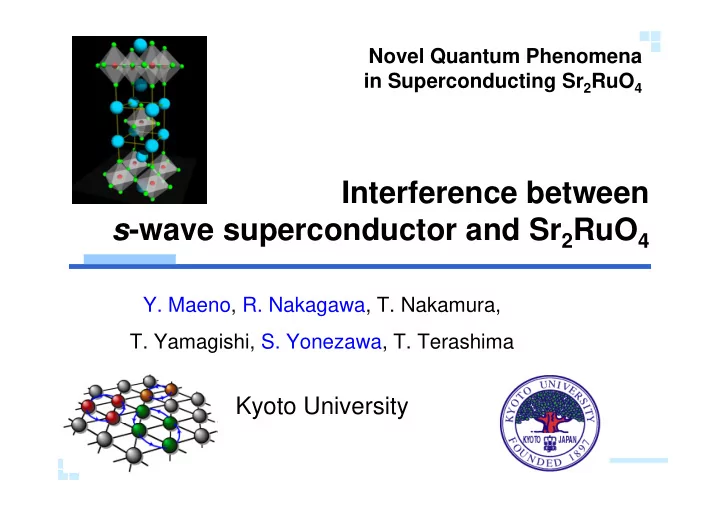
Novel Quantum Phenomena in Superconducting Sr 2 RuO 4 Interference between s -wave superconductor and Sr 2 RuO 4 Y. Maeno, R. Nakagawa, T. Nakamura, T. Yamagishi, S. Yonezawa, T. Terashima Kyoto University The Superclean Project

slide-1
SLIDE 1

Interference between s-wave superconductor and Sr2RuO4

  • Y. Maeno, R. Nakagawa, T. Nakamura,
  • T. Yamagishi, S. Yonezawa, T. Terashima

Kyoto University

Novel Quantum Phenomena in Superconducting Sr2RuO4

slide-2
SLIDE 2

The “Superclean” Project (FY2005-2009)

A04: Anisotropic Superconductors and Superfluids

Sr2RuO4 (1.5 K)

3He-A, B

Sr2RuO4-Ru (3 K) 3He-A-like A04g: Maeno (Kyoto) A04h: Ishikawa (Osaka City)

BULK EUTECTICS 共晶 INTERFACES

Ishida Yonezawa Miyake Kashiwaya Kambara Tanaka M a e n o

slide-3
SLIDE 3

Posters on Ruthenate SupeC

P121 Kittaka: Tc of pure Sr2RuO4 can be as high as 3.2 K ! P123 Nakagawa: Pb/Ru/Sr2RuO4 proximity junctions P 116 Karaki, P118 Tenya: Magnetization curves P119 Ishida: NMR review P139 Kashiwaya: Microdevices P117 Nomura, P120 H.Ikeda, P124 Yanase: d-vector orientation (theories) P138 Sakaki: E-induced M-I transition in Ca2RuO4

slide-4
SLIDE 4

Interference between s-wave superconductor and Sr2RuO4

  • Y. Maeno, R. Nakagawa, T. Nakamura,
  • T. Yamagishi, S. Yonezawa, T. Terashima

Kyoto University

Novel Quantum Phenomena in Superconducting Sr2RuO4

slide-5
SLIDE 5

Pairing Symmetry of Sr2RuO4

・NMR Knight shifts ・Polarized neutrons

➜ Spin Triplet Pairing

Spin

Orbital moment: L = 1, Lz = 1

A.P. Mackenzie and Y. Maeno,

  • Rev. Mod. Phys. 75, 657 (2003).

・SR ・Vortex lattice ・Kerr effect

➜ Broken Time Reversal Symmetry

・ Josephson effect ・chiral domains

➜ Odd Parity (p-wave)

Orbital

Broken T spins

  • rbital

moment

Spins: S = 1, Sz = 0 →?

d = z 0(kx+iky)

slide-6
SLIDE 6

Spin Orientation (d d-

  • vector

vector) in Sr2RuO4

Spins Sz=0 Orbital Lz=+1 ⇒ d // z

Both spin states are compatible with NMR experiments. Murakawa, Ishida et al.

d // x

Half-quantum vortex (HQV) is possible, with the rotation of the d-vector (spin) by π, and the orbital phase winding of π. HQV

S.B. Chung, Bluhm, Kim, PRL 99, 197002 (2007). Vakaryuk, Leggett, PRL 103, 057003 (2009).

d //x is preferred energetically.

Yoshioka & Miyake, Agterberg

slide-7
SLIDE 7

Chiral p-wave state of Sr2RuO4

Δ (k) ∝ kx + iky

Chiral p-wave

- i

  • i

   2    2  + 

kx ky

∝ e ik

Thus (phase) =  k (direction) s-wave (with vortex)

cf.) s-wave +

+ + + +         - i

  • i

+     2     2    

slide-8
SLIDE 8
  • H. Kaneyasu and M. Sigrist, arXiv: 1002.4793v2.

Tc (Sr2RuO4) = 1.5 K Tc (Ru) = 0.49 K At lower T, a vortex should be induced in Ru.

slide-9
SLIDE 9

T (K) 2 4 6 0.4 0.8 Ic(mA)

Anomalous Ic–T of Pb/Sr2RuO4/Pb junction

■ Experimental study

  • R. Jin et al., PRB 55, 4433 (1999). PSU

current source

V

Pb Pb

Tc,SRO

The critical current Ic is suppressed just below Tc.SRO

Interference between the superconductivities of Pb and Sr2RuO4

slide-10
SLIDE 10

Sr2RuO4

Pb Pb c

■ Theoretical study

Honerkamp & Sigrist

  • Prog. Theor. Phys. 100, 53 (1998).
  • Pb : s-wave SC (Tc = 7.2 K)

+ + 1.5 K < T < 7.2 K Sr2RuO4

c Pb Pb - i

  • i

+ +

0-junction unstable

T 1.5 K

Proximity effect in Pb/Sr2RuO4/Pb junction

stable Also by Yamashiro, Kashiwaya, and Tanaka.

slide-11
SLIDE 11

c

Sr2RuO4

Pb Pb

Ru In Jin’s experiments, the crystals were not pure Sr2RuO4 but Sr2RuO4-Ru eutectic crystal. 共晶 Low contact resistance between Pb and Ru allows the penetration of s-wave SC (Pb) into Ru, and then into Sr2RuO4 A complication: the 3-K superconductivity.

Important roles of Ru

slide-12
SLIDE 12

Sr2RuO4-Ru eutectic system (3-K phase)

Ru

c

Sr2RuO4

T (K)

1 0.4 0.2

dV/dI (m)

2 3 4 5 0.6 0.8 1.0 1.2 0 Oe 1000 Oe 400 Oe

Onset of bulk sc. Onset of chiral sc: Expansion of the 3-K sc into the bulk. Onset of the single-component p-wave.

3-K phase superconductivity

10 μm

slide-13
SLIDE 13

Interference well-reproduced in micro-fabricated junctions

The proximity effect channel Width : 0.5μm

Pb Sr2RuO4

100 μm Tc of Sr2RuO4 Ic1 Ic2

I The location of a pair

  • f Ru inclusions

are precisely known.

Nakamura, Nakagawa et al.

slide-14
SLIDE 14

Two Ic’s: Only one Pb is sufficient !

VLeft-Right = VLeft-SRO + VSRO-Right

ILeft IRight VRight VLeft VSRO

1 peak 1 peak 2 peak

Bridging T = 1.59 K

10 A-rms 887 Hz

We need to re-consider the previous interpretation, since only one Pb is needed.

slide-15
SLIDE 15

Pb/Ru/Sr2RuO4 junction

current source

V

Measurement

I = IDC + IAC

(IDC >> IAC)

Apply Measure

V = VAC

~1 mm

slide-16
SLIDE 16

Pb/Ru/Sr2RuO4 junction

Tc,SRO

T (K) Ic (mA)

current source

V 6.9 K 0.75 K

slide-17
SLIDE 17

Sr2RuO4 and the 3-K phase

Sr2RuO4 Sr2RuO4-Ru eutectic system

k-dependence spatial dependence

chiral p-wave

kx+iky

- i

  • i

+ Around the Sr2RuO4-Ru interface

Phase winding: N = 0 non chiral p-wave

kx

+ -

(T < 3 K)

+ -

kx+  iky

(T < 2.4 K)

chiral p-wave

homogeneous in bulk Sr2RuO4

Phase winding: N = 1

- +

Ru

- + - +

slide-18
SLIDE 18

Conclusions

  • 1. Pb/Ru/Sr2RuO4 proximity junctions reveal

the interference between s-SC and Sr2RuO4.

  • 2. The unusual Ic (T ) is ascribable to the change

in the phase windings around Ru. “Topological quantum phenomenon”

  • 3. Further tests needed

to prove Odd Parity of Sr2RuO4 : ◆ Direct observation of induced vortex in Ru.