Interdisciplinary Working (in Valuing Nature) Prof. Nicola - - PowerPoint PPT Presentation

interdisciplinary
SMART_READER_LITE
LIVE PREVIEW

Interdisciplinary Working (in Valuing Nature) Prof. Nicola - - PowerPoint PPT Presentation

Demystifying Interdisciplinary Working (in Valuing Nature) Prof. Nicola Beaumont: nijb@pml.ac.uk Contributors: Meghan Alexander, Jonathan Porter, Ece Ozdemiroglu, Rosalind Bark, Claire Wansbury, Kirk Woolford, Chris Fremantle, Gemma Delafield,


slide-1
SLIDE 1

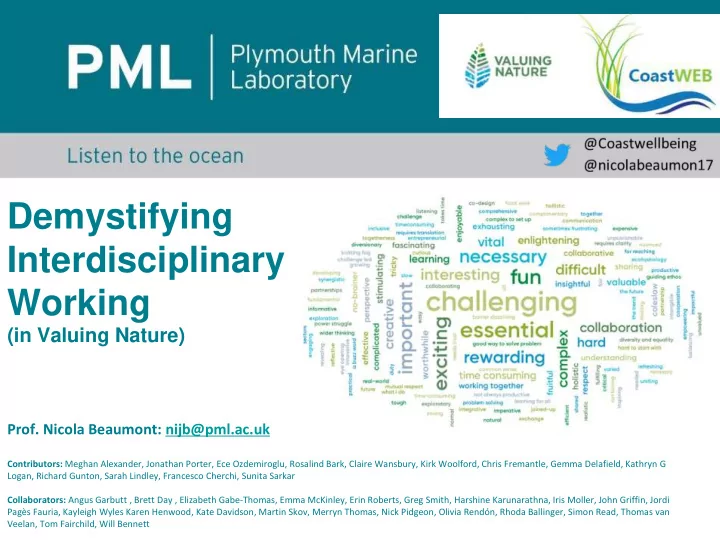
Demystifying Interdisciplinary Working

(in Valuing Nature)

  • Prof. Nicola Beaumont: nijb@pml.ac.uk

Contributors: Meghan Alexander, Jonathan Porter, Ece Ozdemiroglu, Rosalind Bark, Claire Wansbury, Kirk Woolford, Chris Fremantle, Gemma Delafield, Kathryn G Logan, Richard Gunton, Sarah Lindley, Francesco Cherchi, Sunita Sarkar Collaborators: Angus Garbutt , Brett Day , Elizabeth Gabe-Thomas, Emma McKinley, Erin Roberts, Greg Smith, Harshine Karunarathna, Iris Moller, John Griffin, Jordi Pagès Fauria, Kayleigh Wyles Karen Henwood, Kate Davidson, Martin Skov, Merryn Thomas, Nick Pidgeon, Olivia Rendón, Rhoda Ballinger, Simon Read, Thomas van Veelan, Tom Fairchild, Will Bennett

slide-2
SLIDE 2

The CoastWEB Team

@Coastwellbeing

slide-3
SLIDE 3

Why Interdisciplinary Working?

@Coastwellbeing @nicolabeaumon17

slide-4
SLIDE 4

Valuing the contribution which saltmarshes make to human health and wellbeing

@Coastwellbeing @nicolabeaumon17

Stakeholders

Wecono

Economics Governance Geography

Psychology

Ecology and modelling Art

slide-5
SLIDE 5

What is Interdisciplinary Working? Intradisciplinary

Working within a single discipline either as an individual or a collaboration of people from the same discipline.

@Coastwellbeing @nicolabeaumon17

slide-6
SLIDE 6

Crossdisciplinary

Working in one discipline with awareness of one or more

  • ther disciplines, sometimes using your discipline in the

context of issues normally belonging to another. This approach rarely involves the deep engagement with expertise from another discipline.

@Coastwellbeing @nicolabeaumon17

slide-7
SLIDE 7

Multidisciplinary

A process whereby people from different disciplines work together simultaneously or in close succession, sharing their disciplinary knowledge in a way which is additive rather than

  • integrative. That is, the disciplinary perspectives are not

changed by the process, only contrasted (Klein, 1990).

@Coastwellbeing @nicolabeaumon17

slide-8
SLIDE 8

Interdisciplinary

Integrating knowledge and methods from different disciplines, using a true synthesis of two or more disciplines, leading to the establishment of a new level of discourse and integration

  • f knowledge. The collaboration between people from

different disciplines with the goal of producing new knowledge.

@Coastwellbeing @nicolabeaumon17

slide-9
SLIDE 9

Transdisciplinary

A holistic approach which creates a unity of intellectual frameworks beyond the disciplinary perspectives , subordinating disciplines and resulting in an outcome which is not recognisable from the original parts (Klein, 1990).

@Coastwellbeing @nicolabeaumon17

slide-10
SLIDE 10

A Spectrum

Inter disciplinary: "projects that integrate both academic researchers from different unrelated disciplines and user- group participants to reach a common goal“ Tress et al (2003)

@Coastwellbeing @nicolabeaumon17

slide-11
SLIDE 11

Positives and negatives

@Coastwellbeing @nicolabeaumon17

slide-12
SLIDE 12

Barriers and Solutions

@Coastwellbeing @nicolabeaumon17

Barriers Solutions

  • i. Inadequate Communication
  • i. Enhanced communication
  • ii. Poor understanding of ‘the other’
  • ii. Improving understanding of ‘the other’
  • iii. Lack of time and facilitation
  • iii. Time allowance and active facilitation
  • iv. Narrow Academic Training
  • iv. Revised academic training
  • v. Funding constraints
  • v. New approaches to funding:
  • vi. Impediment to career progression
  • vi. Changes to career progression
  • vii. Current evaluation of ‘success’
  • vii. New methods to evaluate ‘success’
slide-13
SLIDE 13

https://usafamilymedicine.wordpress.com/tag/black-belt-of-alabama/ @Coastwellbeing @nicolabeaumon17

slide-14
SLIDE 14

7 Principles of Interdisciplinary working

  • 1. Respect

Source: http://xkcd.com/435/ @Coastwellbeing @nicolabeaumon17

slide-15
SLIDE 15
  • 1. Respect – Top tips
  • Keep an open mind, listen deeply and ask questions
  • Avoid pre-conceptions, assumptions and patronisation
  • Co-develop project guidelines for respect and equality
  • Acknowledge and demonstrate appreciation for all contributors

involved in achieving goals

  • Write an early joint publication to provide an immediate shared

goal.

@Coastwellbeing @nicolabeaumon17

slide-16
SLIDE 16
  • 2. Take Time

There is a need to learn and understand different backgrounds, methods and language. “it is a pity that as a team we are so disparate that there is precious little opportunity to get under the skin of each others process.”

@Coastwellbeing @nicolabeaumon17

slide-17
SLIDE 17
  • 2. Take Time – Top Tips
  • Build additional time into project timelines, both
  • verall and for specific interdisciplinary activities
  • Build additional time into meetings for extended

discussions

  • Explicitly budget for the extra time, resources and

activities required.

@Coastwellbeing @nicolabeaumon17

slide-18
SLIDE 18
  • 3. Communicate

Don’t assume that the forms of communication within your discipline are universal, different disciplines may use the same words but with very different meanings.

@Coastwellbeing @nicolabeaumon17

slide-19
SLIDE 19
  • 3. Communicate – Top tips
  • Collaboratively develop a project-specific dictionary
  • Do not be afraid to admit that you do not understand;
  • Listen actively and repeat back what you have heard in your own

words to ensure that you have understood;

  • Visit a field site and ask each team member to explain what they see
  • listen to the differences;
  • Remember that simplicity in communication is not the same as

being simple, explaining complex issues to non-experts requires skill.

@Coastwellbeing @nicolabeaumon17

slide-20
SLIDE 20

@Coastwellbeing @nicolabeaumon17

slide-21
SLIDE 21
  • 4. Embrace personalities

Successful interdisciplinary working is not just about bringing two or more disciplines together; it is about bringing two or more people harmoniously together.

@Coastwellbeing @nicolabeaumon17

slide-22
SLIDE 22
  • 4. Embrace personalities – Top tips
  • Create opportunities to get to know each other
  • utside of the usual work place, e.g. outreach and

STEM events are valuable as they place people in an impartial space, often outside their comfort zone, and create a shared experience.

  • Remember that no one person embodies an entire

discipline and it can take time to find a suitable disciplinary representative for your team/project.

@Coastwellbeing @nicolabeaumon17

slide-23
SLIDE 23

@Coastwellbeing @nicolabeaumon17

slide-24
SLIDE 24
  • 5. Prepare

The development of an interdisciplinary collaboration can require unfamiliar procedures which need additional consideration. Top tips:

  • Take time at the beginning of a collaboration to determine if

an interdisciplinary approach is required, what disciplines are needed, and how they will be organised

  • Ensure roles and responsibilities are clear including who will be

delivering what and to whom, and when

  • Have an agreed publication strategy with an emphasis on

inclusivity

@Coastwellbeing @nicolabeaumon17

slide-25
SLIDE 25
  • 6. Adapt

Interdisciplinary working can be unpredictable requiring adaptability.

@Coastwellbeing @nicolabeaumon17

slide-26
SLIDE 26
  • 6. Adapt – Top tips
  • Jointly develop and regularly revisit a Gantt chart, if an

activity is struggling be proactive and do not be afraid to change direction if needed

  • Include risk management strategies in the proposal to

address delays and non-delivery, or the delivery of alternative outputs;

  • Maintain open communication and encourage partners

to vocalise concerns without the risk of reprimand.

slide-27
SLIDE 27
  • 7. Share

Interdisciplinary working is challenging and to support and improve success, the sharing of experiences is critical before, during and after a project is undertaken. Top tips:

  • Discuss with other people who are working in an

interdisciplinary context

  • Keep a record or diary of what works well and what works less

well

  • take time to read some of the extensive interdisciplinary

literature

  • Write up and publicise your own interdisciplinary experiences.

@Coastwellbeing @nicolabeaumon17

slide-28
SLIDE 28

@Coastwellbeing @nicolabeaumon17

slide-29
SLIDE 29

https://www.elephantjournal.com/2011/07/why-elephant/ @Coastwellbeing @nicolabeaumon17

slide-30
SLIDE 30

@Coastwellbeing @nicolabeaumon17