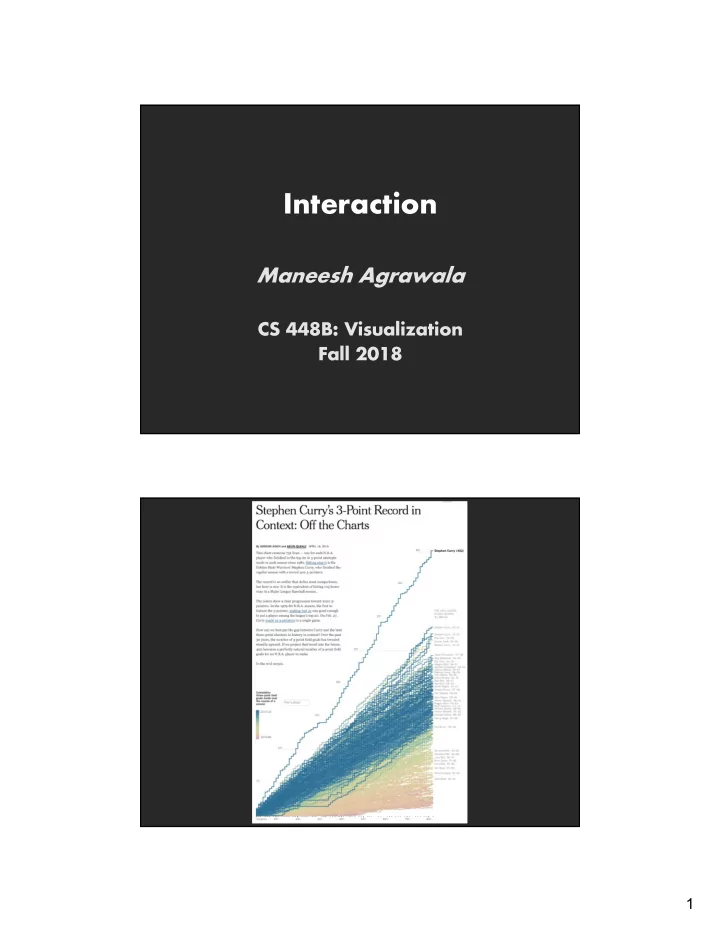
Interaction Maneesh Agrawala CS 448B: Visualization Fall 2018 1 - - PDF document

interaction
SMART_READER_LITE
LIVE PREVIEW

Interaction Maneesh Agrawala CS 448B: Visualization Fall 2018 1 - - PDF document

Interaction Maneesh Agrawala CS 448B: Visualization Fall 2018 1 Last Time: Perception Just noticeable difference JND (Weber s Law) Ratios more important than magnitude Most continuous variations in stimuli are perceived in


slide-1
SLIDE 1

1

Interaction

Maneesh Agrawala

CS 448B: Visualization Fall 2018

slide-2
SLIDE 2

2

Last Time: Perception Just noticeable difference

JND (Webers Law)

Ratios more important than magnitude

Most continuous variations in stimuli are perceived in discrete steps

slide-3
SLIDE 3

3

Stevens power law

p < 1 : underestimate p > 1 : overestimate [graph from Wilkinson 99, based on Stevens 61] [Cleveland and McGill 84]

slide-4
SLIDE 4

4

[Cleveland and McGill 84]

Relative magnitude estimation

Most accurate Position (common) scale Position (non-aligned) scale Length Slope Angle Area Volume Least accurate Color hue-saturation-density

slide-5
SLIDE 5

5

Gestalt

Principles

■ figure/ground ■ proximity ■ similarity ■ symmetry ■ connectedness ■ continuity ■ closure ■ common fate ■ transparency

slide-6
SLIDE 6

6

Figure/Ground

http://www.aber.ac.uk/media/Modules/MC10220/visper06.html

Ambiguous Principle of surroundedness Principle of relative size

Figure/Ground

Ambiguous Unambiguous

http://www.aber.ac.uk/media/Modules/MC10220/visper06.html

slide-7
SLIDE 7

7

Proximity

[Ware 00]

Similarity

Rows dominate due to similarity [from Ware 04]

slide-8
SLIDE 8

8

Symmetry

Bilateral symmetry gives strong sense of figure [from Ware 04]

Connectedness

Connectedness overrules proximity, size, color shape [from Ware 04]

slide-9
SLIDE 9

9

Continuity

We prefer smooth not abrupt changes [from Ware 04] Connections are clearer with smooth contours [from Ware 04]

Continuity: Vector fields

Prefer field that shows smooth continuous contours [from Ware 04]

slide-10
SLIDE 10

10

Closure

We see a circle behind a rectangle, not a broken circle [from Ware 04] Illusory contours [from Durand 02]

Common fate

http://coe.sdsu.edu/eet/articles/visualperc1/start.htm

Dots moving together are grouped

slide-11
SLIDE 11

11

Transparency

Requires continuity and proper color correspondence [from Ware 04]

Layering and Small Multiples

slide-12
SLIDE 12

12

Layering: Gridlines

Electrocardiogram tracelines [from Tufte 90]

Layering: Gridlines

Stravinsky score [from Tufte 90]

slide-13
SLIDE 13

13

Setting Gridline Contrast

How light can gridlines be and remain visible? How dark can gridlines be and not distract? Safe setting: 20% Alpha

[Stone & Bartram 2009]

Layering: Color and line width

IBM Series III Copier [from Tufte 90]

slide-14
SLIDE 14

14

Small multiples

[Figure 2.11, p. 38, MacEachren 95]

Small multiples

Operating trains. Redrawn by Tufte to emphasize colored lights. [fromTufte 90]

slide-15
SLIDE 15

15

Change blindness

[Example from Palmer 99, originally due to Rock]

Change detection

slide-16
SLIDE 16

16

Change detection Rensinks demonstration

http://www.csc.ncsu.edu/faculty/healey/PP/index.html

slide-17
SLIDE 17

17

Summary

Choosing effective visual encodings requires knowledge of visual perception Visual features/attributes

■ Individual attributes often preattentive ■ Multiple attributes may be separable, often

integral

Gestalt principles provide higher level design guidelines We dont always see everything that is there

Announcements

slide-18
SLIDE 18

18

A2: Exploratory Data Analysis

Use Tableau to formulate & answer questions First steps

■ Step 1: Pick a domain ■ Step 2: Pose questions ■ Step 3: Find data ■ Iterate

Create visualizations

■ Interact with data ■ Question will evolve ■ Tableau

Make wiki notebook

■ Keep record of all steps

you took to answer the questions

Due before class on Oct 15, 2018

Interaction

slide-19
SLIDE 19

19

Gulfs of execution & evaluation

Real world Conceptual model

Evaluation Execution

Gulfs

[Norman 1986]

Gulf of Execution

The difference between the users intentions and the allowable actions.

Gulf of Evaluation

The amount of effort that the person must exert to interpret the state of the system and to determine how well the expectations and intentions have been met.

[Norman 1986]

slide-20
SLIDE 20

20

Gulf of evaluation

Real world: Conceptual model: x,y correlated?

Evaluation Gulf

X Y 0.67 0.79 0.32 0.63 0.39 0.72 0.27 0.85 0.71 0.43 0.63 0.09 0.03 0.03 0.20 0.54 0.51 0.38 0.11 0.33 0.46 0.46

Gulf of evaluation

Real world: Conceptual model: x,y correlated?

Evaluation Gulf

0.5 1 0.5 1 X Y

slide-21
SLIDE 21

21

Gulf of evaluation

Real world: Conceptual model: x,y correlated?

Evaluation

Gulf

r = -.29

Gulf of execution

Real world

Conceptual model: Draw a scatterplot

Execution

Gulf

Move 90 30 Rotate 35 Pen down …

0.5 1 0.5 1 X Y

slide-22
SLIDE 22

22

Gulf of execution

Gulf Execution

Conceptual model: Draw a scatterplot

0.5 1 0.5 1 X Y

Real world

Topics

Early interactive systems Brushing and linking Dynamic queries Generalized selections

slide-23
SLIDE 23

23

Early Systems

[Graphics and Graphic Information Processing, Bertin 81]

slide-24
SLIDE 24

24

Bertin Matrices

Research question Table

  • 1. Encode table cells visually
  • 2. Group similar rows and columns

to reveal patterns

[Graphics and Graphic Information Processing, Bertin 81]

slide-25
SLIDE 25

25

Group similar rows and columns

Choose a row with a particular visual

  • aspect. Move to extremity of matrix

Move similar rows close, opposite rows to

  • bottom. (Creates two opposing groups

and a middle group) Repeat for columns (??) Iterate

[Graphics and Graphic Information Processing, Bertin 81]

slide-26
SLIDE 26

26

[Graphics and Graphic Information Processing, Bertin 81] [Graphics and Graphic Information Processing, Bertin 81]

slide-27
SLIDE 27

27

[Graphics and Graphic Information Processing, Bertin 81]

Bertifier [Perin 2014]

slide-28
SLIDE 28

28

Bertifier [Perin 2014]

slide-29
SLIDE 29

29

Pointing

Basic Pointing Methods

Point Selection Mouse Hover / Click Touch / Tap Select Nearby Element (e.g., Bubble Cursor)

slide-30
SLIDE 30

30

slide-31
SLIDE 31

31

Basic Pointing Methods

Point Selection Mouse Hover / Click Touch / Tap Select Nearby Element (e.g., Bubble Cursor) Region Selection Rubber-band or Lasso Area Cursors (“Brushes”)

slide-32
SLIDE 32

32

Brushing and Linking

Focus user attention on a subset of the data within one graph [from Wills 95]

Highlighting

slide-33
SLIDE 33

33

Brushing

■ Interactively select subset of data ■ See selected data in other views ■ Two things (normally views) must be

linked to allow for brushing

Brushing Scatterplots

Brushing Scatterplots, Becker & Cleveland 1982

slide-34
SLIDE 34

34

Baseball statistics [from Wills 95]

select high salaries avg career HRs vs avg career hits (batting ability) avg assists vs avg putouts (fielding ability) how long in majors distribution

  • f positions

played

Linking assists to positions

slide-35
SLIDE 35

35

GGobi: Brushing

http://www.ggobi.org/

Dynamic Queries

slide-36
SLIDE 36

36

Query and results

SELECT house FROM east bay WHERE price < 1,000,000 AND bedrooms > 2 ORDER BY price

Issues

  • 1. For programmers
  • 2. Rigid syntax
  • 3. Only shows exact matches
  • 4. Too few or too many hits
  • 5. No hint on how to reformulate the query
  • 6. Slow question-answer loop
  • 7. Results returned as table
slide-37
SLIDE 37

37

[Ahlberg and Schneiderman 92]

HomeFinder Direct manipulation

  • 1. Visual representation of objects and actions
  • 2. Rapid, incremental and reversible actions
  • 3. Selection by pointing (not typing)
  • 4. Immediate and continuous display of

results