Interaction-based knowledge evolution Small team (three permanent - - PowerPoint PPT Presentation

interaction based knowledge evolution
SMART_READER_LITE
LIVE PREVIEW

Interaction-based knowledge evolution Small team (three permanent - - PowerPoint PPT Presentation

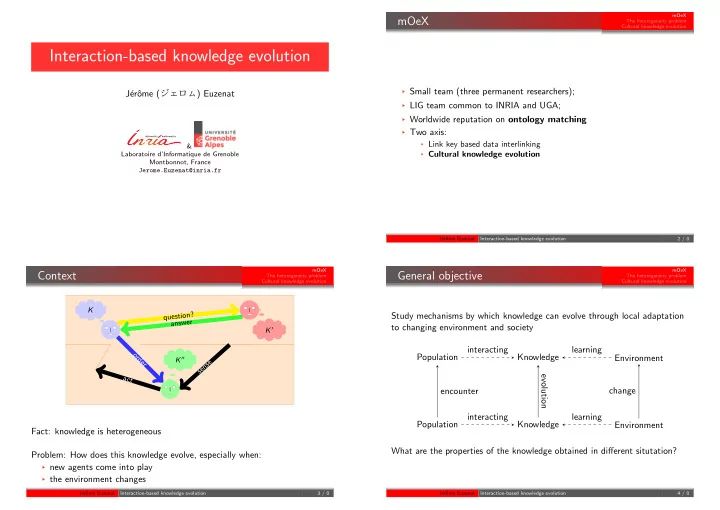
mOeX mOeX The heterogeneity problem Cultural knowledge evolution Interaction-based knowledge evolution Small team (three permanent researchers); ome ( ) Euzenat J er LIG team common to INRIA and UGA; Worldwide


slide-1
SLIDE 1

Interaction-based knowledge evolution

J´ erˆ

  • me (ジェロㇺ) Euzenat

& Laboratoire d’Informatique de Grenoble Montbonnot, France Jerome.Euzenat@inria.fr

mOeX The heterogeneity problem Cultural knowledge evolution

mOeX

§ Small team (three permanent researchers); § LIG team common to INRIA and UGA; § Worldwide reputation on ontology matching § Two axis:

§ Link key based data interlinking § Cultural knowledge evolution J´ erˆ

  • me Euzenat

Interaction-based knowledge evolution 2 / 0 mOeX The heterogeneity problem Cultural knowledge evolution

Context

K K 1 K 2 s e n s e a c t question? answer

  • r

d e r

Fact: knowledge is heterogeneous Problem: How does this knowledge evolve, especially when:

§ new agents come into play § the environment changes

J´ erˆ

  • me Euzenat

Interaction-based knowledge evolution 3 / 0 mOeX The heterogeneity problem Cultural knowledge evolution

General objective

Study mechanisms by which knowledge can evolve through local adaptation to changing environment and society Population Environment Knowledge interacting learning Population Environment encounter change Knowledge interacting learning evolution What are the properties of the knowledge obtained in different situtation?

J´ erˆ

  • me Euzenat

Interaction-based knowledge evolution 4 / 0

slide-2
SLIDE 2

mOeX The heterogeneity problem Cultural knowledge evolution

Knowledge interpretation

polygone quadrilat` ere losange rectangle triangle carr´ e planar polygone triangle rectangle isocelle quadrangle simple convexe concave complexe K ě ” ď carr´ e K triangle ? triangle K carr´ e )

J´ erˆ

  • me Euzenat

Interaction-based knowledge evolution 5 / 0 mOeX The heterogeneity problem Cultural knowledge evolution

Knowledge interpretation

polygone quadrilat` ere losange rectangle triangle carr´ e K ě ” carr´ e K triangle ? triangle K carr´ e ) 多形 三角形 四邊形 菱形 梯形 矩形 ď

J´ erˆ

  • me Euzenat

Interaction-based knowledge evolution 5 / 0 mOeX The heterogeneity problem Cultural knowledge evolution

Approach: Cultural knowledge evolution

§ Natural evolution (Darwin): variation-selection-transmission; § Cultural evolution (Cavalli Sforza, Richerson): applied to culture

(knowhow, society structure, language)

§ Experimental cultural language evolution (Axelrod, Steels): multi-agent

simulation ñ Cultural knowledge evolution: applied to knowledge

J´ erˆ

  • me Euzenat

Interaction-based knowledge evolution 6 / 0 mOeX The heterogeneity problem Cultural knowledge evolution

Relevant questions

Adaptation:

§ How do agent populations adapt their knowledge representation to their

environment and to other populations? Evolution:

§ How must this knowledge evolve when the environment changes and

new populations are encountered?

§ To what extent the environment and society constrain (formal)

knowledge representation? Diversity:

§ How can agents preserve knowledge diversity and is this diversity

beneficial?

J´ erˆ

  • me Euzenat

Interaction-based knowledge evolution 7 / 0

slide-3
SLIDE 3

mOeX The heterogeneity problem Cultural knowledge evolution

Alignment repair game

all white white small white large black black small black large K K K black all small small square small triangle large large square large triangle K K K ” ” ”

  • classOf() ?

black black

J´ erˆ

  • me Euzenat

Interaction-based knowledge evolution 8 / 0 mOeX The heterogeneity problem Cultural knowledge evolution

Alignment repair game

all white white small white large black black small black large K K K black all small small square small triangle large large square large triangle K K K ” ” △ classOf(△) ? black black

J´ erˆ

  • me Euzenat

Interaction-based knowledge evolution 8 / 0 mOeX The heterogeneity problem Cultural knowledge evolution

Adaptation operators

black white small large black K K small K K △ ” ”

delete

ď

replace

ě

add

ě

addjoin r e fi n e

ě

refine

ě

J´ erˆ

  • me Euzenat

Interaction-based knowledge evolution 9 / 0 mOeX The heterogeneity problem Cultural knowledge evolution

Experimental questions

  • 1. Does the process converge?
  • 2. How different adaptation operators compare?
  • 3. How do they compare to baselines?
  • 4. Can operators improve away from the initial situation?
  • 5. Can this start from scratch?

J´ erˆ

  • me Euzenat

Interaction-based knowledge evolution 10 / 0

slide-4
SLIDE 4

mOeX The heterogeneity problem Cultural knowledge evolution

Convergence and operators

200 400 600 800 1000 1200 1400 1600 1800 2000 0.2 0.4 0.6 0.8 1 Games Success rate

  • perator=add; #agents=4; #games=2000; #runs=1

J´ erˆ

  • me Euzenat

Interaction-based knowledge evolution 11 / 0 mOeX The heterogeneity problem Cultural knowledge evolution

Initial success rate and F-measure

1000 2000 3000 4000 5000 6000 7000 8000 9000 10000 0.2 0.4 0.6 0.8 1 Games F-measure{Success rate delete replace refine add addjoin refadd

  • perator=del,repl,add,addjoin,refine,refadd; #agents=4; #games=10000;

#runs=10

J´ erˆ

  • me Euzenat

Interaction-based knowledge evolution 12 / 0 mOeX The heterogeneity problem Cultural knowledge evolution

Initial results

Success Inc. Sem. Sem. Sem. Operator Size rate degree Precision F-measure Recall Conv. reference 86 1.0 0.0 1.0 1.0 1.0 1 initial 54 0.24 0.34 0.11 0.20 0.89

  • delete

6 0.99 0.0 1.0 0.13 0.07 445

replace

11 0.99 0.01 0.99 0.21 0.12 1478

add

33 0.98 0.14 0.80 0.52 0.39 1396

refine

20 0.99 0.02 0.96 0.37 0.23 1133

addjoin

23 0.99 0.10 0.84 0.43 0.29 1004

refadd

41 0.99 0.09 0.86 0.62 0.48 1266 Alcomo 28 0.43 0.0 0.21 0.26 0.33

  • LogMap

29 0.51 0.0 0.24 0.26 0.29

  • perator=del,repl,add,addjoin,refine,refadd; #agents=4; #games=10000;

#runs=10

J´ erˆ

  • me Euzenat

Interaction-based knowledge evolution 13 / 0 mOeX The heterogeneity problem Cultural knowledge evolution

Further exploration

  • 1. Altering ontologies
  • 2. Learning ontologies and alignments
  • 3. Involving several populations
  • 4. Modifying the environment
  • 5. Maintaining several representations
  • 6. Using different selective pressure
  • 7. Playing games with heterogeneous agents
  • 8. . . .

J´ erˆ

  • me Euzenat

Interaction-based knowledge evolution 14 / 0

slide-5
SLIDE 5

http://mOeX.inria.fr Jerome . Euzenat @ inria . fr