Integrating Faculty Development and Research through a - - PowerPoint PPT Presentation

integrating faculty development and research through a
SMART_READER_LITE
LIVE PREVIEW

Integrating Faculty Development and Research through a - - PowerPoint PPT Presentation

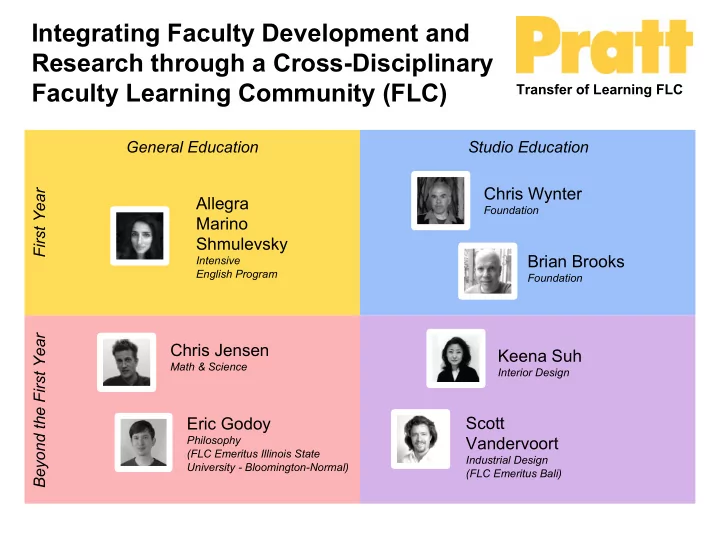
Integrating Faculty Development and Research through a Cross-Disciplinary Faculty Learning Community (FLC) Transfer of Learning FLC General Education Studio Education Chris Wynter First Year Allegra Foundation Marino Shmulevsky Brian


slide-1
SLIDE 1

Integrating Faculty Development and Research through a Cross-Disciplinary Faculty Learning Community (FLC)

Keena Suh

Interior Design

Transfer of Learning FLC

Chris Wynter

Foundation

Eric Godoy

Philosophy (FLC Emeritus Illinois State University - Bloomington-Normal)

Allegra Marino Shmulevsky

Intensive English Program

First Year Beyond the First Year General Education Studio Education

Chris Jensen

Math & Science

Scott Vandervoort

Industrial Design (FLC Emeritus Bali)

Brian Brooks

Foundation

slide-2
SLIDE 2

We will end with a Group Exercise

"SPACE" Conference 2018

Name: _________________________________ Institution: __________________________ Name of your course: ____________________________________________________________ Year / Level you teach: (1st, 2nd, 3rd, 4th yr, beyond?) _________________________________

As you learn a little bit about how we have approached transfer of learning, begin thinking about one of your class assignments and the learning that you hope transfers in/out of this assignment.

Transfer of Learning FLC

Briefly describe your class assignment: Learning students need to transfer into this assignment: 1. 2. 3. Learning that you hope that students are able to transfer out of this assignment: 1. 2. 3.

slide-3
SLIDE 3

First Year Beyond the First Year General Education Studio Education

What is Transfer of Learning?

The application of what has been learned in one context to new contexts

Element of Learning

Transfer of Learning FLC

Element of Learning Element of Learning Element of Learning

TRANSFER TRANSFER TRANSFER TRANSFER T R A N S F E R T R A N S F E R

slide-4
SLIDE 4

Transfer of Learning FLC

Year 1 Process : Cross-Disciplinary Comparisons

DISCIPLINARY DIFFERENCES Establishing mutual understanding of how each of our disciplines are taught at Pratt COMMON APPROACHES Coming to a common understanding of what “transfer of learning” means POTENTIAL TRANSFER Conceiving of a research approach to studying the potential for transfer in the Pratt art & design education

slide-5
SLIDE 5

Year 1 Process : Cross-Disciplinary Comparisons

Transfer of Learning FLC

DISCIPLINARY DIFFERENCES Establishing mutual understanding of how each of our disciplines are taught at Pratt COMMON APPROACHES Coming to a common understanding of what “transfer of learning” means POTENTIAL TRANSFER Conceiving of a research approach to studying the potential for transfer in the Pratt art & design education

slide-6
SLIDE 6

Year 1 Process : Cross-Disciplinary Comparisons

Transfer of Learning FLC

DISCIPLINARY DIFFERENCES Establishing mutual understanding of how each of our disciplines are taught at Pratt COMMON APPROACHES Coming to a common understanding of what “transfer of learning” means POTENTIAL TRANSFER Conceiving of a research approach to studying the potential for transfer in the Pratt art & design education

slide-7
SLIDE 7

Year 1 Process : Mapping Transfer Connections

Discovering potential pathways of transfer between our course assignments

Transfer of Learning FLC

slide-8
SLIDE 8

Year 1 Process : Process as Transferable

Transfer of Learning FLC

Exploring the potential for transfer of process

slide-9
SLIDE 9

Year 1 Process : Process as Transferable

Transfer of Learning FLC

slide-10
SLIDE 10

Year 1 Process : Process as Transferable

Transfer of Learning FLC

slide-11
SLIDE 11

Year 1 Process : Process as Transferable

Transfer of Learning FLC

The IIP framework allows for the comparison of different project processes:

slide-12
SLIDE 12

Year 1 Process : Process as Transferable

Transfer of Learning FLC

slide-13
SLIDE 13

Year 2 Process : Transfer Sessions

Humanities & Media Studies (4) History of Art & Design (3) Intensive English Program (1) Foundation: Visualization & Representation (3) Light Color & Design (3) Time & Movement (3) Studio Language (2) Math & Science (3) Social Science & Cultural Studies (2) Humanities & Media Studies (1) Fine Arts (1) Industrial Design (1) Art & Design Education (2) Communications Design (2) Interior Design (2) First Year Beyond the First Year General Education Studio Education

Transfer of Learning FLC

33

participants

slide-14
SLIDE 14

Year 2 Process : Transfer Sessions

  • Expand how faculty contextualize their teaching within

the broader Pratt education

  • Broaden each faculty participant’s perspective on their

teaching by introducing the “transfer lens”

  • Learn more about what transfer of learning means

across the broader Pratt undergraduate (Art & Design) curriculum

  • Build a community of Pratt faculty who are interested in

fostering better transfer of learning

Goals of the Transfer Sessions:

Transfer of Learning FLC

slide-15
SLIDE 15

Year 2 Products : Outreach and Data

Professional development and faculty outreach

  • 10 sessions
  • 33 faculty participants
  • 11 different departments
  • 166 elements of learning

transferred in

  • 249 elements of learning

transferred out

Data on the nature of transfer of learning at Pratt

(from each participant)

Project Guidelines Transfer In List Transfer Out List

Sample student work

Transfer of Learning FLC

slide-16
SLIDE 16

Humanities and Media Studies Literary and Critical Studies course Foundation Time & Movement course Communication Design Research, Analysis & Process course Art & Design Education Foundation in Art & Design Education course

How to conceptualize a design project (how to link idea and visuals) How to execute a design project (process and revisions/ refinement) Basic frame animation execution and principles (12 principles of animation) A better critique vocabulary, and a more thoughtful approach to critique A solid understanding of what Pratt expects in terms of workload, attendance, deadlines and quality. Students are able to unify and develop body paragraphs in support of a working thesis and an overall argument Students can identify and work with these formal elements of literature: plot, structure, character, setting, theme, speaker and voice, tone, imagery, diction, figurative language, rhythm, and sound, dialogue, considerations pertinent to translation, genre expectations particular to tragedy. Students are able to offer useful editorial support to their classmates Students will be able to use writing as a tool for thinking Students will be able to use writing in a way that clearly conveys their thoughts to others Students will be able to understand the critical/theoretical as a longstanding and continuing conversation that can include them. An appreciation of the crucial role of research in the design process The ability to iterate as part of the design process The ability to create prototypes as part of the design process The ability to accept and address feedback The ability to be critical about their own work . The ability to be flexible throughout the design process Introductory knowledge of their studio core at the post-secondary level. Introductory knowledge of how to plan a learning experience for a group of students (design guiding questions, structure timing, assemble necessary materials) How to organize studio core content—artists, tools, materials, concepts, language—in preparation for teaching others How to plan an art making activity and lead participants through it How to develop instructional materials to support participants’ learning Understanding of issues that teachers may encounter in instructing others in their studio core

slide-17
SLIDE 17

Humanities and Media Studies Literary and Critical Studies course Foundation Time & Movement course Communication Design Research, Analysis & Process course Art & Design Education Foundation in Art & Design Education course

How to conceptualize a design project (how to link idea and visuals)

DESIGN & COMMUNICATION

How to execute a design project (process and revisions/ refinement)

IDEATION, ITERATION, PRESENTATION – IIP

Basic frame animation execution and principles (12 principles of animation)

FORM ANALYSIS

A better critique vocabulary, and a more thoughtful approach to critique

FEEDBACK / CRITIQUE

A solid understanding of what Pratt expects in terms of workload, attendance, deadlines and

  • quality. ORGANIZATION & LEARNING SKILLS

Students are able to unify and develop body paragraphs in support of a working thesis and an overall argument DESIGN & COMMUNICATION Students can identify and work with these formal elements of literature: plot, structure, character, setting, theme, speaker and voice, tone, imagery, diction, figurative language, rhythm, and sound, dialogue, considerations pertinent to translation, genre expectations particular to tragedy. FORM ANALYSIS Students are able to offer useful editorial support to their classmates

FEEDBACK / CRITIQUE

Students will be able to use writing as a tool for thinking

IDEATION, ITERATION, PRESENTATION – IIP

Students will be able to use writing in a way that clearly conveys their thoughts to others

DESIGN & COMMUNICATION

Students will be able to understand the critical/theoretical as a longstanding and continuing conversation that can include them. SELF REFLECTION An appreciation of the crucial role of research in the design process

DESIGN & COMMUNICATION

The ability to iterate as part of the design process

IDEATION, ITERATION, PRESENTATION – IIP

The ability to create prototypes as part of the design process

IDEATION, ITERATION, PRESENTATION – IIP

The ability to accept and address feedback FEEDBACK / CRITIQUE The ability to be critical about their own work . SELF REFLECTION The ability to be flexible throughout the design process ORGANIZATION &

LEARNING SKILLS

Introductory knowledge of their studio core at the post-secondary level.

FORM ANALYSIS

Introductory knowledge of how to plan a learning experience for a group of students (design guiding questions, structure timing, assemble necessary materials)

DESIGN & COMMUNICATION

How to organize studio core content—artists, tools, materials, concepts, language—in preparation for teaching others DESIGN & COMMUNICATION How to plan an art making activity and lead participants through it

IDEATION, ITERATION, PRESENTATION – IIP

How to develop instructional materials to support participants’ learning

DESIGN & COMMUNICATION

Understanding of issues that teachers may encounter in instructing others in their studio core

DESIGN & COMMUNICATION
slide-18
SLIDE 18

Humanities and Media Studies Literary and Critical Studies course Foundation Time & Movement course Communication Design Research, Analysis & Process course Art & Design Education Foundation in Art & Design Education course

How to conceptualize a design project (how to link idea and visuals)

DESIGN & COMMUNICATION

How to execute a design project (process and revisions/ refinement)

IDEATION, ITERATION, PRESENTATION – IIP

Basic frame animation execution and principles (12 principles of animation)

FORM ANALYSIS

A better critique vocabulary, and a more thoughtful approach to critique

FEEDBACK / CRITIQUE

A solid understanding of what Pratt expects in terms of workload, attendance, deadlines and

  • quality. ORGANIZATION & LEARNING SKILLS

Students are able to unify and develop body paragraphs in support of a working thesis and an overall argument DESIGN & COMMUNICATION Students can identify and work with these formal elements of literature: plot, structure, character, setting, theme, speaker and voice, tone, imagery, diction, figurative language, rhythm, and sound, dialogue, considerations pertinent to translation, genre expectations particular to tragedy. FORM ANALYSIS Students are able to offer useful editorial support to their classmates

FEEDBACK / CRITIQUE

Students will be able to use writing as a tool for thinking

IDEATION, ITERATION, PRESENTATION – IIP

Students will be able to use writing in a way that clearly conveys their thoughts to others

DESIGN & COMMUNICATION

Students will be able to understand the critical/theoretical as a longstanding and continuing conversation that can include them. SELF REFLECTION An appreciation of the crucial role of research in the design process

DESIGN & COMMUNICATION

The ability to iterate as part of the design process

IDEATION, ITERATION, PRESENTATION – IIP

The ability to create prototypes as part of the design process

IDEATION, ITERATION, PRESENTATION – IIP

The ability to accept and address feedback FEEDBACK / CRITIQUE The ability to be critical about their own work . SELF REFLECTION The ability to be flexible throughout the design process ORGANIZATION &

LEARNING SKILLS

Introductory knowledge of their studio core at the post-secondary level.

FORM ANALYSIS

Introductory knowledge of how to plan a learning experience for a group of students (design guiding questions, structure timing, assemble necessary materials)

DESIGN & COMMUNICATION

How to organize studio core content—artists, tools, materials, concepts, language—in preparation for teaching others DESIGN & COMMUNICATION How to plan an art making activity and lead participants through it

IDEATION, ITERATION, PRESENTATION – IIP

How to develop instructional materials to support participants’ learning

DESIGN & COMMUNICATION

Understanding of issues that teachers may encounter in instructing others in their studio core

DESIGN & COMMUNICATION

slide-19
SLIDE 19

Humanities and Media Studies Literary and Critical Studies course Foundation Time & Movement course Communication Design Research, Analysis & Process course Art & Design Education Foundation in Art & Design Education course

How to conceptualize a design project (how to link idea and visuals)

DESIGN & COMMUNICATION

How to execute a design project (process and revisions/ refinement)

IDEATION, ITERATION, PRESENTATION – IIP

Basic frame animation execution and principles (12 principles of animation)

FORM ANALYSIS

A better critique vocabulary, and a more thoughtful approach to critique

FEEDBACK / CRITIQUE

A solid understanding of what Pratt expects in terms of workload, attendance, deadlines and

  • quality. ORGANIZATION & LEARNING SKILLS

Students are able to unify and develop body paragraphs in support of a working thesis and an overall argument DESIGN & COMMUNICATION Students can identify and work with these formal elements of literature: plot, structure, character, setting, theme, speaker and voice, tone, imagery, diction, figurative language, rhythm, and sound, dialogue, considerations pertinent to translation, genre expectations particular to tragedy. FORM ANALYSIS Students are able to offer useful editorial support to their classmates

FEEDBACK / CRITIQUE

Students will be able to use writing as a tool for thinking

IDEATION, ITERATION, PRESENTATION – IIP

Students will be able to use writing in a way that clearly conveys their thoughts to others

DESIGN & COMMUNICATION

Students will be able to understand the critical/theoretical as a longstanding and continuing conversation that can include them. SELF REFLECTION An appreciation of the crucial role of research in the design process

DESIGN & COMMUNICATION

The ability to iterate as part of the design process

IDEATION, ITERATION, PRESENTATION – IIP

The ability to create prototypes as part of the design process

IDEATION, ITERATION, PRESENTATION – IIP

The ability to accept and address feedback FEEDBACK / CRITIQUE The ability to be critical about their own work . SELF REFLECTION The ability to be flexible throughout the design process ORGANIZATION &

LEARNING SKILLS

Introductory knowledge of their studio core at the post-secondary level.

FORM ANALYSIS

Introductory knowledge of how to plan a learning experience for a group of students (design guiding questions, structure timing, assemble necessary materials)

DESIGN & COMMUNICATION

How to organize studio core content—artists, tools, materials, concepts, language—in preparation for teaching others DESIGN & COMMUNICATION How to plan an art making activity and lead participants through it

IDEATION, ITERATION, PRESENTATION – IIP

How to develop instructional materials to support participants’ learning

DESIGN & COMMUNICATION

Understanding of issues that teachers may encounter in instructing others in their studio core

DESIGN & COMMUNICATION

slide-20
SLIDE 20

Humanities and Media Studies Literary and Critical Studies course Foundation Time & Movement course Communication Design Research, Analysis & Process course Art & Design Education Foundation in Art & Design Education course

How to conceptualize a design project (how to link idea and visuals)

DESIGN & COMMUNICATION

How to execute a design project (process and revisions/ refinement)

IDEATION, ITERATION, PRESENTATION – IIP

Basic frame animation execution and principles (12 principles of animation)

FORM ANALYSIS

A better critique vocabulary, and a more thoughtful approach to critique

FEEDBACK / CRITIQUE

A solid understanding of what Pratt expects in terms of workload, attendance, deadlines and

  • quality. ORGANIZATION & LEARNING SKILLS

Students are able to unify and develop body paragraphs in support of a working thesis and an overall argument DESIGN & COMMUNICATION Students can identify and work with these formal elements of literature: plot, structure, character, setting, theme, speaker and voice, tone, imagery, diction, figurative language, rhythm, and sound, dialogue, considerations pertinent to translation, genre expectations particular to tragedy. FORM ANALYSIS Students are able to offer useful editorial support to their classmates

FEEDBACK / CRITIQUE

Students will be able to use writing as a tool for thinking

IDEATION, ITERATION, PRESENTATION – IIP

Students will be able to use writing in a way that clearly conveys their thoughts to others

DESIGN & COMMUNICATION

Students will be able to understand the critical/theoretical as a longstanding and continuing conversation that can include them. SELF REFLECTION An appreciation of the crucial role of research in the design process

DESIGN & COMMUNICATION

The ability to iterate as part of the design process

IDEATION, ITERATION, PRESENTATION – IIP

The ability to create prototypes as part of the design process

IDEATION, ITERATION, PRESENTATION – IIP

The ability to accept and address feedback FEEDBACK / CRITIQUE The ability to be critical about their own work . SELF REFLECTION The ability to be flexible throughout the design process ORGANIZATION &

LEARNING SKILLS

Introductory knowledge of their studio core at the post-secondary level.

FORM ANALYSIS

Introductory knowledge of how to plan a learning experience for a group of students (design guiding questions, structure timing, assemble necessary materials)

DESIGN & COMMUNICATION

How to organize studio core content—artists, tools, materials, concepts, language—in preparation for teaching others DESIGN & COMMUNICATION How to plan an art making activity and lead participants through it

IDEATION, ITERATION, PRESENTATION – IIP

How to develop instructional materials to support participants’ learning

DESIGN & COMMUNICATION

Understanding of issues that teachers may encounter in instructing others in their studio core

DESIGN & COMMUNICATION

slide-21
SLIDE 21

Humanities and Media Studies Literary and Critical Studies course Foundation Time & Movement course Communication Design Research, Analysis & Process course Art & Design Education Foundation in Art & Design Education course

How to conceptualize a design project (how to link idea and visuals)

DESIGN & COMMUNICATION

How to execute a design project (process and revisions/ refinement)

IDEATION, ITERATION, PRESENTATION – IIP

Basic frame animation execution and principles (12 principles of animation)

FORM ANALYSIS

A better critique vocabulary, and a more thoughtful approach to critique

FEEDBACK / CRITIQUE

A solid understanding of what Pratt expects in terms of workload, attendance, deadlines and

  • quality. ORGANIZATION & LEARNING SKILLS

Students are able to unify and develop body paragraphs in support of a working thesis and an overall argument DESIGN & COMMUNICATION Students can identify and work with these formal elements of literature: plot, structure, character, setting, theme, speaker and voice, tone, imagery, diction, figurative language, rhythm, and sound, dialogue, considerations pertinent to translation, genre expectations particular to tragedy. FORM ANALYSIS Students are able to offer useful editorial support to their classmates

FEEDBACK / CRITIQUE

Students will be able to use writing as a tool for thinking

IDEATION, ITERATION, PRESENTATION – IIP

Students will be able to use writing in a way that clearly conveys their thoughts to others

DESIGN & COMMUNICATION

Students will be able to understand the critical/theoretical as a longstanding and continuing conversation that can include them. SELF REFLECTION An appreciation of the crucial role of research in the design process

DESIGN & COMMUNICATION

The ability to iterate as part of the design process

IDEATION, ITERATION, PRESENTATION – IIP

The ability to create prototypes as part of the design process

IDEATION, ITERATION, PRESENTATION – IIP

The ability to accept and address feedback FEEDBACK / CRITIQUE The ability to be critical about their own work . SELF REFLECTION The ability to be flexible throughout the design process ORGANIZATION &

LEARNING SKILLS

Introductory knowledge of their studio core at the post-secondary level.

FORM ANALYSIS

Introductory knowledge of how to plan a learning experience for a group of students (design guiding questions, structure timing, assemble necessary materials)

DESIGN & COMMUNICATION

How to organize studio core content—artists, tools, materials, concepts, language—in preparation for teaching others DESIGN & COMMUNICATION How to plan an art making activity and lead participants through it

IDEATION, ITERATION, PRESENTATION – IIP

How to develop instructional materials to support participants’ learning

DESIGN & COMMUNICATION

Understanding of issues that teachers may encounter in instructing others in their studio core

DESIGN & COMMUNICATION

slide-22
SLIDE 22

Humanities and Media Studies Literary and Critical Studies course Foundation Time & Movement course Communication Design Research, Analysis & Process course Art & Design Education Foundation in Art & Design Education course

How to conceptualize a design project (how to link idea and visuals)

DESIGN & COMMUNICATION

How to execute a design project (process and revisions/ refinement)

IDEATION, ITERATION, PRESENTATION – IIP

Basic frame animation execution and principles (12 principles of animation)

FORM ANALYSIS

A better critique vocabulary, and a more thoughtful approach to critique

FEEDBACK / CRITIQUE

A solid understanding of what Pratt expects in terms of workload, attendance, deadlines and

  • quality. ORGANIZATION & LEARNING SKILLS

Students are able to unify and develop body paragraphs in support of a working thesis and an overall argument DESIGN & COMMUNICATION Students can identify and work with these formal elements of literature: plot, structure, character, setting, theme, speaker and voice, tone, imagery, diction, figurative language, rhythm, and sound, dialogue, considerations pertinent to translation, genre expectations particular to tragedy. FORM ANALYSIS Students are able to offer useful editorial support to their classmates

FEEDBACK / CRITIQUE

Students will be able to use writing as a tool for thinking

IDEATION, ITERATION, PRESENTATION – IIP

Students will be able to use writing in a way that clearly conveys their thoughts to others

DESIGN & COMMUNICATION

Students will be able to understand the critical/theoretical as a longstanding and continuing conversation that can include them. SELF REFLECTION An appreciation of the crucial role of research in the design process

DESIGN & COMMUNICATION

The ability to iterate as part of the design process

IDEATION, ITERATION, PRESENTATION – IIP

The ability to create prototypes as part of the design process

IDEATION, ITERATION, PRESENTATION – IIP

The ability to accept and address feedback FEEDBACK / CRITIQUE The ability to be critical about their own work . SELF REFLECTION The ability to be flexible throughout the design process ORGANIZATION &

LEARNING SKILLS

Introductory knowledge of their studio core at the post-secondary level.

FORM ANALYSIS

Introductory knowledge of how to plan a learning experience for a group of students (design guiding questions, structure timing, assemble necessary materials)

DESIGN & COMMUNICATION

How to organize studio core content—artists, tools, materials, concepts, language—in preparation for teaching others DESIGN & COMMUNICATION How to plan an art making activity and lead participants through it

IDEATION, ITERATION, PRESENTATION – IIP

How to develop instructional materials to support participants’ learning

DESIGN & COMMUNICATION

Understanding of issues that teachers may encounter in instructing others in their studio core

DESIGN & COMMUNICATION

slide-23
SLIDE 23

Humanities and Media Studies Literary and Critical Studies course Foundation Time & Movement course Communication Design Research, Analysis & Process course Art & Design Education Foundation in Art & Design Education course

How to conceptualize a design project (how to link idea and visuals)

DESIGN & COMMUNICATION

How to execute a design project (process and revisions/ refinement)

IDEATION, ITERATION, PRESENTATION – IIP

Basic frame animation execution and principles (12 principles of animation)

FORM ANALYSIS

A better critique vocabulary, and a more thoughtful approach to critique

FEEDBACK / CRITIQUE

A solid understanding of what Pratt expects in terms of workload, attendance, deadlines and

  • quality. ORGANIZATION & LEARNING SKILLS

Students are able to unify and develop body paragraphs in support of a working thesis and an overall argument DESIGN & COMMUNICATION Students can identify and work with these formal elements of literature: plot, structure, character, setting, theme, speaker and voice, tone, imagery, diction, figurative language, rhythm, and sound, dialogue, considerations pertinent to translation, genre expectations particular to tragedy. FORM ANALYSIS Students are able to offer useful editorial support to their classmates

FEEDBACK / CRITIQUE

Students will be able to use writing as a tool for thinking

IDEATION, ITERATION, PRESENTATION – IIP

Students will be able to use writing in a way that clearly conveys their thoughts to others

DESIGN & COMMUNICATION

Students will be able to understand the critical/theoretical as a longstanding and continuing conversation that can include them. SELF REFLECTION An appreciation of the crucial role of research in the design process

DESIGN & COMMUNICATION

The ability to iterate as part of the design process

IDEATION, ITERATION, PRESENTATION – IIP

The ability to create prototypes as part of the design process

IDEATION, ITERATION, PRESENTATION – IIP

The ability to accept and address feedback FEEDBACK / CRITIQUE The ability to be critical about their own work . SELF REFLECTION The ability to be flexible throughout the design process ORGANIZATION &

LEARNING SKILLS

Introductory knowledge of their studio core at the post-secondary level.

FORM ANALYSIS

Introductory knowledge of how to plan a learning experience for a group of students (design guiding questions, structure timing, assemble necessary materials)

DESIGN & COMMUNICATION

How to organize studio core content—artists, tools, materials, concepts, language—in preparation for teaching others DESIGN & COMMUNICATION How to plan an art making activity and lead participants through it

IDEATION, ITERATION, PRESENTATION – IIP

How to develop instructional materials to support participants’ learning

DESIGN & COMMUNICATION

Understanding of issues that teachers may encounter in instructing others in their studio core

DESIGN & COMMUNICATION

slide-24
SLIDE 24

History of Art & Design Themes in Art & Culture II course Foundation Visualization/Representation/Concept course Math & Science Evolution course Interior Design Language of Drawing 1 course

Ability to visually analyze historical works Ability to design a work using spatial analysis Ability to analyze visual form in relation to meaning & cultural context

slide-25
SLIDE 25

Teaching & Learning Center External Publications

Our Expanding Community… and Next Steps

Learning Management Site provides a repository for all Transfer Sessions participants to visit Transfer FLC Transfer to ??? Narrative account of the project Formal analysis driven by Research Questions

Transfer of Learning FLC

slide-26
SLIDE 26

Transfer FLC Research Questions

Within our existing curriculum, what’s the potential for student transfer of…

  • The ability to plan a process of project development?
  • The ability to give and respond to feedback/critique?
  • The ability to self-assess and self-reflect?
  • The ability to deconstruct existing work and

plan/conceptualize a work by playing with constituent design elements?

  • The ability to translate between visual and written

languages?

  • The ability to perform the research necessary to inform

a project?

Transfer of Learning FLC

slide-27
SLIDE 27

The Transfer Sessions Project Database

Samples

Project Guidelines

Sample student work

Transfer In List Transfer Out List Descriptive Data

Creating a searchable, sortable means of analyzing all of the qualitative data that we have collected via these sessions

Transfer of Learning FLC

slide-28
SLIDE 28

Briefly describe your class assignment: Learning students need to transfer into this assignment: 1. 2. 3. Learning that you hope that students are able to transfer out of this assignment: 1. 2. 3.

Name: _________________________________ Institution: __________________________ Name of your course: ____________________________________________________________ Year / Level you teach: (1st, 2nd, 3rd, 4th yr, beyond?) _________________________________

Group Exercise : Step 1 of 3

Please take about 3 minutes to complete this form by identifying a class assignment and the learning that you hope students transfer in/out of this assignment.

Transfer of Learning FLC

"SPACE" Conference 2018

slide-29
SLIDE 29

Group Exercise : Step 2 of 3

  • Form a group of four
  • Share the kinds of learning that you hope transfers

in/out of your class assignment

  • See if you can find possible “pathways of transfer”

between the class assignments of each of your group members

  • Prepare to share any “pathways of transfer” that

you discover

Transfer of Learning FLC Transfer of Learning FLC

"SPACE" Conference 2018

slide-30
SLIDE 30

Group Exercise : Step 3 of 3

  • Let’s share with the whole group !
  • Please report any interesting “pathways of

transfer” that you discovered to the rest of the groups

Transfer of Learning FLC Transfer of Learning FLC

"SPACE" Conference 2018