
SLIDE 1
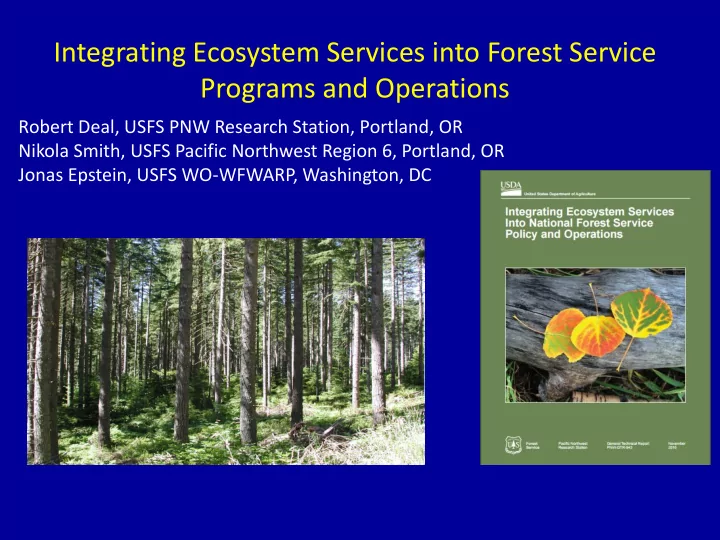
Integrating Ecosystem Services into Forest Service Programs and Operations
Robert Deal, USFS PNW Research Station, Portland, OR Nikola Smith, USFS Pacific Northwest Region 6, Portland, OR Jonas Epstein, USFS WO-WFWARP, Washington, DC
Integrating Ecosystem Services into Forest Service Programs and - - PowerPoint PPT Presentation
Integrating Ecosystem Services into Forest Service Programs and Operations Robert Deal, USFS PNW Research Station, Portland, OR Nikola Smith, USFS Pacific Northwest Region 6, Portland, OR Jonas Epstein, USFS WO-WFWARP, Washington, DC Outli
Robert Deal, USFS PNW Research Station, Portland, OR Nikola Smith, USFS Pacific Northwest Region 6, Portland, OR Jonas Epstein, USFS WO-WFWARP, Washington, DC
Outli line o
ion
Ec Ecosystem Se Servic ices a and t the U USF SFS
concept
NESST
Natural resource legislation and federal agency responses and applications
Legislation Intent of Legislation Federal Agencies
Multiple Use Sustained Yield Act (1960)
Sustainable management of natural resources USFS and BLM
National Environmental Policy Act (1969))
Impacts of people and the environment and understanding of the connection between ecological systems and management actions Any federal project that used federal funding
National Forest Management Act (1976)
Establishes policy of inventory and planning in accordance with MUSYA USFS and BLM
National Forest System Land Management Planning Rule (2012)
USFS regulation to implement planning from NFMA Rule explicitly requires managers to address ecosystem services in planning
Presidential Memorandum: Ecosystem Services into Federal Decision Making (2015)
Directs federal agencies to incorporate ES into decision frameworks NOAA, NRCS, USFWS, USFS, EPA, BLM, USGS
USF SFS S Pla lannin ing R Rule le
ystem servi vices an and m multiple le uses “considering a full range of resources, uses and benefits”
ater, r recreat ation, ran ange, w wildlife fe & f fish.
arly y ad adopter forests ar are u using Plan anning Rule for forest plan an revi visions an and a assessments.
services” in forest plan revisions.
also includes cultural al heritag age va values, an and o
vices not directly y included in multiple uses.
Incorporat ating Ecosys yste tem Servi vices into to Federal al D Decision Mak aking
Octo tober, 2 2015 –CEQ, Q, OM OMB Directi tive ve.
ts ag agencies to to d deve velop an and i insti titu tuti tional alize policies for ecosys yste tem servi vices in p plan anning, inve vestm tment a t and regulat atory y conte text. t.
ach ag agency d y deve veloping work plan an due Ma March, 2 2016.
tati tion guidan ance, C CEQ Q conve vening subject t matter experts for “community of practice” concept.
USFS programs and operations
ystem m Se Service ces s Champi pion
m in 2012.
Scientist ists-R&D, , Line office cers rs-NF NFS, S, Practi titi tion
rs-S&P
Set of recomme mend ndat ation
s for Ecosyst system em Se Services es Framewo work rk includi ding ng: develo lopin ping g common
age and underst rstan andin ing, g, relevan ance e to the agency, y, availab able e tools and informa rmatio ion, n, better commun unica catio ion n across ss USF SFS De S Deputy ty Areas. s.
strate tegy gy and policy y for the agency
SST was chartere ered d in 2013, re-charte artere red d in 2016.
Robert Deal, Nikola Smith, Jonas Epstein, Emily Weidner, Mary Snieckus, Lisa Fong, Tommie Herbert, Tania Ellersick, Greg Arthaud, Claire Harper, many others
NESST- National Ecosystem Services Strategy Team
NESST Purpose
Approach
Communicating
investments in ES
https://www.fs.fed.us/pnw/pubs/pnw_gtr943.pdf
The Opportunities
decision-making and priority-setting
ecosystem services through partnerships and investments
to people through measurement and reporting
Considering the full suite of objectives in analysis, decision-making and priority-setting
Activities
watersheds, counties, regional markets, or eco-regions).
characteristics of ecosystems that currently sustain ecosystem services.
authority of the Forest Service that influence the plan area’s ability to provide ecosystem services.
between 7-22 services per assessment
Relative capacity for:
Mapped areas of service provision at risk from
stressors:
Increasing focus on geospatial tools to quantify benefits delivered to the public Characterization of threats and justification for targeted restoration National Forest Contributions to Stream Flow
Rocky Mountain Research Station, Luce et al. 2016
Forests to Faucets Project
Assessing Drinking Water Importance and Threats
Timber – appropriate vegetation types and infrastructure locations Grazing – permitted areas Energy – potential areas of fuel treatment (source of biomass)
Recreation - “Recreation Opportunity Spectrum”; recreation sites; visitation Aesthetics – existing condition based on “Visual Quality Objectives” Cultural services – historic sites, Tribal significance, locations of important species for hunting, medicine, and food Carbon Sequestration – sites vulnerable to fire, land cover critical in providing capacity for carbon sequestration Biodiversity – critical terrestrial and aquatic habitat
PROPOSED ACTION DECISION PROPOSAL Implementation
Monitor and Evaluate
Adaptive Management
Karen Bennett, Retired Regional Soil Scientist, USFS Pacific Northwest Region
~ Washington State Forest Action Plan
Tennessee estimates the value of its urban forests for improving air quality is over $203 million annually Georgia determined that its forest industry employs 128,000 at an economic benefit of nearly $29 billion USFS is assisting the Southern Group of State Foresters to standardize ecosystem service valuation across the region
Connecting providers and beneficiaries of ecosystem services through partnerships and shared investments.
On average, each acre of healthy riparian forest protected through the program results in an $438 economic benefit per year, with a 260% return on investment over 20 years.
Watershed investments Compensatory mitigation Corporate social responsibility Voluntary and regulatory carbon Voter initiatives
Quantifying and communicating the value of resources and impacts of management actions in terms of benefits to people
Performance Reporting
Creating standardized metrics & indicators that enhance national reporting, program management, and encourage third-party investment
Performance Reporting
Creating standardized metrics & indicators that enhance national reporting, program management, and encourage third-party investment
Summary of Opportunities
Common Needs
Common Needs
A changing political landscape…
National Action Plan – 2017 & Beyond
Facilitate a Community of Practice
to identify strategically important points of contact
compendium of resources and continue monthly webinar series
materials to foster greater understanding of ES & valuation in decision-making
agency foundation for Natural Capital
National Action Plan – 2017 & Beyond
Strategic Engagement with Leadership
National Action Plan – 2017 & Beyond
Strengthening Agency Communications
Water, Air, Carbon, Soil, Fish & Wildlife, Forests-Food-Fiber, Energy, Recreation Access & Culture, Local Economies
Glance
coordination with regional plans
National Action Plan – 2017 & Beyond
Market-Based Solutions
Analysis
Analysis
Analysis
National Action Plan – 2017 & Beyond
Market-Based Solutions
enable innovative financing
Partnership toolkit
National Action Plan – 2017 & Beyond
Quantifying Impact through Metrics
National Action Plan – 2017 & Beyond
Sharing Best Practices
Sy Synthesis is an and F Future D Dir irectio ion f for NES ESST ST
scale application of ecosystem services concepts.
applying ecosystem services (e.g. USFS Planning Rule).
and webinars to get expertise out to the field.
Example: USFS R5 Ecosystem Services Framework
– Regional Leadership and Program Priority Setting – Forest Management Plans and NEPA – Coordination with State Initiatives/Programs
Management Actions in Terms of Benefits to People – Standardize Tools for Valuation of Benefits – Compile and Complete Connective Data and Narratives – Create Communication Tools and Messages
– Collaborative Frameworks and Authorities – Demonstration Projects – Outreach Initiatives and Communication Products
public to how their lives are made better by benefits received from our National Forests, and to – Incentivize citizen-stewardship, volunteerism, and restoration investment
integration of work, and access to senior-level thinking and strategy. – Comprised of RO and NF leadership, meets quarterly – Identified initial priority Benefits to focus on – Water, Carbon, Local Economies – As leadership solidifies its thinking around its strategy, the R5 Regional Leadership Team from all 18 Forests will likely be asked to provide thoughts
Service Programs – 1 full-time RO specialist reporting to Regional Forester team, focusing on coordination of program, communication strategies and products – 1 part-time RO specialist in State and Private Forestry focusing on coordination of program, data/analysis coordination and state initiatives
Element #1: Coordinate Integration
Standardize Tools for Valuation of Benefits
– Water Example:
– 34million acre feet annually from R5 NFs
– Have estimated quantity by NF; Valuation ongoing – Tracking various project and research metrics (BFC, SoCal, etc) – Carbon Example:
– Local Economies Example:
Element 2: Quantify and Communicate
Nature’s Benefits Demonstration Projects
– Coordination with PSW; University research – SoCal Ecosystem Service Project – State Meadow Carbon Research
– Compensatory Mitigation – Voluntary Carbon – GGRF (State Carbon Grants)
– Exploring private financing - eg: Forest Resilience Bond & Blue Forest Conservation – Good Neighbor and Stewardship Agreements – Other Regional successes and NESST Element 3: Connect