Integrated people-centred health services WHO Framework adopted at 69 - - PowerPoint PPT Presentation

integrated people centred health services
SMART_READER_LITE
LIVE PREVIEW

Integrated people-centred health services WHO Framework adopted at 69 - - PowerPoint PPT Presentation

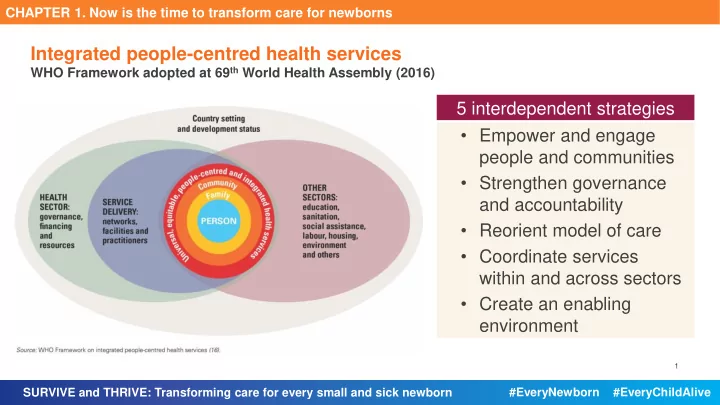
CHAPTER 1. Now is the time to transform care for newborns Integrated people-centred health services WHO Framework adopted at 69 th World Health Assembly (2016) 5 interdependent strategies Empower and engage people and communities


slide-1
SLIDE 1

CHAPTER 1. Now is the time to transform care for newborns

#EveryNewborn #EveryChildAlive SURVIVE and THRIVE: Transforming care for every small and sick newborn

Integrated people-centred health services

WHO Framework adopted at 69th World Health Assembly (2016)

1

5 interdependent strategies

  • Empower and engage

people and communities

  • Strengthen governance

and accountability

  • Reorient model of care
  • Coordinate services

within and across sectors

  • Create an enabling

environment

slide-2
SLIDE 2

CHAPTER 1. Now is the time to transform care for newborns

#EveryNewborn #EveryChildAlive SURVIVE and THRIVE: Transforming care for every small and sick newborn

Family-centred care for newborn health

2

  • Family-centred care principles: Dignity and respect,

Information sharing, Participation, Collaboration

  • Mothers, fathers and caregivers are active partners

in the child’s care → Parent and newborn = unit of care

  • Demonstrated benefits for newborn’s weight gain

and neurodevelopmental progress

MYTH: Allowing parents & family members to visit a child in the NICU will introduce infections. FACT:

  • Family-centred care does not increase infections
  • Prevent infections with hand hygiene practice

and access to human milk

slide-3
SLIDE 3

CHAPTER 1. Now is the time to transform care for newborns

#EveryNewborn #EveryChildAlive SURVIVE and THRIVE: Transforming care for every small and sick newborn

Case study: Engaging families in newborn care in India

3

Adapted from: Sudan et al. Profile on family participatory care in India

2008 2014 2016 - 2018

Family engagement programme introduced in New Delhi NICU National policy Systematic documentation

  • 1. Handwashing skills;

infection prevention; protocol for entry to nursery

  • 2. Developmentally supportive care
  • 3. Kangaroo Mother Care (KMC)
  • 4. Preparation for discharge

and care at home To support 700 district-based special newborn care units

  • 85 neonatal units in 3 states,

reaching >13,000 mothers and family members

  • Newborns with birth weight <2000g:
  • 86% received KMC and

exclusive breastfeeding

  • 75% continued to receive

KMC at home

  • Post-discharge mortality reduced

from 7% to 3%

slide-4
SLIDE 4

CHAPTER 1. Now is the time to transform care for newborns

#EveryNewborn #EveryChildAlive SURVIVE and THRIVE: Transforming care for every small and sick newborn

The power of parent voices

4

  • Historically, parents have played an important role

to improve small and sick newborn care

  • As parents consistently care for newborns,

they become “patient experts”

  • Parents are a great asset advising inpatient

newborn care units seeking to improve quality, safety and family-centred care

Location Group Description

Colombia La Liga de Los Múltiples (The League of Multiples) Founded by parents of triplets, for parents of multiple births France SOS Préma Established National Assembly working group, developed policy recommendation: small & sick newborns should receive family-centred care in hospital

Examples:

slide-5
SLIDE 5

CHAPTER 1. Now is the time to transform care for newborns

#EveryNewborn #EveryChildAlive SURVIVE and THRIVE: Transforming care for every small and sick newborn

5

“When my children were born too soon, I experienced an emotional rollercoaster and was struggling with the challenges of preterm birth. A strong partnership between health- care professionals and parents is the best way to face the [challenges]

  • f having a small and sick newborn

and to overcome the obstacles.

Parents’ Stories

– Silke Mader, parent, advocate and founder

European Foundation for the Care of Newborn Infants and The Global Alliance for Newborn Care

slide-6
SLIDE 6

CHAPTER 1. Now is the time to transform care for newborns

#EveryNewborn #EveryChildAlive SURVIVE and THRIVE: Transforming care for every small and sick newborn

The power of parent representatives

6

  • Learn from each other and provide professional trainings and

information in several languages

  • Develop strategies to get a voice, e.g. World Prematurity Day, the

European Standards of Care for Newborn Health

  • Founding GLANCE - a global network for parents
slide-7
SLIDE 7

CHAPTER 1. Now is the time to transform care for newborns

#EveryNewborn #EveryChildAlive SURVIVE and THRIVE: Transforming care for every small and sick newborn

7

Lessons from the past

Countries that have substantially reduced newborn deaths can provide guidance for other countries.

slide-8
SLIDE 8

CHAPTER 1. Now is the time to transform care for newborns

#EveryNewborn #EveryChildAlive SURVIVE and THRIVE: Transforming care for every small and sick newborn

Historical and current mortality reductions by phases of care

8

*SDG 3.2 target: all countries to reduce neonatal mortality to at least as low as 12 per 1000 live births by 2030. Sources: UN IGME 2017 estimates, March of Dimes, PMNCH, Save the Children, WHO. Born too soon: the global action report on preterm birth.

1900s-1940s:

  • Increased handwashing in

health facilities

  • Decline in homebirths w/out

skilled attendants 1940s-1970s:

  • Shift towards individualized

special care of sick newborns

  • ↑ available lifesaving

interventions, but overuse of technology

  • Parents and newborns

separated 1980s-present:

  • High-quality, individualized,

advanced clinical care & strong health systems

  • Family-centred care as a best

practice

  • Focus on disability-free

survival

Lessons from the past

slide-9
SLIDE 9

CHAPTER 1. Now is the time to transform care for newborns

#EveryNewborn #EveryChildAlive SURVIVE and THRIVE: Transforming care for every small and sick newborn

Lessons from the past

9

  • Routine separation puts mothers and newborns at risk

for medical and developmental complications regardless of setting or level of care

  • There is an urgent need to adapt and scale up:
  • Family-centred care
  • Special and intensive newborn care
  • Competent and equipped health providers
slide-10
SLIDE 10

CHAPTER 1. Now is the time to transform care for newborns

#EveryNewborn #EveryChildAlive SURVIVE and THRIVE: Transforming care for every small and sick newborn

10

To end preventable newborn and child deaths, care for small and sick newborns requires:

  • Investments in quality
  • Nurturing and responsive health care

designed to prevent disabilities

  • Supporting cognitive function
  • Promoting nurturing newborn care to support

early childhood development and reduce stunted growth

Action must be taken now to save more than 1.7 million newborns each year.