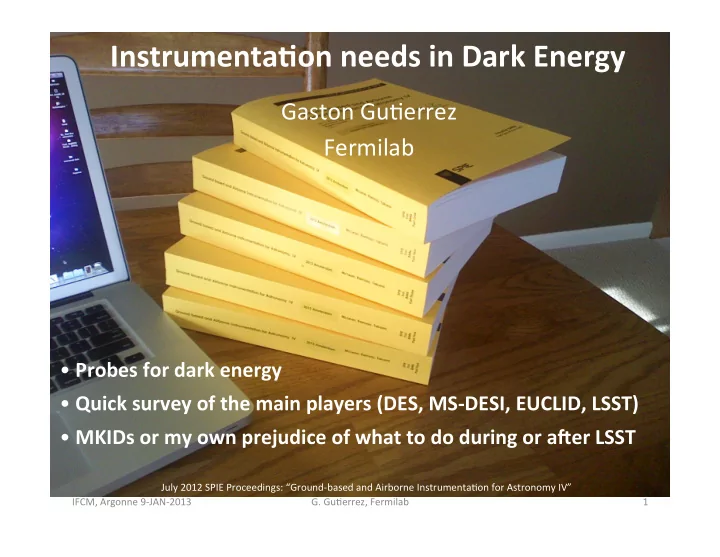
Instrumenta*on needs in Dark Energy Gaston Gu8errez - - PowerPoint PPT Presentation

instrumenta on needs in dark energy
SMART_READER_LITE
LIVE PREVIEW

Instrumenta*on needs in Dark Energy Gaston Gu8errez - - PowerPoint PPT Presentation

Instrumenta*on needs in Dark Energy Gaston Gu8errez Fermilab Probes for dark energy Quick survey of the main players (DES, MS-DESI, EUCLID,


slide-1
SLIDE 1

IFCM, ¡Argonne ¡9-­‑JAN-­‑2013 ¡

  • G. ¡Gu8errez, ¡Fermilab ¡

1 ¡

Instrumenta*on ¡needs ¡in ¡Dark ¡Energy ¡

  • ¡Probes ¡for ¡dark ¡energy ¡
  • ¡Quick ¡survey ¡of ¡the ¡main ¡players ¡(DES, ¡MS-­‑DESI, ¡EUCLID, ¡LSST) ¡ ¡
  • ¡MKIDs ¡or ¡my ¡own ¡prejudice ¡of ¡what ¡to ¡do ¡during ¡or ¡aJer ¡LSST ¡

Gaston ¡Gu8errez ¡ Fermilab ¡

July ¡2012 ¡SPIE ¡Proceedings: ¡“Ground-­‑based ¡and ¡Airborne ¡Instrumenta8on ¡for ¡Astronomy ¡IV” ¡

slide-2
SLIDE 2

IFCM, ¡Argonne ¡9-­‑JAN-­‑2013 ¡

  • G. ¡Gu8errez, ¡Fermilab ¡

2 ¡

Two ¡kinds ¡of ¡probes ¡are ¡used ¡to ¡measure ¡dark ¡energy: ¡ ¡

  • 1. Distance ¡measurements ¡(to ¡track ¡the ¡expansion ¡of ¡the ¡Universe) ¡
  • 2. Growth ¡of ¡cosmic ¡structure ¡(to ¡answer ¡the ¡ques*on: ¡is ¡the ¡accelera*on ¡

due ¡to ¡dark ¡energy ¡of ¡modified ¡gravity?) ¡

In ¡linearized ¡GR ¡both ¡quan88es ¡depend ¡on ¡the ¡Hubble ¡ra8o: ¡

H(z) = ! a a = H0 !r(1+ z)4 +!m(1+ z)3 +!k(1+ z)2 +!" !" = !DE exp 3(1+W0 +Wa)ln(1+ z)#Wa z / (1+ z)

{ }

With ¡W=p/E=W0+Wa ¡(1-­‑a) ¡ ¡we ¡have: ¡ For ¡a ¡cosmological ¡constant ¡W0=-­‑1 ¡and ¡Wa=0 ¡

Probes ¡for ¡Dark ¡Energy ¡

slide-3
SLIDE 3

IFCM, ¡Argonne ¡9-­‑JAN-­‑2013 ¡

  • G. ¡Gu8errez, ¡Fermilab ¡

3 ¡

Dc = c dz' H(z')

z

!

Distance ¡measurements ¡

Then ¡the ¡co-­‑moving ¡distance ¡is: ¡ Two ¡proven ¡forms ¡of ¡measuring ¡distances ¡are: ¡

6.7 sigma 1.7% distance

Supernovae ¡ Baryon ¡Acous*c ¡Oscilla*ons ¡(BAO) ¡

(Courtesy ¡of ¡M. ¡Levi) ¡

slide-4
SLIDE 4

IFCM, ¡Argonne ¡9-­‑JAN-­‑2013 ¡

  • G. ¡Gu8errez, ¡Fermilab ¡

4 ¡

Structure ¡measurements ¡

! !

  • Fig. VI-6: Schematic of gravitational lensing: the deflection angle apparent to the
  • bserver at left depends both upon the mass of the deflector and on the distance ratios

between source, lens, and observer.

DETF, ¡Albrecht ¡et ¡al. ¡

The ¡two ¡“common” ¡methods ¡are: ¡ ¡

  • Weak ¡Lensing ¡(WL) ¡

¡

  • Galaxy ¡cluster ¡coun*ng ¡(CC) ¡
slide-5
SLIDE 5

IFCM, ¡Argonne ¡9-­‑JAN-­‑2013 ¡

  • G. ¡Gu8errez, ¡Fermilab ¡

5 ¡

Two ¡ques8ons ¡

1. How ¡far ¡in ¡redshiJ ¡do ¡we ¡need ¡to ¡go? ¡

  • 2. ¡What ¡kind ¡of ¡redshiJ ¡resolu*on ¡do ¡we ¡need? ¡

n y

  • .

9) 5. e he

H(z)/(1+z) (km/sec/Mpc) 1 2 z 90 80 70 60 50

Beau8ful ¡new ¡result: ¡“BAO ¡in ¡the ¡Lyα ¡forest ¡of ¡BOSS ¡quasars” ¡ ¡arXiv:1211.261v1, ¡Nov ¡2012. ¡

slide-6
SLIDE 6

IFCM, ¡Argonne ¡9-­‑JAN-­‑2013 ¡

  • G. ¡Gu8errez, ¡Fermilab ¡

6 ¡

Growth ¡of ¡structure ¡(I) ¡

Aeer ¡the ¡mafer-­‑radia8on ¡equality ¡epoch ¡(at ¡z ¡≈ ¡3000) ¡non-­‑rela8vis8c ¡mafer ¡evolves ¡prefy ¡ much ¡following ¡Newton’s ¡gravity. ¡The ¡correct ¡treatment ¡(GR ¡+ ¡Boltzmann’s ¡equa8on) ¡in ¡the ¡ linear ¡approxima8on ¡give ¡the ¡same ¡equa8ons ¡and ¡for ¡me ¡at ¡least ¡it ¡is ¡easier ¡to ¡think ¡in ¡ Newtonian ¡terms. ¡ ¡Newton’s ¡gravity ¡is ¡expressed ¡in ¡Euler’s ¡equa8on: ¡ One ¡ends ¡up ¡with ¡a ¡second ¡order ¡differen8al ¡equa8on ¡for ¡δ ¡

!! !t + ".(! ! V) = 0

Conserva*on ¡of ¡mass ¡

!(! vi) !t + ".(! vi ! V) = (i-axis force)/volume

Newton’s ¡second ¡law ¡ The ¡force ¡has ¡two ¡components, ¡one ¡due ¡to ¡pressure ¡and ¡the ¡other ¡due ¡to ¡gravity, ¡so ¡one ¡ has ¡to ¡add ¡Poisson’s ¡equa8on. ¡ ¡Using ¡co-­‑moving ¡coordinates ¡and ¡wri8ng ¡the ¡mafer ¡ density ¡as ¡

! = !0 (1+") = !m a3 (1+"), (!m = matter desity today)

slide-7
SLIDE 7

IFCM, ¡Argonne ¡9-­‑JAN-­‑2013 ¡

  • G. ¡Gu8errez, ¡Fermilab ¡

7 ¡

Growth ¡of ¡structure ¡(II) ¡

d 2! dt2 + 2H d! dt ! vs

2

a2 "c

2! ! 4"G #0! = 0

We ¡can ¡see ¡that ¡if ¡that ¡the ¡sound ¡speed ¡vs ¡is ¡large ¡the ¡density ¡contrast ¡δ ¡forms ¡traveling ¡

  • waves. ¡ ¡But ¡aeer ¡recombina8on ¡(z≈1000) ¡the ¡speed ¡of ¡sound ¡becomes ¡zero ¡and ¡the ¡

waves ¡“freeze”. ¡ ¡From ¡there ¡on ¡δ ¡just ¡changes ¡amplitude, ¡the ¡structure ¡sits ¡in ¡place ¡and ¡ just ¡grows. ¡ ¡If ¡there ¡is ¡no ¡dark ¡energy ¡and ¡vs=0 ¡the ¡solu8on ¡of ¡the ¡above ¡equa8on ¡is ¡just ¡ ¡

G(a) = (constant)H da' (a'H)3

a

!

G ¡is ¡called ¡the ¡growth ¡factor ¡and ¡(constant) ¡is ¡usually ¡set ¡such ¡that ¡G(a<<1)=a ¡ When ¡dark ¡energy ¡is ¡present ¡the ¡growth ¡slows ¡down ¡and ¡can ¡be ¡wrifen ¡as: ¡

!(x,t) = G(t)!(x), with G(t) = a(t)

slide-8
SLIDE 8

IFCM, ¡Argonne ¡9-­‑JAN-­‑2013 ¡

  • G. ¡Gu8errez, ¡Fermilab ¡

8 ¡

The ¡growth ¡factor ¡

The ¡growth ¡factor ¡can ¡also ¡be ¡wrifen ¡as: ¡

G(a) = exp ! da' a' f (a')

a 1

"

# $ % & ' ( f = a G dG da ! ["m(a')]!, with "m(a) = "m a3 H0 H # $ % & ' (

2

Where ¡the ¡growth ¡rate ¡f(a) ¡can ¡be ¡approximated ¡by: ¡ In ¡GR ¡γ=0.55, ¡an ¡any ¡devia8on ¡from ¡this ¡number ¡will ¡indicate ¡a ¡modifica8on ¡of ¡GR. ¡ ¡ Since ¡measures ¡the ¡change ¡in ¡growth ¡is ¡not ¡surprising ¡that ¡it ¡will ¡sensi8ve ¡to ¡mafer ¡ veloci8es ¡on ¡large ¡scales. ¡ ¡Which ¡brings ¡as ¡to ¡Redshie ¡Space ¡Distor8ons. ¡

slide-9
SLIDE 9

IFCM, ¡Argonne ¡9-­‑JAN-­‑2013 ¡

  • G. ¡Gu8errez, ¡Fermilab ¡

9 ¡ Simula8ons ¡from: ¡ Enrique ¡Gaztañaga ¡et ¡al, ¡ ¡ MNRAS ¡422, ¡2904 ¡(2012) ¡ ¡

!(r,cos", f ) = !0(r, f )P

0(cos")+!2(r, f )P 2(cos")+!4(r, f )P 4(cos")

The ¡two ¡point ¡correla8on ¡func8on ¡ξ ¡looks ¡like: ¡

Redshie ¡Space ¡Distor8ons ¡(RSD) ¡

slide-10
SLIDE 10

IFCM, ¡Argonne ¡9-­‑JAN-­‑2013 ¡

  • G. ¡Gu8errez, ¡Fermilab ¡

10 ¡

r! (Mpc/h) r" (Mpc/h) −100 −50 50 100 −100 −50 50 100

Reid ¡et ¡al, ¡arXiv:1203.6641v1, ¡Mar ¡2012 ¡

RSD ¡with ¡BOSS ¡

slide-11
SLIDE 11

IFCM, ¡Argonne ¡9-­‑JAN-­‑2013 ¡

  • G. ¡Gu8errez, ¡Fermilab ¡

11 ¡

Then ¡for ¡Dark ¡Energy ¡studies ¡we ¡want ¡to ¡measure ¡the ¡following ¡objects ¡over ¡as ¡large ¡ a ¡volume ¡as ¡possible ¡(many ¡Gpc3): ¡ ¡

  • 1. Galaxy ¡shapes, ¡types, ¡angular ¡posi*on ¡and ¡redshiJs. ¡

¡

  • 2. Supernovae ¡(SNe ¡Ia). ¡

¡

  • 3. Angular ¡posi*on ¡and ¡spectrum ¡of ¡quasars. ¡ ¡Mapping ¡of ¡hydrogen ¡clouds. ¡

¡ Future ¡projects ¡that ¡will ¡do ¡that ¡on ¡a ¡large ¡scale ¡are: ¡ ¡

  • DES: ¡imager ¡with ¡5 ¡filters. ¡In ¡5 ¡years ¡will ¡cover ¡5000 ¡square ¡degrees ¡to ¡magnitude ¡24 ¡

and ¡z ¡up ¡to ¡~1.5. ¡ ¡Status: ¡running. ¡

  • MS-­‑DESI ¡(BigBOSS/DESpec): ¡Spectrograph. ¡ ¡Status: ¡start ¡in ¡2017? ¡
  • EUCLID: ¡Space ¡imager ¡and ¡spectrograph. ¡ ¡Status: ¡launch ¡date ¡~2019. ¡
  • LSST: ¡imager ¡with ¡6 ¡filters. ¡ ¡ ¡Status: ¡scheduled ¡to ¡start ¡in ¡2021. ¡

So, ¡what ¡needs ¡to ¡be ¡measured ¡to ¡study ¡DE? ¡

slide-12
SLIDE 12

SDSS ~ 2h-3Gpc3 BOSS ~ 6h-3Gpc3 BigBOSS ~50h-3Gpc3

SDSS-I Volume

LRGs ELGs QSOs

IFCM, ¡Argonne ¡9-­‑JAN-­‑2013 ¡

  • G. ¡Gu8errez, ¡Fermilab ¡

12 ¡

BigBOSS ¡ ¡

  • SmartScope

LBL ~5 ¡μm ¡ resolu8on ¡ ¡ ~12 ¡mm ¡ actuator ¡ pitch ¡

  • 1. 4 ¡m ¡telescope ¡
  • 2. 5000 ¡fiber, ¡3 ¡arm ¡spectrograph, ¡R~4000 ¡
  • 3. Spectra ¡for ¡1800 ¡objects/deg2 ¡(~10% ¡of ¡

available ¡galaxies) ¡ ¡

  • 4. Magnitude ¡limit ¡~22.5, ¡z~3.5 ¡
  • 5. Will ¡cover ¡14,000 ¡deg2 ¡in ¡3 ¡years ¡
  • 6. 20 ¡M ¡galaxies, ¡0.6 ¡M ¡QSO ¡
slide-13
SLIDE 13

IFCM, ¡Argonne ¡9-­‑JAN-­‑2013 ¡

  • G. ¡Gu8errez, ¡Fermilab ¡

13 ¡

BigBOSS ¡ ¡

redshift

~1% error on f8 (growth rate) Sub-1% distance error

NASA WFIRST Science Definition Team

redshift

BigBOSS

log10 8 )

slide-14
SLIDE 14

IFCM, ¡Argonne ¡9-­‑JAN-­‑2013 ¡

  • G. ¡Gu8errez, ¡Fermilab ¡

14 ¡

EUCLID ¡ ¡

  • 1. 1.2 ¡m ¡telescope ¡
  • 2. Visible ¡imager ¡(VIS), ¡NIR ¡photometry, ¡

low ¡resolu8on ¡NIR ¡spectroscopy ¡R~250 ¡ to ¡0.7<z<2.1 ¡

  • 3. Visible ¡m~24.5, ¡NIR ¡m~24 ¡
  • 4. Shapes ¡for ¡~1.5 ¡B ¡galaxies ¡
  • 5. Low ¡resolu8on ¡spectra ¡for ¡~50 ¡M ¡

galaxies ¡to ¡0.7<z<2.1 ¡

  • 6. Will ¡cover ¡15,000 ¡deg2 ¡in ¡6 ¡years ¡
  • VIS ¡

#

  • NISP ¡
slide-15
SLIDE 15

IFCM, ¡Argonne ¡9-­‑JAN-­‑2013 ¡

  • G. ¡Gu8errez, ¡Fermilab ¡

15 ¡

EUCLID ¡ ¡

slide-16
SLIDE 16

IFCM, ¡Argonne ¡9-­‑JAN-­‑2013 ¡

  • G. ¡Gu8errez, ¡Fermilab ¡

16 ¡

LSST ¡ ¡

  • 1. ~8 ¡m ¡telescope ¡
  • 2. 6 ¡filter ¡for ¡visible ¡photometry ¡
  • 3. Reach ¡up ¡to ¡magnitude ¡~27.5 ¡
  • 4. Will ¡cover ¡20,000 ¡deg2 ¡in ¡10 ¡years. ¡
  • 5. Will ¡measure ¡~20 ¡B ¡galaxies ¡
slide-17
SLIDE 17

IFCM, ¡Argonne ¡9-­‑JAN-­‑2013 ¡

  • G. ¡Gu8errez, ¡Fermilab ¡

17 ¡

LSST ¡ ¡

Di ¡= ¡co-­‑moving ¡distance ¡ Gi ¡= ¡growth ¡rate ¡

slide-18
SLIDE 18

IFCM, ¡Argonne ¡9-­‑JAN-­‑2013 ¡

  • G. ¡Gu8errez, ¡Fermilab ¡

18 ¡

What ¡do ¡we ¡do ¡in ¡the ¡decade ¡2020-­‑2030? ¡

Situa8on ¡aeer ¡DES, ¡MS-­‑DESI ¡(BigBOSS), ¡EUCLID, ¡Panstars ¡… ¡: ¡ ¡

  • About ¡15,000 ¡deg2 ¡of ¡the ¡sky ¡will ¡have ¡been ¡imaged ¡to ¡magnitude ¡of ¡24-­‑24.5. ¡ ¡This ¡

will ¡give ¡about ¡1.5 ¡billion ¡galaxies. ¡

  • High ¡resolu8on ¡spectroscopy ¡will ¡exists ¡for ¡about ¡25 ¡million ¡galaxies ¡and ¡about ¡

0.5-­‑1. ¡M ¡QSO. ¡ ¡Low ¡resolu8on ¡NIR ¡spectroscopy ¡will ¡exists ¡for ¡about ¡50 ¡M ¡galaxies. ¡ Situa8on ¡during/aeer ¡LSST: ¡ ¡

  • Imaging ¡will ¡improve ¡by ¡an ¡order ¡of ¡magnitude. ¡ ¡About ¡20,000 ¡deg2 ¡of ¡the ¡sky ¡will ¡

be ¡imaged ¡to ¡magnitude ¡of ¡about ¡27.5. ¡ ¡This ¡will ¡give ¡about ¡10 ¡billion ¡galaxies. ¡

  • But ¡no ¡big ¡improvement ¡in ¡spectroscopy ¡that ¡I ¡know ¡off. ¡

So ¡we ¡may ¡ask ¡the ¡ques8on: ¡can ¡we ¡get ¡high ¡or ¡low ¡spectroscopy ¡for ¡most ¡of ¡the ¡ LSST ¡galaxies ¡up ¡to ¡magnitude ¡~24.5 ¡? ¡

slide-19
SLIDE 19

IFCM, ¡Argonne ¡9-­‑JAN-­‑2013 ¡

  • G. ¡Gu8errez, ¡Fermilab ¡

19 ¡

Can ¡we ¡scale ¡spectrographs ¡like ¡BigBOSS/DESpec? ¡

  • 1. Scaling ¡from ¡magnitude ¡22.5 ¡to ¡24.5 ¡requires ¡an ¡increase ¡in ¡the ¡number ¡of ¡

photons ¡by ¡a ¡factor ¡of ¡40. ¡ ¡This ¡can ¡not ¡be ¡done ¡by ¡increasing ¡the ¡exposure ¡8me. ¡ ¡ Going ¡to ¡an ¡8 ¡m ¡telescope ¡will ¡s8ll ¡leaves ¡us ¡short ¡of ¡a ¡factor ¡of ¡10. ¡ ¡Reducing ¡R ¡ may ¡help ¡but ¡not ¡by ¡much, ¡so ¡this ¡looks ¡difficult. ¡

  • 2. Right ¡now ¡with ¡4000-­‑5000 ¡fibers ¡DESpec/BigBOSS ¡measure ¡1500-­‑1800 ¡objects ¡

per ¡deg2 ¡out ¡of ¡the ¡10,000 ¡available. ¡

  • 3. At ¡magnitude ¡24.5 ¡one ¡has ¡about ¡100,000 ¡galaxies/deg2, ¡doing ¡spectroscopy ¡on ¡

half ¡of ¡them ¡will ¡require ¡30 ¡8mes ¡the ¡number ¡of ¡fibers ¡and ¡2 ¡mm ¡pitch ¡between ¡

  • fibers. ¡ ¡To ¡me ¡that ¡kind ¡of ¡scaling ¡doesn’t ¡look ¡doable ¡with ¡current ¡technology. ¡

Can ¡MKIDs ¡provide ¡a ¡way ¡out ¡of ¡this ¡problem? ¡

slide-20
SLIDE 20

IFCM, ¡Argonne ¡9-­‑JAN-­‑2013 ¡

  • G. ¡Gu8errez, ¡Fermilab ¡

20 ¡

What ¡are ¡MKIDs ¡? ¡ ¡

Feedline L Extension Ground Straps

LEI 5.0kV X600 10pm WD 10.1 mm
  • 1. A ¡photon ¡strikes ¡the ¡superconductor ¡breaking ¡

a ¡few ¡thousand ¡Cooper ¡pairs. ¡

  • 2. The ¡broken ¡Cooper ¡pairs ¡change ¡the ¡

inductance ¡of ¡the ¡resonator. ¡ MKIDs ¡= ¡Microwave ¡Kine8c ¡inductance ¡Detector ¡(or ¡a ¡superconduc8ng ¡resonator) ¡

slide-21
SLIDE 21

IFCM, ¡Argonne ¡9-­‑JAN-­‑2013 ¡

  • G. ¡Gu8errez, ¡Fermilab ¡

21 ¡

MKIDs ¡(superconduc8ng ¡resonators) ¡ ¡

  • 3. The ¡resonance ¡frequency ¡and ¡phase ¡change ¡

due ¡to ¡the ¡change ¡in ¡inductance. ¡

  • 4. The ¡phase ¡change ¡is ¡measured ¡providing ¡a ¡

8me ¡and ¡energy ¡measurement ¡for ¡each ¡

  • photon. ¡
  • 5. The ¡theore8cal ¡energy ¡resolu8on ¡is ¡about ¡

R=λ/Δλ≈100 ¡

  • 6. Up ¡to ¡about ¡2000 ¡resonators ¡could ¡be ¡

coupled ¡to ¡the ¡same ¡feed ¡line. ¡

slide-22
SLIDE 22

IFCM, ¡Argonne ¡9-­‑JAN-­‑2013 ¡

  • G. ¡Gu8errez, ¡Fermilab ¡

22 ¡

Giga-­‑Z, ¡a ¡low ¡resolu8on ¡mul8-­‑object ¡spectrograph ¡ ¡

(See ¡B. ¡Mazin ¡et ¡al. ¡in ¡the ¡SPIE ¡Proceedings, ¡July ¡2012) ¡ A ¡1” ¡mask ¡(red ¡circles) ¡in ¡each ¡of ¡the ¡ 10” ¡pixels ¡is ¡superimposed ¡over ¡a ¡ Hubble ¡UDF ¡image. ¡ Galaxies ¡are ¡projected ¡on ¡an ¡array ¡of ¡100,000 ¡ MKIDs+microlense ¡array ¡(~0.7 ¡deg2). ¡ ¡A ¡mask ¡ selects ¡a ¡galaxy ¡in ¡each ¡pixel. ¡ ¡The ¡readout ¡ consists ¡of ¡about ¡100 ¡feed-­‑lines. ¡

slide-23
SLIDE 23

IFCM, ¡Argonne ¡9-­‑JAN-­‑2013 ¡

  • G. ¡Gu8errez, ¡Fermilab ¡

23 ¡

What ¡can ¡Giga-­‑Z ¡do ¡if ¡it ¡works ¡as ¡expected? ¡

  • 1. In ¡a ¡4 ¡(8) ¡m ¡telescope ¡it ¡could ¡go ¡up ¡to ¡magnitude ¡24.5 ¡(25.7), ¡covering ¡20,000 ¡

square ¡degrees ¡in ¡3 ¡years ¡(7 ¡year ¡run). ¡

  • 2. It ¡could ¡provide ¡a ¡redshie ¡resolu8on ¡equivalent ¡to ¡a ¡distance ¡resolu8on ¡of ¡≈15 ¡

Mpc, ¡good ¡enough ¡to ¡be ¡into ¡the ¡non-­‑linear ¡regime ¡of ¡GR. ¡

  • 3. It ¡will ¡cover ¡most ¡of ¡the ¡available ¡galaxies/deg2 ¡up ¡to ¡magnitude ¡24.5. ¡ ¡That ¡is ¡

about ¡100,000 ¡galaxies ¡per ¡square ¡degree ¡for ¡a ¡total ¡of ¡about ¡2 ¡(4) ¡billion ¡

  • galaxies. ¡

What ¡are ¡the ¡problems ¡that ¡need ¡to ¡be ¡solved? ¡

The ¡list ¡is ¡daun8ng ¡but ¡we ¡believe ¡doable: ¡

  • 1. R ¡has ¡to ¡get ¡closer ¡to ¡the ¡theore8cal ¡limit. ¡
  • 2. The ¡packaging ¡need ¡to ¡be ¡greatly ¡improved. ¡
  • 3. The ¡RF ¡electronics ¡needs ¡improvement. ¡
  • 4. A ¡flat ¡RF ¡cable ¡suitable ¡to ¡work ¡at ¡100 ¡mK ¡needs ¡to ¡be ¡developed. ¡
  • 5. It ¡will ¡help ¡to ¡improve ¡the ¡QE. ¡
slide-24
SLIDE 24

IFCM, ¡Argonne ¡9-­‑JAN-­‑2013 ¡

  • G. ¡Gu8errez, ¡Fermilab ¡

24 ¡

The End

slide-25
SLIDE 25

IFCM, ¡Argonne ¡9-­‑JAN-­‑2013 ¡

  • G. ¡Gu8errez, ¡Fermilab ¡

25 ¡

Galaxy ¡numbers ¡as ¡a ¡func8on ¡of ¡magnitude ¡

22 24 26 28 30 32 4 4.5 5 5.5 6 6.5 7 22 24 26 28 30 32 22 24 26 28 30 32

  • Fig. 7.—Plot of nðmÞ final results in the F450W, F606W, and F814W filters. Filled circles represent Williams et al. (1996) differential number counts, and
  • pen circles show the results from Metcalfe et al. (2001). The solid line represents the obtained faint end (fainter than magnitude 28.8) of nðmÞ. The obtained

nðmÞ function is valid down to a magnitude of 31 at least.

  • A. ¡Marín-­‑Franch ¡and ¡A. ¡Aparicio, ¡ApJ ¡594, ¡63, ¡2003. ¡

DES ¡goes ¡to ¡magnitude ¡24, ¡BigBOSS/DESpec ¡to ¡22.5, ¡EUCLID ¡to ¡magnitude ¡24 ¡and ¡LSST ¡ to ¡magnitude ¡27. ¡

slide-26
SLIDE 26

IFCM, ¡Argonne ¡9-­‑JAN-­‑2013 ¡

  • G. ¡Gu8errez, ¡Fermilab ¡

26 ¡

  • Review. Redshift-space distortions

WiggleZ BOSS DES two-dimensional FGRS SDSS main SDSS LRG HETDEX Big BOSS Euclid log10 ∆fgs8/fgs8 –1 –2 1 2 redshift 3

  • Phil. Trans. R. Soc. A (2011) 369, 5058–5067

doi:10.1098/rsta.2011.0370

REVIEW

Redshift-space distortions

BY WILL J. PERCIVAL*, LADO SAMUSHIA, ASHLEY J. ROSS, CHARLES SHAPIRO AND ALVISE RACCANELLI

Institute of Cosmology and Gravitation, University of Portsmouth, Dennis Sciama Building, Portsmouth PO1 3FX, UK

Astro, ¡RSD ¡

slide-27
SLIDE 27

IFCM, ¡Argonne ¡9-­‑JAN-­‑2013 ¡

  • G. ¡Gu8errez, ¡Fermilab ¡

27 ¡