
SLIDE 1
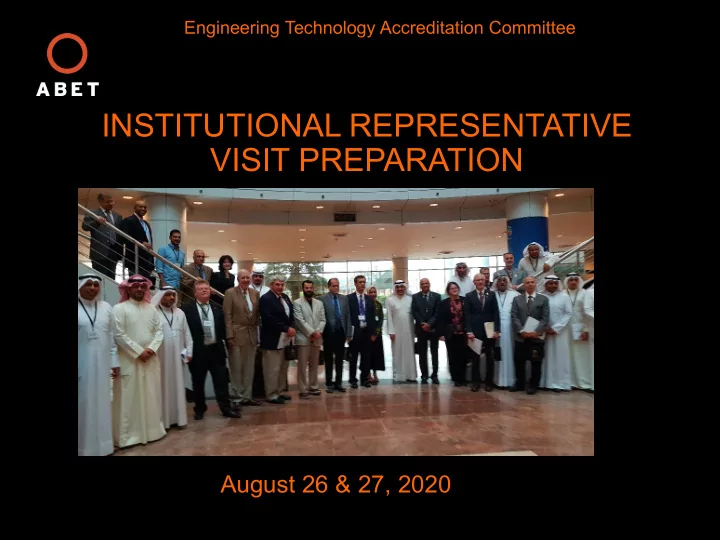
INSTITUTIONAL REPRESENTATIVE VISIT PREPARATION
August 26 & 27, 2020
Engineering Technology Accreditation Committee
INSTITUTIONAL REPRESENTATIVE VISIT PREPARATION August 26 & 27, - - PowerPoint PPT Presentation
Engineering Technology Accreditation Committee INSTITUTIONAL REPRESENTATIVE VISIT PREPARATION August 26 & 27, 2020 WELCOME! ETAC INSTITUTIONAL REPRESENTATIVE WEBINAR We will be recording todays Q&A We will not be providing
Engineering Technology Accreditation Committee
2
We will be recording today’s webinar
be available on ABET’s public website
will receive a follow up email with the link to the recording and slides and instructions to their location on the ABET public website.
for all 4 commissions
Q&A
ask questions throughout the webinar using the Q&A button at the bottom
We will not be providing technical support during today’s
will be available after webinars are completed.
If we are unable to address all your question due to time constraints, please follow up with your team chair.
3
3
4
April Cheung
Chair-Elect
Thomas Hall
Past Chair
Carol Schulte
Vice Chair - Operations
Scott Danielson
Chair
Bobby Crawford
Member-at-Large
Harrie Stevens
Member-at-Large
Marty Reed
Member-at-Large
Larraine Kapka
Board Area Delegation Chair
Raju Dandu
Member-at-Large
Steven Browning
Public Commissioner
Mark Lower,
Commissioner
ETAC Institutional Day Training Chair
5
5
Specific Criteria
Policy and Procedure Manual (APPM)
General Criteria
evaluated against a set of international standards
ABET/ETAC accredits PROGRAMS, not Institutions ETAC accredits associate & bachelor degrees ABET accredits thousands
in over in 30 countries
Programs will undergo preliminary self-study review followed by site visit
Approximately 85,000 students graduate from ABET-accredited programs EACH YEAR!
6
Faculty and administrative staff working remotely Grading systems change to pass/fail (or some other variation) Students leave campus and continue under difficult circumstances Courses transitioning to fully-online Laboratories unavailable Data is difficult to collect and documentation difficult to produce Programs and processes will be evaluated for compliance with the criteria and the APPM based on the duration of the accreditation cycle—not just the last 6 months!
ABET will NOT be judging program(s) based on their COVID response
7
7 Jan-Aug Accreditation Request & Pre-Visit Sept-Mar Virtual visit & Due Process Dec-Mar Draft Statements & Due Process July ETAC Commission Action
to vote final action
notified
Due Process
Statement for Commission
Statements Prepared
Response
requests accreditation
Study Report
Assigned
Aug-Nov Prior to visit
recorded facility tours
access to display materials
8
– Program(s) must demonstrate criteria compliance in all modalities/routes to a degree – Assessment and continuous improvement for each delivery method (e.g., F2F, online, hybrid, or multiple locations)
8
9
Team Chair approved Visit dates set Self-Study report uploaded Visiting team PEVs approved
9
Transcripts for each program Team chair can provide guidance on number of transcripts Student names should be removed and replaced by a tracking system Explanation of course substitutions Approval of transfer/substitution of courses Graduation audit form Follow-up with Team Chair: Transcript and Enrollment documentation
10
Team Oriented
10 Team Chair Primary Contact before and after the visit Volunteers selected by ETAC ExCom Will decide communication protocol Program Evaluators Program Specialists Volunteers selected by professional society Observers No vote in accreditation process PEV in training or state board member
Refresher training Organized Trained & Evaluated by ABET Professional
Interpersonally Skilled
Technically competent
11
11
Logistics Transcripts Additional information
Sample from each program Document all paths to graduation Clarification
report Additional display materials All visits will be handled
support provided by institutions
Follow-up with Team Chair on Communication Protocol
12
What does a Virtual Review look like??
The goal is to conduct a virtual visit which achieves the same goals as a traditional on-site visit, recognizing the team members and institution representatives may all be in different time zones.
No team travel Zoom is the default ABET videoconferencing platform If requirements at your institution require an alternative videoconferencing platform, you will need to provide access, set up meetings, and provide training and support to the team. Virtual visits MAY be extended beyond 3 days but not longer than 1 week (end by March 31, 2021) Team chair and PEVs will set up
institution) Program materials to be provided electronically (Institutional or 3rd party i.e. Dropbox, Google) No exchange of printed materials, USB, or other physical formats will be requested or accepted Systems Programs to provide virtual facility and lab tours Logistics Interviews of students, faculty, and staff conducted virtually NOTE: Any type of electronic recording of live ABET accreditation conversations or meetings is prohibited.
13
The program must make materials available at least one month prior to the start date of the virtual visit
Teams AND programs benefit from clearing up documentation and support material issues before the visit begins Work with the Team Chair and PEVs regarding materials they will require and where the materials will be located Guidance on materials from the institution must be provided so team members can work efficiently If an institutional system is used for documentation, team members must be given access to your network and the software
Requirements are not different for virtual visits; however, the timing and methods of submission,
presentation may be different Note: Programs need not duplicate and resubmit documentation and supporting material submitted with the Self-Study Report.
14
Laboratory Tours
location in building/on campus
courses the lab supports
the setting of labs
stations, showers, first aid kits, SDS sheets, inspection reports, etc.)
experimental setups in the lab
supplies
concurrently in the lab or on any single experimental station (capacity)
Classroom Tours
give the team a sense for representative types of classrooms
technology classroom with associated audio-visual equipment
its general condition
Note: All parties involved in the pre-recorded laboratory/classroom tours must be identified by name and provide their recorded consent to be recorded.
15
Develop the pre-recorded videos as early as feasible. If campus accessibility becomes a problem as the academic year progresses, you will have addressed this critical component of the review. Where possible, use a smartphone (typically has a decent camera) rather than an iPad (awkward to hold) or a video camera (does not integrate with Zoom easily for a live broadcast). Charge your phone before the tour Use landscape mode for a better and larger image Record the tour through Zoom Have WIFI and LTE services turned on Start each tour with a view of the signage for the space Include name, location, signage, general layout, safety, courses supported, instructional equipment, etc. Move the camera slowly around the room. Rapid movement will make it impossible to clearly see details. Provide a narrative as you walk through the tour Short videos (10 min/lab, one video/lab or other location) Practice a tour prior to the virtual visit
16
One-on-one meetings, such as interviews with institutional personnel and faculty are
easier to do.
All participants will require a camera and are encouraged to use a headset, for high
fidelity in communications.
Group meetings, such as meetings with students, advisory boards, and the Exit
Interview require some thought.
Headsets are preferred for individual interviews In-person groups will need shared microphone & external speaker Determine if the participants will be on campus
1 2 3
Business Zoom license for large range of capabilities
4
Determine IT/Bandwidth requirements (Wired, wireless, and cellular)
5
Schedule and conduct testing
6 Recording Is prohibited 7
17
17
The following tasks should be completed soon. Visit dates set
Choose one that fits your situation. How many of the above tasks have been completed?
Follow-up with Team Chair: Outstanding tasks
18
Program criteria limited to curriculum and faculty
General Criteria
Students
Program Criteria
Program Educational Objectives Student Outcomes
map to new student outcomes
Accreditation Policy and Procedure Manual (APPM)
Continuous Improvement Curriculum Faculty Facilities Instructional Support
1 2 3 4 5 7 6 8
19
3, 5, & 6
criteria change from a-k to 1-5 Criterion 6
add specificity to faculty requirements
20
Criterion 3, 5, & 6
criteria change from a-i to 1-5. New (2) - design Criterion 6
may add specificity to faculty requirements
Program criteria limited to curriculum and faculty
21
Fewer Student Outcomes are required by General Criteria ALL Student Outcomes identified by the program must be assessed. To take attain reduced assessment burden, programs should change their
Provides performance indicators for assessment (e.g., old a, b, e/f) Reduces assessment burden Programs not required to change Student Outcomes to comply* * Associate Degree programs compelled to put appropriate “design” (back) into their Student
Dublin Accords) Strengthens ties between General Criteria and Program Criteria Program must ensure that curricular requirements are met. Reduces the required number of Student Outcomes
Changes allow efficient use of time to effect program continuous improvement
22
We have discussed the new criteria and Student Outcomes. Assessments must:
Choose all that fit your situation during the past accreditation cycle.
Outcomes Follow-up with Team Chair: Criteria changes / concerns
23
Preparation
23
including course syllabi, example assignments and exams, and examples of student work showing range of student achievement
program’s educational
needs of program constituencies
assessment, evaluation, and attainment of student
to improve the program based on the evaluation
used and connected primary evidence (student work) being assessed
results reported in a usable form (have a “scorecard” for program student
level of attainment)
program improvement based on the data (Continuous Improvement)
Review Process Expectation
the process of meeting criteria
attainment
loop
Materials must be available/accessible by PEVs at least one month prior to virtual visit
24
We have discussed the program materials:
Out of the above four tasks, you fully understand and have plan of action for _____ out of the four tasks
24
25
Working on statements and Exit Meeting remain at the end of the virtual visit and might also require more than
Meetings may occur
more days, depending on the
between the team members and the institution.
Traditionally for reviewing display materials and conducting facility
visit, teams should complete these tasks well before Day 0.
26
26
Meetings with the Dean and Program Heads Opening Meeting – brief
Individual assignments
faculty
Interviews
alumni, faculty, students
Day 1
Team follow-up Individual briefings Exit meeting Team Meeting Facility Tour Materials Review
Prior to Day 0 Day 0 Day 2
Meetings with the Dean and Program Heads
The team chair should plan on meeting with the Dean each day of the virtual visit and program evaluators should meet with the heads of their programs to keep everyone connected and to make sure there are no surprises.
27
The following are events for which you will need to make arrangements/ appointments with individuals well ahead of time. (Do it NOW)
Choose which applies to your institution
27
Follow-up with Team Chair: Visit schedule, attendance, logistics (IT, etc.)
28
28
Team chair makes introductory remarks and reads any statements or findings that apply at the institutional level. Each program evaluator reads findings related to their program Team chair makes concluding remarks Preliminary findings will be entered into AMS. The Dean will have access to the information in AMS This is a scripted meeting. There should be no surprises. Recording is prohibited
29
29 Strength
Recognizes an exceptionally strong and effective practice or condition that stands above the norm and has a positive effect on the program Does not relate directly to the criteria
Observation Concern Weakness Deficiency
A comment or suggestion
the institution in its continuing efforts to improve the program Program currently satisfies criterion Potential exists for the situation to change such that the criterion may not be satisfied. Program lacks strength of compliance with criterion to ensure quality
not be compromised Remedial action is required to strengthen compliance with the criterion prior to the next evaluation Program does NOT satisfy criterion Action is required to restore compliance
30
30
Preliminary report provided at exit meeting Draft statement by TC sent to institution 2-3 months after visit Final statement from TC Commission Hearing 7-day response from institution for errors in fact 30-day response from institution on Draft statement Post 30-day response due by May 20 Institution notified of action
*If no response is received either to provide or not providing materials during the 30-day response then post 30-day documentation may not be accepted. Response should fully document (provide evidence) any developments that could mitigate any shortcomings identified by the team.
31
31 7 Day Response ABET Team Evaluation Due Process May submit a response to TC within 7 days of visit conclusion Documentation of corrective actions can be submitted as part of the 30-day response process
provided to the institution Institution feedback is a key component in ABET’s continuous improvement efforts Addresses errors in fact
Does not include planned actions, actions in progress, or errors of interpretation Limited to information not available at the time of the 30-day due process period Online Team Chair evaluation Online PEV evaluation 30-Day Post 30-Day
32
Which of the following actions can a program take after the visit and before the July Commission meeting?
NOTE: Some shortcomings may not be resolved in the time between the visit and the Commission meeting.
32
Follow-up with Team Chair: other questions / concerns
33
33
34
sufficient for continuity of programs
authority to implement changes or improvements to programs
documented
evaluation
level of attainment
used for continuous improvement of the program 34
sufficient to meet program needs
35
2 1 7 10 4 28 8 3 5 6 3 4 5 2 6 22 9 19 5 17 2 C1 C2 C3 C4 C5 C6 C7 C8 Prgm APPM
Findings Before Due Process
Deficiency Weakness Concern
2 1 3 5 4 19 7 2 2 3 3 2 5 6 6 21 9 16 7 19 1 4 1 10 3 4 1 1 1 6 C1 C2 C3 C4 C5 C6 C7 C8 Prgm APPM
Findings After Due Process
Deficiency Weakness Concern Resolved
36
9 78 87 174 3 50 83 136
Deficiency Weakness Concern Total
Before DP After DP
37
avoid taking improvement actions.
data for measuring student outcome attainment.
program’s defined cycle (e.g. 2 yrs., 3, yrs., etc.)
38
39
39
40
40
41
41
42
43
Please provide us your feedback for this session https://meet.ps/etac